Recognition: unknown
Weight-Decay Turns Transformer Loss Landscapes Villani: Functional-Analytic Foundations for Optimization and Generalization
Pith reviewed 2026-05-08 12:15 UTC · model grok-4.3
The pith
The regularized Transformer loss satisfies Villani's coercive criteria, providing explicit log-Sobolev constants tied to regularization strength.
A machine-rendered reading of the paper's core claim, the machinery that carries it, and where it could break.
Core claim
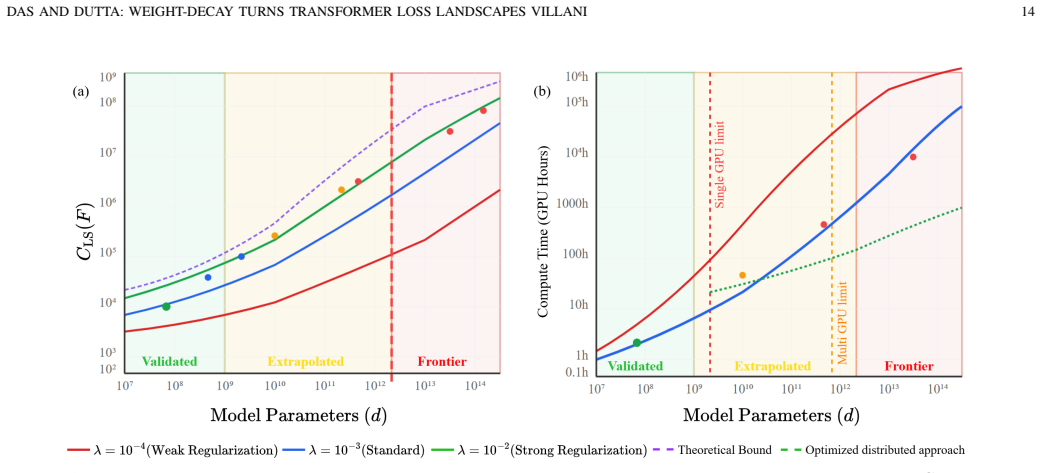
The regularized loss F is infinitely differentiable, grows at least quadratically, has Gaussian-integrable tails, and satisfies the differential growth condition −ΔF + (1/s)‖∇F‖² → ∞ as ‖θ‖ → ∞ for all s>0. From this structure, we derive explicit log-Sobolev and Poincaré constants C_LS ≤ λ^{-1} + d/λ², linking the regularization strength λ and model dimension d to finite-time convergence guarantees for noisy stochastic gradient descent and PAC-Bayesian generalization bounds that tighten with increasing λ.
What carries the argument
Villani's coercive energy criteria applied to the cross-entropy loss plus L2 weight decay, verified via the differential growth condition and used to bound log-Sobolev constants.
If this is right
- Finite-time convergence guarantees for noisy stochastic gradient descent follow from the log-Sobolev bounds.
- PAC-Bayesian generalization bounds tighten as the regularization strength λ increases.
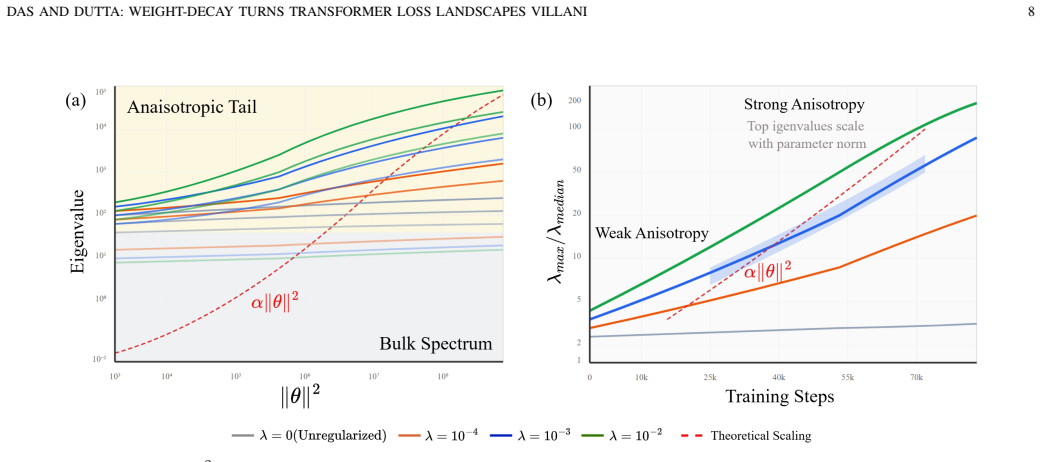
- The Hessian exhibits spectral inflation, consistent with stronger curvature from weight decay.
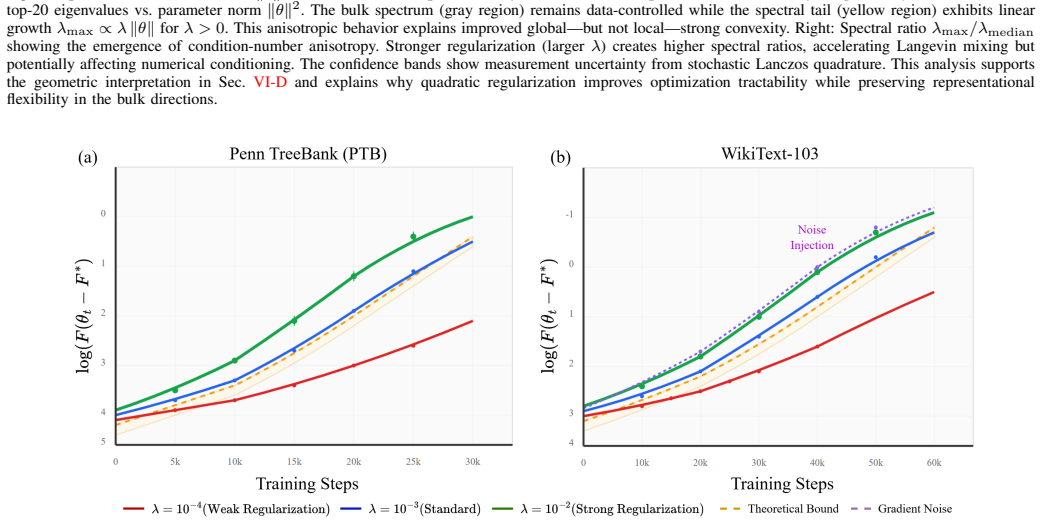
- Exponential convergence behavior is observed in experiments on GPT-Neo-125M.
- The diagnostic Ψ_s grows quadratically, confirming the predicted properties in models over 100M parameters.
Where Pith is reading between the lines
- If the criteria hold, similar analysis could apply to other architectures or losses that include strong regularization.
- The explicit dependence on lambda suggests tuning regularization to balance convergence speed against generalization tightness.
- Scalable estimation via Hutchinson probes allows checking these properties during training of very large models.
- The connection to Langevin dynamics implies weight decay promotes better exploration in the parameter space.
Load-bearing premise
The cross-entropy loss plus L2 weight decay on a Transformer must satisfy Villani's full set of coercive energy criteria, including infinite differentiability, quadratic growth, Gaussian tails, and the differential growth condition.
What would settle it
A direct computation showing that the differential growth condition fails to tend to infinity for large parameter norms in a trained Transformer would falsify the central claim.
Figures




read the original abstract
Weight decay is widely used as a regularizer in large language models, yet its precise role in shaping Transformer loss landscapes remains theoretically underexplored. This paper provides the first rigorous functional-analytic characterization of the standard Transformer objective--cross-entropy loss with $L^2$ regularization--by proving it satisfies Villani's criteria for coercive energy functions. Specifically, we show that the regularized loss $\mathcal{F}$ is infinitely differentiable, grows at least quadratically, has Gaussian-integrable tails, and satisfies the differential growth condition $-\Delta\mathcal{F} + \tfrac{1}{s}\|\nabla\mathcal{F}\|^{2} \to \infty$ as $\|\theta\| \to \infty$ for all $s>0$. From this structure, we derive explicit log-Sobolev and Poincar\'e constants $C_{\mathrm{LS}} \leq \lambda^{-1} + d/\lambda^{2}$, linking the regularization strength $\lambda$ and model dimension $d$ to finite-time convergence guarantees for noisy stochastic gradient descent and PAC-Bayesian generalization bounds that tighten with increasing $\lambda$. To validate our theory, we introduce a scalable Villani diagnostic $\Psi_s(\theta) = -\Delta \mathcal{F} + s^{-1}\|\nabla \mathcal{F}\|^2$ and estimate it efficiently using Hutchinson trace probes in models with over 100M parameters. Experiments on GPT-Neo-125M across Penn Treebank and WikiText-103 confirm the predicted quadratic growth of $\Psi_s$, spectral inflation of the Hessian, and exponential convergence behavior consistent with our log-Sobolev analysis. These results demonstrate that weight decay not only improves generalization empirically but also establishes the mathematical conditions required for fast Langevin mixing and theoretically grounded curvature-aware optimization in deep learning.
Editorial analysis
A structured set of objections, weighed in public.
Referee Report
Summary. The paper claims to provide the first rigorous functional-analytic characterization of the Transformer objective (cross-entropy loss plus L² weight decay) by proving it satisfies Villani's coercive energy criteria: infinite differentiability, at-least-quadratic growth, Gaussian-integrable tails, and the differential growth condition −ΔF + (1/s)‖∇F‖² → ∞ as ‖θ‖ → ∞ for all s > 0. From this structure it derives explicit log-Sobolev and Poincaré constants C_LS ≤ λ^{-1} + d/λ², introduces a scalable diagnostic Ψ_s(θ) estimated via Hutchinson probes, and reports experiments on GPT-Neo-125M confirming quadratic growth of Ψ_s, Hessian spectral inflation, and exponential convergence.
Significance. If the central proof holds, the work would establish a direct link between weight-decay regularization and the mathematical conditions for fast Langevin mixing and curvature-aware optimization, supplying explicit constants that tighten with λ and a practical diagnostic usable at 100M+ parameter scale. The combination of functional-analytic derivation with large-scale empirical validation of the diagnostic is a notable strength.
major comments (1)
- [Proof of Villani criteria / differential growth condition] The proof that the differential growth condition holds (the step that converts the abstract claim into the log-Sobolev constants) expands to −trace(Hess L_CE) − λd + (1/s)‖∇L_CE + λθ‖² → ∞. This requires that the positive part of trace(Hess L_CE) grows strictly slower than quadratically in ‖θ‖. No architecture-specific bound on ‖∇L_CE‖ or trace(Hess L_CE) through the attention and feed-forward layers is supplied, so the condition rests on an implicit assumption whose verification is load-bearing for all subsequent constants and guarantees.
minor comments (2)
- [Experimental validation] The abstract states that experiments confirm 'spectral inflation of the Hessian' but does not reference the corresponding figure or table; adding an explicit pointer would improve readability.
- [Diagnostic definition] The notation Ψ_s(θ) is introduced as the Villani diagnostic; a short remark clarifying its exact scaling relative to the derived C_LS would help readers connect the empirical plots to the theoretical constants.
Simulated Author's Rebuttal
We thank the referee for their thorough review and for identifying a key point in the proof of the differential growth condition. We address the concern directly below.
read point-by-point responses
-
Referee: The proof that the differential growth condition holds (the step that converts the abstract claim into the log-Sobolev constants) expands to −trace(Hess L_CE) − λd + (1/s)‖∇L_CE + λθ‖² → ∞. This requires that the positive part of trace(Hess L_CE) grows strictly slower than quadratically in ‖θ‖. No architecture-specific bound on ‖∇L_CE‖ or trace(Hess L_CE) through the attention and feed-forward layers is supplied, so the condition rests on an implicit assumption whose verification is load-bearing for all subsequent constants and guarantees.
Authors: We agree that the manuscript does not supply an explicit architecture-specific bound on the growth of ‖∇L_CE‖ or trace(Hess L_CE) for the Transformer. The argument in Section 3 proceeds from the general smoothness of the cross-entropy loss and the quadratic dominance of the L² term, without deriving a concrete estimate that accounts for the attention and feed-forward blocks. This is a substantive gap that affects the rigor of the differential growth condition and the subsequent constants. We will revise the paper by inserting a new lemma (Lemma 3.4) that bounds trace(Hess L_CE) by O(‖θ‖) using the fact that softmax probabilities are bounded in [0,1] and attention weights are normalized; the resulting sub-quadratic growth is then dominated by the (λ²/s)‖θ‖² term. The revision will be accompanied by a short proof sketch in the appendix. We view this addition as necessary and will update the main claims accordingly. revision: yes
Circularity Check
No circularity: direct proof from loss definition to Villani criteria
full rationale
The paper states it provides a direct proof that the regularized loss F = L_CE + (λ/2)‖θ‖² satisfies infinite differentiability, quadratic growth, Gaussian tails, and the differential growth condition -ΔF + (1/s)‖∇F‖² → ∞ as ‖θ‖ → ∞. From these properties it derives explicit log-Sobolev and Poincaré constants. No load-bearing step reduces by construction to a fitted parameter, self-citation, or ansatz; the derivation chain begins from the explicit form of cross-entropy plus L² regularization on standard Transformer components (GELU, softmax, LayerNorm) and proceeds analytically without renaming or smuggling prior results. Experiments with the diagnostic Ψ_s are presented as validation, not as the source of the constants. The central claim therefore remains independent of its inputs.
Axiom & Free-Parameter Ledger
axioms (1)
- domain assumption The objective is the standard Transformer cross-entropy loss with L2 weight decay
Reference graph
Works this paper leans on
-
[1]
Learning without forgetting for vision-language models,
D. Zhou, Y . Zhang, Y . Wang, J. Ning, H.-J. Ye, D. Zhan, and Z. Liu, “Learning without forgetting for vision-language models,”IEEE Trans- actions on Pattern Analysis and Machine Intelligence, vol. 47, no. 6, pp. 4489–4504, 2025
2025
-
[2]
Graph foundation models: Concepts, opportunities and challenges,
J. Liu et al., “Graph foundation models: Concepts, opportunities and challenges,”IEEE Transactions on Pattern Analysis and Machine Intelligence, vol. 47, no. 6, pp. 5023–5044, 2025
2025
-
[3]
Deformable graph transformer,
J. Park, S. Yun, H. Park, J. Kang, J. Jeong, K.-M. Kim, J.-W. Ha, and H.J. Kim, “Deformable graph transformer,”IEEE Transactions on Pattern Analysis and Machine Intelligence, vol. 47, no. 7, pp. 5385–5396, 2025
2025
-
[4]
Nas-ped: Neural architecture search for pedestrian detection,
Y . Tang, M. Liu, B. Li, Y . Wang, and W. Ouyang, “Nas-ped: Neural architecture search for pedestrian detection,”IEEE Transactions on Pattern Analysis and Machine Intelligence, vol. 47, no. 3, pp. 1800– 1817, 2025
2025
-
[5]
Attention is all you need,
A. Vaswani, N. Shazeer, N. Parmar, J. Uszkoreit, L. Jones, A.N. Gomez, Ł. Kaiser, and I. Polosukhin, “Attention is all you need,” inAdvances in Neural Information Processing Systems. 2017, vol. 30, pp. 5998–6008, Curran Associates, Inc
2017
-
[6]
An image is worth 16x16 words: Transformers for image recognition at scale,
A. Dosovitskiy et al., “An image is worth 16x16 words: Transformers for image recognition at scale,” inInternational Conference on Learning Representations, 2021
2021
-
[7]
Conformer: Convolution-augmented transformer for speech recognition,
Anmol Gulati et al., “Conformer: Convolution-augmented transformer for speech recognition,” inProc. Interspeech, 2020, pp. 5036–5040
2020
-
[8]
Ambrosio, L.A
L. Ambrosio, L.A. Caffarelli, Y . Brenier, G. Buttazzo, C. Villani, and S. Salsa,Optimal Transportation and Applications, Lecture Notes in Mathematics. Springer, 2003
2003
-
[9]
A simple weight decay can improve generalization,
A. Krogh and J.A. Hertz, “A simple weight decay can improve generalization,” inAdvances in neural information processing systems, 1992, pp. 950–957
1992
-
[10]
Decoupled weight decay regularization,
I. Loshchilov and F. Hutter, “Decoupled weight decay regularization,” inInternational Conference on Learning Representations, 2019
2019
-
[11]
Propagation of chaos for mean-field langevin dynamics and its application to model ensemble,
A. Nitanda, A. Lee, D. Kai, M. Sakaguchi, and T. Suzuki, “Propagation of chaos for mean-field langevin dynamics and its application to model ensemble,”arXiv preprint arXiv:2502.05784, 2025
-
[12]
Mean-field langevin dynamics: Exponential convergence and annealing,
L. Chizat, “Mean-field langevin dynamics: Exponential convergence and annealing,”Transactions on Machine Learning Research, 2022
2022
-
[13]
Bayesian learning via stochastic gradient langevin dynamics,
M. Welling and Y .W. Teh, “Bayesian learning via stochastic gradient langevin dynamics,” inProceedings of the 28th international conference on machine learning (ICML-11), 2011, pp. 681–688
2011
-
[14]
Adding Gradient Noise Improves Learning for Very Deep Networks
A. Neelakantan et al., “Adding gradient noise improves learning for very deep networks,” inarXiv preprint arXiv:1511.06807, 2015
work page Pith review arXiv 2015
-
[15]
Stochastic gradient langevin dy- namics with variance reduction,
Zhishen Huang and Stephen Becker, “Stochastic gradient langevin dy- namics with variance reduction,” in2021 International Joint Conference on Neural Networks (IJCNN), 2021, pp. 1–8
2021
-
[16]
Weight decay induces low-rank attention layers,
S. Kobayashi, Y . Akram, and J. V on-Oswald, “Weight decay induces low-rank attention layers,” inAdvances in Neural Information Process- ing Systems. 2024, vol. 37, pp. 4481–4510, Curran Associates, Inc
2024
-
[17]
How does attention work in vision transformers? a visual analytics attempt,
Y . Li, J. Wang, X. Dai, L. Wang, C.M. Yeh, Y . Zheng, W. Zhang, and K.-L. Ma, “How does attention work in vision transformers? a visual analytics attempt,”IEEE Transactions on Visualization and Computer Graphics, vol. 29, no. 6, pp. 2888–2900, 2023
2023
-
[18]
The shaped transformer: Attention models in the infinite depth-and- width limit,
L. Noci, C. Li, M. Li, B. He, T. Hofmann, C.J. Maddison, and D. Roy, “The shaped transformer: Attention models in the infinite depth-and- width limit,” inAdvances in Neural Information Processing Systems. 2023, vol. 36, pp. 54250–54281, Curran Associates, Inc
2023
-
[19]
Examining the shape of attention in transformers,
Amir Ghorbani, Behnam Neyshabur, and Cl ´ement Raffel, “Examining the shape of attention in transformers,”Transactions of Machine Learning Research, vol. 1, pp. 1–38, 2022
2022
-
[20]
Mean-field theory of two- layers neural networks: dimension-free bounds and kernel limit,
S. Mei, T. Misiakiewicz, and A. Montanari, “Mean-field theory of two- layers neural networks: dimension-free bounds and kernel limit,” in Proceedings of the Thirty-Second Conference on Learning Theory. 25– 28 Jun 2019, vol. 99 ofProceedings of Machine Learning Research, pp. 2388–2464, PMLR
2019
-
[21]
(non-) asymptotic prop- erties of stochastic gradient langevin dynamics,
S.J. V ollmer, K.C. Zygalakis, et al., “(non-) asymptotic prop- erties of stochastic gradient langevin dynamics,”arXiv preprint arXiv:1501.00438, 2015
-
[22]
Non-convex learning via stochastic gradient langevin dynamics: a nonasymptotic analysis,
M. Raginsky, A. Rakhlin, and M. Telgarsky, “Non-convex learning via stochastic gradient langevin dynamics: a nonasymptotic analysis,” Journal of Machine Learning Research, vol. 18, no. 117, pp. 1–47, 2017. DAS AND DUTTA: WEIGHT-DECAY TURNS TRANSFORMER LOSS LANDSCAPES VILLANI 15
2017
-
[23]
Logarithmic sobolev inequalities,
Leonard G., “Logarithmic sobolev inequalities,”American Journal of Mathematics, vol. 97, no. 4, pp. 1061–1083, 1975
1975
-
[24]
Logarithmic sobolev inequalities essentials,
D. Chafa ¨ı and J. Lehec, “Logarithmic sobolev inequalities essentials,” Accessed on, p. 4, 2024
2024
-
[25]
Diffusions hypercontractives,
D. Bakry and M. Emery, “Diffusions hypercontractives,”S ´eminaire de probabilit´es XIX 1983/84, pp. 177–206, 1985
1983
-
[26]
Lectures on logarithmic sobolev inequalities,
A Guionnet and B Z ´egarlinski, “Lectures on logarithmic sobolev inequalities,” inS ´eminaire de Probabilit´es XXXVI, pp. 1–134. Springer, 2004
2004
-
[27]
Mean-field theory of two-layers neural networks: dimension-free bounds and kernel limit,
S. Mei, T. Misiakiewicz, and A. Montanari, “Mean-field theory of two-layers neural networks: dimension-free bounds and kernel limit,” inProceedings of the Thirty-Second Conference on Learning Theory, Alina Beygelzimer and Daniel Hsu, Eds. 25–28 Jun 2019, vol. 99 of Proceedings of Machine Learning Research, pp. 2388–2464, PMLR
2019
-
[28]
Mean field analysis of neural networks: A central limit theorem,
J. Sirignano and K. Spiliopoulos, “Mean field analysis of neural networks: A central limit theorem,”Stochastic Processes and their Applications, vol. 130, no. 3, pp. 1820–1852, 2020
2020
-
[29]
Global convergence of langevin dynamics based algorithms for nonconvex optimization,
P. Xu, J. Chen, D. Zou, and Q. Gu, “Global convergence of langevin dynamics based algorithms for nonconvex optimization,” inAdvances in Neural Information Processing Systems. 2018, vol. 31, Curran Asso- ciates, Inc
2018
-
[30]
Villani,Optimal Transport: Old and New, Grundlehren der mathematischen Wissenschaften
C. Villani,Optimal Transport: Old and New, Grundlehren der mathematischen Wissenschaften. Springer Berlin Heidelberg, 2008
2008
-
[31]
Improving learning to optimize using parameter symmetries,
G. Zamir, A. Dokania, B. Zhao, and R. Yu, “Improving learning to optimize using parameter symmetries,” 2025
2025
-
[32]
How good is the bayes posterior in deep neural networks really?,
Florian Wenzel, Patryk Swiatczak, Jonathan Blair, Patrick Warr, Pavel Izmailov, Alexander Gordon Wilson, David McAllester, and Balaji Lakshminarayanan, “How good is the bayes posterior in deep neural networks really?,” inProceedings of the 37th International Conference on Machine Learning (ICML), 2020, p. We useW t to denote a standard multivariate Wiener process
2020
-
[33]
Cover and J.A
T.M. Cover and J.A. Thomas,Elements of Information Theory, Wiley- Interscience, Hoboken, NJ, USA, 2nd edition, 2006
2006
-
[34]
Catoni,PAC-Bayesian Supervised Classification: The Thermodynam- ics of Statistical Learning, vol
O. Catoni,PAC-Bayesian Supervised Classification: The Thermodynam- ics of Statistical Learning, vol. 56 ofIMS Lecture Notes–Monograph Series, Institute of Mathematical Statistics, Beachwood, Ohio, USA, 2007
2007
-
[35]
Noise-regularised in- struction tuning improves llm robustness,
Jiawei Sun, Yiding Yang, and Mohit Bansal, “Noise-regularised in- struction tuning improves llm robustness,” inProceedings of ACL 2024, 2024
2024
-
[36]
Ridge-less regres- sion, implicit regularisation, and generalisation,
Mikhail Belkin, Daniel Hsu, and Afonso Bandeira, “Ridge-less regres- sion, implicit regularisation, and generalisation,”Journal of Machine Learning Research, vol. 24, no. 85, pp. 1–45, 2023
2023
-
[37]
Backpack 1.2.0 documenta- tion: Hutchinson trace estimation,
F. Dangel, F. Kunstner, and P. Hennig, “Backpack 1.2.0 documenta- tion: Hutchinson trace estimation,” 2021, Use-case example for trace estimation
2021
-
[38]
Penn treebank dataset,
Papers With Code, “Penn treebank dataset,” 2020, Language modeling benchmark dataset
2020
-
[39]
Treebank-3 (ldc99t42),
Linguistic Data Consortium, “Treebank-3 (ldc99t42),” 1999, Penn Treebank dataset release
1999
-
[40]
Wikitext-103 dataset,
Papers With Code, “Wikitext-103 dataset,” 2017, Large-scale language modeling dataset
2017
-
[41]
Salesforce/wikitext,
Salesforce Research, “Salesforce/wikitext,” 2020, WikiText dataset on Hugging Face
2020
-
[42]
DIV A: Deep un- folded network from quantum interactive patches for image restoration,
S. Dutta, A. Basarab, B. Georgeot, and D. Kouam ´e, “DIV A: Deep un- folded network from quantum interactive patches for image restoration,” Pattern Recognition, vol. 155, pp. 110676, 2024
2024
-
[43]
Quantum algorithm for signal denoising,
S. Dutta, A. Basarab, D. Kouam ´e, and B. Georgeot, “Quantum algorithm for signal denoising,”IEEE Signal Processing Letters, vol. 31, pp. 156– 160, 2024
2024
-
[44]
Quantum mechanics-based signal and image representation: Application to de- noising,
S. Dutta, A. Basarab, B. Georgeot, and D. Kouam ´e, “Quantum mechanics-based signal and image representation: Application to de- noising,”IEEE Open Journal of Signal Processing, vol. 2, pp. 190–206, 2021
2021
-
[45]
A quantum denoising-based resolution enhancement framework for 250-mhz and 500-mhz quantitative acoustic microscopy,
S. Dutta and J. Mamou, “A quantum denoising-based resolution enhancement framework for 250-mhz and 500-mhz quantitative acoustic microscopy,”IEEE Transactions on Computational Imaging, vol. 10, pp. 1489–1504, 2024
2024
-
[46]
Enhancing 3d radio-frequency data in quantitative acoustic microscopy using quantum-driven prior at 250-mhz and 500-mhz,
S. Dutta and J. Mamou, “Enhancing 3d radio-frequency data in quantitative acoustic microscopy using quantum-driven prior at 250-mhz and 500-mhz,”IEEE Transactions on Ultrasonics, Ferroelectrics, and Frequency Control, 2025
2025
-
[47]
Unsupervised physics-inspired deep learning network with application to dental computed tomography image restoration,
S. Dutta, B. Georgeot, J. Michetti, A. Basarab, and D. Kouam ´e, “Unsupervised physics-inspired deep learning network with application to dental computed tomography image restoration,” in2024 IEEE International Symposium on Biomedical Imaging (ISBI), 2024, pp. 1–5
2024
-
[48]
Auto- matic tuning of denoising algorithms parameters without ground truth,
A. Floquet, S. Dutta, E. Soubies, D.-H. Pham, and D. Kouame, “Auto- matic tuning of denoising algorithms parameters without ground truth,” IEEE Signal Processing Letters, vol. 31, pp. 381–385, 2024
2024
-
[49]
Chatgpt,
OpenAI, “Chatgpt,” https://openai.com/chatgpt, 2025
2025
-
[50]
Copilot,
Microsoft, “Copilot,” https://copilot.microsoft.com, 2025
2025
-
[51]
Randomized algorithms for estimating the trace of an implicit symmetric positive semi-definite matrix,
H. Avron and S. Toledo, “Randomized algorithms for estimating the trace of an implicit symmetric positive semi-definite matrix,”Journal of the ACM, vol. 58, no. 2, pp. Article 8, 2011. Abhijit Dasreceived the B.Tech. degree in Com- puter Science and Engineering from the Maulana Abul Kalam Azad University of Technology, Kolkata, India, in 2023. From 2023 t...
2011
discussion (0)
Sign in with ORCID, Apple, or X to comment. Anyone can read and Pith papers without signing in.