Recognition: unknown
What You Don't Know Won't Hurt You: Self-Consistent Hierarchical Inference with Unknown Follow-up Selection Strategies
Pith reviewed 2026-05-08 04:55 UTC · model grok-4.3
The pith
Hierarchical Bayesian inference recovers intrinsic populations without modeling unknown follow-up selection.
A machine-rendered reading of the paper's core claim, the machinery that carries it, and where it could break.
Core claim
We show that explicitly modeling the follow-up selection process is not required for self-consistent inference of the intrinsic population. Using the framework of hierarchical Bayesian inference, the intrinsic population can be accurately inferred even when the decision to follow up candidates strongly correlates with latent parameters of interest. We provide several worked examples, showing that the precision of posterior constraints can depend on the follow-up process and that one may have to model a population of contaminants if the initial selection is imperfect.
What carries the argument
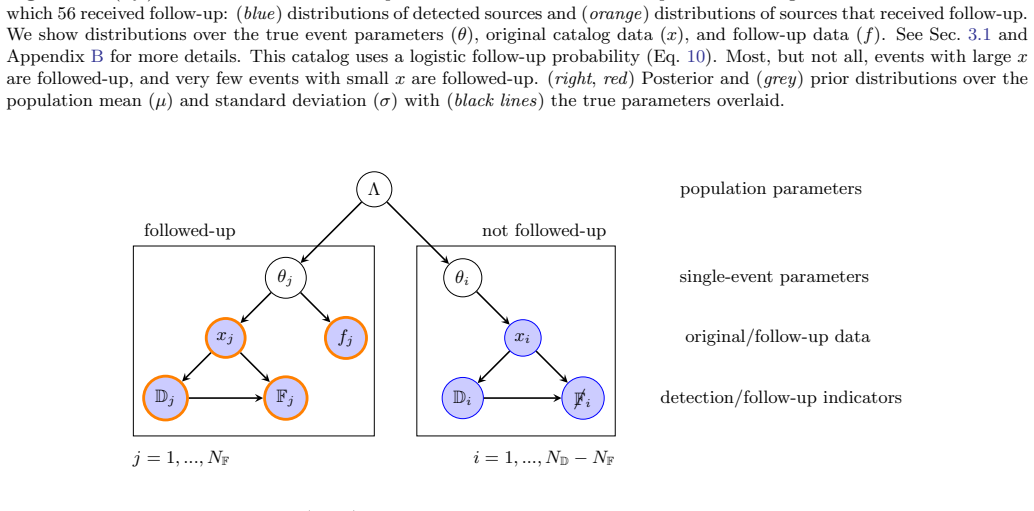
Hierarchical Bayesian inference that integrates over individual source parameters while conditioning only on the modeled initial detection selection and marginalizing over unknown follow-up decisions.
If this is right
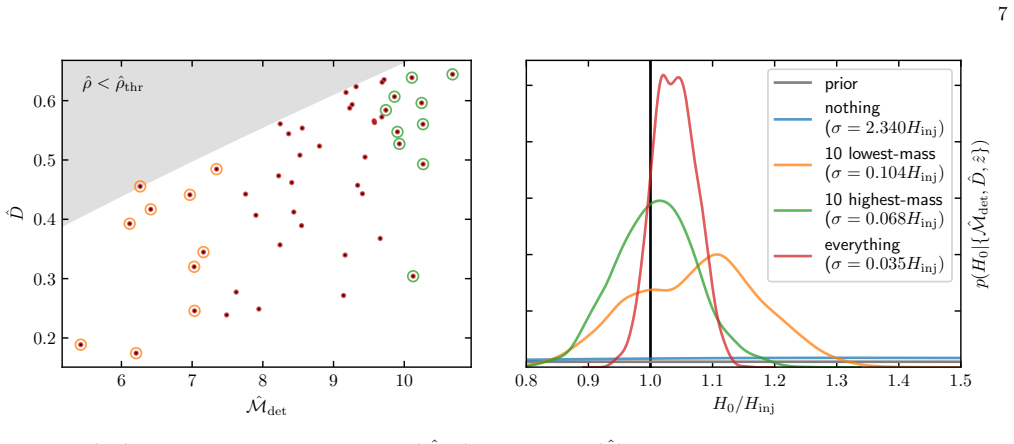
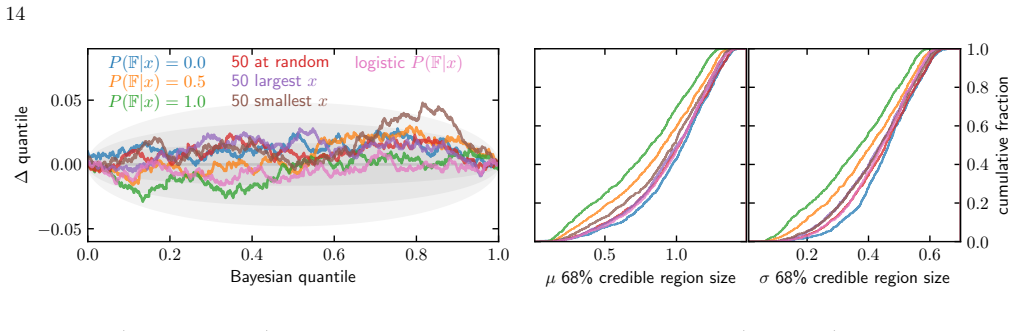
- The precision of posterior constraints on the population depends on the details of the follow-up process.
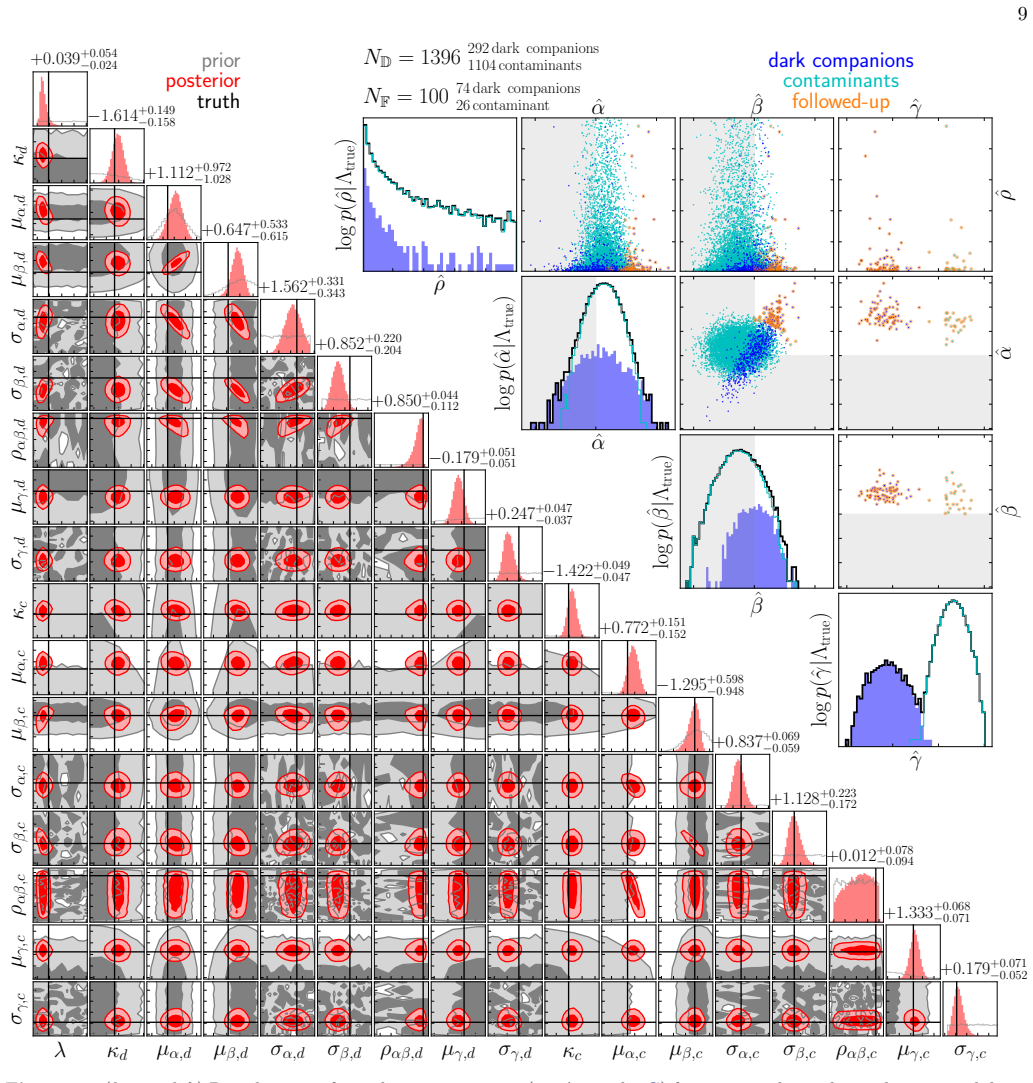
- Contaminants in the initial selection must be modeled explicitly to avoid bias in the inferred population.
- Population inference can use follow-up data from multiple independent observers without knowledge of their selection strategies.
- The approach applies directly to high-volume surveys such as LSST, Gaia, and next-generation gravitational-wave detectors.
Where Pith is reading between the lines
- The same hierarchical structure may simplify inference in other fields that face layered and partially unknown selection effects.
- Mock-data tests with deliberately correlated follow-up rules could be used to verify recovery of known populations.
- Real-time population updates become more practical during ongoing surveys since not every follow-up decision needs to be tracked.
Load-bearing premise
The initial detection or candidate selection process must be either perfect or its imperfections such as contaminants must be explicitly modeled.
What would settle it
A simulation with a known true population and a follow-up rule that depends on the latent parameters of interest; the method should recover the true population parameters within posterior uncertainties when the follow-up rule is left unmodeled.
Figures



read the original abstract
Many astronomical surveys prompt follow-up observations, but the decision process through which candidates are selected for follow-up can be difficult to model. This poses a challenge when inferring properties of the intrinsic population of astrophysical sources, rather than those of the set of objects detected by the survey and often-incomplete follow-up observations. We alleviate this problem by demonstrating that explicitly modeling of the follow-up selection process is not required for self-consistent inference of the intrinsic population. Using the framework of hierarchical Bayesian inference, we show that the intrinsic population can be accurately inferred even when the decision to follow up candidates strongly correlates with latent parameters of interest. We provide several worked examples, showing that the precision of posterior constraints can depend on the follow-up process and that one may have to model a population of contaminants if the initial selection is imperfect. Our result could dramatically simplify population inference that incorporates uncoordinated follow-up from multiple observers triggered by the deluge of candidates from surveys like LSST, Gaia, and next-generation gravitational-wave interferometers.
Editorial analysis
A structured set of objections, weighed in public.
Referee Report
Summary. The manuscript claims that hierarchical Bayesian inference allows accurate recovery of the intrinsic astrophysical population parameters even when the follow-up selection strategy is unknown and may correlate arbitrarily with latent parameters of interest. This is supported by several worked examples; the text notes that a population of contaminants must be modeled if the initial detection/selection step is imperfect, but argues that the follow-up step itself need not be modeled explicitly.
Significance. If the central result holds under the stated conditions, the work would substantially simplify population inference for surveys that generate large numbers of candidates with uncoordinated or poorly documented follow-up (LSST, Gaia, next-generation GW detectors). The provision of concrete worked examples is a strength that aids reproducibility and practical adoption.
major comments (1)
- [Abstract] Abstract and the discussion of the initial selection process: the central claim that follow-up selection need not be modeled is presented as general, yet the text explicitly states that contaminants must be modeled when initial selection is imperfect. No derivation or worked example is referenced that demonstrates unbiased recovery when both the initial filter and the follow-up strategy are unmodeled and their product becomes the effective selection function. This assumption is load-bearing for the generality of the result.
minor comments (1)
- [Methods] The notation distinguishing the initial detection probability, the follow-up probability, and the effective selection function should be introduced once and used consistently in the methods and examples sections to avoid reader confusion.
Simulated Author's Rebuttal
We thank the referee for their careful reading and constructive comments. The major comment raises a valid point about the scope and presentation of our central claim, and we have revised the manuscript to clarify the assumptions regarding initial selection and to better distinguish the follow-up component from the effective selection function.
read point-by-point responses
-
Referee: [Abstract] Abstract and the discussion of the initial selection process: the central claim that follow-up selection need not be modeled is presented as general, yet the text explicitly states that contaminants must be modeled when initial selection is imperfect. No derivation or worked example is referenced that demonstrates unbiased recovery when both the initial filter and the follow-up strategy are unmodeled and their product becomes the effective selection function. This assumption is load-bearing for the generality of the result.
Authors: We agree that the abstract and introductory discussion would benefit from greater precision on this point. Our result is specifically that the follow-up selection strategy need not be modeled explicitly, because the hierarchical Bayesian framework allows marginalization over unknown follow-up decisions (even when they correlate arbitrarily with latent parameters) without biasing the inferred population parameters. This holds provided the initial detection/selection step is either perfect or that any resulting contaminants are modeled as an additional population component, as already stated in the manuscript. We do not claim that the product of two unknown selection functions can be ignored; on the contrary, the text explicitly requires contaminant modeling precisely when the initial step is imperfect. The worked examples demonstrate recovery under unknown follow-up while properly accounting for the initial selection. We have revised the abstract to reference the relevant sections on initial selection and contaminants, and added a clarifying sentence in the discussion to emphasize that the effective selection function must still be handled via the initial-step modeling. No new derivation is required, as the marginalization over follow-up is a direct consequence of the hierarchical model structure. revision: yes
Circularity Check
No circularity; result is a general property of hierarchical Bayesian marginalization
full rationale
The paper demonstrates via hierarchical Bayesian inference that population parameters remain recoverable without explicit follow-up selection modeling, provided the initial detection is either perfect or contaminants are included in the model. This is shown through worked examples rather than a closed derivation that reduces to its own inputs. The abstract states the caveat directly, and no self-citations, fitted predictions renamed as results, or self-definitional steps are present in the provided text. The central claim is a robustness property of the inference framework itself and does not loop back to assumptions that presuppose the conclusion.
Axiom & Free-Parameter Ledger
axioms (1)
- domain assumption Hierarchical Bayesian inference framework applies to inferring intrinsic populations from selected observations.
Reference graph
Works this paper leans on
-
[1]
Aasi, J., et al. 2015, Class. Quant. Grav., 32, 074001, doi: 10.1088/0264-9381/32/7/074001
-
[2]
GWTC-4.0: Population Properties of Merging Compact Binaries
Abac, A. G., et al. 2025, https://arxiv.org/abs/2508.18083
work page internal anchor Pith review arXiv 2025
-
[3]
2017, PhRvL, 119, 161101, doi: 10.1103/PhysRevLett.119.161101
Abbott, B. P., et al. 2017a, Phys. Rev. Lett., 119, 161101, doi: 10.1103/PhysRevLett.119.161101
-
[4]
Abbott, B. P., et al. 2017b, Astrophys. J. Lett., 848, L12, doi: 10.3847/2041-8213/aa91c9
-
[5]
2015, Classical and Quantum Gravity, 32, 024001, doi: 10.1088/0264-9381/32/2/024001
Acernese, F., et al. 2015, Class. Quant. Grav., 32, 024001, doi: 10.1088/0264-9381/32/2/024001
-
[6]
Progress of Theoretical and Experimental Physics , keywords =
Akutsu, T., et al. 2021, Progress of Theoretical and Experimental Physics, 2021, 05A101, doi: 10.1093/ptep/ptaa125
-
[7]
2018, The Astrophysical Journal, 863, 48, doi: 10.3847/1538-4357/aad188
Amiri, M., Bandura, K., Berger, P., et al. 2018, ApJ, 863, 48, doi: 10.3847/1538-4357/aad188
-
[8]
Bianchi, D., Burden, A., Percival, W. J., et al. 2018, Mon. Not. Roy. Astron. Soc., 481, 2338, doi: 10.1093/mnras/sty2377
-
[9]
Bianco, F. B., Ivezi´ c,ˇZ., Jones, R. L., et al. 2022, ApJS, 258, 1, doi: 10.3847/1538-4365/ac3e72
-
[10]
2026, The Astrophysical Journal, 1001, 208, doi: 10.3847/1538-4357/ae589c
Boone, K., Ferguson, P., Tabbutt, M., et al. 2026, The Astrophysical Journal, 1001, 208, doi: 10.3847/1538-4357/ae589c
-
[11]
2018, JAX: composable transformations of Python+NumPy programs, 0.3.13 http://github.com/jax-ml/jax
Bradbury, J., Frostig, R., Hawkins, P., et al. 2018, JAX: composable transformations of Python+NumPy programs, 0.3.13 http://github.com/jax-ml/jax
2018
-
[12]
Burke, C. J., Christiansen, J. L., Mullally, F., et al. 2015, The Astrophysical Journal, 809, 8, doi: 10.1088/0004-637X/809/1/8
-
[13]
Chen, H.-Y., Fishbach, M., & Holz, D. E. 2018, Nature, 562, 545, doi: 10.1038/s41586-018-0606-0
-
[14]
Chen, H.-Y., Talbot, C., & Chase, E. A. 2024, Phys. Rev. Lett., 132, 191003, doi: 10.1103/PhysRevLett.132.191003
-
[15]
Desai, D. D., Kochanek, C. S., Shappee, B. J., et al. 2024, MNRAS, 530, 5016, doi: 10.1093/mnras/stae606
-
[16]
Desai, D. D., Shappee, B. J., Kochanek, C. S., et al. 2026, arXiv e-prints, arXiv:2602.00223, doi: 10.48550/arXiv.2602.00223
-
[17]
2024, The Open Journal of Astrophysics, 7, 100, doi: 10.33232/001c.125461
El-Badry, K., Lam, C., Holl, B., et al. 2024, The Open Journal of Astrophysics, 7, 100, doi: 10.33232/001c.125461
-
[18]
doi:10.1093/mnras/stac3140 , arxivId =
El-Badry, K., Rix, H.-W., Quataert, E., et al. 2023a, MNRAS, 518, 1057, doi: 10.1093/mnras/stac3140
-
[19]
2023b, MNRAS, 521, 4323, doi: 10.1093/mnras/stad799
El-Badry, K., Rix, H.-W., Cendes, Y., et al. 2023b, MNRAS, 521, 4323, doi: 10.1093/mnras/stad799
-
[20]
Essick, R. 2023, Phys. Rev. D, 108, 043011, doi: 10.1103/PhysRevD.108.043011
-
[21]
Essick, R. 2026, Astrophys. J., 997, 76, doi: 10.3847/1538-4357/ae2255
-
[22]
2022, The Astrophysical Journal, 926, 34, doi: 10.3847/1538-4357/ac3978
Essick, R., Farah, A., Galaudage, S., et al. 2022, The Astrophysical Journal, 926, 34, doi: 10.3847/1538-4357/ac3978
-
[23]
Ensuring Consistency between Noise and Detection in Hierarchical Bayesian Inference
Essick, R., & Fishbach, M. 2024, The Astrophysical Journal, 962, 169, doi: 10.3847/1538-4357/ad1604
-
[24]
Essick, R., & Holz, D. E. 2024, Phys. Rev. D, 110, 103018, doi: 10.1103/PhysRevD.110.103018
-
[25]
Essick, R., et al. 2025, Phys. Rev. D, 112, 102001, doi: 10.1103/44x3-hv3y
-
[26]
Farah, A. M., Callister, T. A., Ezquiaga, J. M., Zevin, M., & Holz, D. E. 2025, Astrophys. J., 978, 153, doi: 10.3847/1538-4357/ad9253
-
[27]
Gair, J. R., Ghosh, A., Gray, R., et al. 2023, The Astronomical Journal, 166, 22, doi: 10.3847/1538-3881/acca78
-
[28]
2023, arXiv e-prints, arXiv:2304.01288, doi: 10.48550/arXiv.2304.01288
Godfrey, J., Edelman, B., & Farr, B. 2023, https://arxiv.org/abs/2304.01288 21
-
[29]
Gray, R., et al. 2023, JCAP, 12, 023, doi: 10.1088/1475-7516/2023/12/023
-
[30]
Harris, C. R., Millman, K. J., van der Walt, S. J., et al. 2020, Nature, 585, 357, doi: 10.1038/s41586-020-2649-2
-
[31]
Hunter, J. D. 2007, Computing in Science & Engineering, 9, 90, doi: 10.1109/MCSE.2007.55 Ivezi´ c,ˇZ., Kahn, S. M., Tyson, J. A., et al. 2019, ApJ, 873, 111, doi: 10.3847/1538-4357/ab042c
-
[32]
Koch, D. G., Borucki, W. J., Basri, G., et al. 2010, ApJL, 713, L79, doi: 10.1088/2041-8205/713/2/L79
-
[33]
Lam, C. Y., El-Badry, K., & Simon, J. D. 2025, The Astrophysical Journal, 987, 215, doi: 10.3847/1538-4357/addac2
- [34]
-
[35]
Li, T. S., Koposov, S. E., Zucker, D. B., et al. 2019, MNRAS, 490, 3508, doi: 10.1093/mnras/stz2731
-
[36]
2018, A&A, 616, A2, doi: 10.1051/0004-6361/201832727
Lindegren, L., Hern´ andez, J., Bombrun, A., et al. 2018, A&A, 616, A2, doi: 10.1051/0004-6361/201832727 LVK. 2021a, GWTC-3: Compact Binary Coalescences Observed by LIGO and Virgo During the Second Part of the Third Observing Run — O3 search sensitivity estimates, Zenodo, doi: 10.5281/zenodo.5546676 LVK. 2021b, GWTC-3: Compact Binary Coalescences Observed...
-
[37]
Estimates, Zenodo, doi: 10.5281/zenodo.16740128
-
[38]
Mali, U., & Essick, R. 2025, Astrophys. J., 980, 85, doi: 10.3847/1538-4357/ad9de7
-
[39]
Mandel, I., Farr, W. M., & Gair, J. R. 2019, Mon. Not. Roy. Astron. Soc., 486, 1086, doi: 10.1093/mnras/stz896
-
[40]
2012, PhRvL, 108, 091101, doi: 10.1103/PhysRevLett.108.091101
Messenger, C., & Read, J. 2012, Phys. Rev. Lett., 108, 091101, doi: 10.1103/PhysRevLett.108.091101
-
[41]
Dormant black hole candidates from Gaia DR3 summary diagnostics
Mould, M., Moore, C. J., & Gerosa, D. 2024, Phys. Rev. D, 109, 063013, doi: 10.1103/PhysRevD.109.063013 M¨ uller-Horn, J., Rix, H.-W., El-Badry, K., et al. 2025, arXiv e-prints, arXiv:2510.05982, doi: 10.48550/arXiv.2510.05982
work page internal anchor Pith review Pith/arXiv arXiv doi:10.1103/physrevd.109.063013 2024
-
[42]
Pessi, T., Desai, D. D., Prieto, J. L., et al. 2025, A&A, 703, A34, doi: 10.1051/0004-6361/202556799
-
[43]
Phan, D., Pradhan, N., & Jankowiak, M. 2019, arXiv preprint arXiv:1912.11554
-
[44]
Prusti, T., de Bruijne, J. H. J., Brown, A. G. A., et al. 2016, A&A, 595, A1, doi: 10.1051/0004-6361/201629272
-
[45]
Ricker, G. R., Winn, J. N., Vanderspek, R., et al. 2014, in Society of Photo-Optical Instrumentation Engineers (SPIE) Conference Series, Vol. 9143, Space Telescopes and Instrumentation 2014: Optical, Infrared, and Millimeter Wave, ed. J. M. Oschmann, Jr., M. Clampin, G. G. Fazio, & H. A. MacEwen, 914320, doi: 10.1117/12.2063489 Rosado-Mar´ ın, A. J., et a...
-
[46]
Ross, A. J., et al. 2025, JCAP, 01, 125, doi: 10.1088/1475-7516/2025/01/125
-
[47]
Mitigating the Binary Viewing Angle Bias for Standard Sirens
Salvarese, A., & Chen, H.-Y. 2024, Astrophys. J. Lett., 974, L16, doi: 10.3847/2041-8213/ad7bbc
-
[48]
Schutz, B. F. 1986, Nature, 323, 310, doi: 10.1038/323310a0
-
[49]
Shabram, M. I., Batalha, N., Thompson, S. E., et al. 2020, AJ, 160, 16, doi: 10.3847/1538-3881/ab90fe
-
[50]
2019, Monthly Notices of the Royal Astronomical Society, 487, 5610, doi: 10.1093/mnras/stz1636
Shahaf, S., Mazeh, T., Faigler, S., & Holl, B. 2019, Monthly Notices of the Royal Astronomical Society, 487, 5610, doi: 10.1093/mnras/stz1636
-
[51]
Taylor, S. R., Gair, J. R., & Mandel, I. 2012, Phys. Rev. D, 85, 023535, doi: 10.1103/PhysRevD.85.023535
-
[52]
2025b, ApJ, 985, 220, doi: 10.3847/1538-4357/adcec5
Tong, H., Fishbach, M., & Thrane, E. 2025, Astrophys. J., 985, 220, doi: 10.3847/1538-4357/adcec5
-
[53]
Comparing astrophysical models to gravitational-wave data in the observable space
Toubiana, A., et al. 2025, https://arxiv.org/abs/2507.13249
work page internal anchor Pith review Pith/arXiv arXiv 2025
-
[54]
Vallenari, A., Brown, A. G. A., Prusti, T., et al. 2023, A&A, 674, A1, doi: 10.1051/0004-6361/202243940
-
[55]
Virtanen, P., Gommers, R., Oliphant, T. E., et al. 2020, Nature Methods, 17, 261, doi: 10.1038/s41592-019-0686-2
discussion (0)
Sign in with ORCID, Apple, or X to comment. Anyone can read and Pith papers without signing in.