Recognition: unknown
A preliminary exploration of the effects of baseline length for the LIFE space mission
Pith reviewed 2026-05-08 04:51 UTC · model grok-4.3
The pith
The LIFE space mission can achieve comparable habitable exoplanet yields using shorter nulling baselines of 25-80 meters or discrete sets.
A machine-rendered reading of the paper's core claim, the machinery that carries it, and where it could break.
Core claim
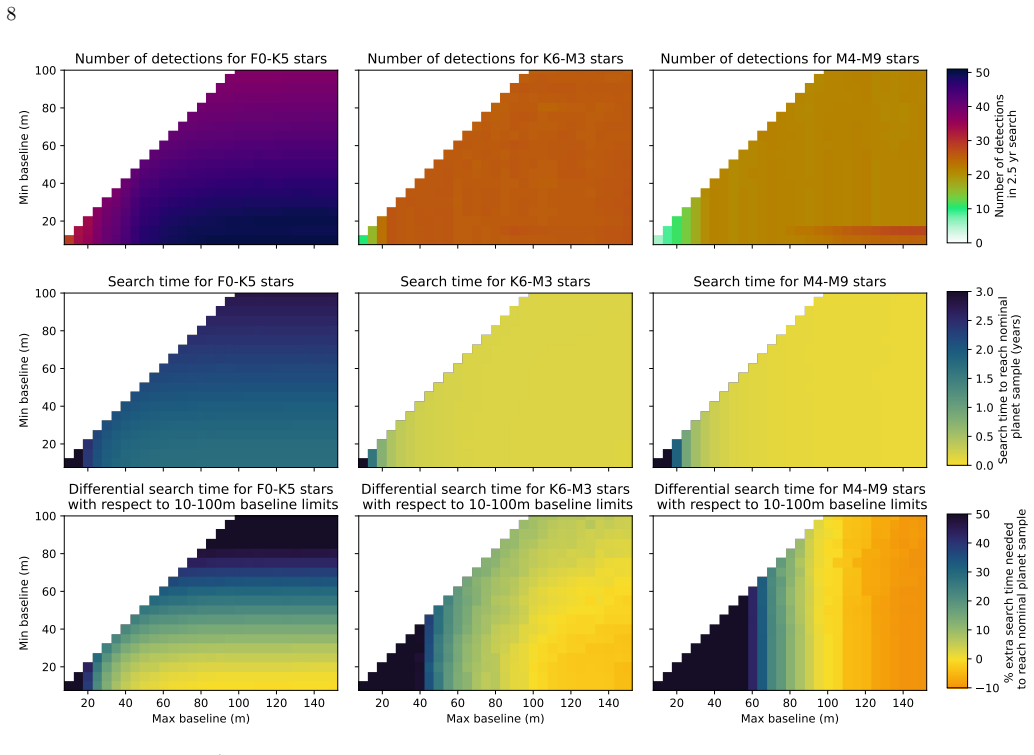
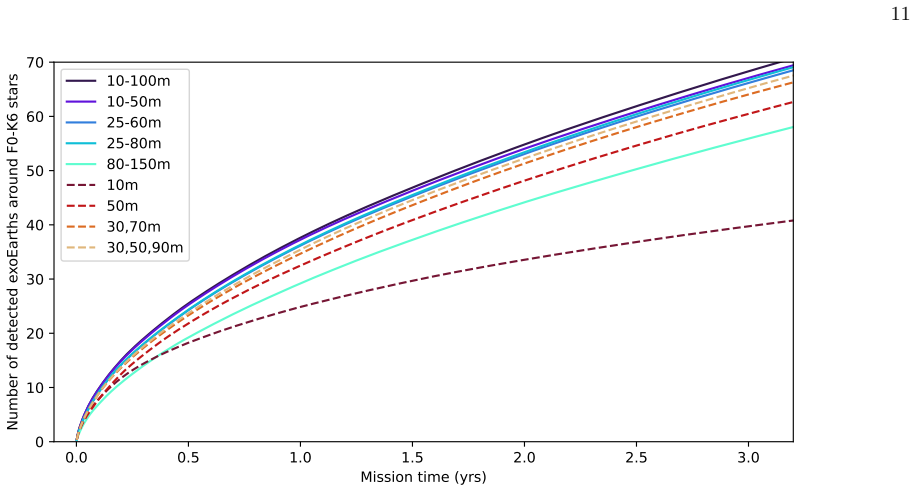
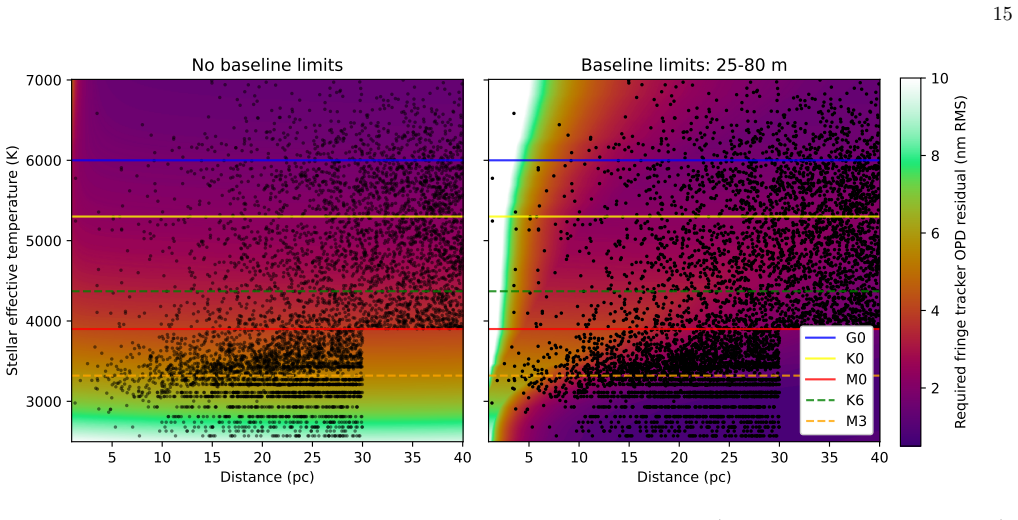
Utilizing the LIFEsim simulator along with revised mathematical tools and updated planet occurrence rates, the analysis shows that LIFE could utilize a considerably shorter range of baselines, such as 25-80 m, or even discrete baselines without much (<10%) loss of performance in planet yield and fringe tracking, while also determining a new astrophysically motivated technique for choosing optimal baselines for a given science target.
What carries the argument
The LIFEsim mission simulator, which models interferometric performance, paired with a new astrophysically motivated technique for selecting optimal nulling baselines based on the science target.
If this is right
- Careful trade-offs between performance and implementation simplification must be considered for the mission.
- Planet yield and fringe tracking performance remain largely unaffected by the reduced baseline range.
- Any required spectral weighting by scientific goals may influence the optimal baseline choices.
- Some loss of target-specific baseline optimization could occur with a fixed shorter range.
Where Pith is reading between the lines
- Similar re-evaluations of baseline requirements could benefit other proposed space interferometry concepts.
- The target-specific selection method might improve efficiency in ground-based nulling interferometers.
- Reducing baseline complexity may allow for more flexible mission architectures or lower operational risks.
Load-bearing premise
The LIFEsim simulator and the revised planet occurrence statistics accurately represent real mission performance and exoplanet demographics.
What would settle it
A comparison of the simulated planet yields using the proposed shorter baselines against yields from actual future observations of habitable zone exoplanets would test the <10% loss claim.
Figures








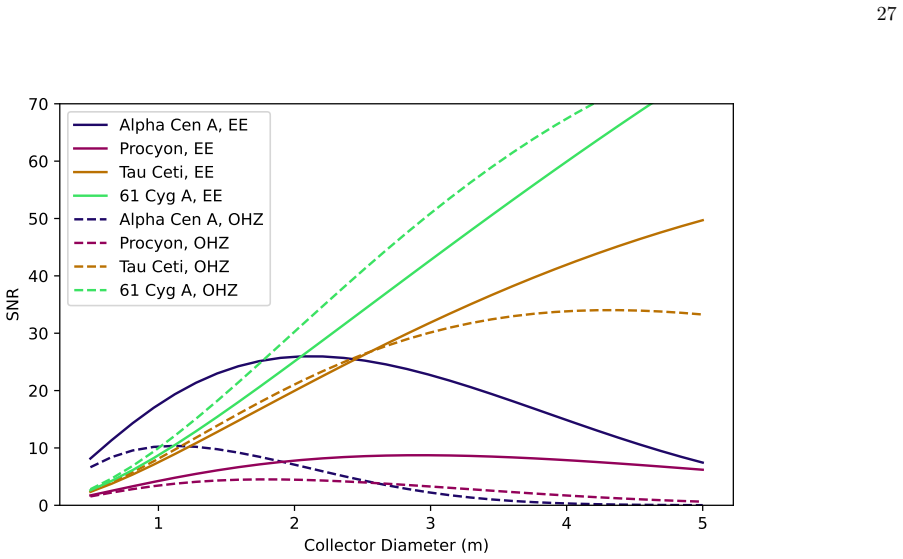


read the original abstract
By aiming to find and characterise dozens of habitable exoplanets through the technique of nulling interferometry, the LIFE space mission will produce transformational science. One of the key parameters for such an interferometric mission is the nulling baseline length - the distance between nulled apertures, which past studies have assumed to be 10-100m. Advances in planet occurrence statistics and simulation tools allow us now to revisit this key assumption with significantly more detail, particularly with the intention to reduce the range of baselines considered due to mission implementation concerns. We utilise the LIFEsim mission simulator along with revised mathematical tools to identify whether the range of baselines could be reduced without significantly affecting planet yield and fringe tracking performance. Along the way, we also determine a new astrophysically motivated technique for choosing which baselines are optimal for a given science target. We find that indeed, LIFE could utilise a considerably shorter range of baselines, such as 25-80m, or even discrete baselines without much (<10%) loss of performance. Nevertheless, careful trade-offs between performance and implementation simplification must be made, especially considering any spectral weighting that may be required by the scientific goals, and the potential loss of target-specific baseline optimisation.
Editorial analysis
A structured set of objections, weighed in public.
Referee Report
Summary. The paper claims that the LIFE space mission could utilize a considerably shorter range of nulling baselines (e.g., 25-80 m or discrete baselines) with less than 10% loss in planet yield and fringe-tracking performance relative to the previously assumed 10-100 m range. This conclusion is reached via forward modeling with the LIFEsim simulator fed by revised planet occurrence statistics, together with a new astrophysically motivated technique for selecting optimal baselines per target.
Significance. If the <10% loss result holds under scrutiny, the work would be significant for simplifying the technical implementation of the LIFE nulling interferometer, potentially lowering cost and complexity while retaining most of the mission's capability to characterize habitable-zone exoplanets. The incorporation of updated occurrence rates and the introduction of a target-specific baseline optimization method are clear strengths.
major comments (2)
- [Results section (baseline-range comparisons)] The central quantitative claim of <10% performance loss for the 25-80 m (or discrete) baseline ranges is presented without error bars, simulation-run statistics, exclusion criteria, or sensitivity analyses to key LIFEsim parameters (null depth vs. wavelength, stellar leakage, integration-time scaling, or inner-working-angle mapping). This directly affects the robustness of the headline result.
- [Methods (LIFEsim description and simulation setup)] The manuscript provides no external calibration, cross-code comparison, or validation against real interferometric data to confirm that LIFEsim's treatment of baseline-dependent quantities remains accurate when the range is truncated to 25-80 m; any systematic bias in those modules would rescale the reported loss figure.
minor comments (2)
- [Introduction] The introduction's reference to earlier studies that assumed 10-100 m baselines would be strengthened by explicit citations to those works.
- [Figures and tables] Figure or table captions comparing yields across baseline sets could more explicitly define the performance metrics (e.g., which spectral weighting is applied) to improve clarity.
Simulated Author's Rebuttal
We thank the referee for their constructive review and for recognizing the potential significance of our findings for simplifying the LIFE mission architecture. We address each major comment point by point below, with a commitment to revisions that improve the robustness of the presented results while remaining faithful to the scope of this preliminary exploration.
read point-by-point responses
-
Referee: [Results section (baseline-range comparisons)] The central quantitative claim of <10% performance loss for the 25-80 m (or discrete) baseline ranges is presented without error bars, simulation-run statistics, exclusion criteria, or sensitivity analyses to key LIFEsim parameters (null depth vs. wavelength, stellar leakage, integration-time scaling, or inner-working-angle mapping). This directly affects the robustness of the headline result.
Authors: We agree that the absence of error bars, run statistics, and sensitivity tests limits the ability to assess the robustness of the <10% loss claim. The LIFEsim runs underlying our figures are stochastic due to the planet occurrence rate sampling, but we did not report the associated variances. In the revised manuscript we will (i) rerun the key comparisons with a larger number of Monte Carlo realizations and display standard deviations as error bars on the yield and fringe-tracking metrics, (ii) state the exclusion criteria applied to targets (e.g., minimum SNR thresholds), and (iii) add a short sensitivity study varying null depth, stellar leakage, integration-time scaling, and inner-working-angle mapping within plausible ranges. These additions will be placed in the Results section and will demonstrate that the <10% conclusion is stable under reasonable parameter variations. revision: yes
-
Referee: [Methods (LIFEsim description and simulation setup)] The manuscript provides no external calibration, cross-code comparison, or validation against real interferometric data to confirm that LIFEsim's treatment of baseline-dependent quantities remains accurate when the range is truncated to 25-80 m; any systematic bias in those modules would rescale the reported loss figure.
Authors: LIFEsim is a purpose-built simulator whose baseline-dependent modules (fringe tracking, null depth, leakage) have been documented and exercised in earlier LIFE-related papers for the canonical 10-100 m range. Because the LIFE mission is still a concept, no on-sky interferometric data exist for any baseline range, precluding direct empirical validation. We will nevertheless strengthen the Methods section by (i) explicitly listing the assumptions made in the baseline-dependent calculations, (ii) showing that the functional forms used for null depth and leakage are analytic and therefore insensitive to the absolute range once the projected baseline is fixed, and (iii) adding a brief comparison of the truncated-range results against a simplified analytic model that reproduces the dominant scaling. These steps provide the strongest internal consistency check feasible at present; we do not claim external calibration beyond what already exists in the literature for the simulator as a whole. revision: partial
Circularity Check
No circularity: results from forward simulation with external tools
full rationale
The paper derives its central claim (shorter 25-80 m or discrete baselines yield <10% performance loss) by running the external LIFEsim simulator on revised planet occurrence statistics and directly comparing output yields and fringe-tracking metrics across baseline configurations. No load-bearing step reduces to a self-definition, a fitted parameter renamed as prediction, or a self-citation chain; the new baseline-selection technique is introduced as an independent astrophysical criterion rather than a re-derivation of the same inputs. The numerical experiment is self-contained against the simulator outputs and does not force the reported loss figure by construction.
Axiom & Free-Parameter Ledger
free parameters (1)
- baseline range bounds
axioms (1)
- domain assumption Nulling interferometry performance for habitable-zone planets is adequately modeled by LIFEsim under the revised occurrence statistics
Reference graph
Works this paper leans on
-
[1]
doi:10.1364/AO.27.002334 , nasaads =
1988 , month =. doi:10.1364/AO.27.002334 , nasaads =
-
[2]
doi:10.1051/0004-6361:20020387 , nasaads =
2002 , month =. doi:10.1051/0004-6361:20020387 , nasaads =
-
[3]
2023. 2023 , month =. doi:10.1088/2515-7647/ace869 , nasaads =
-
[4]
doi:10.1051/0004-6361/201630351 , nasaads =
2017 , month =. doi:10.1051/0004-6361/201630351 , nasaads =
-
[5]
doi:10.1051/0004-6361/202140366 , nasaads =
2022 , month =. doi:10.1051/0004-6361/202140366 , nasaads =
-
[6]
doi:10.1051/0004-6361/202141958 , nasaads =
2022 , month =. doi:10.1051/0004-6361/202141958 , nasaads =
-
[7]
doi:10.1051/0004-6361/202243863 , nasaads =
2023 , month =. doi:10.1051/0004-6361/202243863 , nasaads =
-
[8]
doi:10.1117/12.3018845 , nasaads =
2024 , month =. doi:10.1117/12.3018845 , nasaads =
-
[9]
doi:10.1117/12.3018652 , nasaads =
2024 , month =. doi:10.1117/12.3018652 , nasaads =
-
[10]
doi:10.1117/12.3018644 , nasaads =
2024 , month =. doi:10.1117/12.3018644 , nasaads =
-
[11]
doi:10.1051/0004-6361/202243107 , nasaads =
2022 , month =. doi:10.1051/0004-6361/202243107 , nasaads =
-
[12]
doi:10.1051/0004-6361/202345927 , nasaads =
2023 , month =. doi:10.1051/0004-6361/202345927 , nasaads =
-
[13]
doi:10.1051/0004-6361/202347027 , nasaads =
2023 , month =. doi:10.1051/0004-6361/202347027 , nasaads =
-
[14]
doi:10.1117/12.3020673 , nasaads =
2024 , month =. doi:10.1117/12.3020673 , nasaads =
-
[15]
2024, , 692, A172, 10.1051/0004-6361/202450764
2024 , month =. doi:10.1051/0004-6361/202450764 , nasaads =
-
[16]
doi:10.1117/12.3019090 , nasaads =
2024 , month =. doi:10.1117/12.3019090 , nasaads =
-
[17]
Goodman , title =
Joseph W. Goodman , title =. 1996 , edition =
1996
-
[18]
2010 , edition =
Handbook of Optics, Volume 1 , publisher =. 2010 , edition =
2010
-
[19]
doi:10.1117/12.2057210 , nasaads =
2014 , month =. doi:10.1117/12.2057210 , nasaads =
-
[20]
doi:10.1117/12.670603 , nasaads =
2006 , month =. doi:10.1117/12.670603 , nasaads =
-
[21]
Systematic errors in nulling inter- ferometers,
2004 , month =. doi:10.1364/AO.43.006100 , nasaads =
-
[22]
The Mid-Infrared Instrument for the James Webb Space Telescope, IX: Predicted Sensitivity. Publications of the Astronomical Society of the Pacific , keywords =. doi:10.1086/682259 , archivePrefix =. 1508.02427 , primaryClass =
-
[23]
The Astrophysical Journal , keywords =
Angular Power Spectra of the COBE DIRBE Maps. The Astrophysical Journal , keywords =. doi:10.1086/305345 , archivePrefix =. astro-ph/9711261 , primaryClass =
-
[24]
doi:10.1051/0004-6361/202141785 , nasaads =
2022 , month =. doi:10.1051/0004-6361/202141785 , nasaads =
-
[25]
doi:10.3847/1538-3881/aba957 , nasaads =
2020 , month =. doi:10.3847/1538-3881/aba957 , nasaads =
-
[26]
doi:10.1117/12.2233079 , nasaads =
2016 , month =. doi:10.1117/12.2233079 , nasaads =
-
[27]
doi:10.1093/mnras/167.3.475 , nasaads =
1974 , month =. doi:10.1093/mnras/167.3.475 , nasaads =
-
[28]
doi:10.1051/0004-6361/201016222 , nasaads =
2011 , month =. doi:10.1051/0004-6361/201016222 , nasaads =
-
[29]
doi:10.1051/0004-6361/200811083 , nasaads =
2009 , month =. doi:10.1051/0004-6361/200811083 , nasaads =
-
[30]
doi:10.1117/1.JATIS.8.2.025002 , nasaads =
2022 , month =. doi:10.1117/1.JATIS.8.2.025002 , nasaads =
- [31]
-
[32]
doi:10.1088/0067-0049/216/2/23 , nasaads =
2015 , month =. doi:10.1088/0067-0049/216/2/23 , nasaads =
-
[33]
2011 , month =. doi:10.1051/0004-6361/201116451 , nasaads =
-
[34]
doi:10.1051/0004-6361/201834981 , nasaads =
2019 , month =. doi:10.1051/0004-6361/201834981 , nasaads =
-
[35]
doi:10.1051/0004-6361/202243846 , nasaads =
2022 , month =. doi:10.1051/0004-6361/202243846 , nasaads =
-
[36]
doi:10.1073/pnas.2117933119 , nasaads =
2022 , month =. doi:10.1073/pnas.2117933119 , nasaads =
-
[37]
doi:10.1038/s41550-025-02532-8 , nasaads =
2025 , month =. doi:10.1038/s41550-025-02532-8 , nasaads =
-
[38]
The Astronomical Journal , author =
2021 , month =. doi:10.3847/1538-3881/abc418 , nasaads =
-
[39]
2017, Annual Review of Astronomy and Astrophysics, 55, 433, doi: 10.1146/annurev-astro-082214-122238
2017 , month =. doi:10.1146/annurev-astro-082214-122238 , nasaads =
-
[40]
2013 , month =. doi:10.1088/0067-0049/208/1/9 , nasaads =
-
[41]
Memorie della Societa Astronomica Italiana Supplementi , keywords =
2013 , month =. doi:10.48550/arXiv.1306.4307 , nasaads =
-
[42]
2001 , month =. doi:10.1046/j.1365-8711.2001.04510.x , nasaads =
-
[43]
doi:10.3847/2515-5172/ad887e , nasaads =
2024 , month =. doi:10.3847/2515-5172/ad887e , nasaads =
-
[44]
2025 , month =. doi:10.3847/1538-3881/adb96d , nasaads =
-
[45]
doi:10.3847/1538-4357/addc6e , nasaads =
2025 , month =. doi:10.3847/1538-4357/addc6e , nasaads =
-
[46]
doi:10.1093/pasj/psaf086 , nasaads =
2025 , month =. doi:10.1093/pasj/psaf086 , nasaads =
-
[47]
doi:10.3847/1538-3881/add720 , nasaads =
2025 , month =. doi:10.3847/1538-3881/add720 , nasaads =
-
[48]
doi:10.1051/0004-6361/202452998 , nasaads =
2025 , month =. doi:10.1051/0004-6361/202452998 , nasaads =
-
[49]
doi:10.3847/1538-4357/aab205 , nasaads =
2018 , month =. doi:10.3847/1538-4357/aab205 , nasaads =
-
[50]
doi:10.1089/ast.2007.0227 , nasaads =
2009 , month =. doi:10.1089/ast.2007.0227 , nasaads =
-
[51]
doi:10.3847/1538-3881/adfb6b , nasaads =
2025 , month =. doi:10.3847/1538-3881/adfb6b , nasaads =
-
[52]
doi:10.1117/12.734835 , nasaads =
2007 , month =. doi:10.1117/12.734835 , nasaads =
-
[53]
doi:10.1117/12.786822 , nasaads =
2008 , month =. doi:10.1117/12.786822 , nasaads =
-
[54]
doi:10.1016/j.asr.2005.05.061 , nasaads =
2005 , month =. doi:10.1016/j.asr.2005.05.061 , nasaads =
-
[55]
2018 , month =. doi:10.1089/ast.2017.1729 , nasaads =
-
[56]
J., Koch, D., Basri, G., et al
2010 , month =. doi:10.1126/science.1185402 , nasaads =
-
[57]
doi:10.3847/1538-4357/ad74f7 , nasaads =
2024 , month =. doi:10.3847/1538-4357/ad74f7 , nasaads =
-
[58]
2024 , month =. doi:10.1117/12.3019256 , nasaads =
-
[59]
doi:10.1051/0004-6361/202243576 , nasaads =
2022 , month =. doi:10.1051/0004-6361/202243576 , nasaads =
-
[60]
doi:10.1051/0004-6361/200912973 , archivePrefix =
Nulling interferometry: impact of exozodiacal clouds on the performance of future life-finding space missions. doi:10.1051/0004-6361/200912973 , archivePrefix =. 0910.3486 , primaryClass =
-
[61]
2024 , month =. doi:10.3847/1538-3881/ad25ec , nasaads =
-
[62]
2015 , month =. doi:10.1117/1.JATIS.1.1.014003 , nasaads =
-
[63]
, year =
Dannert, Felix A. , year =. How
-
[64]
ar. 2025 , month =. doi:10.48550/arXiv.2512.16619 , nasaads =
-
[65]
ar. 2025 , month =. doi:10.48550/arXiv.2512.16575 , nasaads =
-
[66]
2015 , month =. doi:10.1088/0004-637X/807/1/45 , nasaads =
-
[67]
Flexible versus fixed baselines: A comparison of nulling interferometry exoplanet detection yields in the presence of instrumental noise
-
[68]
The Nulling Interferometry Cryogenic Experiment (NICE): Architecture, requirements, and preliminary warm precursor results. arXiv e-prints , keywords =. doi:10.48550/arXiv.2602.02279 , archivePrefix =. 2602.02279 , primaryClass =
-
[69]
Konnerth , Fiona and Glauser , Adrian M. 2025
2025
-
[70]
The HOSTS Survey for Exozodiacal Dust: Observational Results from the Complete Survey. , keywords =. doi:10.3847/1538-3881/ab7817 , archivePrefix =. 2003.03499 , primaryClass =
-
[71]
The Astropy Project: Sustaining and Growing a Community-oriented Open-source Project and the Latest Major Release (v5.0) of the Core Package. , keywords =. doi:10.3847/1538-4357/ac7c74 , archivePrefix =. 2206.14220 , primaryClass =
-
[72]
The Astronomical Journal , author =
The Astropy Project: Building an Open-science Project and Status of the v2.0 Core Package. , keywords =. doi:10.3847/1538-3881/aabc4f , archivePrefix =. 1801.02634 , primaryClass =
-
[73]
Astropy: A community Python package for astronomy. , keywords =. 2013. doi:10.1051/0004-6361/201322068 , archivePrefix =. 1307.6212 , primaryClass =
-
[74]
The Journal of Open Source Software , keywords =
van der Velden, Ellert , title =. 2020 , publisher =. doi:10.21105/joss.02004 , url =
-
[75]
Castro, S. G. P. and Loukianov, A. and others , title =. doi:10.5281/zenodo.2541552 , url =
-
[76]
GitHub repository , howpublished =
Dmitry Savransky , title =. GitHub repository , howpublished =. 2025 , publisher =
2025
-
[77]
Gaia Early Data Release 3. The Gaia Catalogue of Nearby Stars. , keywords =. doi:10.1051/0004-6361/202039498 , archivePrefix =. 2012.02061 , primaryClass =
-
[78]
2018 , month =. doi:10.1016/j.jqsrt.2018.05.023 , nasaads =
-
[79]
2026 , url =
Joblib: running Python functions as pipeline jobs , author =. 2026 , url =
2026
-
[80]
2025,, 1.3.4 Zenodo, doi: 10.5281/zenodo.16175987
Newville, Matthew and Otten, Renee and Nelson, Andrew and Stensitzki, Till and Ingargiola, Antonino and Allan, Daniel and Fox, Austin and Carter, Faustin and Rawlik, Michal , title =. doi:10.5281/zenodo.16175987 , url =
discussion (0)
Sign in with ORCID, Apple, or X to comment. Anyone can read and Pith papers without signing in.