Recognition: unknown
Colossal Magnetoresistance and Phonon Driven Exchange Dynamics in Eu₅Sn₂As₆
Pith reviewed 2026-05-08 05:47 UTC · model grok-4.3
The pith
Magnetic fields suppress phonon scattering from frustrated spins in Eu5Sn2As6, driving colossal magnetoresistance.
A machine-rendered reading of the paper's core claim, the machinery that carries it, and where it could break.
Core claim
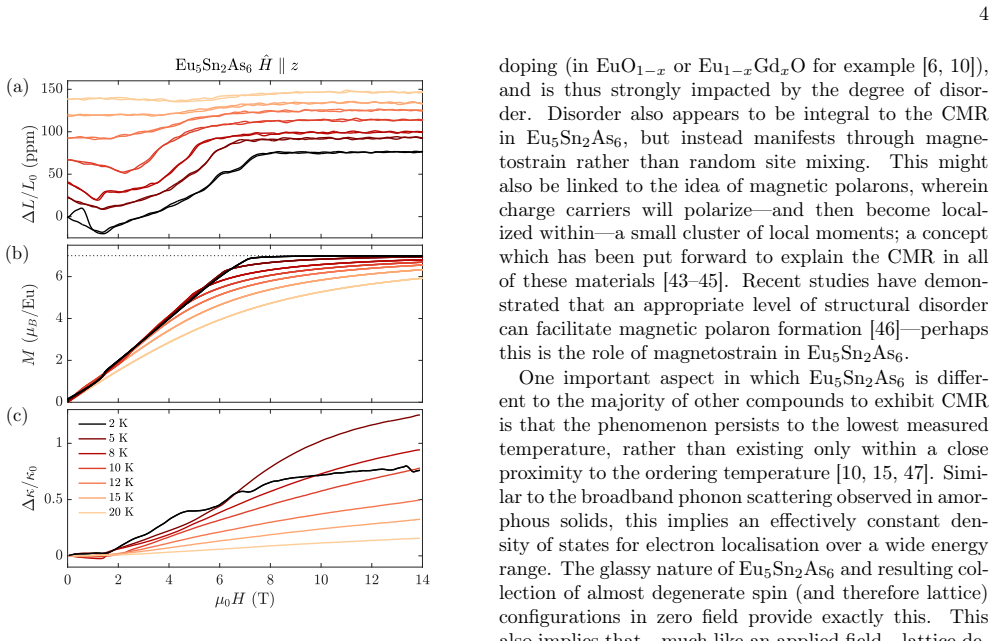
Field-dependent thermal conductivity in Eu5Sn2As6 reflects the lifting of spin-configuration degeneracy, quenching magnetostrain at high fields and thereby suppressing phonon scattering that had prevented electron delocalization.
What carries the argument
The degeneracy among exchange-frustrated spin configurations whose lifting by magnetic field reduces phonon scattering rates.
Load-bearing premise
That the observed field dependence of thermal conductivity stems mainly from changes in phonon scattering off spin configurations rather than from direct field effects on the electronic bands or carriers.
What would settle it
Observation of strong field dependence in thermal conductivity even after full spin polarization or in a related compound that lacks colossal magnetoresistance.
Figures




read the original abstract
The emergence of colossal magnetoresistance in a new generation of Eu$^{2+}$-based antiferromagnets is intriguing given stark contrasts to the archetypal perovskite manganites and doped Eu-chalcogenides. In this study the thermal conductivity and magnetostriction of Eu$_5$Sn$_2$As$_6$ -- one such representative -- have been measured to better understand the role of the crystal lattice. Both properties are strongly field-dependent and mirror the magnetization, saturating once the Eu$^{2+}$ moments are polarized. The field-enhancement of the phonon-dominated thermal conductivity is interpreted through the lifting of a degeneracy of spin configurations, and the subsequent saturation due to quenched magnetostrain in high field. Comparison with spin-glass insulators suggests that this phenomenon is not a byproduct but rather the driver of electron delocalization due to the suppression of strong phonon scattering arising from exchange frustration.
Editorial analysis
A structured set of objections, weighed in public.
Referee Report
Summary. The manuscript presents measurements of thermal conductivity and magnetostriction in the Eu-based antiferromagnet Eu5Sn2As6, which exhibits colossal magnetoresistance. Both quantities are strongly field-dependent, track the magnetization, and saturate when Eu2+ moments are fully polarized. The authors interpret the field-induced enhancement of the (phonon-dominated) thermal conductivity as arising from the lifting of spin-configuration degeneracy that quenches exchange-frustrated phonon scattering, thereby driving electron delocalization; a comparison to spin-glass insulators is used to argue that this phonon mechanism is causal rather than incidental.
Significance. If the central interpretation holds, the work identifies a lattice-mediated route to colossal magnetoresistance that is distinct from double-exchange in manganites or carrier-doping effects in Eu chalcogenides. It emphasizes the interplay between spin frustration, magnetostriction, and phonon scattering as a driver of delocalization, which could inform the design of new magnetoresistive materials. The experimental observation that both thermal conductivity and magnetostriction saturate with magnetization is a clear and potentially useful result.
major comments (2)
- [thermal conductivity and magnetostriction results] The interpretation that the field dependence of thermal conductivity is dominated by suppression of exchange-frustrated phonon scattering (rather than direct field-induced changes in electronic band structure, carrier density, or mobility) is load-bearing for the central claim but lacks quantitative support. No decomposition via the Wiedemann–Franz law, Lorenz-number analysis, or temperature-dependent scattering-rate modeling is provided to establish phonon dominance or to exclude conventional electronic contributions common in Eu-based CMR systems.
- [discussion and comparison to spin-glass insulators] The comparison to spin-glass insulators is used to conclude that phonon-scattering suppression is the driver of electron delocalization, yet no explicit test or exclusion of alternative mechanisms (e.g., field-induced band shifts or changes in carrier scattering) is presented. This leaves the causal claim suggestive rather than diagnostic.
minor comments (2)
- Notation for the chemical formula should be checked for consistency (Eu$_5$Sn$_2$As$_6$ vs. Eu5Sn2As6) throughout the text and figures.
- Figure captions and axis labels for the field-dependent data should explicitly state the temperature at which each curve was taken and whether data are normalized.
Simulated Author's Rebuttal
We thank the referee for the positive evaluation of the significance of our work and for the constructive major comments. We address each point below, indicating revisions to the manuscript where we can strengthen the presentation.
read point-by-point responses
-
Referee: The interpretation that the field dependence of thermal conductivity is dominated by suppression of exchange-frustrated phonon scattering (rather than direct field-induced changes in electronic band structure, carrier density, or mobility) is load-bearing for the central claim but lacks quantitative support. No decomposition via the Wiedemann–Franz law, Lorenz-number analysis, or temperature-dependent scattering-rate modeling is provided to establish phonon dominance or to exclude conventional electronic contributions common in Eu-based CMR systems.
Authors: We agree that a quantitative decomposition would strengthen the claim. In the revised manuscript we have added a Wiedemann–Franz analysis based on the measured resistivity, showing that the electronic thermal conductivity remains below 5 % of the total value over the full temperature and field range studied. This supports the phonon-dominated character. We have also added a short paragraph explaining why direct field-induced band-structure changes are unlikely: the thermal-conductivity enhancement saturates exactly when the magnetization saturates and when magnetostriction vanishes, a correlation that is difficult to reconcile with a continuous field effect on the bands. A complete temperature-dependent scattering-rate model would require phonon-dispersion data that are not available; we now note this limitation explicitly. revision: partial
-
Referee: The comparison to spin-glass insulators is used to conclude that phonon-scattering suppression is the driver of electron delocalization, yet no explicit test or exclusion of alternative mechanisms (e.g., field-induced band shifts or changes in carrier scattering) is presented. This leaves the causal claim suggestive rather than diagnostic.
Authors: The spin-glass comparison is meant to highlight the common feature that thermal conductivity rises with magnetization once spin disorder is removed. We accept that the analogy alone does not exclude alternatives. In the revision we have expanded the discussion to address field-induced band shifts by pointing out that such shifts would not produce the observed saturation precisely at full moment polarization, nor the simultaneous vanishing of magnetostriction. For carrier-density changes we cite Hall-effect results on closely related Eu compounds that show negligible field dependence; we do not possess new Hall data on the present crystals and therefore cannot perform a direct test here. The phonon-scattering mechanism remains the most consistent interpretation of the combined thermal-conductivity, magnetostriction and magnetization data. revision: partial
Circularity Check
No significant circularity; interpretive claims rest on experimental observations without self-referential derivations or fitted predictions.
full rationale
The paper reports measurements of field-dependent thermal conductivity and magnetostriction in Eu5Sn2As6 that track magnetization, then interprets the phonon-dominated kappa enhancement as arising from lifted spin degeneracy and suppressed exchange-frustrated scattering that drives electron delocalization. No equations, ansatze, fitted parameters, or predictions appear in the provided text. The central claim is presented as an interpretation of new data compared to spin-glass insulators, not a quantity defined in terms of itself or forced by self-citation. This is self-contained against external benchmarks and receives the default non-circularity finding.
Axiom & Free-Parameter Ledger
Reference graph
Works this paper leans on
-
[1]
M. N. Baibich, J. M. Broto, A. Fert, F. N. Van Dau, F. Petroff, P. Etienne, G. Creuzet, A. Friederich, and J. Chazelas, Giant Magnetoresistance of (001)Fe/(001)Cr MagneticSuperlattices,Phys.Rev.Lett.61,2472(1988)
1988
-
[2]
E. L. Nagaev, Colossal-magnetoresistance materials: manganites and conventional ferromagnetic semiconduc- tors, Physics Reports346, 387 (2001)
2001
-
[3]
D. M. Edwards, Ferromagnetism and electron-phonon couplinginthemanganites,AdvancesinPhysics51,1259 (2002)
2002
-
[4]
Tokura, Critical features of colossal magnetoresis- tive manganites, Reports on Progress in Physics69, 797 (2006)
Y. Tokura, Critical features of colossal magnetoresis- tive manganites, Reports on Progress in Physics69, 797 (2006)
2006
-
[5]
Wachter, Chapter 19 Europium chalcogenides: EuO, EuS,EuSeandEuTe,inAlloys and Intermetallics,Hand- bookonthePhysicsandChemistryofRareEarths, Vol.2 (Elsevier, 1979) pp
P. Wachter, Chapter 19 Europium chalcogenides: EuO, EuS,EuSeandEuTe,inAlloys and Intermetallics,Hand- bookonthePhysicsandChemistryofRareEarths, Vol.2 (Elsevier, 1979) pp. 507–574
1979
-
[6]
Mauger and C
A. Mauger and C. Godart, The magnetic, optical, and transport properties of representatives of a class of magnetic semiconductors: The europium chalcogenides, Physics Reports141, 51 (1986)
1986
-
[7]
A. J. Millis, P. B. Littlewood, and B. I. Shraiman, Dou- ble Exchange Alone Does Not Explain the Resistivity of La1−xSrxMnO3, Phys. Rev. Lett.74, 5144 (1995)
1995
-
[8]
D. W. Visser, A. P. Ramirez, and M. A. Subramanian, Thermal Conductivity of Manganite Perovskites: Colos- sal Magnetoresistance as a Lattice-Dynamics Transition, Phys. Rev. Lett.78, 3947 (1997)
1997
-
[9]
J. L. Cohn, J. J. Neumeier, C. P. Popoviciu, K. J. Mc- Clellan, and T. Leventouri, Local lattice distortions and thermal transport in perovskite manganites, Phys. Rev. B56, R8495 (1997)
1997
-
[10]
M. R. Oliver, J. O. Dimmock, A. L. McWhorter, and T. B. Reed, Conductivity Studies in Europium Oxide, Phys. Rev. B5, 1078 (1972)
1972
-
[11]
Arnold and J
M. Arnold and J. Kroha, Simultaneous Ferromag- netic Metal-Semiconductor Transition in Electron-Doped EuO, Phys. Rev. Lett.100, 46404 (2008)
2008
-
[12]
J. Y. Chan, S. M. Kauzlarich, P. Klavins, R. N. Shelton, and D. J. Webb, Colossal negative magnetoresistance in an antiferromagnet, Phys. Rev. B57, R8103 (1998)
1998
-
[13]
Süllow, I
S. Süllow, I. Prasad, M. C. Aronson, S. Bogdanovich, J. L. Sarrao, and Z. Fisk, Metallization and magnetic order inEuB 6, Phys. Rev. B62, 11626 (2000)
2000
-
[14]
K. P. Devlin, N. Kazem, J. V. Zaikina, J. A. Cooley, J. R. Badger, J. C. Fettinger, V. Taufour, and S. M. Kau- zlarich,Eu 11Zn4Sn2As12: A Ferromagnetic Zintl Semi- conductor with a Layered Structure Featuring Extended Zn4As6 Sheets and Ethane-like Sn2As6 Units, Chemistry of Materials30, 7067 (2018)
2018
-
[15]
Z.-C. Wang, J. D. Rogers, X. Yao, R. Nichols, K. Atay, B. Xu, J. Franklin, I. Sochnikov, P. J. Ryan, D. Haskel, and F. Tafti, Colossal Magnetoresistance without Mixed Valence in a Layered Phosphide Crystal, Advanced Ma- terials33, 2005755 (2021)
2021
-
[16]
Krebber, M
S. Krebber, M. Kopp, C. Garg, K. Kummer, J. Sichelschmidt, S. Schulz, G. Poelchen, M. Mende, A. V. Virovets, K. Warawa, M. D. Thomson, A. V. Tarasov, D. Y. Usachov, D. V. Vyalikh, H. G. Roskos, J. Müller, C. Krellner, and K. Kliemt, Colossal magne- toresistance inEuZn 2P2 and its electronic and magnetic structure, Phys. Rev. B108, 45116 (2023)
2023
-
[17]
Arzoumanian, A
C. Arzoumanian, A. De Goër, B. Salce, and F. Holtzberg, A study of the insulating spin-glassEu 0.44Sr0.56Sby low temperature thermal conductivity measurements, J. Physique Lett.44, 39 (1983)
1983
-
[18]
H. v. Löhneysen, R. van den Berg, J. Wosnitza, G. V. Lecomte, U. Krey, and W. Zinn, Magnons in spin-glasses in zero-field and in high magnetic fields: Experiments and theory, inHeidelberg Colloquium on Glassy Dynam- ics, edited by J. L. van Hemmen and I. Morgenstern (Springer Berlin Heidelberg, Berlin, Heidelberg, 1987) pp. 51–59
1987
-
[19]
R.P.Day, K.Yamakawa, L.P.Cairns, J.Singleton, W.L. Cao, C. Wu, M. Allen, J. E. Moore, and J. G. Analytis, Colossal magnetoresistance and anisotropic spin dynam- ics in the antiferromagnetic semiconductorEu 5Sn2As6, Phys. Rev. B111, 54406 (2025)
2025
-
[20]
Balguri, M
S. Balguri, M. B. Mahendru, E. O. G. Delgado, K. Fruh- ling, X. Yao, D. E. Graf, J. A. Rodriguez-Rivera, A. A. Aczel, T. J. Hicken, H. Luetkens, M. J. Graf, A. Rydh, J. Gaudet, and F. Tafti, Two types of colossal magnetore- sistance with distinct mechanisms inEu 5In2As6, Phys. Rev. B111, 115114 (2025)
2025
-
[21]
V. C. Morano, J. Gaudet, N. Varnava, T. Berry, T. Hal- loran, C. J. Lygouras, X. Wang, C. M. Hoffman, G. Xu, J. W. Lynn, T. M. McQueen, D. Vanderbilt, and C. L. Broholm, Noncollinear2kantiferromagnetism in the Zintl semiconductorEu5In2Sb6, Phys. Rev. B109, 14432 (2024)
2024
-
[22]
Kasuya, Exchange Mechanisms in Europium Chalco- genides, IBM Journal of Research and Development14, 214 (1970)
T. Kasuya, Exchange Mechanisms in Europium Chalco- genides, IBM Journal of Research and Development14, 214 (1970)
1970
-
[23]
Doerr, M
M. Doerr, M. Rotter, and A. Lindbaum, Magnetostric- tion in rare-earth based antiferromagnets, Advances in Physics54, 1 (2005)
2005
-
[24]
Lu,Physical Acoustics in the Solid State(Springer Science and Business Media, 2007)
B. Lu,Physical Acoustics in the Solid State(Springer Science and Business Media, 2007)
2007
-
[25]
Rotter, M
M. Rotter, M. Doerr, M. Loewenhaupt, A. Lindbaum, H. Müller, J. Enser, and E. Gratz, Magnetic exchange driven magnetoelastic properties inGdCu 2, Journal of Magnetism and Magnetic Materials236, 267 (2001)
2001
-
[26]
El Massalami, H
M. El Massalami, H. Takeya, K. Hirata, M. Amara, R.- M. Galera, and D. Schmitt, Magnetic phase diagram of GdNi2B2C :Two-ion magnetoelasticity and anisotropic exchange couplings, Phys. Rev. B67, 144421 (2003)
2003
-
[27]
V. F. Correa, N. Haberkorn, G. Nieva, D. J. García, and B. Alascio, Unusual large magnetostriction in the ferrimagnetGd 2/3Ca1/3MnO3, Europhysics Letters98, 37003 (2012)
2012
-
[28]
N. Lee, C. Vecchini, Y. J. Choi, L. C. Chapon, A. Bom- bardi, P. G. Radaelli, and S.-W. Cheong, Giant Tunabil- ity of Ferroelectric Polarization inGdMn2O5, Phys. Rev. Lett.110, 137203 (2013)
2013
-
[29]
Prejean and J
J. Prejean and J. Souletie, Two-level-systems in spin glasses : a dynamical study of the magnetizations be- low TG, application to CuMn systems, J. Phys. France 41, 1335 (1980)
1980
-
[30]
W Anderson, B
P. W Anderson, B. I. Halperin, and C. M. Varma, Anomalous low-temperature thermal properties of 8 glasses and spin glasses, The Philosophical Magazine: A JournalofTheoreticalExperimentalandAppliedPhysics 25, 1 (1972)
1972
-
[31]
W. A. Phillips, Tunneling states in amorphous solids, Journal of Low Temperature Physics7, 351 (1972)
1972
-
[32]
Müller, J
C. Müller, J. H. Cole, and J. Lisenfeld, Towards under- standing two-level-systems in amorphous solids: insights from quantum circuits, Reports on Progress in Physics 82, 124501 (2019)
2019
-
[33]
R. O. Pohl, X. Liu, and E. Thompson, Low-temperature thermal conductivity and acoustic attenuation in amor- phous solids, Rev. Mod. Phys.74, 991 (2002)
2002
-
[34]
E. F. Wassermann and D. M. Herlach, Experimental ev- idence for magnetic two level systems in spin glasses (in- vited), Journal of Applied Physics55, 1709 (1984)
1984
-
[35]
Z.Ma, J.Wang, Z.-Y.Dong, J.Zhang, S.Li, S.-H.Zheng, Y. Yu, W. Wang, L. Che, K. Ran, S. Bao, P. Cai, Zheng- wei, A. Schneidewind, S. Yano, J. S. Gardner, X. Lu, S.-L. Yu, J.-M. Liu, S. Li, J.-X. Li, and J. Wen, Spin- Glass Ground State in a Triangular-Lattice Compound YbZnGaO4, Phys. Rev. Lett.120, 87201 (2018)
2018
-
[36]
Dahlbom, H
D. Dahlbom, H. Zhang, C. Miles, S. Quinn, A. Niraula, B. Thipe, M. Wilson, S. Matin, H. Mankad, S. Hahn, D. Pajerowski, S. Johnston, Z. Wang, H. Lane, Y. W. Li, X. Bai, M. Mourigal, C. D. Batista, and K. Barros, Sunny.jl: A Julia Package for Spin Dynamics, Journal of Open Source Software10, 8138 (2025)
2025
-
[37]
K. G. Subhadra, B. Raghavendra Rao, and D. B. Sird- eshmukh, X-ray determination of the Debye-Waller fac- tors and Debye temperatures of europium monochalco- genides, Pramana38, 681 (1992)
1992
-
[38]
Yasuhiko, O
T. Yasuhiko, O. Ken-ichi, O. F. P., O. Shigeki, and T. Takaho, Crystallographic Parameters of Atoms in the Single Crystals of the CompoundsRB6 (R=Y, La, Ce, Nd, Sm, Eu, Gd), Journal of the Physical Society of Japan68, 2304 (1999)
1999
-
[39]
D. J. Lovinger, E. Zoghlin, P. Kissin, G. Ahn, K. Ahadi, P. Kim, M. Poore, S. Stemmer, S. J. Moon, S. D. Wil- son, and R. D. Averitt, Magnetoelastic coupling to coher- ent acoustic phonon modes in the ferrimagnetic insulator GdTiO3, Phys. Rev. B102, 85138 (2020)
2020
-
[40]
Padmanabhan, M
H. Padmanabhan, M. Poore, P. K. Kim, N. Z. Koocher, V. A. Stoica, D. Puggioni, H. (Hugo) Wang, X. Shen, A. H. Reid, M. Gu, M. Wetherington, S. H. Lee, R. D. Schaller, Z. Mao, A. M. Lindenberg, X. Wang, J. M. Rondinelli, R. D. Averitt, and V. Gopalan, Interlayer magnetophononic coupling inMnBi 2Te4, Nature Com- munications13, 1929 (2022)
1929
-
[41]
A. Cong, J. Liu, W. Xue, H. Liu, Y. Liu, and K. Shen, Exchange-mediated magnon-phonon scattering in mono- layerCrI 3, Phys. Rev. B106, 214424 (2022)
2022
-
[42]
E. M. Kogan and M. I. Auslender, Anderson Localization in Ferromagnetic Semiconductors Due to Spin Disorder I. Narrow Conduction Band, physica status solidi (b)147, 613 (1988)
1988
-
[43]
C. D. Batista, J. Eroles, M. Avignon, and B. Alascio, Ferromagnetic polarons in manganites, Phys. Rev. B62, 15047 (2000)
2000
-
[44]
J. B. Torrance, M. W. Shafer, and T. R. McGuire, Bound Magnetic Polarons and the Insulator-Metal Transition in EuO, Phys. Rev. Lett.29, 1168 (1972)
1972
-
[45]
P. Rosa, Y. Xu, M. Rahn, J. Souza, S. Kushwaha, L. Veiga, A. Bombardi, S. Thomas, M. Janoschek, E. Bauer, M. Chan, Z. Wang, J. Thompson, N. Harrison, P. Pagliuso, A. Bernevig, and F. Ronning, Colossal mag- netoresistance in a nonsymmorphic antiferromagnetic in- sulator, npj Quantum Materials5, 52 (2020)
2020
-
[46]
T. Mondal and P. Majumdar, Disorder driven maximum in the magnetoresistance of spin polaron systems (2025), arXiv:2512.21388 [cond-mat.str-el]
-
[47]
Schiffer, A
P. Schiffer, A. P. Ramirez, W. Bao, and S.-W. Cheong, Low Temperature Magnetoresistance and the Magnetic Phase Diagram ofLa1−xCaxMnO3, Phys. Rev. Lett.75, 3336 (1995)
1995
-
[48]
Ghosh, C
S. Ghosh, C. Lane, F. Ronning, E. D. Bauer, J. D. Thompson, J.-X. Zhu, P. F. S. Rosa, and S. M. Thomas, Colossal piezoresistance in narrow-gapEu5In2Sb6, Phys. Rev. B106, 45110 (2022)
2022
-
[49]
A. M. Ganose, A. J. Jackson, and D. O. Scanlon, sumo: Command-line tools for plotting and analysis of periodic *ab initio* calculations, Journal of Open Source Software 3, 717 (2018)
2018
-
[50]
Neupane, N
M. Neupane, N. Alidoust, S.-Y. Xu, T. Kondo, Y. Ishida, D. J. Kim, C. Liu, I. Belopolski, Y. J. Jo, T.-R. Chang, H.-T. Jeng, T. Durakiewicz, L. Balicas, H. Lin, A. Ban- sil, S. Shin, Z. Fisk, and M. Z. Hasan, Surface electronic structure of the topological Kondo-insulator candidate correlated electron systemSmB 6, Nature Communica- tions4, 2991 (2013)
2013
-
[51]
Y. Xu, L. Elcoro, Z.-D. Song, B. J. Wieder, M. G. Vergniory, N. Regnault, Y. Chen, C. Felser, and B. A. Bernevig, High-throughput calculations of mag- netic topological materials, Nature586, 702 (2020)
2020
-
[52]
Elcoro, B
L. Elcoro, B. J. Wieder, Z. Song, Y. Xu, B. Bradlyn, and B.A.Bernevig,Magnetictopologicalquantumchemistry, Nature Communications12, 5965 (2021)
2021
-
[53]
Pivetta, F
M. Pivetta, F. m. ç. Patthey, I. Di Marco, A. Subra- monian, O. Eriksson, S. Rusponi, and H. Brune, Mea- suring the Intra-Atomic Exchange Energy in Rare-Earth Adatoms, Phys. Rev. X10, 31054 (2020)
2020
-
[54]
D. G. Cahill, S. K. Watson, and R. O. Pohl, Lower limit to the thermal conductivity of disordered crystals, Phys. Rev. B46, 6131 (1992)
1992
-
[55]
M. Jaime, C. Corvalán Moya, F. Weickert, V. Zapf, F. F. Balakirev, M. Wartenbe, P. F. S. Rosa, J. B. Betts, G. Rodriguez, S. A. Crooker, and R. Daou, Fiber Bragg Grating Dilatometry in Extreme Magnetic Field and Cryogenic Conditions, Sensors17, 10.3390/s17112572 (2017)
-
[56]
H.-L. Kim, M. J. Coak, J. C. Baglo, K. Murphy, R. W. Hill, M. Sutherland, M. C. Hatnean, G. Balakrishnan, and J.-G. Park, Modular thermal Hall effect measure- ment setup for fast-turnaround screening of materials over wide temperature range using capacitive thermom- etry, Rev. Sci. Instrum.90, 103904 (2019)
2019
-
[57]
Kresse and J
G. Kresse and J. Furthmüller, Efficiency of ab-initio total energy calculations for metals and semiconductors using a plane-wave basis set, Computational Materials Science 6, 15 (1996)
1996
-
[58]
Kresse and J
G. Kresse and J. Furthmüller, Efficient iterative schemes for ab initio total-energy calculations using a plane-wave basis set, Phys. Rev. B54, 11169 (1996)
1996
-
[59]
J. P. Perdew, K. Burke, and M. Ernzerhof, Generalized Gradient Approximation Made Simple, Phys. Rev. Lett. 77, 3865 (1996)
1996
-
[60]
Kresse and D
G. Kresse and D. Joubert, From ultrasoft pseudopoten- tials to the projector augmented-wave method, Phys. Rev. B59, 1758 (1999). 9
1999
-
[61]
P. E. Blöchl, Projector augmented-wave method, Phys. Rev. B50, 17953 (1994)
1994
-
[62]
P. E. Blöchl, O. Jepsen, and O. K. Andersen, Im- proved tetrahedron method for Brillouin-zone integra- tions, Phys. Rev. B49, 16223 (1994)
1994
-
[63]
S. L. Dudarev, G. A. Botton, S. Y. Savrasov, C. J. Humphreys, and A. P. Sutton, Electron-energy-loss spec- tra and the structural stability of nickel oxide: An LSDA+U study, Phys. Rev. B57, 1505 (1998)
1998
-
[64]
o2hvLYVsBn1LjhLmQoNUQGSR9wI=
G. K. H. Madsen, J. Carrete, and M. J. Verstraete, BoltzTraP2, a program for interpolating band struc- tures and calculating semi-classical transport coefficients, Computer Physics Communications231, 140 (2018). 10 Supplementary Material Experimental Methods All measurements were performed on single crystals, using a Quantum Design (QD) PPMS Dynacool for ...
2018
discussion (0)
Sign in with ORCID, Apple, or X to comment. Anyone can read and Pith papers without signing in.