Recognition: no theorem link
Gated QKAN-FWP: Scalable Quantum-inspired Sequence Learning
Pith reviewed 2026-05-11 01:51 UTC · model grok-4.3
The pith
A gated quantum-inspired fast-weight model delivers better long-horizon solar forecasts than much larger classical recurrent networks.
A machine-rendered reading of the paper's core claim, the machinery that carries it, and where it could break.
Core claim
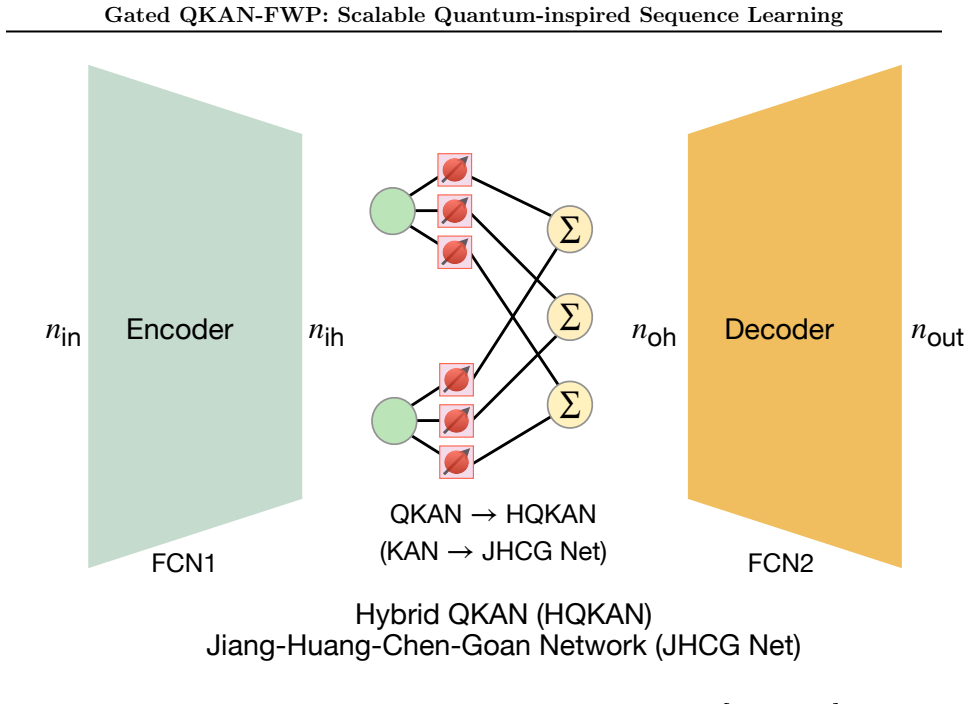
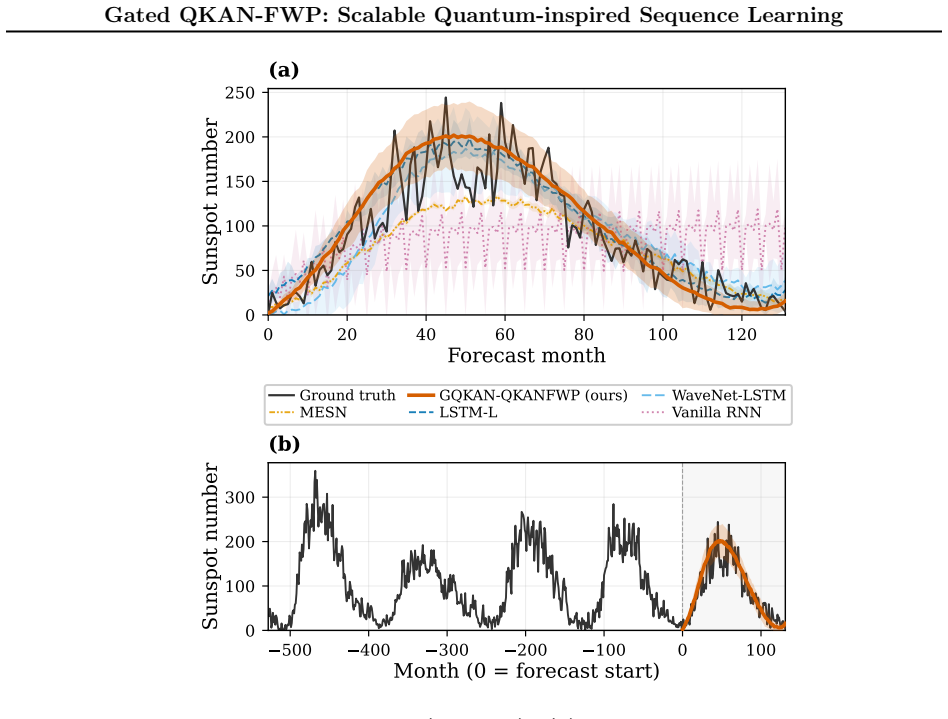
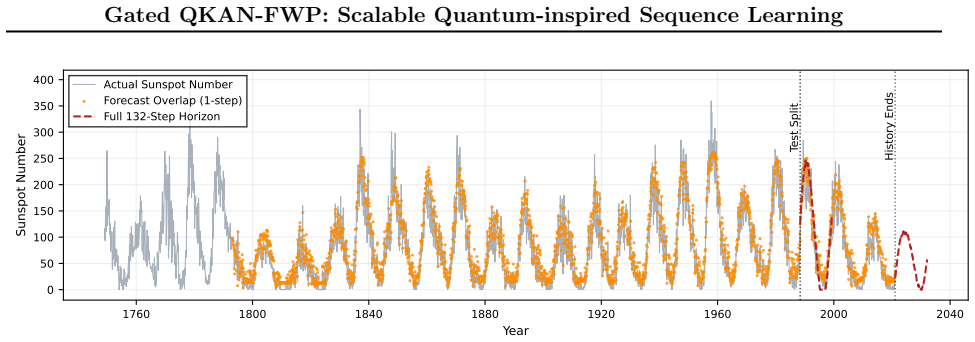
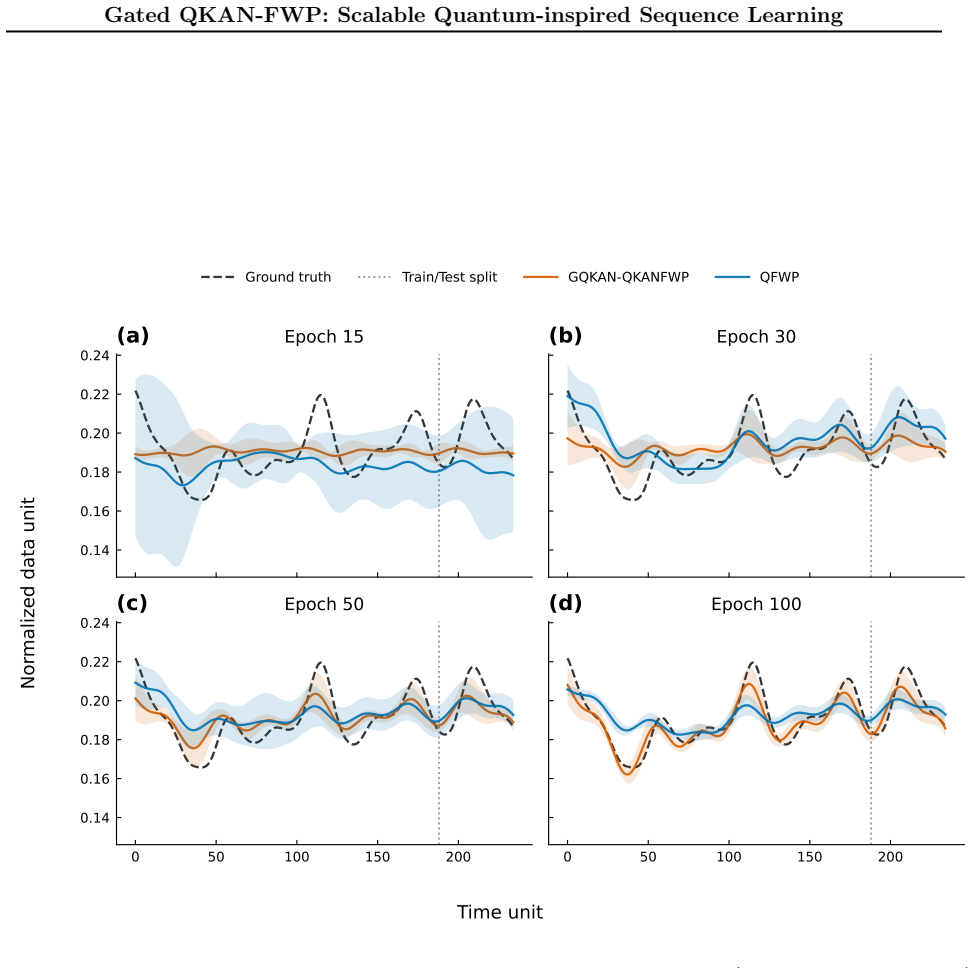
By combining fast weight programming with Kolmogorov-Arnold networks realized through single-qubit data re-uploading circuits called DARUAN and introducing a scalar-gated update rule, the framework encodes temporal dependencies in dynamically updated parameters. This yields a model that, on a 528-month input to 132-month forecast solar task, records lower scaled MSE, peak amplitude error, and peak timing error than LSTM, WaveNet-LSTM, vanilla RNN, and modified echo state networks with far more parameters, while maintaining performance when executed on quantum processors at 1024 shots.
What carries the argument
The scalar-gated fast-weight update rule, which provides an adaptive memory kernel and geometric boundedness while keeping gradient paths parallelizable, paired with single-qubit DARUAN activations as learnable nonlinearities.
Load-bearing premise
The single-qubit data re-uploading circuits supply adequate expressive power for intricate time dependencies even without multi-qubit entanglement, and the scalar-gated rule's theoretical traits translate directly into the measured forecasting improvements.
What would settle it
Running the same solar forecasting experiment with 528-month inputs and 132-month outputs, if any classical recurrent baseline with comparable or fewer parameters achieves equal or lower scaled MSE along with matching or better peak amplitude and timing errors, or if hardware execution deviates by more than 0.1 percent relative MSE from simulation.
Figures





read the original abstract
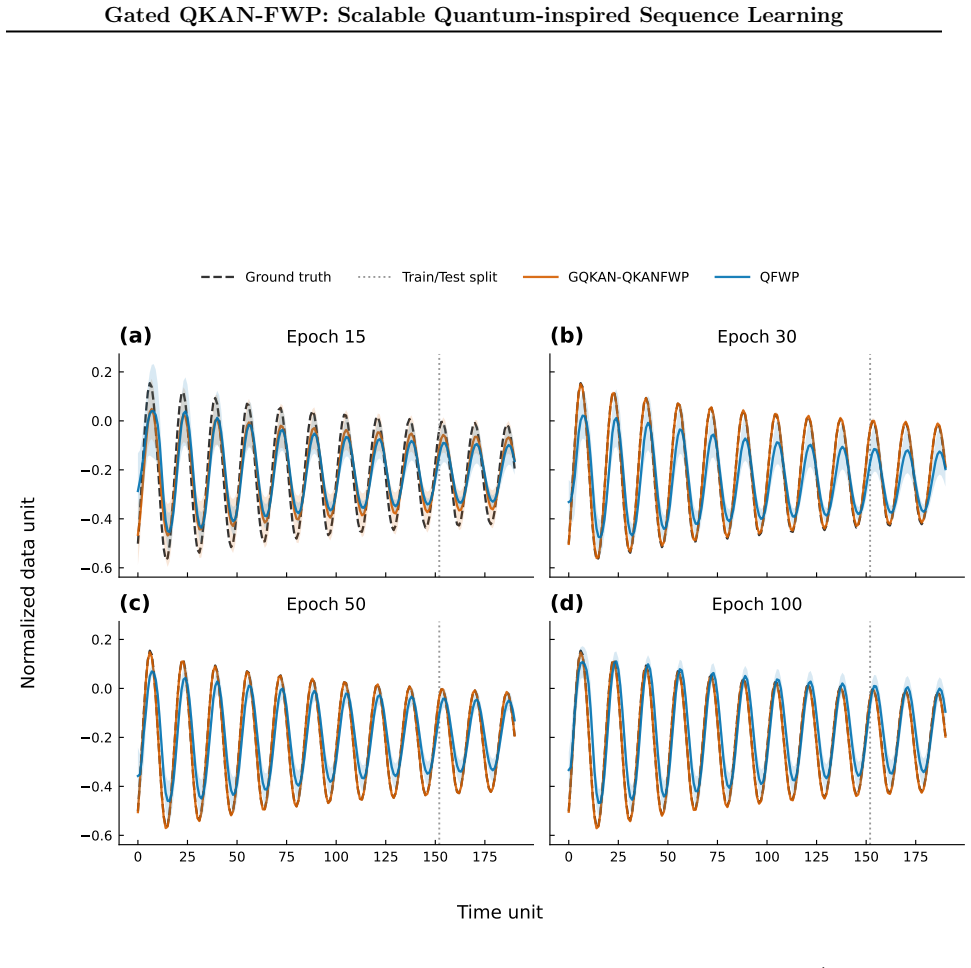
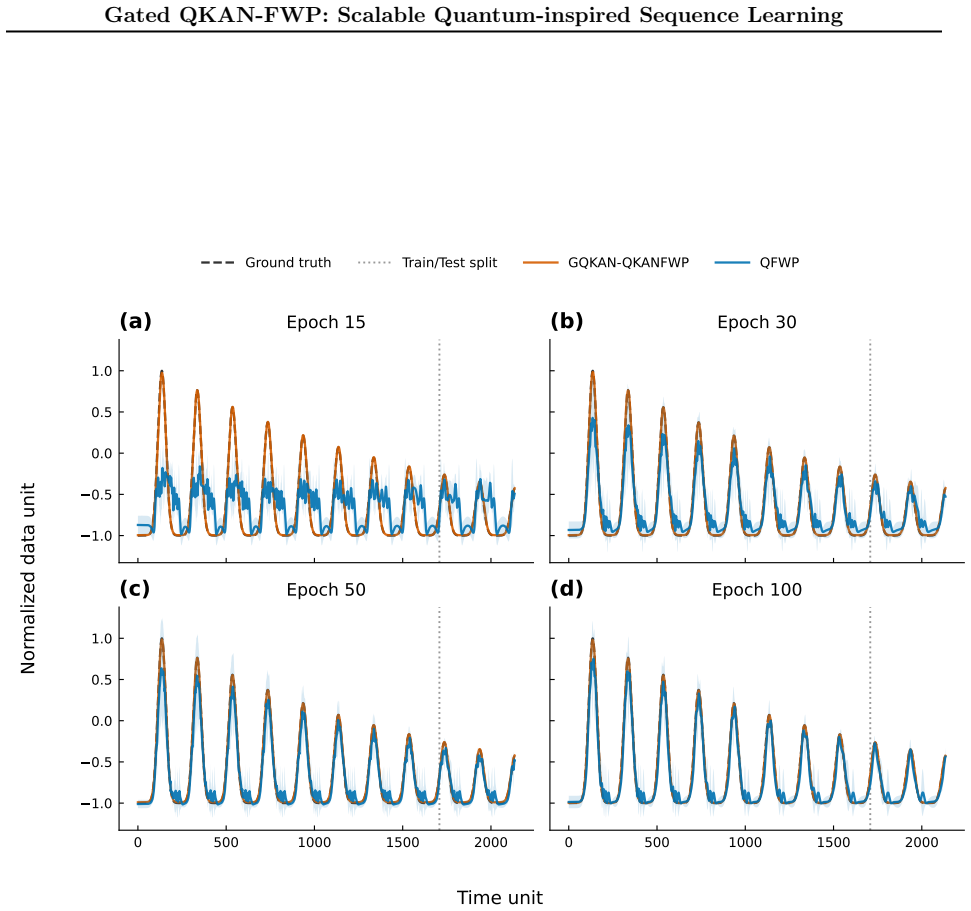
Fast Weight Programmers (FWPs) encode temporal dependencies through dynamically updated parameters rather than recurrent hidden states. Quantum FWPs (QFWPs) extend this idea with variational quantum circuits (VQCs), but existing implementations rely on multi-qubit architectures that are difficult to scale on noisy intermediate-scale quantum (NISQ) devices and expensive to simulate classically. We propose gated QKAN-FWP, a fast-weight framework that integrates FWP with Quantum-inspired Kolmogorov-Arnold Network (QKAN) using single-qubit data re-uploading circuits as learnable nonlinear activation, known as DatA Re-Uploading ActivatioN (DARUAN). We further introduce a scalar-gated fast-weight update rule that stabilizes parameter evolution, supported by a theoretical analysis of its adaptive memory kernel, geometric boundedness, and parallelizable gradient paths. We evaluate the framework across time-series benchmarks, MiniGrid reinforcement learning, and highlight real-world solar cycle forecasting as our main practical result. In the long-horizon setting with 528-month input window and 132-month forecast horizon, our 12.5k-parameter model achieves lower scaled Mean Square Error (MSE), peak amplitude error, and peak timing error than a suite of classical recurrent baselines with up to 13x more parameters, including Long Short-Term Memory (LSTM) networks (25.9k-89.1k parameters), WaveNet-LSTM (167k), Vanilla recurrent neural network (11.5k), and a Modified Echo State Network (132k). To validate NISQ compatibility, we further deploy the trained fast programmer on IonQ and IBM Quantum processors, recovering forecasting accuracy within 0.1% relative MSE of the noiseless simulator at 1024 shots. These results position gated QKAN-FWP as a scalable, parameter-efficient, and NISQ-compatible approach to quantum-inspired sequence modeling.
Editorial analysis
A structured set of objections, weighed in public.
Referee Report
Summary. The paper introduces gated QKAN-FWP, a fast-weight programmer framework that uses single-qubit data re-uploading circuits (DARUAN) as learnable nonlinear activations inside a Quantum-inspired Kolmogorov-Arnold Network, combined with a scalar-gated update rule. It claims this 12.5k-parameter model outperforms classical recurrent baselines (LSTM, WaveNet-LSTM, Vanilla RNN, Modified ESN) with up to 13x more parameters on long-horizon solar cycle forecasting (528-month input, 132-month output) in scaled MSE, peak amplitude error, and peak timing error, while also showing NISQ compatibility by recovering accuracy within 0.1% relative MSE of the noiseless simulator when deployed on IonQ and IBM hardware at 1024 shots. The design is supported by theoretical analysis of the gated rule's adaptive memory kernel and geometric boundedness.
Significance. If the empirical gains and theoretical properties hold after verification, the work offers a parameter-efficient, NISQ-scalable route to quantum-inspired sequence modeling that avoids multi-qubit entanglement costs. The combination of FWP with single-qubit re-uploading and the gated update could advance practical quantum ML for temporal tasks, provided the performance edge is isolated from classical components.
major comments (3)
- [§3] §3 (theoretical analysis of the scalar-gated fast-weight update): the geometric boundedness and adaptive memory kernel are derived under the fitted scalar gate parameter; this creates a circularity risk where the claimed stability properties are partly defined by the data-dependent values rather than providing independent, a priori guarantees that explain the long-horizon gains.
- [§4.3] §4.3 (solar forecasting experiments): the central claim that the 12.5k-parameter gated QKAN-FWP beats up to 13x larger RNNs on 528-in/132-out solar data rests on the assumption that single-qubit DARUAN activations supply the necessary temporal expressivity without entanglement; no ablation replacing DARUAN with classical nonlinearities in the identical FWP skeleton is reported, so the contribution of the quantum-inspired component versus the FWP structure remains unisolated.
- [§5] §5 (NISQ deployment): the 0.1% relative MSE recovery at 1024 shots on IonQ/IBM is presented as validation of NISQ compatibility, but without reported circuit depth, noise model, or error-mitigation details, it is difficult to assess whether the result supports the scalability narrative or is specific to the solar dataset's periodicity.
minor comments (3)
- [Abstract] The acronym expansion 'DatA Re-Uploading ActivatioN' contains inconsistent capitalization; standardize to 'Data Re-Uploading Activation' for clarity.
- [§4] Baseline parameter counts (e.g., LSTM 25.9k–89.1k) are given, but training protocols, hyperparameter search, and whether the same input window/forecast horizon were used for all models are not fully specified.
- [Table 2] Add standard deviations or error bars to the reported scaled MSE, amplitude, and timing errors in the solar results table to allow assessment of statistical significance.
Simulated Author's Rebuttal
We thank the referee for their thorough review and constructive comments on our manuscript. We address each of the major comments point by point below. We will make revisions to the manuscript to incorporate clarifications and additional details as outlined in our responses.
read point-by-point responses
-
Referee: [§3] §3 (theoretical analysis of the scalar-gated fast-weight update): the geometric boundedness and adaptive memory kernel are derived under the fitted scalar gate parameter; this creates a circularity risk where the claimed stability properties are partly defined by the data-dependent values rather than providing independent, a priori guarantees that explain the long-horizon gains.
Authors: We thank the referee for highlighting this potential circularity. Upon reflection, the derivation in §3 shows that the adaptive memory kernel depends on the scalar gate value, but the geometric boundedness is proven for any gate value in [0,1], which is the valid range for the sigmoid-activated gate. This provides an a priori guarantee independent of the specific fitted value. However, to address the concern directly, we will revise the section to explicitly state the uniform bounds over the gate parameter range and discuss how this contributes to long-horizon stability regardless of data-dependent fitting. revision: yes
-
Referee: [§4.3] §4.3 (solar forecasting experiments): the central claim that the 12.5k-parameter gated QKAN-FWP beats up to 13x larger RNNs on 528-in/132-out solar data rests on the assumption that single-qubit DARUAN activations supply the necessary temporal expressivity without entanglement; no ablation replacing DARUAN with classical nonlinearities in the identical FWP skeleton is reported, so the contribution of the quantum-inspired component versus the FWP structure remains unisolated.
Authors: We agree that isolating the contribution of the DARUAN activations is important to substantiate the quantum-inspired aspect. We will add an ablation study in the revised §4.3, where we replace the DARUAN activations with classical nonlinearities such as ReLU or tanh within the same gated FWP architecture and compare performance on the solar forecasting task. This will help clarify whether the performance gains stem primarily from the FWP structure or the specific choice of quantum-inspired activations. revision: yes
-
Referee: [§5] §5 (NISQ deployment): the 0.1% relative MSE recovery at 1024 shots on IonQ/IBM is presented as validation of NISQ compatibility, but without reported circuit depth, noise model, or error-mitigation details, it is difficult to assess whether the result supports the scalability narrative or is specific to the solar dataset's periodicity.
Authors: We appreciate this feedback on the NISQ section. In the revised manuscript, we will expand §5 to include the circuit depth details (noting that each DARUAN is a single-qubit circuit with fixed depth independent of sequence length), the noise model employed in our simulations (depolarizing noise with parameters matching the hardware), and the error mitigation strategies used (such as measurement error mitigation via calibration matrices). These additions will provide a clearer assessment of the scalability and help evaluate the generality beyond the solar dataset. revision: yes
Circularity Check
No circularity: derivation and claims are self-contained
full rationale
The paper defines the scalar-gated update rule explicitly, then derives its adaptive memory kernel and geometric boundedness properties mathematically from that definition (independent of any fitted parameters or data). Performance claims consist of direct empirical comparisons on external benchmarks (solar cycles, MiniGrid) against classical baselines; these are measurements, not predictions that reduce to the fitted values by construction. No self-citations are load-bearing for the central architecture or results, no ansatz is smuggled, and no uniqueness theorem is invoked to force the design. The single-qubit DARUAN choice is presented as a deliberate scalability decision, not derived tautologically from the outcomes.
Axiom & Free-Parameter Ledger
free parameters (2)
- 12.5k model parameters
- scalar gate parameter
axioms (2)
- domain assumption Single-qubit variational circuits with data re-uploading can serve as effective learnable nonlinear activations for temporal tasks.
- ad hoc to paper The scalar-gated fast-weight update produces an adaptive memory kernel with geometric boundedness.
invented entities (2)
-
DARUAN (DatA Re-Uploading ActivatioN)
no independent evidence
-
scalar-gated fast-weight update rule
no independent evidence
Reference graph
Works this paper leans on
-
[1]
On quantum backpropagation, information reuse, and cheating measurement collapse
Amira Abbas et al. On quantum backpropagation, information reuse, and cheating measurement collapse. Advances in Neural Information Processing Systems , 36:44792--44819, 2023
work page 2023
- [2]
-
[3]
Amazon Web Services . Amazon Braket . https://aws.amazon.com/braket/, 2020. Accessed: 2026-04-22
work page 2020
-
[4]
Noisy intermediate-scale quantum algorithms
Kishor Bharti et al. Noisy intermediate-scale quantum algorithms. Reviews of Modern Physics , 94(1):015004, 2022
work page 2022
-
[5]
cuQuantum SDK: A High-Performance Library for Accelerating Quantum Science
Harun Bayraktar et al. cuQuantum SDK: A High-Performance Library for Accelerating Quantum Science . In 2023 IEEE International Conference on Quantum Computing and Engineering (QCE) , volume 01, pages 1050--1061, 2023
work page 2023
-
[6]
Ryan Babbush et al. The grand challenge of quantum applications. arXiv preprint arXiv:2511.09124 , 2025
-
[7]
Recurrent quantum neural networks
Johannes Bausch. Recurrent quantum neural networks. Advances in neural information processing systems , 33:1368--1379, 2020
work page 2020
-
[8]
PennyLane: Automatic differentiation of hybrid quantum-classical computations
Ville Bergholm, Josh Izaac, Maria Schuld, Christian Gogolin, Shahnawaz Ahmed, Vishnu Ajith, M Sohaib Alam, Guillermo Alonso-Linaje, B AkashNarayanan, Ali Asadi, et al. Pennylane: Automatic differentiation of hybrid quantum-classical computations. arXiv preprint arXiv:1811.04968 , 2018
work page internal anchor Pith review Pith/arXiv arXiv 2018
-
[9]
Prefix sums and their applications
Guy E Blelloch. Prefix sums and their applications. 1990
work page 1990
-
[10]
Denis Bokhan, Alena S Mastiukova, Aleksey S Boev, Dmitrii N Trubnikov, and Aleksey K Fedorov. Multiclass classification using quantum convolutional neural networks with hybrid quantum-classical learning. Frontiers in Physics , 10:1069985, 2022
work page 2022
-
[11]
Prantika Bhowmik and Dibyendu Nandy. Prediction of the strength and timing of sunspot cycle 25 reveal decadal-scale space environmental conditions. Nature communications , 9(1):5209, 2018
work page 2018
-
[12]
Forecasting solar cycle 25 using deep neural networks
B Benson, WD Pan, A Prasad, GA Gary, and Q Hu. Forecasting solar cycle 25 using deep neural networks. Solar Physics , 295(5):65, 2020
work page 2020
-
[13]
Variational quantum algorithms
Marco Cerezo et al. Variational quantum algorithms. Nature Reviews Physics , 3(9):625--644, 2021
work page 2021
-
[14]
Maxime Chevalier - Boisvert et al. Minigrid & miniworld: Modular & customizable reinforcement learning environments for goal-oriented tasks. In Advances in Neural Information Processing Systems 36, New Orleans, LA, USA , December 2023
work page 2023
-
[15]
Benchmarking a trapped-ion quantum computer with 30 qubits
Jwo-Sy Chen et al. Benchmarking a trapped-ion quantum computer with 30 qubits. Quantum , 8:1516, 2024
work page 2024
-
[16]
Marco Cerezo et al. Does provable absence of barren plateaus imply classical simulability? Nature Communications , 16(1):7907, 2025
work page 2025
-
[17]
Quantum convolutional neural networks
Iris Cong, Soonwon Choi, and Mikhail D Lukin. Quantum convolutional neural networks. Nature Physics , 15(12):1273--1278, 2019
work page 2019
-
[18]
Quantum-train-based distributed multi-agent reinforcement learning
Kuan-Cheng Chen, Samuel Yen-Chi Chen, Chen-Yu Liu, and Kin K Leung. Quantum-train-based distributed multi-agent reinforcement learning. In 2025 IEEE Symposium for Multidisciplinary Computational Intelligence Incubators (MCII Companion) , pages 1--5. IEEE, 2025
work page 2025
-
[19]
Toward large-scale distributed quantum long short-term memory with modular quantum computers
Kuan-Cheng Chen, Samuel Yen-Chi Chen, Chen-Yu Liu, and Kin K Leung. Toward large-scale distributed quantum long short-term memory with modular quantum computers. In 2025 International Wireless Communications and Mobile Computing (IWCMC) , pages 337--342. IEEE, 2025
work page 2025
-
[20]
Chi-Sheng Chen, Samuel Yen-Chi Chen, and Hsin-Hsiung Tseng. Exploring the potential of QEEGNet for cross-task and cross-dataset electroencephalography encoding with quantum machine learning. Journal of Signal Processing Systems , 98:5, 2026
work page 2026
-
[21]
QEEGNet : Quantum machine learning for enhanced electroencephalography encoding
Chi-Sheng Chen, Samuel Yen-Chi Chen, Aidan Hung-Wen Tsai, and Chun-Shu Wei. QEEGNet : Quantum machine learning for enhanced electroencephalography encoding. In 2024 IEEE Workshop on Signal Processing Systems (SiPS) , pages 153--158. IEEE, 2024
work page 2024
-
[22]
Exciting a bound state in the continuum through multiphoton scattering plus delayed quantum feedback
Giuseppe Calaj \'o , Yao-Lung L Fang, Harold U Baranger, and Francesco Ciccarello. Exciting a bound state in the continuum through multiphoton scattering plus delayed quantum feedback. Physical review letters , 122(7):073601, 2019
work page 2019
-
[23]
Reservoir computing via quantum recurrent neural networks
Samuel Yen-Chi Chen, Daniel Fry, Amol Deshmukh, Vladimir Rastunkov, and Charlee Stefanski. Reservoir computing via quantum recurrent neural networks. arXiv preprint arXiv:2211.02612 , 2022
-
[24]
Asynchronous training of quantum reinforcement learning
Samuel Yen-Chi Chen. Asynchronous training of quantum reinforcement learning. Procedia Computer Science , 222:321--330, 2023
work page 2023
-
[25]
Quantum deep recurrent reinforcement learning
Samuel Yen-Chi Chen. Quantum deep recurrent reinforcement learning. In ICASSP 2023-2023 IEEE International Conference on Acoustics, Speech and Signal Processing (ICASSP) , pages 1--5. IEEE, 2023
work page 2023
-
[26]
Efficient quantum recurrent reinforcement learning via quantum reservoir computing
Samuel Yen-Chi Chen. Efficient quantum recurrent reinforcement learning via quantum reservoir computing. In ICASSP 2024-2024 IEEE International Conference on Acoustics, Speech and Signal Processing (ICASSP) , pages 13186--13190. IEEE, 2024
work page 2024
-
[27]
Learning to program variational quantum circuits with fast weights
Samuel Yen-Chi Chen. Learning to program variational quantum circuits with fast weights. In 2024 International Joint Conference on Neural Networks (IJCNN) , pages 1--9. IEEE, 2024
work page 2024
-
[28]
Chi-Sheng Chen and En-Jui Kuo. Quantum-enhanced natural language generation: A multi-model framework with hybrid quantum-classical architectures. arXiv preprint arXiv:2508.21332 , 2025
-
[29]
Chi-Sheng Chen and En-Jui Kuo. Quantum reinforcement learning-guided diffusion model for image synthesis via hybrid quantum-classical generative model architectures. arXiv preprint arXiv:2509.14163 , 2025
-
[30]
The new sunspot number: assembling all corrections
Fr \'e d \'e ric Clette and Laure Lef \`e vre. The new sunspot number: assembling all corrections. Solar Physics , 291(9):2629--2651, 2016
work page 2016
-
[31]
A variational approach to quantum gated recurrent units
Andrea Ceschini, Antonello Rosato, and Massimo Panella. A variational approach to quantum gated recurrent units. Journal of Physics Communications , 8(8):085004, 2024
work page 2024
-
[32]
Quantum fast weight programming for time series prediction
Andrea Ceschini, Antonello Rosato, Massimo Panella, and Samuel Yen-Chi Chen. Quantum fast weight programming for time series prediction. In ICASSP 2026-2026 IEEE International Conference on Acoustics, Speech and Signal Processing (ICASSP) , pages 22032--22036. IEEE, 2026
work page 2026
-
[33]
Chi-Sheng Chen and Aidan Hung-Wen Tsai. Quantum adaptive self-attention for financial rebalancing: An empirical study on automated market makers in decentralized finance. arXiv preprint arXiv:2509.16955 , 2025
-
[34]
Challenges and opportunities in quantum machine learning
Marco Cerezo, Guillaume Verdon, Hsin-Yuan Huang, Lukasz Cincio, and Patrick J Coles. Challenges and opportunities in quantum machine learning. Nature computational science , 2(9):567--576, 2022
work page 2022
-
[35]
Quantum long short-term memory
Samuel Yen-Chi Chen, Shinjae Yoo, and Yao-Lung L Fang. Quantum long short-term memory. In Icassp 2022-2022 IEEE international conference on acoustics, speech and signal processing (ICASSP) , pages 8622--8626. IEEE, 2022
work page 2022
-
[36]
Variational quantum circuits for deep reinforcement learning
Samuel Yen-Chi Chen, Chao-Han Huck Yang, Jun Qi, Pin-Yu Chen, Xiaoli Ma, and Hsi-Sheng Goan. Variational quantum circuits for deep reinforcement learning. IEEE access , 8:141007--141024, 2020
work page 2020
-
[37]
Quantum reinforcement learning for qos-aware real-time job scheduling in cloud systems
Shuhong Dai et al. Quantum reinforcement learning for qos-aware real-time job scheduling in cloud systems. IEEE Systems Journal , 2025
work page 2025
-
[38]
Quantum reinforcement learning
Daoyi Dong, Chunlin Chen, Hanxiong Li, and Tzyh-Jong Tarn. Quantum reinforcement learning. IEEE Transactions on Systems, Man, and Cybernetics, Part B (Cybernetics) , 38(5):1207--1220, 2008
work page 2008
-
[39]
Forecasting solar cycle 25 with physical model-validated recurrent neural networks
Aleix Espu \ n a Fontcuberta, Anubhab Ghosh, Saikat Chatterjee, Dhrubaditya Mitra, and Dibyendu Nandy. Forecasting solar cycle 25 with physical model-validated recurrent neural networks. Solar Physics , 298(1):8, 2023
work page 2023
-
[40]
Non- Markovian dynamics of a qubit due to single-photon scattering in a waveguide
Yao-Lung L Fang, Francesco Ciccarello, and Harold U Baranger. Non- Markovian dynamics of a qubit due to single-photon scattering in a waveguide. New Journal of Physics , 20(4):043035, 2018
work page 2018
-
[41]
Quantum-enhanced measurements: beating the standard quantum limit
Vittorio Giovannetti, Seth Lloyd, and Lorenzo Maccone. Quantum-enhanced measurements: beating the standard quantum limit. Science , 306(5700):1330--1336, 2004
work page 2004
-
[42]
QKAN-LSTM : Quantum-inspired Kolmogorov - Arnold long short-term memory
Yu-Chao Hsu et al. QKAN-LSTM : Quantum-inspired Kolmogorov - Arnold long short-term memory. arXiv preprint arXiv:2512.05049 , 2025
- [43]
-
[44]
Quantum kernel-based long short-term memory for climate time-series forecasting
Yu-Chao Hsu, Nan-Yow Chen, Tai-Yu Li, Po-Heng Henry Lee, and Kuan-Cheng Chen. Quantum kernel-based long short-term memory for climate time-series forecasting. In 2025 International Conference on Quantum Communications, Networking, and Computing (QCNC) , pages 421--426. IEEE, 2025
work page 2025
-
[45]
Songtao Huang, Zhen Zhao, Can Li, and Lei Bai. Timekan: Kan-based frequency decomposition learning architecture for long-term time series forecasting. arXiv preprint arXiv:2502.06910 , 2025
-
[46]
IBM Quantum . IBM Quantum . https://quantum.cloud.ibm.com/, 2026. Accessed: 2026-04-22
work page 2026
-
[47]
Going beyond linear transformers with recurrent fast weight programmers
Kazuki Irie, Imanol Schlag, R \'o bert Csord \'a s, and J \"u rgen Schmidhuber. Going beyond linear transformers with recurrent fast weight programmers. Advances in neural information processing systems , 34:7703--7717, 2021
work page 2021
-
[48]
Imen Jarraya et al. SOH-KLSTM : A hybrid Kolmogorov - Arnold network and LSTM model for enhanced lithium-ion battery health monitoring. Journal of Energy Storage , 122:116541, 2025
work page 2025
-
[49]
Quantum computing with Q iskit, 2024
Ali Javadi-Abhari et al. Quantum computing with Q iskit, 2024
work page 2024
-
[50]
Quantum variational activation functions empower Kolmogorov - Arnold networks
Jiun-Cheng Jiang, Yu-Chao Huang, Tianlong Chen, and Hsi-Sheng Goan. Quantum variational activation functions empower Kolmogorov - Arnold networks. arXiv preprint arXiv:2509.14026 , 2025
-
[51]
Quantum recurrent embedding neural network
Mingrui Jing, Erdong Huang, Xiao Shi, Shengyu Zhang, and Xin Wang. Quantum recurrent embedding neural network. arXiv preprint arXiv:2506.13185 , 2025
-
[52]
QKAN : Quantum -inspired Kolmogorov - Arnold network, 2025
Jiun-Cheng Jiang. QKAN : Quantum -inspired Kolmogorov - Arnold network, 2025
work page 2025
-
[53]
Cuda quantum: The platform for integrated quantum-classical computing
Jin-Sung Kim et al. Cuda quantum: The platform for integrated quantum-classical computing. In 2023 60th ACM/IEEE Design Automation Conference (DAC) , pages 1--4. IEEE, 2023
work page 2023
-
[54]
KANQAS : Kolmogorov - Arnold network for quantum architecture search
Akash Kundu et al. KANQAS : Kolmogorov - Arnold network for quantum architecture search. EPJ Quantum Technology , 11(1):76, 2024
work page 2024
-
[55]
Optimal quantum measurements of expectation values of observables
Emanuel Knill, Gerardo Ortiz, and Rolando D Somma. Optimal quantum measurements of expectation values of observables. Physical Review A—Atomic, Molecular, and Optical Physics , 75(1):012328, 2007
work page 2007
-
[56]
Solving nonlinear differential equations with differentiable quantum circuits
Oleksandr Kyriienko, Annie E Paine, and Vincent E Elfving. Solving nonlinear differential equations with differentiable quantum circuits. Physical Review A , 103(5):052416, 2021
work page 2021
-
[57]
Barren plateaus in variational quantum computing
Martin Larocca et al. Barren plateaus in variational quantum computing. Nature Reviews Physics , 7(4):174--189, 2025
work page 2025
-
[58]
Segrnn: Segment recurrent neural network for long-term time series forecasting
Shengsheng Lin et al. Segrnn: Segment recurrent neural network for long-term time series forecasting. IEEE Internet of Things Journal , 2025
work page 2025
-
[59]
Programming variational quantum circuits with quantum-train agent
Chen-Yu Liu et al. Programming variational quantum circuits with quantum-train agent. In 2025 International Conference on Quantum Communications, Networking, and Computing (QCNC) , pages 544--548. IEEE, 2025
work page 2025
-
[60]
Quantum-enhanced parameter-efficient learning for typhoon trajectory forecasting
Chen-Yu Liu et al. Quantum-enhanced parameter-efficient learning for typhoon trajectory forecasting. In 2025 IEEE International Conference on Quantum Computing and Engineering (QCE) , volume 1, pages 2046--2056. IEEE, 2025
work page 2025
-
[61]
Chen-Yu Liu et al. Quantum-train: Rethinking hybrid quantum-classical machine learning in the model compression perspective. Quantum Machine Intelligence , 7(2):80, 2025
work page 2025
-
[62]
Neural quantum embedding via deterministic quantum computation with one qubit
Hongfeng Liu et al. Neural quantum embedding via deterministic quantum computation with one qubit. Physical Review Letters , 135(8):080603, 2025
work page 2025
-
[63]
KAN : Kolmogorov -- Arnold networks
Ziming Liu et al. KAN : Kolmogorov -- Arnold networks. In The Thirteenth International Conference on Learning Representations , 2025
work page 2025
-
[64]
KANO : Kolmogorov -- Arnold neural operator
Jin Lee et al. KANO : Kolmogorov -- Arnold neural operator. In The Fourteenth International Conference on Learning Representations , 2026
work page 2026
-
[65]
Ioannis E Livieris. C-KAN : A new approach for integrating convolutional layers with kolmogorov -- Arnold networks for time-series forecasting. Mathematics , 12(19):3022, 2024
work page 2024
-
[66]
You only measure once: On designing single-shot quantum machine learning models
Chen-Yu Liu, Leonardo Placidi, Kuan-Cheng Chen, Samuel Yen-Chi Chen, and Gabriel Matos. You only measure once: On designing single-shot quantum machine learning models. arXiv preprint arXiv:2509.20090 , 2025
-
[67]
Reinforcement learning with quantum variational circuit
Owen Lockwood and Mei Si. Reinforcement learning with quantum variational circuit. In Proceedings of the AAAI conference on artificial intelligence and interactive digital entertainment , volume 16, pages 245--251, 2020
work page 2020
-
[68]
Kolmogorov -- Arnold networks meet science
Ziming Liu, Max Tegmark, Pingchuan Ma, Wojciech Matusik, and Yixuan Wang. Kolmogorov -- Arnold networks meet science. Physical Review X , 15(4):041051, 2025
work page 2025
-
[69]
Quantum generative adversarial learning
Seth Lloyd and Christian Weedbrook. Quantum generative adversarial learning. Physical review letters , 121(4):040502, 2018
work page 2018
-
[70]
Barren plateaus in quantum neural network training landscapes
Jarrod R McClean, Sergio Boixo, Vadim N Smelyanskiy, Ryan Babbush, and Hartmut Neven. Barren plateaus in quantum neural network training landscapes. Nature communications , 9(1):4812, 2018
work page 2018
-
[71]
Parallelizing linear recurrent neural nets over sequence length
Eric Martin and Chris Cundy. Parallelizing linear recurrent neural nets over sequence length. In International Conference on Learning Representations , 2018
work page 2018
- [72]
-
[73]
A Practitioner's Guide to Kolmogorov-Arnold Networks
Amir Noorizadegan, Sifan Wang, Leevan Ling, and Juan P Dominguez-Morales. A practitioner's guide to Kolmogorov - Arnold networks. arXiv preprint arXiv:2510.25781 , 2025
work page internal anchor Pith review Pith/arXiv arXiv 2025
-
[74]
Pytorch: An imperative style, high-performance deep learning library
Adam Paszke et al. Pytorch: An imperative style, high-performance deep learning library. Advances in Neural Information Processing Systems , 32, 2019
work page 2019
-
[75]
Curriculum reinforcement learning for quantum architecture search under hardware errors
Yash J Patel et al. Curriculum reinforcement learning for quantum architecture search under hardware errors. arXiv preprint arXiv:2402.03500 , 2024
-
[76]
William Dean Pesnell. Predictions of solar cycle 24. Solar Physics , 252(1):209--220, 2008
work page 2008
-
[77]
Krist \'o f Petrovay. Solar cycle prediction. Living Reviews in Solar Physics , 17(1):2, 2020
work page 2020
-
[78]
Variational quantum optimization with multibasis encodings
Taylor L Patti, Jean Kossaifi, Anima Anandkumar, and Susanne F Yelin. Variational quantum optimization with multibasis encodings. Physical Review Research , 4(3):033142, 2022
work page 2022
-
[79]
Quantum computing in the NISQ era and beyond
John Preskill. Quantum computing in the NISQ era and beyond. Quantum , 2:79, 2018
work page 2018
-
[80]
Data re-uploading for a universal quantum classifier
Adri \'a n P \'e rez-Salinas, Alba Cervera-Lierta, Elies Gil-Fuster, and Jos \'e I Latorre. Data re-uploading for a universal quantum classifier. Quantum , 4:226, 2020
work page 2020
discussion (0)
Sign in with ORCID, Apple, or X to comment. Anyone can read and Pith papers without signing in.