Recognition: no theorem link
Forest Diagrams and Lengths for the Generalised Thompson's Group F(n)
Pith reviewed 2026-05-11 01:20 UTC · model grok-4.3
The pith
Extended forest diagrams represent elements of F(n) as n-ary forests with leaf bijections and supply a new word-length formula.
A machine-rendered reading of the paper's core claim, the machinery that carries it, and where it could break.
Core claim
Every element of the generalized Thompson group F(n) can be represented by a pair of infinite, bounded n-ary forests together with an order-preserving bijection between their leaves, and the word length of the element equals a quantity read directly from the number and arrangement of carets in these diagrams.
What carries the argument
The extended two-way forest diagram: a pair of infinite bounded n-ary forests equipped with an order-preserving bijection of their leaves.
If this is right
- A new explicit formula for word length in F(n) is obtained from the forest diagrams.
- Dead-end elements exist inside F(n).
- Every dead-end element of F(n) has depth exactly two.
Where Pith is reading between the lines
- The diagrammatic length may be easier to compute by hand or machine than previous formulas for moderate n.
- Similar forest representations could be tried for other Thompson-like groups or for subgroups of F(n).
- The depth-two result suggests that the Cayley graph of F(n) has a uniform local structure around dead ends.
Load-bearing premise
The diagrams must faithfully encode every element of F(n) and the length read from the diagrams must coincide with the minimal word length in the standard generating set.
What would settle it
An explicit element of F(n) whose forest-diagram length differs from its known word length, or a dead-end element whose depth is not two.
Figures
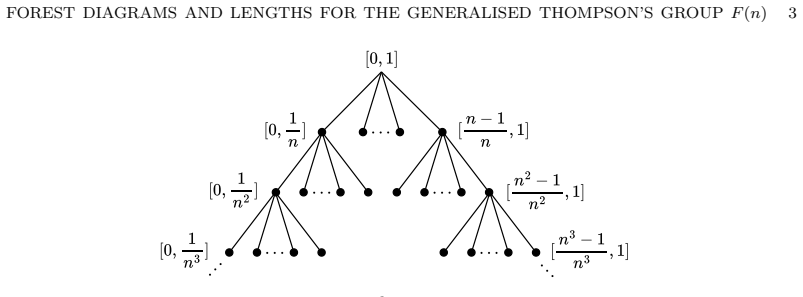


read the original abstract
We extend the concept of two-way forest diagrams, introduced by Belk and Brown in 2003, to represent elements of $F(n)$ as a pair of infinite, bounded $n$-ary forests together with an order-preserving bijection of the leaves. This representation allows us to develop an alternative way to compute the length of an element of $F(n)$, distinct from the formula established by Fordham and Cleary in 2009. As an application of our length formula, we re-prove the existence of dead end elements in $F(n)$ and show that their depth is always two, first proved by Wladis in 2009.
Editorial analysis
A structured set of objections, weighed in public.
Referee Report
Summary. The manuscript extends Belk-Brown two-way forest diagrams to the generalized Thompson group F(n) by representing each element as a pair of infinite but bounded n-ary forests together with an order-preserving bijection of their leaves. From this representation the authors extract a length formula that they claim equals the word length with respect to the standard finite generating set; they then apply the formula to give an independent proof that dead-end elements exist in F(n) and that every such element has depth exactly two.
Significance. If the representation is bijective and the extracted length is provably minimal, the work supplies a new combinatorial calculus for F(n) that is independent of the Fordham-Cleary formula. The explicit diagram-to-word construction and the re-proof of the dead-end result are concrete strengths; the latter in particular demonstrates that the new length function can be used to recover known geometric facts without invoking the original Wladis argument.
major comments (2)
- [§4] §4, Theorem 4.3 and the surrounding discussion: the upper bound (any diagram yields a word of the stated length) is obtained by explicit multiplication rules on the forests, but the lower bound (no shorter word exists) is asserted via an invariant that is only sketched; an explicit verification that the invariant is preserved by every generator and that every diagram reduction is forced by the group operation is required before the length formula can be accepted as exact.
- [§5] §5, Proposition 5.1: the argument that dead-end depth is always two proceeds by exhibiting diagrams whose length cannot be reduced by right-multiplication by a generator; this relies on the correctness of the length formula established in §4, so the gap noted above is load-bearing for the dead-end claim as well.
minor comments (2)
- [Figure 2] Figure 2 and the caption on p. 7: the n-ary branching is drawn with varying edge thicknesses; a uniform convention or an additional legend would improve readability.
- [Definition 3.4] Definition 3.4: the phrase 'bounded n-ary forest' is introduced without an immediate formal definition; moving the definition one paragraph earlier would prevent the reader from having to infer the meaning from the subsequent examples.
Simulated Author's Rebuttal
We thank the referee for the careful reading of the manuscript and for the positive evaluation of its significance. We agree that the lower bound in the length formula requires a more explicit treatment and will revise the paper to supply the requested verifications. The responses to the major comments are given below.
read point-by-point responses
-
Referee: [§4] §4, Theorem 4.3 and the surrounding discussion: the upper bound (any diagram yields a word of the stated length) is obtained by explicit multiplication rules on the forests, but the lower bound (no shorter word exists) is asserted via an invariant that is only sketched; an explicit verification that the invariant is preserved by every generator and that every diagram reduction is forced by the group operation is required before the length formula can be accepted as exact.
Authors: We acknowledge that the lower bound argument in Theorem 4.3 relies on an invariant (the total caret count across both forests) whose invariance under generators and whose relation to diagram reductions were only sketched. In the revised manuscript we will insert a dedicated lemma that (i) enumerates the effect of right-multiplication by each standard generator on the pair of forests, (ii) shows that the invariant changes by at most the length of the generator, and (iii) proves that any diagram reduction step is forced by the group law (i.e., cannot be bypassed by a different sequence of generators). This will make the equality between the diagram length and the word length fully rigorous while leaving the upper-bound construction and the overall statement of the theorem unchanged. revision: yes
-
Referee: [§5] §5, Proposition 5.1: the argument that dead-end depth is always two proceeds by exhibiting diagrams whose length cannot be reduced by right-multiplication by a generator; this relies on the correctness of the length formula established in §4, so the gap noted above is load-bearing for the dead-end claim as well.
Authors: We agree that the dead-end result in Proposition 5.1 depends on the correctness of the length formula. Once the expanded verification of the lower bound is added to §4, the explicit diagrams constructed in §5 will satisfy the required minimality condition, confirming that right-multiplication by any generator cannot decrease the length. We will add a brief cross-reference in §5 to the new lemma in §4; no other modifications to the dead-end argument are needed. revision: yes
Circularity Check
No circularity: length formula derived from explicit diagram rules and faithful representation, independent of prior formulas
full rationale
The paper extends Belk-Brown forest diagrams to n-ary case via explicit construction of infinite bounded forests plus leaf bijection. It supplies diagram multiplication rules that construct words realizing the diagram length (upper bound) and argues via reduction invariants that this equals word length (lower bound). The resulting formula is presented as distinct from Fordham-Cleary and is used to re-prove dead-end elements independently of Wladis. No step reduces by definition, fitting, or self-citation chain to its own inputs; the representation is shown faithful by direct correspondence with group elements. This is the normal self-contained case for a diagrammatic proof in geometric group theory.
Axiom & Free-Parameter Ledger
axioms (2)
- domain assumption Elements of F(n) are faithfully represented by the extended forest diagrams.
- domain assumption The standard generating set and word metric on F(n) are used.
Reference graph
Works this paper leans on
-
[1]
Burillo, José , title =
- [2]
- [3]
-
[4]
Journal of Pure and Applied Algebra , volume =. 1987 , issn =. doi:https://doi.org/10.1016/0022-4049(87)90015-6 , url =
-
[5]
Finitely Presented Infinite Simple Groups , author=. 1974 , publisher=
work page 1974
- [6]
- [7]
-
[8]
Cleary, Sean and Taback, Jennifer , journal=
- [9]
- [10]
-
[11]
Geometric Methods in Group Theory , series =
James Belk and Kai-Uwe Bux , title =. Geometric Methods in Group Theory , series =. 2005 , mrnumber =
work page 2005
-
[12]
Elder, Murray and Fusy,. Journal of Algebra , volume=. 2010 , publisher=
work page 2010
-
[13]
Francesco Mattuci , title =
discussion (0)
Sign in with ORCID, Apple, or X to comment. Anyone can read and Pith papers without signing in.