Recognition: no theorem link
Quantum spin liquid on a 3D bipartite lattice of spin trimers stabilized by enhanced effective anisotropy
Pith reviewed 2026-05-11 00:45 UTC · model grok-4.3
The pith
KBa3Ca4Cu3V7O28 is a three-dimensional bipartite quantum spin liquid stabilized by amplified trimer anisotropy.
A machine-rendered reading of the paper's core claim, the machinery that carries it, and where it could break.
Core claim
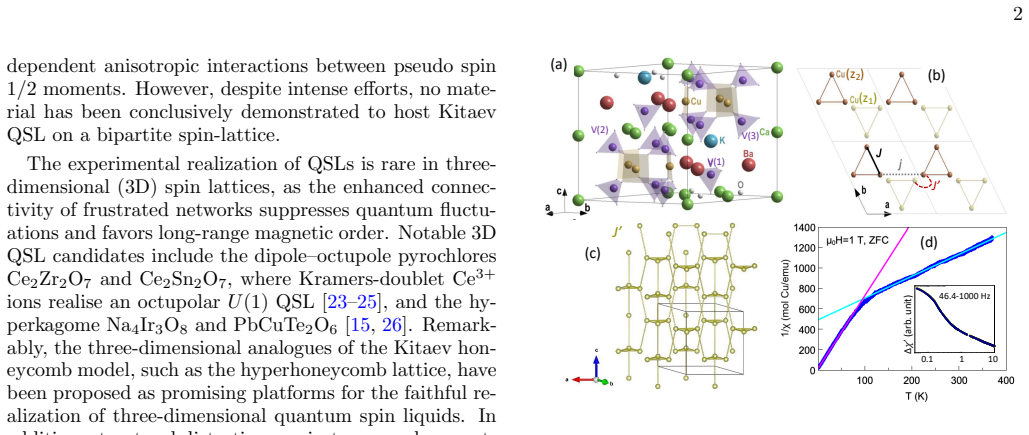
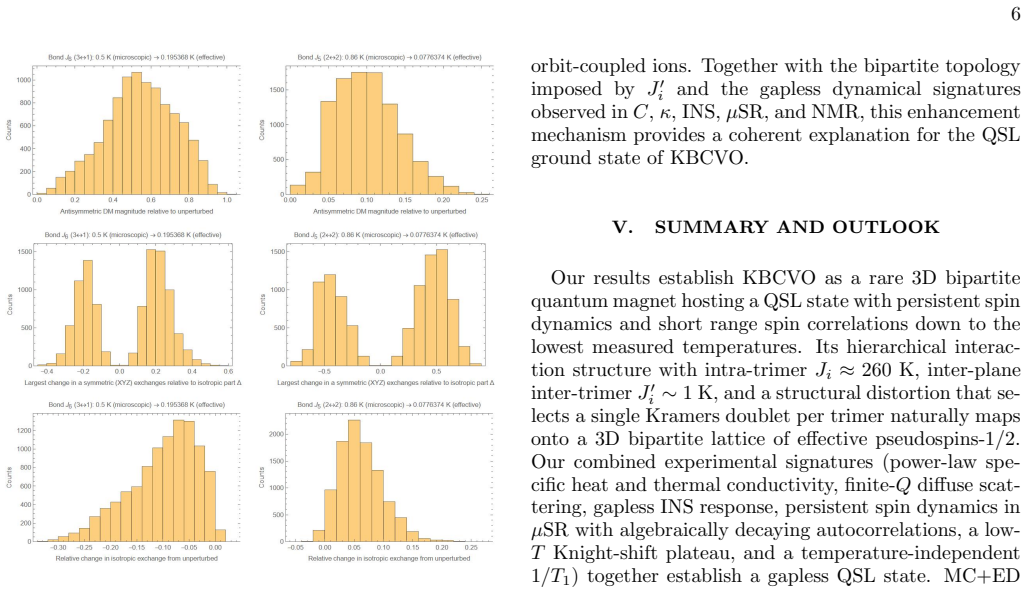
We identify the three-dimensional spin-trimer magnet KBa3Ca4Cu3V7O28 as a promising candidate for a bipartite quantum spin liquid persisting to the lowest temperatures. Strongly coupled Cu2+ trimers form effective pseudospin-1/2 degrees of freedom upon cooling, which constitute a three-dimensional bipartite network. Bulk measurements detect no spin freezing or symmetry-breaking phase transition down to 20 mK but reveal a gapless dynamical ground state with algebraic spin autocorrelations. This state is stabilized by a strong enhancement of effective anisotropy: a weak microscopic Cu-Cu exchange anisotropy of approximately 15 percent is generically amplified at the trimer level, producing 60-
What carries the argument
The effective pseudospin-1/2 network on a 3D bipartite lattice of spin trimers, where microscopic anisotropy is amplified to large effective values.
Load-bearing premise
The lack of any spin freezing or symmetry breaking detected down to 20 mK combined with algebraic correlations means the system has reached a true quantum spin liquid ground state rather than a crossover or a transition at even lower temperatures.
What would settle it
Observation of a magnetic phase transition, spin freezing, or a gap opening in the excitation spectrum at temperatures below 20 mK would disprove the persistent quantum spin liquid claim.
Figures


read the original abstract
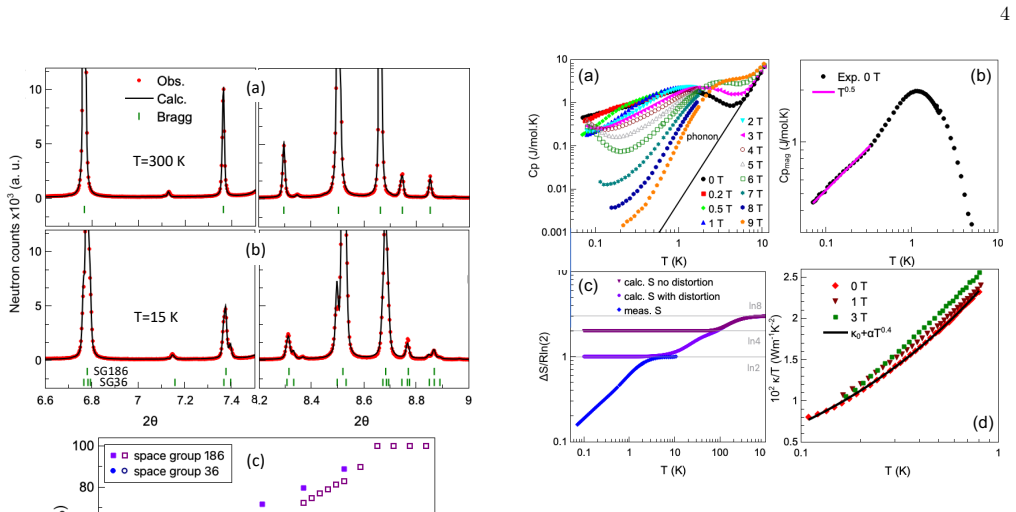
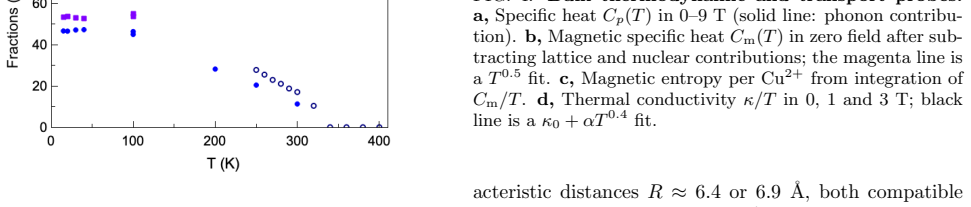
Quantum spin liquids (QSLs) represent highly entangled states of matter in which frustration-induced quantum fluctuations suppress any symmetry-breaking phase transition down to absolute zero, giving rise to fractionalized excitations and emergent gauge fields. Theoretically, bond anisotropy can stabilize QSLs even on bipartite lattices, as exemplified by the Kitaev honeycomb model; however, no material has so far been established to realize such a state as its true ground state. Here we identify the three-dimensional spin-trimer magnet KBa$_3$Ca$_4$Cu$_3$V$_7$O$_{28}$ as a promising candidate for a bipartite quantum spin liquid persisting to the lowest temperatures. Strongly coupled Cu$^{2+}$ trimers form effective pseudospin-1/2 degrees of freedom upon cooling, which in turn constitute a three-dimensional bipartite network. Bulk thermodynamic measurements, neutron scattering, $\mu$SR, and NMR detect no spin freezing or symmetry-breaking phase transition down to 20 mK, but instead reveal a gapless dynamical ground state with algebraic spin autocorrelations. Complementary Monte Carlo and exact-diagonalization calculations show that this state is stabilized by a strong enhancement of effective anisotropy: a weak microscopic Cu-Cu exchange anisotropy of approximately 15 percent is generically amplified at the trimer level, producing effective pseudospin-pseudospin interaction anisotropies of 60 to 100 percent. Our results establish trimer-based networks as a promising platform for realizing anisotropy-stabilized quantum entangled states, even in three-dimensional bipartite systems with only weak microscopic anisotropy.
Editorial analysis
A structured set of objections, weighed in public.
Referee Report
Summary. The paper identifies the 3D spin-trimer material KBa₃Ca₄Cu₃V₇O₂₈ as a promising candidate for a bipartite quantum spin liquid. Effective pseudospin-1/2 moments form a 3D bipartite network; bulk thermodynamics, neutron scattering, μSR and NMR show no ordering or freezing down to 20 mK together with algebraic autocorrelations. Monte Carlo and exact-diagonalization calculations on the projected trimer model demonstrate that a microscopic Cu-Cu exchange anisotropy of ~15 % is generically amplified to effective pseudospin anisotropies of 60–100 %, stabilizing the gapless entangled state.
Significance. If the central interpretation is sustained, the work supplies the first concrete material example of an anisotropy-stabilized QSL on a three-dimensional bipartite lattice. It also establishes trimer-based networks as a practical route to strong effective anisotropy from weak microscopic ingredients, with potential implications for the broader search for fractionalized phases in less frustrated geometries.
major comments (2)
- [calculations section (Monte Carlo and exact-diagonalization results)] The amplification result (60–100 % effective anisotropy) is obtained from ED/MC runs that take the microscopic 15 % value as fixed input. While the projection onto the trimer doublet is internally consistent, the manuscript does not report a systematic scan over a plausible microscopic range (e.g., 5–25 %); without this, the adjective “generically” remains only partially substantiated and could be sensitive to the precise microscopic parameter chosen.
- [experimental results and discussion of μSR/NMR autocorrelations] The claim that the ground state is a true QSL “persisting to the lowest temperatures” rests on the absence of any detected transition or freezing down to 20 mK together with algebraic autocorrelations. No quantitative bound is given on the possible location of a hypothetical transition at still lower temperature, nor on the correlation length or relaxation-time scales that would be required to exclude a crossover regime; this assumption is load-bearing for the “promising candidate” designation.
minor comments (2)
- [introduction and methods] The abstract and main text both state “approximately 15 percent” for the microscopic anisotropy; a single explicit reference or supplementary table giving the microscopic exchange parameters extracted from high-temperature data would improve traceability.
- [figure captions] Figure captions for the MC/ED results should explicitly state the system sizes used and the number of disorder realizations (if any) so that the quoted anisotropy ranges can be reproduced.
Simulated Author's Rebuttal
We thank the referee for the careful reading of our manuscript and the constructive comments. We address each major point below and indicate the revisions made to strengthen the manuscript.
read point-by-point responses
-
Referee: [calculations section (Monte Carlo and exact-diagonalization results)] The amplification result (60–100 % effective anisotropy) is obtained from ED/MC runs that take the microscopic 15 % value as fixed input. While the projection onto the trimer doublet is internally consistent, the manuscript does not report a systematic scan over a plausible microscopic range (e.g., 5–25 %); without this, the adjective “generically” remains only partially substantiated and could be sensitive to the precise microscopic parameter chosen.
Authors: We agree that a systematic scan over a range of microscopic anisotropy values would better substantiate the claim that the amplification is generic. We have performed additional exact-diagonalization and Monte Carlo simulations varying the microscopic Cu-Cu exchange anisotropy from 5% to 25%. Across this range the effective pseudospin anisotropy is amplified to 50–110%, with the 60–100% values at the 15% input remaining representative. These results will be added to the calculations section of the revised manuscript. revision: yes
-
Referee: [experimental results and discussion of μSR/NMR autocorrelations] The claim that the ground state is a true QSL “persisting to the lowest temperatures” rests on the absence of any detected transition or freezing down to 20 mK together with algebraic autocorrelations. No quantitative bound is given on the possible location of a hypothetical transition at still lower temperature, nor on the correlation length or relaxation-time scales that would be required to exclude a crossover regime; this assumption is load-bearing for the “promising candidate” designation.
Authors: We acknowledge that the absence of ordering down to 20 mK, while consistent with a gapless QSL, does not by itself provide a quantitative upper bound on a possible transition at still lower temperatures. In the revised manuscript we have added a discussion that uses the measured relaxation rates and probe sensitivities to estimate that any hypothetical transition would have to lie below a few mK to remain undetected. We have also adjusted the language to describe the state as persisting to the lowest experimentally accessed temperatures, thereby framing the material as a promising candidate rather than a definitively proven QSL. revision: partial
- A rigorous, model-independent quantitative bound on any hypothetical transition temperature below the current 20 mK limit cannot be derived from the existing data without additional measurements at dilution-refrigerator temperatures.
Circularity Check
No significant circularity detected in derivation chain
full rationale
The paper's identification of KBa3Ca4Cu3V7O28 as a QSL candidate rests on direct experimental observations (no freezing or symmetry breaking to 20 mK, algebraic autocorrelations from neutron, μSR, NMR) plus numerical ED/MC calculations that explicitly input a microscopic ~15% Cu-Cu anisotropy and output the amplified 60-100% effective pseudospin anisotropy via trimer projection. This is a standard forward computation, not a self-definitional loop, fitted input renamed as prediction, or load-bearing self-citation. The claim that the amplification is 'generic' is presented as a result of the simulations rather than an unverified ansatz or uniqueness theorem imported from prior work. The overall chain is self-contained against the stated data and calculations without reducing to tautological equivalence with its inputs.
Axiom & Free-Parameter Ledger
free parameters (1)
- microscopic Cu-Cu exchange anisotropy =
approximately 15 percent
axioms (1)
- domain assumption Strongly coupled Cu2+ trimers form effective pseudospin-1/2 degrees of freedom upon cooling
Reference graph
Works this paper leans on
-
[1]
The mean effective magnitudes (J ′eff 1 =J ′eff 3 ≈0.20 andJ ′eff 2 ≈0.08 K) confirm that the inter-plane bonds J ′ 1 andJ ′ 3 dominate the low-energy pseudospin physics and carry the strongest anisotropy. Increasing the micro- scopic anisotropy to a still-realisticδ= 25 % drives the mean effective DM anisotropy onJ ′ 1 andJ ′ 3 to∼100%; in other words, t...
2000
-
[2]
Khatua, B
J. Khatua, B. Sana, A. Zorko, M. Gomilˇ sek, K. Sethu- pathi, M. R. Rao, M. Baenitz, B. Schmidt, and P. Khuntia, Experimental signatures of quantum and topological states in frustrated magnetism, Physics Re- ports1041, 1 (2023)
2023
-
[3]
Lacroix,Introduction to Frustrated Magnetism, edited by C
C. Lacroix,Introduction to Frustrated Magnetism, edited by C. Lacroix, P. Mendels, and F. Mila (Springer-Verlag, Berlin, 2011)
2011
-
[4]
Anderson, Resonating valence bonds: A new kind of insulator?, Materials Research Bulletin8, 153 (1973)
P. Anderson, Resonating valence bonds: A new kind of insulator?, Materials Research Bulletin8, 153 (1973)
1973
-
[5]
Wen, Quantum orders and symmetric spin liquids, Phys
X.-G. Wen, Quantum orders and symmetric spin liquids, Phys. Rev. B65, 165113 (2002)
2002
-
[6]
Savary and L
L. Savary and L. Balents, Quantum spin liquids: a re- view, Reports on Progress in Physics80, 016502 (2016)
2016
-
[7]
Y. Zhou, K. Kanoda, and T.-K. Ng, Quantum spin liquid states, Rev. Mod. Phys.89, 025003 (2017)
2017
-
[8]
Knolle and R
J. Knolle and R. Moessner, A field guide to spin liq- uids, Annual Review of Condensed Matter Physics10, 451 (2019)
2019
-
[9]
Capponi, Classical and quantum spin liquids, Comptes Rendus
S. Capponi, Classical and quantum spin liquids, Comptes Rendus. Physique26, 91 (2025)
2025
-
[10]
Mendels, F
P. Mendels, F. Bert, M. A. de Vries, A. Olariu, A. Har- rison, F. Duc, J. C. Trombe, J. S. Lord, A. Amato, and C. Baines, Quantum magnetism in the paratacamite fam- ily: Towards an ideal kagom´ e lattice, Phys. Rev. Lett.98, 077204 (2007)
2007
-
[11]
M. B. Hastings, Dirac structure, RVB, and goldstone modes in the kagom´ e antiferromagnet, Phys. Rev. B63, 014413 (2000)
2000
-
[12]
R. R. P. Singh and D. A. Huse, Ground state of the spin- 1/2 kagome-lattice heisenberg antiferromagnet, Phys. Rev. B76, 180407 (2007)
2007
-
[13]
Y. Ran, M. Hermele, P. A. Lee, and X.-G. Wen, Projected-wave-function study of the spin-1/2 heisenberg model on the kagom´ e lattice, Phys. Rev. Lett.98, 117205 (2007)
2007
-
[14]
S. Yan, D. A. Huse, and S. R. White, Spin-liquid ground state of theS= 1/2 kagome heisen- berg antiferromagnet, Science332, 1173 (2011), https://www.science.org/doi/pdf/10.1126/science.1201080
-
[15]
Messio, B
L. Messio, B. Bernu, and C. Lhuillier, Kagome antifer- romagnet: A chiral topological spin liquid?, Phys. Rev. Lett.108, 207204 (2012)
2012
-
[16]
Khuntia, M
P. Khuntia, M. Velazquez, Q. Barth´ elemy, F. Bert, E. Bert, Kermarrec, A. Legros, B. Bernu, L. Mes- sio, A. Z. Zorko, and P. Mendels, Gapless ground state in the archetypal quantum kagome antiferromag- net ZnCu3(OH)6Cl2, Nature Physics16, 469 (2020)
2020
-
[17]
Jiang, Z
H.-C. Jiang, Z. Wang, and L. Balents, Identifying topo- logical order by entanglement entropy, Nature Physics8, 902 (2012)
2012
-
[18]
Depenbrock, I
S. Depenbrock, I. P. McCulloch, and U. Schollw¨ ock, Na- ture of the spin-liquid ground state of thes= 1/2 heisen- berg model on the kagome lattice, Phys. Rev. Lett.109, 067201 (2012)
2012
-
[19]
Y.-C. He, M. P. Zaletel, M. Oshikawa, and F. Pollmann, Signatures of dirac cones in a dmrg study of the kagome heisenberg model, Phys. Rev. X7, 031020 (2017)
2017
-
[20]
Kitaev, Anyons in an exactly solved model and be- yond, Annals of Physics321, 2 (2006), january Special Issue
A. Kitaev, Anyons in an exactly solved model and be- yond, Annals of Physics321, 2 (2006), january Special Issue
2006
-
[21]
Jackeli and G
G. Jackeli and G. Khaliullin, Mott insulators in the strong spin-orbit coupling limit: From heisenberg to a quantum compass and kitaev models, Phys. Rev. Lett. 102, 017205 (2009)
2009
-
[22]
Kitaev, Fault-tolerant quantum computation by anyons, Annals of Physics303, 2 (2003)
A. Kitaev, Fault-tolerant quantum computation by anyons, Annals of Physics303, 2 (2003)
2003
-
[23]
Nayak, S
C. Nayak, S. H. Simon, A. Stern, M. Freedman, and S. Das Sarma, Non-abelian anyons and topological quan- tum computation, Rev. Mod. Phys.80, 1083 (2008)
2008
-
[24]
Gaudet, E
J. Gaudet, E. M. Smith, J. Dudemaine, J. Beare, C. R. C. Buhariwalla, N. P. Butch, M. B. Stone, A. I. Kolesnikov, G. Xu, D. R. Yahne, K. A. Ross, C. A. Marjerrison, J. D. Garrett, G. M. Luke, A. D. Bianchi, and B. D. Gaulin, Quantum spin ice dynamics in the dipole-octupole py- rochlore magnet Ce2Zr2O7, Phys. Rev. Lett.122, 187201 (2019)
2019
-
[25]
B. Gao, T. Chen, D. W. Tam, C.-L. Huang, K. Sas- mal, D. T. Adroja, F. Ye, H. Cao, G. Sala, M. B. Stone, C. Baines, J. A. T. Verezhak, H. Hu, J.-H. Chung, X. Xu, 9 S.-W. Cheong, M. Nallaiyan, S. Spagna, M. B. Maple, A. H. Nevidomskyy, E. Morosan, G. Chen, and P. Dai, Experimental signatures of a three-dimensional quantum spin liquid in effective spin-1/2 ...
2019
-
[26]
Por´ ee, H
V. Por´ ee, H. Yan, F. Desrochers, S. Petit, E. Lhotel, M. Appel, J. Ollivier, Y. B. Kim, A. H. Nevidomskyy, and R. Sibille, Evidence for fractional matter coupled to an emergent gauge field in a quantum spin ice, Nature Physics21, 83 (2025)
2025
-
[27]
Y. Zhou, P. A. Lee, T.-K. Ng, and F.-C. Zhang, na 4ir3o8 as a 3d spin liquid with fermionic spinons, Phys. Rev. Lett.101, 197201 (2008)
2008
-
[28]
C. Balz, B. Lake, J. Reuther, H. Luetkens, R. Sch¨ onemann, T. Herrmannsd¨ orfer, Y. Singh, A. T. M. Nazmul Islam, E. M. Wheeler, J. A. Rodriguez- Rivera, T. Guidi, G. G. Simeoni, C. Baines, and H. Ryll, Physical realization of a quantum spin liquid based on a complex frustration mechanism, Nature Physics12, 942 (2016)
2016
-
[29]
Alexanian, R
Y. Alexanian, R. Kumar, H. Zeroual, B. Bernu, L. Mangin-Thro, J. R. Stewart, J. M. Wilkinson, S. Bhat- tacharya, P. L. Paulose, F. Bert, P. Mendels, B. F˚ ak, and E. Kermarrec, Evidence for spin liquid behavior in the frustrated three-dimensionals= 1/2 heisenberg garnet naca2cu2(VO4)3, Phys. Rev. Mater.9, 074411 (2025)
2025
-
[30]
Khatua, M
J. Khatua, M. Gomilˇ sek, J. Orain, A. Strydom, Z. Jagliˇ ci´ c, C. Colin, S. Petit, A. Ozarowski, L. Mangin- Thro, K. Sethupathi,et al., Signature of a randomness- driven spin-liquid state in a frustrated magnet, Commu- nications Physics5, 99 (2022)
2022
-
[31]
T. Arh, B. Sana, M. Pregelj, P. Khuntia, Z. Jagliˇ ci´ c, M. Le, P. Biswas, P. Manuel, L. Mangin-Thro, A. Ozarowski,et al., The ising triangular-lattice antifer- romagnet neodymium heptatantalate as a quantum spin liquid candidate, Nature Materials21, 416 (2022)
2022
-
[32]
M. E. Zhitomirsky, Effective quantum dimer model for trimerized kagom´ e antiferromagnet, Phys. Rev. B71, 214413 (2005)
2005
-
[33]
Mila, Low-energy sector of theS= 1/2 kagome anti- ferromagnet, Phys
F. Mila, Low-energy sector of theS= 1/2 kagome anti- ferromagnet, Phys. Rev. Lett.81, 2356 (1998)
1998
-
[34]
Repellin, Y.-C
C. Repellin, Y.-C. He, and F. Pollmann, Stability of the spin- 1 2 kagome ground state with breathing anisotropy, Phys. Rev. B96, 205124 (2017)
2017
-
[35]
Iqbal, D
M. Iqbal, D. Poilblanc, and N. Schuch, Gapped𭟋 2 spin liquid in the breathing kagome heisenberg antiferromag- net, Phys. Rev. B101, 155141 (2020)
2020
-
[36]
S. S. Jahromi, R. Or´ us, D. Poilblanc, and F. Mila, Spin-1 2 kagome Heisenberg antiferromagnet with strong breath- ing anisotropy, SciPost Phys.9, 092 (2020)
2020
-
[37]
Robert, V
J. Robert, V. Simonet, B. Canals, R. Ballou, E. Lhotel, C. Darie, P. Bordet, B. Ouladdiaf, M. Johnson, J. Ol- livier, D. Braithwaite, H. Rakoto, and S. de Brion, For- mation of collective spins in frustrated clusters, Phys. Rev. B77, 054421 (2008)
2008
-
[38]
Wessel and S
S. Wessel and S. Haas, Phase diagram and thermody- namic properties of the square lattice of antiferromag- netic spin- 1 2 triangles in la 4cu3moo12, Phys. Rev. B63, 140403 (2001)
2001
-
[39]
Fouet, A
J.-B. Fouet, A. L¨ auchli, S. Pilgram, R. M. Noack, and F. Mila, Frustrated three-leg spin tubes: From spin 1/2 with chirality to spin 3/2, Phys. Rev. B73, 014409 (2006)
2006
-
[40]
Georgeot and F
B. Georgeot and F. Mila, Chirality of triangular anti- ferromagnetic clusters as a qubit, Phys. Rev. Lett.104, 200502 (2010)
2010
-
[41]
10.5291/ILL-DATA.4-05-816 (2021)
-
[42]
10.5291/ILL-DATA.5-32-868 (2019)
-
[43]
10.5291/ILL-DATA.5-32-929 (2021)
-
[44]
E. F. Bertaut and P. Burlet, The magnetic structure of SrCu2(BO3)2 and related compounds: pair correlations in powder neutron diffuse scattering, Solid State Com- munications5, 279 (1967)
1967
-
[45]
J. S. Gardner, M. J. P. Gingras, and J. E. Greedan, Mag- netic pyrochlore oxides, Reviews of Modern Physics82, 53 (2010)
2010
-
[46]
10.5291/ILL-DATA.EASY-397 (2019)
-
[47]
10.5291/ILL-DATA.4-05-834 (2021)
-
[48]
S. J. Blundell, R. De Renzi, T. Lancaster, and F. L. Pratt, Muon Spectroscopy: An Introduction(Oxford University Press, Oxford, 2021)
2021
-
[49]
Gomilˇ sek, M
M. Gomilˇ sek, M. Klanjˇ sek, M. Pregelj, H. Luetkens, Y. Li, Q. M. Zhang, and A. Zorko,µSR insight into the impurity problem in quantum kagome antiferromagnets, Phys. Rev. B94, 024438 (2016)
2016
-
[50]
10.5291/ILL-DATA.EASY-1279 (2024)
-
[51]
Rodriguez-Carvajal, Recent advances in magnetic structure determination by neutron powder diffraction, Physica B192, 55 (1993)
J. Rodriguez-Carvajal, Recent advances in magnetic structure determination by neutron powder diffraction, Physica B192, 55 (1993)
1993
-
[52]
Boultif and D
A. Boultif and D. Lou¨ er, Powder pattern indexing with the dichotomy method, Journal of Applied Crystallogra- phy37, 724 (2004)
2004
-
[53]
Janson, J
O. Janson, J. Richter, and H. Rosner, Modified kagome physics in the natural spin-1/2 kagome lat- tice systems: Kapellasite Cu 3Zn(OH)6Cl2 and haydeeite Cu3Mg(OH)6Cl2, Phys. Rev. Lett.101, 106403 (2008)
2008
-
[54]
H. O. Jeschke, F. Salvat-Pujol, and R. Valent´ ı, First-principles determination of heisenberg hamilto- nian parameters for the spin- 1 2 kagome antiferromagnet ZnCu3(OH)6Cl2, Phys. Rev. B88, 075106 (2013)
2013
-
[55]
H. O. Jeschke, F. Salvat-Pujol, E. Gati, N. H. Hoang, B. Wolf, M. Lang, J. A. Schlueter, and R. Valent´ ı, Bar- lowite as a canted antiferromagnet: Theory and experi- ment, Phys. Rev. B92, 094417 (2015)
2015
-
[56]
Iqbal, H
Y. Iqbal, H. O. Jeschke, J. Reuther, R. Valent´ ı, I. I. Mazin, M. Greiter, and R. Thomale, Paramagnetism in the kagome compounds (Zn,Mg,Cd)Cu 3(OH)6Cl2, Phys. Rev. B92, 220404 (2015)
2015
-
[57]
T. Arh, M. Gomilˇ sek, P. Prelovˇ sek, M. Pregelj, M. Klanjˇ sek, A. Ozarowski, S. J. Clark, T. Lancaster, W. Sun, J.-X. Mi, and A. Zorko, Origin of magnetic or- dering in a structurally perfect quantum kagome antifer- romagnet, Phys. Rev. Lett.125, 027203 (2020)
2020
-
[58]
Stahl and T
B. Stahl and T. Bredow, Critical assessment of the DFT+U approach for the prediction of vanadium dioxide properties, J. Comput. Chem.41, 258 (2020)
2020
-
[59]
Y. Cui, K. Yang, B. Wang, J. Feng, B. Liu, G. Yang, and Y. Gao, First-principles study of phase-transition tem- perature and optical properties of alkaline earth metal (Be, Mg, Ca, Sr or Ba)-doped VO2, Ceram. Int.44, 20814 (2018)
2018
-
[60]
S. J. Clark, M. D. Segall, C. J. Pickard, P. J. Hasnip, M. J. Probert, K. Refson, and M. Payne, First principles methods using CASTEP, Z. Kristall.220, 567 (2005)
2005
-
[61]
V. I. Anisimov, F. Aryasetiawan, and A. I. Lichtenstein, First-principles calculations of the electronic structure and spectra of strongly correlated systems: the LDA +U 10 method, J. Phys.: Condens. Matter9, 767 (1997)
1997
-
[62]
H. J. Monkhorst and J. D. Pack, Special points for Brillouin-zone integrations, Phys. Rev. B13, 5188 (1976)
1976
-
[63]
Riedl, Y
K. Riedl, Y. Li, R. Valent´ ı, and S. M. Winter, Ab ini- tio approaches for low-energy spin hamiltonians, Phys. Status Solidi (B): Basic Res.256, 1800684 (2019)
2019
discussion (0)
Sign in with ORCID, Apple, or X to comment. Anyone can read and Pith papers without signing in.