Recognition: no theorem link
Physics-based Digital Twins for Integrated Thermal Energy Systems Using Active Learning
Pith reviewed 2026-05-11 01:54 UTC · model grok-4.3
The pith
Active learning cuts the simulation trajectories needed for accurate thermal energy digital twins to one-fifth.
A machine-rendered reading of the paper's core claim, the machinery that carries it, and where it could break.
Core claim
The paper establishes that an active learning framework coupling system-level Modelica simulations with tailored surrogate models (SINDyC, MvG-SINDyC, FNN, and GRU) and model-specific query strategies achieves comparable predictive accuracy on the bypass mass flow rate and heat transfer rate outputs of the glycol heat exchanger while using as few as one-fifth the simulation trajectories required by random sampling.
What carries the argument
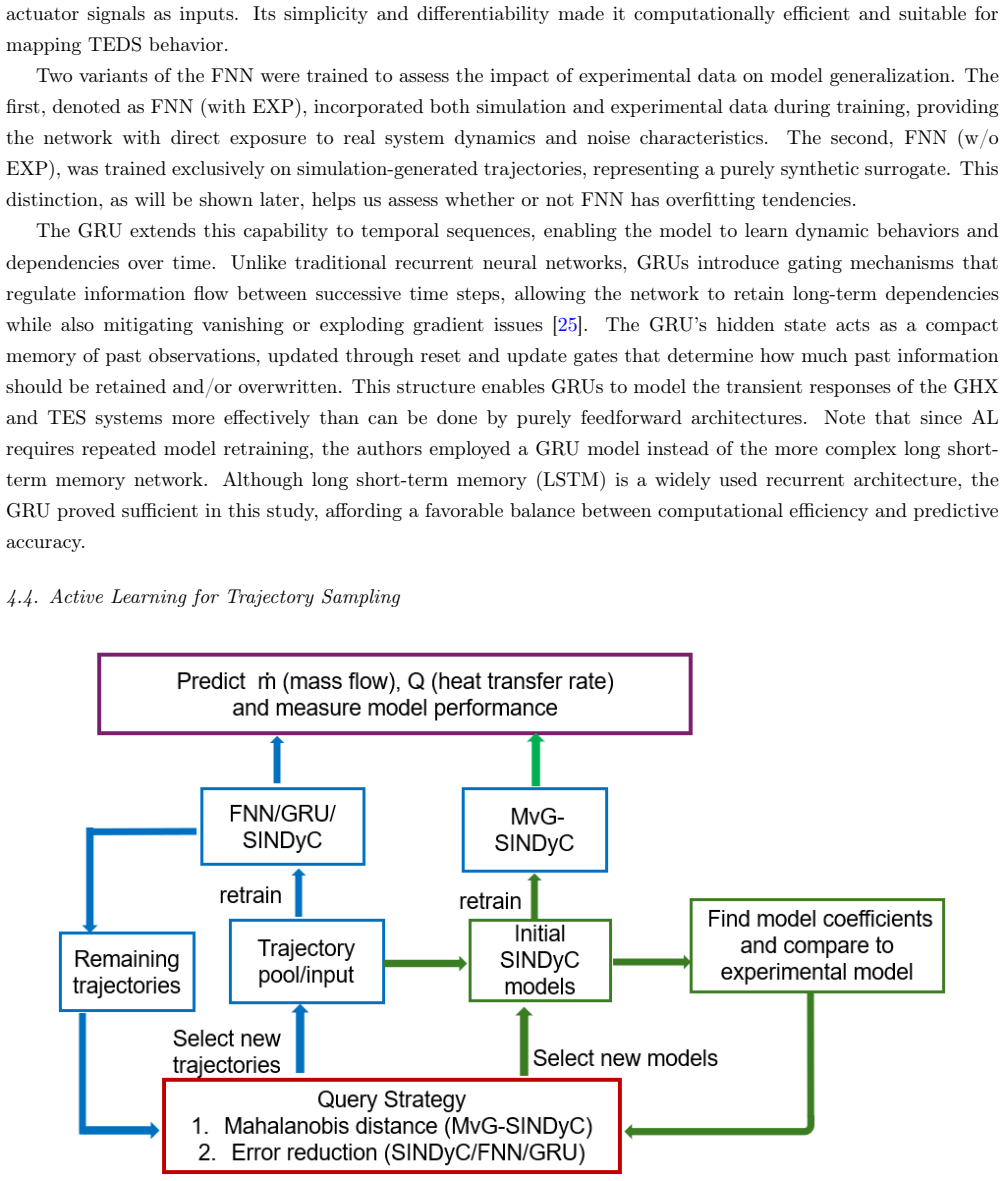
Active learning with model-specific query strategies (Mahalanobis-distance sampling in coefficient space for MvG-SINDyC and error-based sampling in prediction space for the remaining surrogates) that prioritize dynamically informative trajectories from the high-fidelity simulator.
If this is right
- Real-time supervisory control of thermal distribution systems becomes feasible with surrogates that run quickly yet retain physics grounding.
- The probabilistic MvG-SINDyC surrogate supplies uncertainty estimates while delivering the largest reduction in required simulations.
- SINDyC remains the fastest and most interpretable option when computational resources or model transparency are priorities.
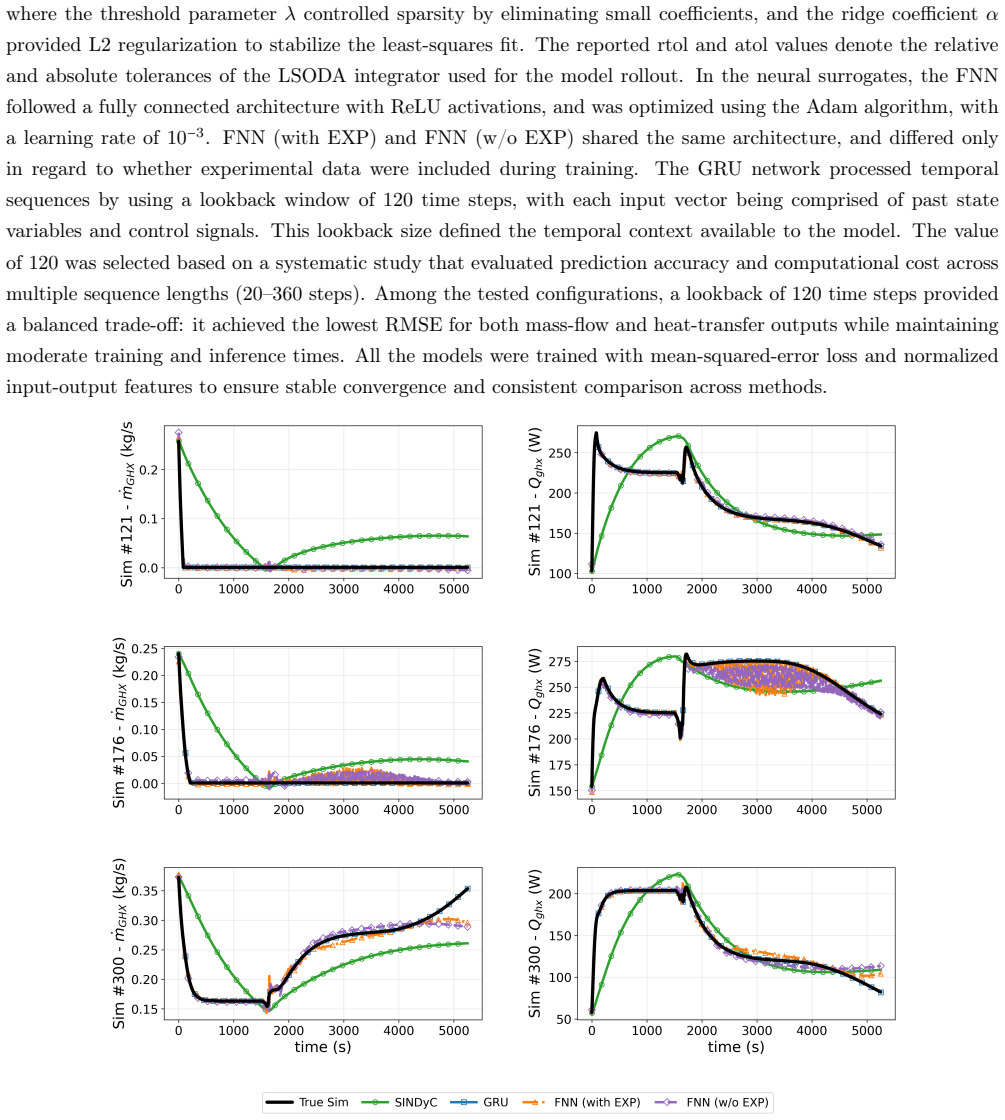
- GRU networks reach the highest pointwise fidelity among the four surrogates tested.
Where Pith is reading between the lines
- The same active-learning loop could be applied to other subsystems within integrated energy networks to lower the overall cost of building plant-wide digital twins.
- Uncertainty outputs from the probabilistic variant could be fed directly into robust control algorithms that adjust setpoints when prediction spreads widen.
- Testing the query strategies on different simulation platforms or additional energy components would show whether the one-fifth data reduction generalizes beyond the glycol heat exchanger.
Load-bearing premise
The chosen query strategies must pick trajectories that remain representative without introducing bias or losing accuracy on operating conditions the model has not yet seen.
What would settle it
Running the trained surrogates on a fresh set of operating conditions drawn from a different distribution and finding that the active-learning versions produce substantially larger errors than versions trained on the same number of randomly chosen trajectories.
Figures





read the original abstract
Real-time supervisory control of thermal energy distribution systems requires digital twins that are accurate, interpretable, and uncertainty-aware, yet remain data and computationally efficient. High-fidelity simulations alone are costly, while purely data-driven surrogates often lack robustness. To address these challenges, this work proposes an active learning (AL) framework that couples system-level Modelica simulations with four simpler physics-informed and data-driven surrogate modeling approaches: deterministic Sparse Identification of Nonlinear Dynamics with Control (SINDyC), its probabilistic multivariate-Gaussian extension (MvG-SINDyC), feedforward neural network (FNN), and gated recurrent unit (GRU) network. Tailored to each surrogate, model-specific AL query strategies are employed, including Mahalanobis-distance sampling in coefficient space for MvG-SINDyC and error-based sampling in prediction space for SINDyC, FNN, and GRU, allowing the learning process to prioritize dynamically informative trajectories. The proposed approach is demonstrated on the glycol heat exchanger (GHX) subsystem of the Thermal Energy Distribution System (TEDS) at Idaho National Laboratory. Across key GHX outputs--the bypass mass flow rate $\dot{m}_{\mathrm{GHX}}$ and heat transfer rate $Q_{\mathrm{GHX}}$-the AL framework achieves comparable predictive accuracy using as few as one-fifth of the simulation trajectories required by random sampling. Among the evaluated surrogates, the GRU achieves the highest predictive fidelity, while SINDyC remains the most computationally efficient and interpretable. The probabilistic MvG-SINDyC surrogate further enables uncertainty quantification and exhibits the largest computational gains under AL.
Editorial analysis
A structured set of objections, weighed in public.
Referee Report
Summary. The paper proposes an active learning (AL) framework to develop data-efficient, physics-informed digital twins for thermal energy distribution systems. It integrates high-fidelity Modelica simulations with surrogate models including SINDyC, MvG-SINDyC, FNN, and GRU, using tailored query strategies such as Mahalanobis-distance sampling for MvG-SINDyC and error-based sampling for others. Demonstrated on the glycol heat exchanger (GHX) of the TEDS at Idaho National Laboratory, the framework claims to achieve comparable predictive accuracy for bypass mass flow rate and heat transfer rate using only one-fifth of the simulation trajectories needed by random sampling, with GRU offering highest fidelity and SINDyC best efficiency and interpretability.
Significance. If the empirical results hold, this approach offers a promising path toward computationally efficient and interpretable digital twins suitable for real-time supervisory control in integrated thermal energy systems. The combination of physics-based structure with active learning for data selection addresses key limitations of both pure simulation and black-box data-driven methods. The inclusion of uncertainty quantification via MvG-SINDyC is a notable strength, as is the focus on specific system outputs relevant to control.
major comments (2)
- [Results] The central claim that the AL framework achieves comparable accuracy on m_GHX and Q_GHX with 1/5 the trajectories of random sampling lacks supporting details on validation splits, number of independent runs, error bars, or statistical significance tests. Without these, it is difficult to assess whether the reported data-efficiency gain is robust.
- [Active Learning Query Strategies] The model-specific AL strategies (Mahalanobis distance in coefficient space for MvG-SINDyC, error-based for others) may introduce selection bias by over-representing certain dynamics. The manuscript should provide quantitative evidence, such as state-space coverage metrics or out-of-distribution generalization errors on unseen operating conditions, to confirm that the selected trajectories do not degrade surrogate performance on the full TEDS envelope.
minor comments (2)
- [Abstract] The abstract mentions performance gains but does not specify the exact metrics or conditions under which the 1/5 reduction holds.
- [Notation] Ensure consistent use of symbols for mass flow rate across the text and equations.
Simulated Author's Rebuttal
We thank the referee for their constructive feedback and positive assessment of the work's significance. We agree that additional statistical details and coverage analyses will strengthen the presentation of our results. We address each major comment below and will revise the manuscript accordingly.
read point-by-point responses
-
Referee: [Results] The central claim that the AL framework achieves comparable accuracy on m_GHX and Q_GHX with 1/5 the trajectories of random sampling lacks supporting details on validation splits, number of independent runs, error bars, or statistical significance tests. Without these, it is difficult to assess whether the reported data-efficiency gain is robust.
Authors: We acknowledge the value of these details for assessing robustness. In the revised manuscript we will explicitly state the validation protocol (80/20 trajectory split with no overlap between training and test sets), report all metrics as means over five independent runs with different random seeds for both AL and random sampling, include error bars as one standard deviation, and add a paired t-test (p < 0.05) confirming that the 1/5 data-efficiency advantage is statistically significant for both m_GHX and Q_GHX. These additions will be placed in Section 4.3 and the associated figures. revision: yes
-
Referee: [Active Learning Query Strategies] The model-specific AL strategies (Mahalanobis distance in coefficient space for MvG-SINDyC, error-based for others) may introduce selection bias by over-representing certain dynamics. The manuscript should provide quantitative evidence, such as state-space coverage metrics or out-of-distribution generalization errors on unseen operating conditions, to confirm that the selected trajectories do not degrade surrogate performance on the full TEDS envelope.
Authors: To demonstrate that the query strategies do not introduce harmful bias, the revised manuscript will include two new quantitative checks. First, we will report state-space coverage via the normalized convex-hull volume and the fraction of the full TEDS operating envelope covered by the AL-selected trajectories versus random sampling. Second, we will evaluate out-of-distribution generalization by holding out a separate test set of trajectories from extreme operating conditions (e.g., mass-flow rates and temperatures outside the training distribution) and report the resulting prediction errors for all four surrogates. These results will appear in a new subsection of Section 4.4 and will confirm that AL-selected data maintain or improve coverage and OOD performance relative to random sampling. revision: yes
Circularity Check
No circularity: empirical AL vs. random sampling comparison on held-out trajectories
full rationale
The paper's central claims rest on running system-level Modelica simulations, training four surrogate classes (SINDyC, MvG-SINDyC, FNN, GRU) under both active-learning query strategies and random sampling, then measuring predictive accuracy on independent held-out GHX trajectories for m_GHX and Q_GHX. The reported 1/5 data-efficiency result is obtained by direct numerical comparison of test-set errors, not by any equation that reduces the output to a fitted parameter or self-citation by construction. No self-definitional loops, uniqueness theorems, or ansatz smuggling appear in the methodology.
Axiom & Free-Parameter Ledger
Reference graph
Works this paper leans on
-
[1]
T. J. Morton, Thermal energy distribution system (teds) startup, Tech. rep., Idaho National Laboratory (INL), Idaho Falls, ID (United States) (2020)
work page 2020
-
[2]
K. L. Frick, S. M. Bragg-Sitton, C. Rabiti, Development of the inl thermal energy distribution system (teds) in the modelica eco-system for validation and verification, Tech. rep., Idaho National Laboratory (INL), Idaho Falls, ID (United States) (2020)
work page 2020
-
[3]
A. I. Arvanitidis, V. Agarwal, M. Alamaniotis, Nuclear-driven integrated energy systems: A state-of-the-art review, Energies 16 (11) (2023) 4293
work page 2023
-
[4]
S. M. Bragg-Sitton, R. Boardman, C. Rabiti, J. O’Brien, Reimagining future energy systems: Overview of the us program to maximize energy utilization via integrated nuclear-renewable energy systems, International Journal of Energy Research 44 (10) (2020) 8156–8169. 20
work page 2020
- [5]
-
[6]
R. S. El-Emam, A. Constantin, R. Bhattacharyya, H. Ishaq, M. E. Ricotti, Nuclear and renewables in multi- purpose integrated energy systems: A critical review, Renewable and Sustainable Energy Reviews 192 (2024) 114157
work page 2024
-
[7]
D. Mikkelson, K. Frick, Analysis of controls for integrated energy storage system in energy arbitrage configura- tion with concrete thermal energy storage, Applied Energy 313 (2022) 118800
work page 2022
-
[8]
R. A. Jacob, J. Zhang, Modeling and control of nuclear–renewable integrated energy systems: Dynamic system model for green electricity and hydrogen production, Journal of Renewable and Sustainable Energy 15 (4) (2023) 046302
work page 2023
- [9]
-
[10]
G. C. Masotti, A. Cammi, S. Lorenzi, M. E. Ricotti, Modeling and simulation of nuclear hybrid energy systems architectures, Energy Conversion and Management 298 (2023) 117684
work page 2023
-
[11]
S. L. Luxembourg, S. S. Salim, K. Smekens, F. D. Longa, B. van der Zwaan, Times-europe: An integrated en- ergy system model for analyzing europe’s energy and climate challenges, Environmental Modeling & Assessment 30 (1) (2025) 1–19
work page 2025
-
[12]
L. Williams, J. M. Doster, D. Mikkelson, Modeling and optimization of a nuclear integrated energy system for the remote microgrid on el hierro, Energies 17 (23) (2024) 5826
work page 2024
- [13]
-
[14]
L. Lin, Development of supervisory control system for thermal energy distribution system, in: 2024 Pacific Basin Nuclear Conference, PBNC 2024, American Nuclear Society, 2024, pp. 435–444
work page 2024
-
[15]
L. Lin, J. Oncken, V. Agarwal, Autonomous control for heat-pipe microreactor using data-driven model pre- dictive control, Annals of Nuclear Energy 200 (2024) 110399
work page 2024
-
[16]
B. Kouvaritakis, M. Cannon, Model predictive control, Switzerland: Springer International Publishing 38 (13-
- [17]
-
[18]
K. L. Frick, S. M. Bragg-Sitton, M. Garrouste, Validation and verification for inl modelica-based teds models via experimental results, Tech. rep., Idaho National Lab.(INL), Idaho Falls, ID (United States) (2021)
work page 2021
-
[19]
S. L. Brunton, J. L. Proctor, J. N. Kutz, Discovering governing equations from data by sparse identification of nonlinear dynamical systems, Proceedings of the national academy of sciences 113 (15) (2016) 3932–3937
work page 2016
- [20]
- [21]
-
[22]
R. De Maesschalck, D. Jouan-Rimbaud, D. L. Massart, The mahalanobis distance, Chemometrics and intelli- gent laboratory systems 50 (1) (2000) 1–18
work page 2000
- [23]
-
[24]
I. Goodfellow, Y. Bengio, A. Courville, Y. Bengio, Deep learning, Vol. 1, MIT press Cambridge, 2016
work page 2016
-
[25]
Empirical Evaluation of Gated Recurrent Neural Networks on Sequence Modeling
J. Chung, C. Gulcehre, K. Cho, Y. Bengio, Empirical evaluation of gated recurrent neural networks on sequence modeling, arXiv preprint arXiv:1412.3555
work page internal anchor Pith review arXiv
-
[26]
M. I. Radaideh, C. Pigg, T. Kozlowski, Y. Deng, A. Qu, Neural-based time series forecasting of loss of coolant accidents in nuclear power plants, Expert Systems with Applications 160 (2020) 113699
work page 2020
-
[27]
M. I. Radaideh, T. Kozlowski, Combining simulations and data with deep learning and uncertainty quantifi- cation for advanced energy modeling, International Journal of Energy Research 43 (14) (2019) 7866–7890
work page 2019
-
[28]
R. A. Saleem, M. I. Radaideh, T. Kozlowski, Application of deep neural networks for high-dimensional large bwr core neutronics, Nuclear Engineering and Technology 52 (12) (2020) 2709–2716
work page 2020
-
[29]
M. I. Radaideh, T. Kozlowski, Surrogate modeling of advanced computer simulations using deep gaussian processes, Reliability Engineering & System Safety 195 (2020) 106731
work page 2020
-
[30]
S. Sene, L. Lin, J. Kim, M. I. Radaideh, Surrogate-driven variance-based sensitivity analysis of thermal storage tanks in integrated energy systems,In: Nuclear Plant Instrumentation and Control & Human-Machine Interface Technology (NPIC&HMIT 2025), Chicago, Illinois, United States, June 15–18, 2025
work page 2025
- [31]
-
[32]
M. G. Prina, M. Dallapiccola, D. Moser, W. Sparber, Machine learning as a surrogate model for energyplan: Speeding up energy system optimization at the country level, Energy 307 (2024) 132735
work page 2024
- [33]
-
[34]
Y. Li, M. Han, M. Shahidehpour, J. Li, C. Long, Data-driven distributionally robust scheduling of commu- nity integrated energy systems with uncertain renewable generations considering integrated demand response, Applied Energy 335 (2023) 120749
work page 2023
-
[35]
Y.Zhou, H.Hou, H.Yan, X.Wang, R.Zhou, Data-drivendistributionallyrobuststochasticoptimaldispatching method of integrated energy system considering multiple uncertainties, Energy 325 (2025) 136104
work page 2025
-
[36]
M. I. Radaideh, I. Wolverton, J. Joseph, J. J. Tusar, U. Otgonbaatar, N. Roy, B. Forget, K. Shirvan, Physics- informed reinforcement learning optimization of nuclear assembly design, Nuclear Engineering and Design 372 (2021) 110966
work page 2021
-
[37]
M. I. Radaideh, K. Shirvan, Pesa: Prioritized experience replay for parallel hybrid evolutionary and swarm algorithms-application to nuclear fuel, Nuclear Engineering and Technology 54 (10) (2022) 3864–3877
work page 2022
-
[38]
M. I. Radaideh, K. Du, P. Seurin, D. Seyler, X. Gu, H. Wang, K. Shirvan, Neorl: Neuroevolution optimization with reinforcement learning—applications to carbon-free energy systems, Nuclear Engineering and Design 412 (2023) 112423
work page 2023
- [39]
- [40]
-
[41]
M. I. Radaideh, L. Tunkle, D. Price, K. Abdulraheem, L. Lin, M. Elias, Multistep criticality search and power shaping in nuclear microreactors with deep reinforcement learning, Nuclear Science and Engineering (2025) 1–13
work page 2025
- [42]
-
[43]
M. Radaideh, C. Pappas, P. Ramuhalli, S. Cousineau, Application of convolutional and feedforward neural networks for fault detection in particle accelerator power systems, in: Annual Conference of the PHM Society, Vol. 14, 2022
work page 2022
-
[44]
M. I. Radaideh, C. Pappas, J. Walden, D. Lu, L. Vidyaratne, T. Britton, K. Rajput, M. Schram, S. Cousineau, Time series anomaly detection in power electronics signals with recurrent and convlstm autoencoders, Digital Signal Processing 130 (2022) 103704
work page 2022
-
[45]
M. I. Radaideh, C. Pappas, M. Wezensky, P. Ramuhalli, S. Cousineau, Early fault detection in particle accel- erator power electronics using ensemble learning, International Journal of Prognostics and Health Management 14 (1)
-
[46]
Y. Alanazi, M. Schram, K. Rajput, S. Goldenberg, L. Vidyaratne, C. Pappas, M. I. Radaideh, D. Lu, P. Ra- muhalli, S. Cousineau, Multi-module-based cvae to predict hvcm faults in the sns accelerator, Machine Learning with Applications 13 (2023) 100484
work page 2023
-
[47]
S. Qin, J. S. Yoo, T. J. Morton, Thermal stress modeling and analysis of packed-bed thermocline energy storage tank for inl thermal energy distribution system (teds), Tech. rep., Idaho National Lab.(INL), Idaho Falls, ID (United States) (2022)
work page 2022
-
[48]
U. M. Nabila, P. Seurin, L. Lin, M. I. Radaideh, Active learning for uncertainty quantification of a physics- informed digital twin of a thermal energy distribution system, in: Proc. International Conference on the Physics of Reactors (PHYSOR 2026), Torino, Italy, April 19–23, 2026. 23
work page 2026
discussion (0)
Sign in with ORCID, Apple, or X to comment. Anyone can read and Pith papers without signing in.