Recognition: 2 theorem links
· Lean TheoremBootstrapping ground state properties of classical frustrated magnets
Pith reviewed 2026-05-11 00:46 UTC · model grok-4.3
The pith
A semidefinite programming hierarchy gives rigorous bounds on ground state energies and correlations for infinite classical spin systems.
A machine-rendered reading of the paper's core claim, the machinery that carries it, and where it could break.
Core claim
By enforcing positivity conditions on probability distributions over spin configurations, the method constructs a hierarchy of semidefinite programs whose solutions bracket the true ground-state energy density and correlation functions from above and below. The hierarchy is proven to converge to the exact values in the thermodynamic limit for translation-invariant models, and it handles general Hamiltonians on arbitrary lattices.
What carries the argument
A hierarchy of finite-size convex optimizations derived from positivity conditions that any probability distribution over spin configurations must satisfy.
If this is right
- The method delivers rigorous two-sided bounds rather than approximate values.
- It applies to non-quadratic interactions and non-Bravais lattices where earlier techniques fail.
- Bounds on energy densities and correlation functions can be obtained with short computation times for two-dimensional models.
- Convergence in the thermodynamic limit guarantees that the bounds become exact for large enough hierarchy levels.
Where Pith is reading between the lines
- Similar positivity-based hierarchies could be adapted to estimate properties of quantum spin systems.
- The approach might help identify ground-state phases in models where analytical solutions are unavailable.
- Increasing the size of the finite clusters in the hierarchy systematically improves the accuracy of the bounds.
Load-bearing premise
The hierarchy of finite-size convex optimizations from positivity conditions converges to the true ground state values as the system size goes to infinity.
What would settle it
For a known solvable frustrated model such as the triangular lattice antiferromagnet, the upper and lower bounds on energy density would fail to approach each other at high hierarchy levels.
Figures


read the original abstract
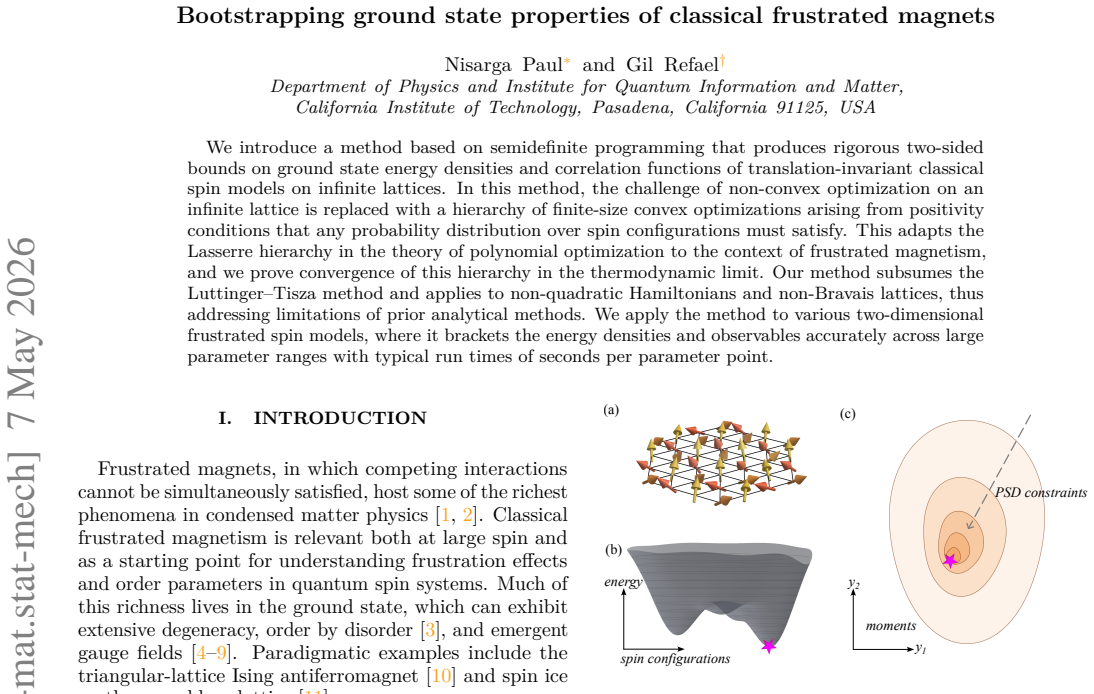
We introduce a method based on semidefinite programming that produces rigorous two-sided bounds on ground state energy densities and correlation functions of translation-invariant classical spin models on infinite lattices. In this method, the challenge of non-convex optimization on an infinite lattice is replaced with a hierarchy of finite-size convex optimizations arising from positivity conditions that any probability distribution over spin configurations must satisfy. This adapts the Lasserre hierarchy in the theory of polynomial optimization to the context of frustrated magnetism, and we prove convergence of this hierarchy in the thermodynamic limit. Our method subsumes the Luttinger--Tisza method and further applies to non-quadratic Hamiltonians and non-Bravais lattices, thus addressing limitations of prior analytical methods. We apply the method to various two-dimensional frustrated spin models, where it brackets the energy densities and observables accurately across large parameter ranges with typical run times of seconds per parameter point.
Editorial analysis
A structured set of objections, weighed in public.
Referee Report
Summary. The paper introduces a semidefinite programming method adapting the Lasserre hierarchy to produce rigorous two-sided bounds on ground-state energy densities and correlation functions for translation-invariant classical spin models on infinite lattices. It replaces non-convex optimization over infinite configurations with a hierarchy of finite-size convex SDPs based on positivity conditions, proves convergence of the hierarchy to the true thermodynamic-limit values, subsumes the Luttinger-Tisza method, and extends to non-quadratic Hamiltonians and non-Bravais lattices. Numerical applications to 2D frustrated models are presented with reported run times of seconds per parameter point.
Significance. If the convergence result holds, the work supplies a practical, rigorous computational framework for ground-state properties of classical frustrated magnets that overcomes limitations of prior analytical techniques. The explicit proof of thermodynamic-limit convergence and the ability to handle general Hamiltonians on arbitrary lattices are notable strengths, as is the reported computational efficiency for parameter scans. This could enable systematic exploration of models where exact solutions are unavailable.
major comments (2)
- [§3] §3 (Convergence theorem): The proof that the adapted hierarchy converges to the infimum over translation-invariant measures must explicitly address how translation invariance is enforced exactly in the finite-cluster moment matrices while ensuring the positivity constraints become dense; any gap in the weak-* compactness argument for non-Bravais lattices would leave a finite separation in the limit, undermining the two-sided bounds claim.
- [§4.2] §4.2, Eq. (12): The local marginal consistency conditions for non-Bravais lattices are stated but the manuscript does not show that they remain sufficient to close the hierarchy without introducing additional free parameters when the unit cell contains multiple sites; this affects the parameter-free character asserted for the bounds.
minor comments (2)
- [Figure 2] Figure 2 caption: the shading used to indicate bound tightness is difficult to distinguish in grayscale; consider adding a second panel or line styles.
- [§2] Notation: the symbol for the relaxation order is introduced in §2 but reused with a different meaning in the numerical section; consistent subscripting would improve readability.
Simulated Author's Rebuttal
We thank the referee for their positive evaluation and for highlighting areas where the convergence proof and non-Bravais lattice treatment require greater explicitness. We address each major comment below and have revised the manuscript to strengthen the presentation without altering the core claims.
read point-by-point responses
-
Referee: [§3] §3 (Convergence theorem): The proof that the adapted hierarchy converges to the infimum over translation-invariant measures must explicitly address how translation invariance is enforced exactly in the finite-cluster moment matrices while ensuring the positivity constraints become dense; any gap in the weak-* compactness argument for non-Bravais lattices would leave a finite separation in the limit, undermining the two-sided bounds claim.
Authors: The original proof in §3 constructs the moment matrices from finite clusters with periodic boundary conditions that are exactly translation-invariant by design, and shows that the positivity constraints on these matrices become dense in the weak-* topology of translation-invariant measures as the hierarchy order increases (via the density of continuous functions on the compact configuration space). For non-Bravais lattices the argument extends by working with the product measure space over the finite unit cell, where weak-* compactness follows from the Banach-Alaoglu theorem applied to the dual of C(X) with X the compact space of unit-cell configurations; this precludes any finite gap in the limit. We have added a dedicated paragraph in the revised §3 that spells out these steps explicitly, including the precise statement of the weak-* limit for multi-site unit cells. revision: yes
-
Referee: [§4.2] §4.2, Eq. (12): The local marginal consistency conditions for non-Bravais lattices are stated but the manuscript does not show that they remain sufficient to close the hierarchy without introducing additional free parameters when the unit cell contains multiple sites; this affects the parameter-free character asserted for the bounds.
Authors: Equation (12) imposes marginal consistency over the entire unit cell at once, so that all sublattice moments are jointly constrained by a single set of linear equalities on the moment matrix entries. Because the SDP variables are precisely the moments of the joint distribution on the unit-cell spins (up to the chosen order), no auxiliary free parameters are introduced; the hierarchy closes exactly as in the Bravais case. We have inserted a short explanatory paragraph immediately after Eq. (12) that derives the dimension count and confirms that the feasible set remains defined solely by the positivity and consistency constraints, preserving the parameter-free character of the resulting bounds. revision: yes
Circularity Check
No circularity: Lasserre hierarchy adaptation includes an explicit convergence proof for translation-invariant measures
full rationale
The paper replaces non-convex minimization over infinite lattices with a hierarchy of SDPs derived from positivity of moment matrices on finite clusters, then states and proves that the hierarchy converges to the true ground-state energy density and correlations in the thermodynamic limit. This proof is presented as part of the contribution rather than imported via self-citation or defined into existence; the method is shown to subsume Luttinger-Tisza as a special case without re-labeling known results as new derivations. No fitted parameters are relabeled as predictions, no ansatz is smuggled through prior work by the same authors, and the central claims rest on standard SDP duality and weak-* compactness arguments external to the present manuscript.
Axiom & Free-Parameter Ledger
axioms (1)
- domain assumption Any valid probability distribution over spin configurations must satisfy positivity conditions.
Lean theorems connected to this paper
-
IndisputableMonolith/Foundation/RealityFromDistinction.leanreality_from_one_distinction unclear?
unclearRelation between the paper passage and the cited Recognition theorem.
moment matrix L... positive semidefinite... localizing matrix Cr... Cr=0
What do these tags mean?
- matches
- The paper's claim is directly supported by a theorem in the formal canon.
- supports
- The theorem supports part of the paper's argument, but the paper may add assumptions or extra steps.
- extends
- The paper goes beyond the formal theorem; the theorem is a base layer rather than the whole result.
- uses
- The paper appears to rely on the theorem as machinery.
- contradicts
- The paper's claim conflicts with a theorem or certificate in the canon.
- unclear
- Pith found a possible connection, but the passage is too broad, indirect, or ambiguous to say the theorem truly supports the claim.
Reference graph
Works this paper leans on
-
[1]
Lacroix, P
C. Lacroix, P. Mendels, and F. Mila,Introduction to frustrated magnetism: materials, experiments, theory (Springer Science & Business Media, 2011)
2011
-
[2]
Balents, Nature464, 199 (2010)
L. Balents, Nature464, 199 (2010)
2010
-
[3]
Villain, R
J. Villain, R. Bidaux, J.-P. Carton, and R. Conte, J. Phys. (Paris)41, 1263 (1980)
1980
-
[4]
Moessner and J
R. Moessner and J. T. Chalker, Phys. Rev. Lett.80, 2929 (1998)
1998
-
[5]
D. A. Huse, W. Krauth, R. Moessner, and S. L. Sondhi, Phys. Rev. Lett.91, 167004 (2003)
2003
-
[6]
Castelnovo, R
C. Castelnovo, R. Moessner, and S. L. Sondhi, Annu. Rev. Condens. Matter Phys.3, 35 (2012)
2012
-
[7]
J. Rehn, A. Sen, K. Damle, and R. Moessner, Phys. Rev. Lett.117, 167201 (2016)
2016
-
[8]
C. L. Henley, Annu. Rev. Condens. Matter Phys.1, 179 (2010)
2010
-
[9]
J. T. Chalker, P. C. Holdsworth, and E. Shender, Phys. Rev. Lett.68, 855 (1992)
1992
-
[10]
G. H. Wannier, Phys. Rev.79, 357 (1950)
1950
-
[11]
S. T. Bramwell and M. J. Gingras, Science294, 1495 (2001)
2001
-
[12]
Barahona, J
F. Barahona, J. Phys. A: Math. Gen.15, 3241 (1982)
1982
-
[13]
Lucas, Front
A. Lucas, Front. Phys.2, 74887 (2014)
2014
-
[14]
Luttinger and L
J. Luttinger and L. Tisza, Phys. Rev.70, 954 (1946)
1946
-
[15]
Lyons and T
D. Lyons and T. Kaplan, Phys. Rev.120, 1580 (1960)
1960
-
[16]
Hukushima and K
K. Hukushima and K. Nemoto, J. Phys. Soc. Jpn.65, 1604 (1996)
1996
-
[17]
D. J. Earl and M. W. Deem, Phys. Chem. Chem. Phys. 7, 3910 (2005)
2005
-
[18]
El-Showk, M
S. El-Showk, M. F. Paulos, D. Poland, S. Rychkov, D. Simmons-Duffin, and A. Vichi, Physical Review D—Particles, Fields, Gravitation, and Cosmology86, 025022 (2012)
2012
-
[19]
H. W. Lin, Journal of High Energy Physics2020, 90 (2020)
2020
-
[20]
X. Han, S. A. Hartnoll, and J. Kruthoff, Phys. Rev. Lett. 125, 041601 (2020)
2020
- [21]
-
[22]
P. W. Anderson, Phys. Rev.83, 1260 (1951)
1951
-
[23]
Barthel and R
T. Barthel and R. H¨ ubener, Phys. Rev. Lett.108, 200404 (2012)
2012
-
[24]
Q. Gao, R. A. Lanzetta, P. Ledwith, J. Wang, and E. Kha- laf, Physical Review X15, 031034 (2025)
2025
- [25]
-
[26]
A. C. Doherty, P. A. Parrilo, and F. M. Spedalieri, Physi- cal Review A69, 022308 (2004)
2004
-
[27]
Navascu´ es, S
M. Navascu´ es, S. Pironio, and A. Ac´ ın, Physical Review Letters98, 010401 (2007). 8
2007
-
[28]
Navascu´ es, S
M. Navascu´ es, S. Pironio, and A. Ac´ ın, New Journal of Physics10, 073013 (2008)
2008
-
[29]
A. J. Coleman, Rev. Mod. Phys.35, 668 (1963)
1963
-
[30]
Nakata, H
M. Nakata, H. Nakatsuji, M. Ehara, M. Fukuda, K. Nakata, and K. Fujisawa, J. Chem. Phys.114, 8282 (2001)
2001
-
[31]
D. A. Mazziotti, Phys. Rev. Lett.93, 213001 (2004)
2004
- [32]
-
[33]
M. B. Hastings and R. O’Donnell, inProceedings of the 54th annual ACM SIGACT symposium on theory of com- puting(2022) pp. 776–789
2022
-
[34]
J. B. Lasserre, SIAM J. Optim.11, 796 (2001)
2001
-
[35]
J. B. Lasserre, inProceedings of the International Congress of Mathematicians: Rio de Janeiro 2018(World Scientific, 2018) pp. 3773–3794
2018
-
[36]
ApS,The MOSEK Python Fusion API manual
M. ApS,The MOSEK Python Fusion API manual. Ver- sion 11.0.(2025)
2025
-
[37]
J. B. Lasserre,Moments, positive polynomials and their applications, Vol. 1 (World Scientific, 2009)
2009
-
[38]
Rudin,Fourier Analysis on Groups, reprint of the 1962 original ed., Wiley Classics Library (John Wiley & Sons, New York, 1990)
W. Rudin,Fourier Analysis on Groups, reprint of the 1962 original ed., Wiley Classics Library (John Wiley & Sons, New York, 1990)
1962
-
[39]
JuMP 1.0: recent improvements to a modeling language for mathematical optimization
M. Lubin, O. Dowson, J. Dias Garcia, J. Huchette, B. Legat, and J. P. Vielma, Mathematical Programming Computation 10.1007/s12532-023-00239-3 (2023)
-
[40]
L¨ auchli, F
A. L¨ auchli, F. Mila, and K. Penc, Phys. Rev. Lett.97, 087205 (2006)
2006
-
[41]
Tsunetsugu and M
H. Tsunetsugu and M. Arikawa, J. Phys. Soc. Jpn.75, 083701 (2006)
2006
-
[42]
Fantuzzi, D
G. Fantuzzi, D. Goluskin, D. Huang, and S. I. Chernyshenko, SIAM Journal on Applied Dynamical Sys- tems15, 1962 (2016)
1962
- [43]
-
[44]
Cho, SciPost Physics19, 124 (2025)
M. Cho, SciPost Physics19, 124 (2025)
2025
-
[45]
Schm¨ udgen,The Moment Problem, Graduate Texts in Mathematics, Vol
K. Schm¨ udgen,The Moment Problem, Graduate Texts in Mathematics, Vol. 277 (Springer, Cham, 2017)
2017
-
[46]
Billingsley,Probability and Measure, 3rd ed
P. Billingsley,Probability and Measure, 3rd ed. (John Wiley & Sons, New York, 1995). Appendix A: The Lasserre hierarchy The SDP bootstrap of Sec. II C is an instance of the Lasserre hierarchy [34, 37], a general framework for poly- nomial optimization via semidefinite relaxations. We review the Lasserre hierarchy briefly here. Suppose we wish to find the ...
1995
-
[47]
thetruncated moment matrix MP,r(y) := ( y[α+β] ) α,β∈BP,r (B20) is positive semidefinite
-
[48]
Together, these conditions define thefeasible set FP,r
for every sitei∈Pand everyα,β∈BP,r−1, ∑ a=x,y,z y[α+β+2ei,a] =y [α+β],(B21) which encodes|Si|2 = 1 at the level of moments. Together, these conditions define thefeasible set FP,r. We may now define the SDP lower bound at patchP and hierarchy levelrby εP,r := min y∈FP,r ⟨E⟩y.(B22) This is the quantity produced by the bootstrap. It is a lower bound on the t...
discussion (0)
Sign in with ORCID, Apple, or X to comment. Anyone can read and Pith papers without signing in.