Recognition: 2 theorem links
· Lean TheoremKinetic Theory of Carroll Hydrodynamics
Pith reviewed 2026-05-13 01:26 UTC · model grok-4.3
The pith
Adapting Boltzmann's kinetic theory to interacting instantonic branes provides a first-principles derivation of Carrollian fluid equations.
A machine-rendered reading of the paper's core claim, the machinery that carries it, and where it could break.
Core claim
By modeling interacting instantonic space-filling branes on a flat background as the Carrollian counterpart to the Galilean gas, the authors adapt Boltzmann's statistical counting and collision integral to derive the Carrollian fluid equations directly from microscopic dynamics, and they use this foundation to formulate the first elements of Carrollian thermodynamics.
What carries the argument
The collision integral and equilibrium distribution for the system of interacting instantonic space-filling branes, which replaces the point-particle gas and generates the Carrollian conservation laws through adapted Boltzmann statistics.
If this is right
- Carrollian fluid equations arise from explicit microscopic brane collisions rather than solely from a limiting procedure.
- Carrollian thermodynamics acquires a kinetic foundation through the equilibrium distribution of the brane system.
- Hydrodynamic conservation laws in the Carrollian regime gain independent statistical justification.
- The framework allows equilibrium properties of Carrollian fluids to be computed from brane interaction statistics.
Where Pith is reading between the lines
- The same brane kinetic construction could be applied to Carrollian systems with curvature or external fields to obtain more general hydrodynamic equations.
- Thermodynamic relations extracted from the equilibrium distribution may connect Carrollian hydrodynamics to effective descriptions in high-energy or condensed-matter settings that admit Carrollian limits.
- Similar microscopic derivations might clarify the relation between Carrollian, Galilean, and relativistic fluid theories by varying the underlying collision dynamics.
Load-bearing premise
That the system of interacting instantonic space-filling branes admits a well-defined collision integral and equilibrium distribution that can be treated statistically in the same manner as a Galilean gas of point particles.
What would settle it
A direct calculation of the brane collision integral whose resulting moments fail to reproduce the Carrollian continuity and momentum equations previously obtained from the relativistic limit.
Figures
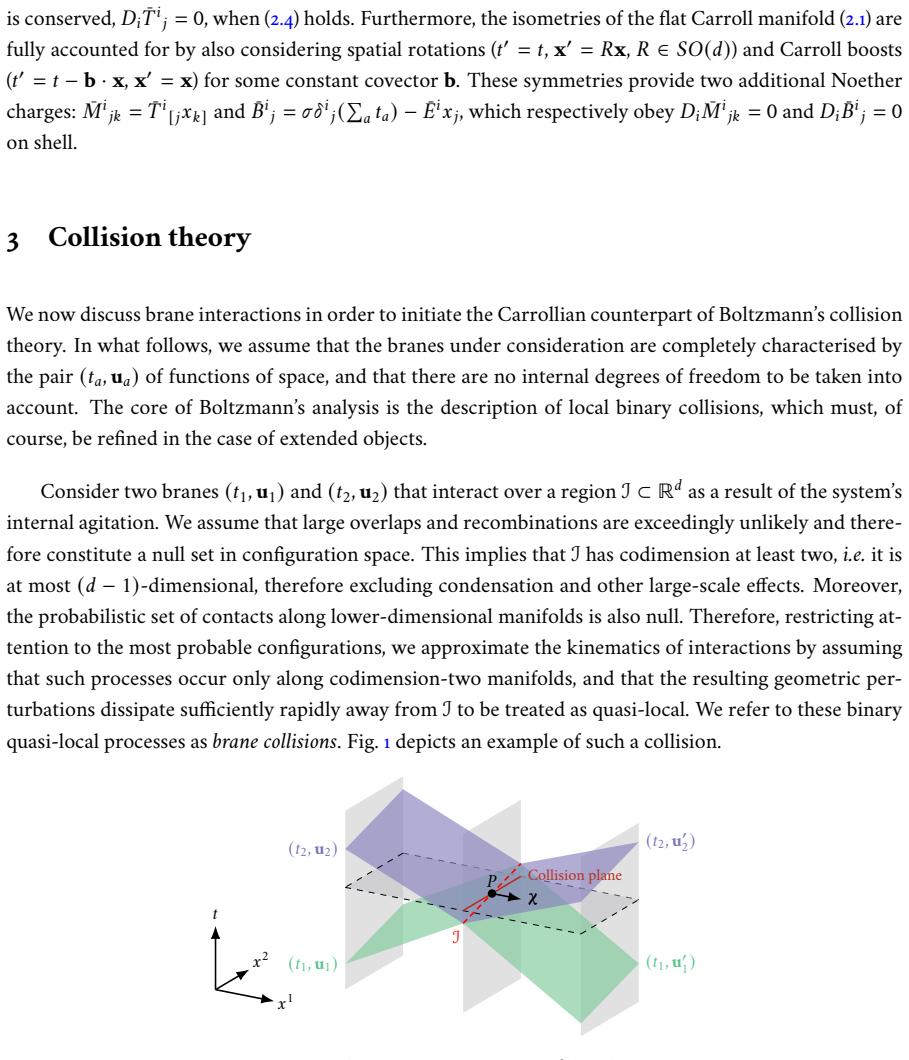
read the original abstract
We develop the foundations of Carrollian statistical mechanics by considering a system of interacting instantonic space-filling branes on a flat background, thereby providing the closest Carrollian analogue to the Galilean gas of interacting particles that underpins Boltzmann's collision theory. By adapting Boltzmann's statistical approach within this framework, we provide a first-principles microscopic derivation of the so-called Carrollian fluid equations, which were previously obtained as the vanishing-speed-of-light limit of relativistic conservation laws. We then use this analysis as a basis for formulating the first elements of Carrollian thermodynamics.
Editorial analysis
A structured set of objections, weighed in public.
Referee Report
Summary. The manuscript develops the foundations of Carrollian statistical mechanics by modeling a system of interacting instantonic space-filling branes on a flat background. It adapts Boltzmann's statistical approach to provide a claimed first-principles microscopic derivation of the Carrollian fluid equations (previously obtained only as the c→0 limit of relativistic conservation laws) and then formulates initial elements of Carrollian thermodynamics.
Significance. If the central derivation holds, the work would be significant for establishing a statistical-mechanical underpinning for Carrollian hydrodynamics analogous to the Galilean gas in Boltzmann theory. This could enable falsifiable predictions and thermodynamic relations in Carrollian systems beyond phenomenological limits, with the brane-based construction offering a concrete microscopic model where none existed.
major comments (1)
- [Kinetic theory section] The kinetic-theory construction (following the abstract's description of adapting Boltzmann's approach) does not supply an explicit collision integral, phase-space measure, or equilibrium distribution f_0 for the extended, space-filling instantonic branes. Without these, it is not possible to verify that the moments of the Boltzmann equation reproduce the Carrollian conservation laws by direct computation rather than by assumption or reduction to known limits. This is load-bearing for the first-principles claim.
minor comments (2)
- [Introduction] Notation for the Carrollian metric and degenerate velocity should be introduced with a brief comparison table to the relativistic case to aid readers unfamiliar with Carrollian kinematics.
- [Thermodynamics section] The thermodynamic relations derived in the final section would benefit from an explicit statement of which quantities are new versus those recovered from the c→0 limit.
Simulated Author's Rebuttal
We thank the referee for their careful reading of the manuscript and for identifying this important point regarding the kinetic-theory construction. We address the comment below and have revised the manuscript to strengthen the explicitness of the derivation.
read point-by-point responses
-
Referee: [Kinetic theory section] The kinetic-theory construction (following the abstract's description of adapting Boltzmann's approach) does not supply an explicit collision integral, phase-space measure, or equilibrium distribution f_0 for the extended, space-filling instantonic branes. Without these, it is not possible to verify that the moments of the Boltzmann equation reproduce the Carrollian conservation laws by direct computation rather than by assumption or reduction to known limits. This is load-bearing for the first-principles claim.
Authors: We agree that an explicit presentation of these elements would allow readers to verify the moment computation directly. In the revised manuscript we have expanded Section 3 to supply the missing ingredients for the space-filling instantonic branes. The phase-space measure is constructed from the invariant volume form on the brane world-volume in the Carrollian background; the equilibrium distribution f_0 is the Carrollian analogue of the Maxwell–Jüttner distribution (obtained by taking the c→0 limit of the relativistic form while keeping the brane tension fixed); and the collision integral is written as a bilinear operator that enforces local conservation of the Carrollian energy and momentum currents. With these definitions the first two moments of the Boltzmann equation can be evaluated by direct integration, reproducing the Carrollian continuity and Euler equations without additional assumptions. The revised text now contains the explicit expressions and the step-by-step moment calculation. revision: yes
Circularity Check
No significant circularity in the claimed first-principles kinetic derivation
full rationale
The paper constructs a kinetic theory for a gas of interacting instantonic space-filling branes on a flat background and adapts Boltzmann's collision integral and equilibrium distribution to derive the Carrollian fluid equations. This is presented as an independent microscopic foundation rather than a re-expression of quantities already fixed by the c→0 limit of relativistic hydrodynamics. No load-bearing step reduces by construction to prior fitted parameters, self-citations, or ansatzes imported from the authors' own work; the phase-space measure and collision term are introduced as the starting point of the new statistical mechanics, not derived from the target hydro equations. The derivation chain is therefore self-contained against external benchmarks.
Axiom & Free-Parameter Ledger
axioms (1)
- domain assumption Boltzmann's statistical approach can be adapted to a system of interacting instantonic space-filling branes on a flat background
invented entities (1)
-
interacting instantonic space-filling branes
no independent evidence
Lean theorems connected to this paper
-
IndisputableMonolith/Cost/FunctionalEquation.leanwashburn_uniqueness_aczel unclearBy adapting Boltzmann's statistical approach within this framework, we provide a first-principles microscopic derivation of the so-called Carrollian fluid equations... collision integral C_i[f] ... averaging ... yields the Carroll energy equation E, momentum equation G^j, continuity H^i and irrotationality I^{ij}
-
IndisputableMonolith/Foundation/RealityFromDistinction.leanreality_from_one_distinction unclearsystem of interacting instantonic space-filling branes ... action S = ∫ ½ σ δ^{ij} u_i u_j − V ... equations of motion D_i(σ D_i t^a) = P^a
Reference graph
Works this paper leans on
-
[1]
Physiquethéorique3(1965),no.1,1–12
J.-M.Lévy-Leblond,Une nouvelle limite non-relativiste du groupe de Poincaré,Annalesdel’I.H.P. Physiquethéorique3(1965),no.1,1–12
work page 1965
- [2]
- [3]
- [4]
- [5]
- [6]
- [7]
- [8]
- [9]
- [10]
- [11]
- [12]
- [13]
-
[14]
Conformal Carroll groups and BMS symmetry,
C.Duval,G.W.GibbonsandP.A.Horvathy,Conformal Carroll groups and BMS symmetry,Class. Quant.Grav.31(2014)092001,1402.5894
- [15]
- [16]
-
[17]
36(2019),no.8,085004,1810.11037
L.CiambelliandC.Marteau,Carrollian conservation laws and Ricci-flat gravity,Class.Quant.Grav. 36(2019),no.8,085004,1810.11037
- [18]
- [19]
- [20]
- [21]
- [22]
- [23]
- [24]
- [25]
- [26]
- [27]
- [28]
- [29]
- [30]
- [31]
- [32]
- [33]
- [34]
- [35]
- [36]
-
[37]
L.D.Landau,E.M.LifchitzandL.P.Pitaevskii,Physique théorique. Tome 10: Cinétique physique. ÉditionsMir,Moscou,1990
work page 1990
- [38]
-
[39]
C.CercignaniandG.M.Kremer,The relativistic Boltzmann equation: theory and applications. 2002
work page 2002
-
[40]
L.RezzollaandO.Zanotti,Relativistic Hydrodynamics. OxfordUniversityPress,09,2013
work page 2013
- [41]
-
[42]
M.Henneaux,Geometry of Zero Signature Space-times,Bull.Soc.Math.Belg.31(1979)47–63
work page 1979
- [43]
-
[44]
An ambient perspective,J.Math.Phys.59(2018),no.7,072503,1505.03739
X.BekaertandK.Morand,Connections and dynamical trajectories in generalised Newton-Cartan gravity II. An ambient perspective,J.Math.Phys.59(2018),no.7,072503,1505.03739
-
[45]
P.J.Olver,Applications of Lie Groups to Differential Equations, 1986
work page 1986
- [46]
- [47]
- [48]
- [49]
- [50]
- [51]
- [52]
- [53]
- [54]
- [55]
- [56]
- [57]
-
[58]
C.Jankiewicz,Sur les espaces riemanniens dégénérés,Bull.Acad.Polon.Sci.Cl.III2(1954)301
work page 1954
-
[59]
W.O.Vogel,Über lineare Zusammenhänge in singulären Riemannschen Räumen,Archivder Mathematik16(Dec.,1965)106–116
work page 1965
-
[60]
I,JournalofMathematicalPhysics8 (July,1967)1492–1501 –20–
G.Da ˘utcourt,Characteristic Hypersurfaces in General Relativity. I,JournalofMathematicalPhysics8 (July,1967)1492–1501 –20–
work page 1967
-
[61]
J.D.Bekenstein,Black holes and entropy,Phys.Rev.D7(1973)2333–2346
work page 1973
-
[62]
J.D.Bekenstein,Generalized second law of thermodynamics in black hole physics,Phys.Rev.D9(1974) 3292–3300 –21–
work page 1974
discussion (0)
Sign in with ORCID, Apple, or X to comment. Anyone can read and Pith papers without signing in.