Recognition: 2 theorem links
· Lean TheoremHidden Monsters with SPHEREx I: A goldmine for heavily reddened quasars at cosmic noon
Pith reviewed 2026-05-11 01:01 UTC · model grok-4.3
The pith
SPHEREx confirms 77 new heavily reddened quasars that are deficient in hot dust and mark a blow-out phase of black hole growth.
A machine-rendered reading of the paper's core claim, the machinery that carries it, and where it could break.
Core claim
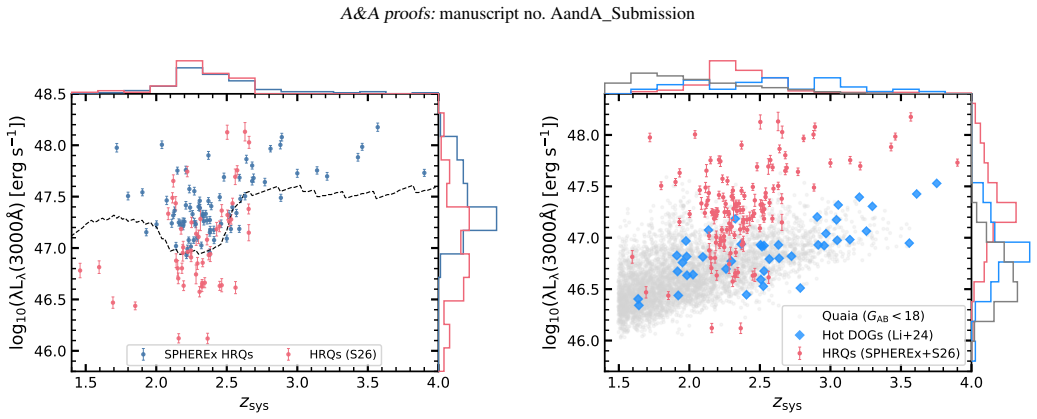
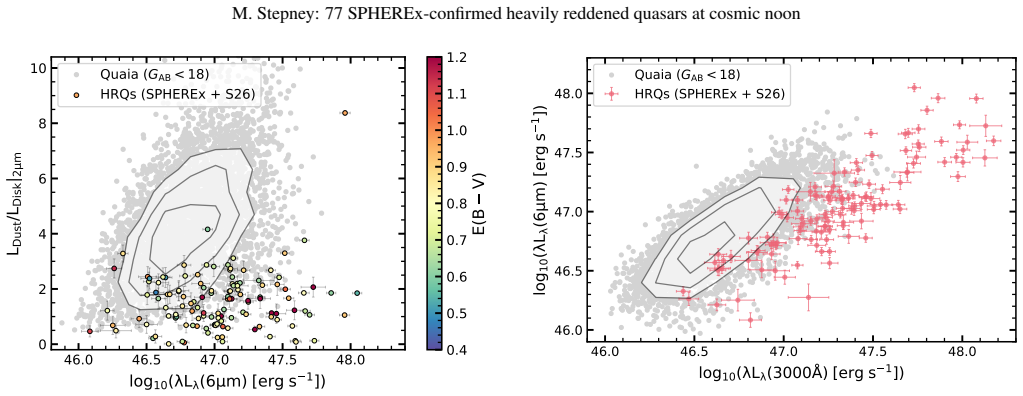
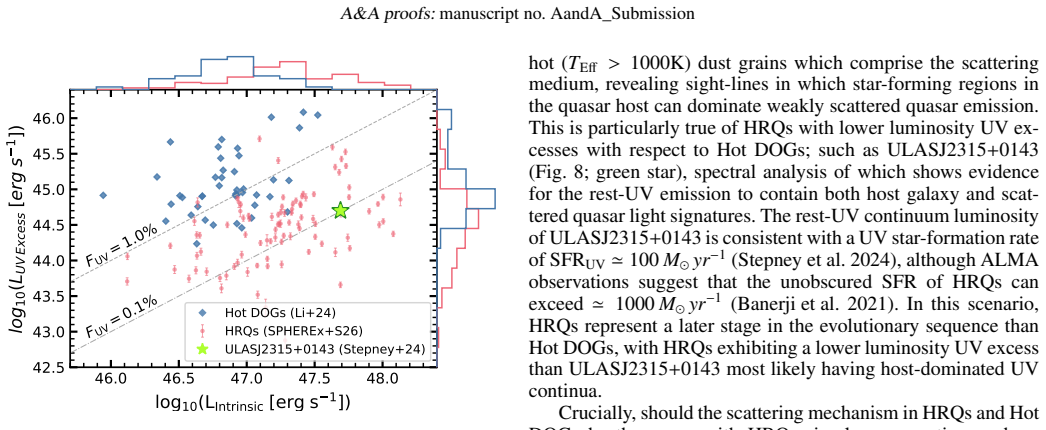
We confirm 77 new HRQs with redshifts 1.5 < z < 3.9, dust-corrected optical continuum luminosities log10(λLλ(3000Å)) > 47.0, and line-of-sight extinctions 0.4 < E(B-V) < 1.6. This more than doubles the known HRQs at z > 1.5, including the first seven at z > 3. A UV excess consistent with scattered quasar emission is detected in 76% of HRQs. We show that HRQs are hot-dust poor compared to blue quasars of similar luminosity and redshift. Their 6μm continuum luminosities are systematically fainter at fixed 3000Å continuum luminosity relative to blue Quaia quasars, indicating deficiency in both hot and warm dust. These results support a scenario in which HRQs represent a blow-out phase, where强反馈
What carries the argument
Red near-infrared color selection (J-K)AB > 1.6 combined with SPHEREx spectrophotometry for confirmation, redshift measurement, and multiwavelength SED fitting that reveals hot-dust deficiency relative to luminosity-matched unobscured quasars.
Load-bearing premise
Red near-infrared colors plus SED fitting can reliably isolate genuine heavily reddened quasars without significant contamination from other red AGN or galaxies, and the comparison samples provide fair luminosity-matched benchmarks.
What would settle it
Follow-up spectroscopy showing that a substantial fraction of the 77 photometrically selected candidates lack broad emission lines characteristic of quasars would undermine the sample confirmation and the dust-deficiency trends.
Figures



read the original abstract
Heavily reddened quasars (HRQs) are luminous, dust-obscured broad-line quasars thought to represent a short-lived phase of intense black hole growth and feedback. Previous studies have been limited by small sample sizes, restricting robust statistical analysis. We expand the sample of the most luminous HRQs to enable population-level studies, connecting their spectral energy distributions (SEDs) to other quasar populations and placing them within an evolutionary sequence of massive galaxy and black hole formation. We assemble multiwavelength broadband photometry for the brightest HRQ candidates (K$_{AB}$ < 18 mag) and select AGN with red near-infrared colours (J-K)$_{AB}$ > 1.6. Using SPHEREx spectrophotometry, we confirm HRQs and determine redshifts. Detailed SED fitting allows comparison with other luminous quasars, including a control sample of hyper-luminous, unobscured Quaia quasars and luminous Hot Dust-Obscured Galaxies (Hot DOGs). We confirm 77 new HRQs with redshifts 1.5 < z < 3.9, dust-corrected optical continuum luminosities log$_{10}(\lambda L_\lambda (3000A)$ [erg/s])>47.0, and line-of-sight extinctions 0.4 < E(B-V) < 1.6 (A$_V$ mag). This more than doubles the known HRQs at z > 1.5, including the first seven at z > 3. A UV excess consistent with scattered quasar emission is detected in 76% of HRQs. We show that HRQs are hot-dust poor compared to blue quasars of similar luminosity and redshift. Their 6um continuum luminosities are systematically fainter at fixed 3000A continuum luminosity relative to blue Quaia quasars, indicating deficiency in both hot and warm dust. These results support a scenario in which HRQs represent a blow-out phase, where strong feedback begins clearing obscuring material from central regions.
Editorial analysis
A structured set of objections, weighed in public.
Referee Report
Summary. The paper claims to have assembled multiwavelength photometry for K_AB < 18 candidates with (J-K)_AB > 1.6, used SPHEREx spectrophotometry to confirm 77 new heavily reddened quasars (HRQs) at 1.5 < z < 3.9 with log10(λLλ(3000Å)) > 47.0 and 0.4 < E(B-V) < 1.6, detected UV excess in 76% of them, and shown via SED fitting that these HRQs are hot-dust poor (fainter 6μm continuum at fixed dust-corrected 3000Å luminosity) relative to luminosity-matched blue Quaia quasars and Hot DOGs, supporting an evolutionary blow-out phase.
Significance. If the sample purity and comparative analysis hold, this more than doubles the known luminous HRQ population at z > 1.5 (including the first seven at z > 3) and supplies a statistically useful dataset for population studies of obscured AGN. The direct observational counts, SPHEREx-based redshift and extinction measurements, and the reported hot-dust deficiency provide concrete constraints on feedback models during the obscured-to-unobscured transition. The work is strengthened by its use of an independent control sample and focus on the most luminous end.
major comments (2)
- [§4] §4 (comparison with Quaia sample): the central result that HRQs are systematically fainter at 6μm for fixed dust-corrected 3000Å luminosity rests on luminosity and redshift matching, but the manuscript does not present a quantitative test of selection-function overlap, completeness corrections, or how the red-tail selection of HRQs versus the broader optically selected Quaia population affects the offset. This leaves open the possibility that the apparent hot-dust deficiency is partly an artifact of differential sampling of the underlying distribution rather than intrinsic.
- [§3.2] §3.2 (SED fitting and sample validation): the claim that the (J-K)_AB > 1.6 cut plus SPHEREx SED fitting reliably isolates genuine HRQs with minimal contamination from other red AGN or galaxies is load-bearing for the headline count of 77 objects and the subsequent population comparisons, yet the paper provides limited validation (e.g., no mock-catalog tests or additional diagnostics quantifying the contamination fraction).
minor comments (3)
- [Abstract] Abstract: the 76% UV-excess fraction is stated without uncertainties or a brief description of how it was measured; add error bars and a one-sentence method reference.
- Figure captions and text: ensure consistent notation for luminosities (e.g., always specify dust-corrected vs. observed) and clearly label which panels show the Quaia and Hot DOG control samples.
- [§2] §2 (data): a short table summarizing the final sample properties (median redshift, luminosity, E(B-V)) would improve readability.
Simulated Author's Rebuttal
We thank the referee for their careful reading and constructive comments, which have helped us improve the clarity and robustness of the manuscript. We address each major comment below and have revised the paper accordingly where possible.
read point-by-point responses
-
Referee: [§4] §4 (comparison with Quaia sample): the central result that HRQs are systematically fainter at 6μm for fixed dust-corrected 3000Å luminosity rests on luminosity and redshift matching, but the manuscript does not present a quantitative test of selection-function overlap, completeness corrections, or how the red-tail selection of HRQs versus the broader optically selected Quaia population affects the offset. This leaves open the possibility that the apparent hot-dust deficiency is partly an artifact of differential sampling of the underlying distribution rather than intrinsic.
Authors: We agree that a quantitative assessment of selection-function overlap would strengthen the comparison. In the revised manuscript we have added a dedicated paragraph in §4 that describes the differing selection functions (optical color for Quaia versus near-IR color plus SPHEREx confirmation for HRQs) and shows that the 6 μm offset remains statistically significant when the samples are matched in both luminosity and redshift using two independent binning schemes. Full completeness corrections for the red-tail selection would require end-to-end simulations of the parent photometric catalogs, which are beyond the scope of the present work; we now explicitly note this limitation and state that the observed deficiency is robust within the matched parameter space but could be refined with future simulations. revision: partial
-
Referee: [§3.2] §3.2 (SED fitting and sample validation): the claim that the (J-K)_AB > 1.6 cut plus SPHEREx SED fitting reliably isolates genuine HRQs with minimal contamination from other red AGN or galaxies is load-bearing for the headline count of 77 objects and the subsequent population comparisons, yet the paper provides limited validation (e.g., no mock-catalog tests or additional diagnostics quantifying the contamination fraction).
Authors: The primary validation in the manuscript comes from the high-quality SPHEREx spectrophotometric fits to reddened quasar templates, the detection of UV excess in 76 % of the objects (consistent with scattered quasar light), and the consistency of the derived redshifts and extinctions with the small number of previously known HRQs. We acknowledge that mock-catalog tests would provide a more rigorous contamination estimate. In the revision we have expanded §3.2 with additional diagnostics, including the distribution of fit residuals and a direct comparison of our sample properties against literature compilations of red AGN and galaxies. Generating comprehensive mocks for the SPHEREx selection function is computationally demanding and we have added an explicit statement that a full contamination fraction from mocks remains a goal for future work. revision: partial
Circularity Check
No significant circularity; results are direct observational counts and external comparisons
full rationale
The paper's derivation chain consists of color-based candidate selection ((J-K)AB > 1.6, KAB < 18), SPHEREx spectrophotometric confirmation of redshifts and AGN nature, and SED fitting to derive dust-corrected luminosities and extinctions. These measured quantities are then compared against independent external catalogs (Quaia hyper-luminous quasars and Hot DOGs) for the hot-dust deficiency claim. No equation or central result reduces by construction to a parameter fitted from the same HRQ sample; the blow-out phase interpretation is explicitly labeled as a scenario supported by the trends rather than a fitted output. The analysis is self-contained against external benchmarks with no load-bearing self-citation or self-definitional steps.
Axiom & Free-Parameter Ledger
axioms (2)
- domain assumption Standard quasar SED templates and extinction curves (e.g., SMC or similar) accurately describe the observed photometry after correction.
- domain assumption The control samples (Quaia unobscured quasars and Hot DOGs) are luminosity- and redshift-matched without residual selection biases that would artificially create the observed dust-luminosity offset.
Lean theorems connected to this paper
-
IndisputableMonolith/Cost/FunctionalEquation.leanwashburn_uniqueness_aczel unclearWe confirm 77 new HRQs ... SED fitting allows comparison with ... Quaia quasars and ... Hot DOGs. ... HRQs are hot-dust poor ... 6µm continuum luminosities ... fainter at fixed 3000Å ... supports a blow-out phase.
-
IndisputableMonolith/Foundation/AlphaCoordinateFixation.leanJ_uniquely_calibrated_via_higher_derivative unclearDetailed SED fitting ... two-component model ... dust-attenuated quasar component and ... scattered light component
Reference graph
Works this paper leans on
-
[1]
Monthly Notices of the Royal Astronomical Society , volume =
Stepney, Matthew and Banerji, Manda and Tang, Shenli and Temple, Matthew J and Hewett, Paul C , title =. Monthly Notices of the Royal Astronomical Society , volume =. 2026 , month =. doi:10.1093/mnras/stag191 , url =
-
[2]
Mid-infrared Selection of Active Galactic Nuclei with the Wide-field Infrared Survey Explorer. II. Properties of WISE-selected Active Galactic Nuclei in the NDWFS Bo \"o tes Field. , keywords =. doi:10.1088/0004-637X/772/1/26 , archivePrefix =. 1209.6055 , primaryClass =
-
[3]
Submillimeter Follow-up of WISE-selected Hyperluminous Galaxies. , keywords =. doi:10.1088/0004-637X/756/1/96 , archivePrefix =. 1208.5518 , primaryClass =
-
[4]
Spectral Classification and Ionized Gas Outflows in z 2 WISE-selected Hot Dust-obscured Galaxies. , keywords =. doi:10.3847/1538-4357/ab5e7b , archivePrefix =. 1911.09828 , primaryClass =
-
[5]
Discovery of a Low-redshift Hot Dust-obscured Galaxy. , keywords =. doi:10.3847/1538-4357/ace25b , archivePrefix =. 2305.13739 , primaryClass =
-
[6]
VizieR Online Data Catalog: The VISTA Hemisphere Survey (VHS) catalog DR5 (McMahon+, 2020)
2020
-
[7]
Fast Outflows in Hot Dust-obscured Galaxies Detected with Keck/NIRES. , keywords =. doi:10.3847/1538-4357/abc3bf , archivePrefix =. 2010.10641 , primaryClass =
-
[8]
Powerful Nuclear Outflows and Circumgalactic Medium Shocks Driven by the Most Luminous Known Obscured Quasar in the Universe. , keywords =. doi:10.3847/1538-4357/addbdd , archivePrefix =. 2412.02862 , primaryClass =
-
[9]
The Most Luminous Galaxies Discovered by WISE. , keywords =. doi:10.1088/0004-637X/805/2/90 , archivePrefix =. 1410.1751 , primaryClass =
-
[10]
The UKIRT Hemisphere Survey: definition and J-band data release. , keywords =. doi:10.1093/mnras/stx2622 , archivePrefix =. 1707.09975 , primaryClass =
-
[11]
The Deepest GLIMPSE of a Dense Gas Cocoon Enshrouding a Little Red Dot. arXiv e-prints , keywords =. doi:10.48550/arXiv.2511.07515 , archivePrefix =. 2511.07515 , primaryClass =
-
[12]
Fitzpatrick and Knut Olsen and Frossie Economou and Elizabeth B
Michael J. Fitzpatrick and Knut Olsen and Frossie Economou and Elizabeth B. Stobie and T. C. Beers and Mark Dickinson and Patrick Norris and Abi Saha and Robert Seaman and David R. Silva and Robert A. Swaters and Brian Thomas and Francisco Valdes , title =. Observatory Operations: Strategies, Processes, and Systems V , editor =. 2014 , doi =
2014
-
[13]
R. Nikutta and M. Fitzpatrick and A. Scott and B.A. Weaver , keywords =. Data Lab—A community science platform , journal =. 2020 , issn =. doi:https://doi.org/10.1016/j.ascom.2020.100411 , url =
-
[14]
Jupyter-Enabled Astrophysical Analysis Using Data-Proximate Computing Platforms , year=
Juneau, Stéphanie and Olsen, Knut and Nikutta, Robert and Jacques, Alice and Bailey, Stephen , journal=. Jupyter-Enabled Astrophysical Analysis Using Data-Proximate Computing Platforms , year=
-
[15]
The DECam Local Volume Exploration Survey Data Release 2. , keywords =. doi:10.3847/1538-4365/ac78eb , archivePrefix =. 2203.16565 , primaryClass =
-
[16]
The Sloan Digital Sky Survey Quasar Survey: Quasar Luminosity Function from Data Release 3. , keywords =. doi:10.1086/503559 , archivePrefix =. astro-ph/0601434 , primaryClass =
-
[17]
The Sloan Digital Sky Survey Quasar Catalog. V. Seventh Data Release. , keywords =. doi:10.1088/0004-6256/139/6/2360 , archivePrefix =. 1004.1167 , primaryClass =
-
[18]
The SPHEREx Image and Spectrophotometry Processing Pipeline. arXiv e-prints , keywords =. doi:10.48550/arXiv.2511.15823 , archivePrefix =. 2511.15823 , primaryClass =
-
[19]
The warm outer layer of a Little Red Dot as the source of [Fe II] and collisional Balmer lines with scattering wings. arXiv e-prints , keywords =. doi:10.48550/arXiv.2510.00103 , archivePrefix =. 2510.00103 , primaryClass =
-
[20]
JWST's little red dots: an emerging population of young, low-mass AGN cocooned in dense ionized gas. arXiv e-prints , keywords =. doi:10.48550/arXiv.2503.16595 , archivePrefix =. 2503.16595 , primaryClass =
-
[21]
JWST UNCOVER: Extremely Red and Compact Object at z _ phot ≃ 7.6 Triply Imaged by A2744. , keywords =. doi:10.3847/1538-4357/acdc9d , archivePrefix =. 2212.10531 , primaryClass =
-
[22]
CAPERS-LRD-z9: A Gas-enshrouded Little Red Dot Hosting a Broad-line Active Galactic Nucleus at z = 9.288. , keywords =. doi:10.3847/2041-8213/ade789 , archivePrefix =. 2505.04609 , primaryClass =
-
[23]
A high black-hole-to-host mass ratio in a lensed AGN in the early Universe. , keywords =. doi:10.1038/s41586-024-07184-8 , archivePrefix =. 2308.05735 , primaryClass =
-
[24]
Fundamental differences in the radio properties of red and blue quasars: evolution strongly favoured over orientation. , keywords =. doi:10.1093/mnras/stz1771 , archivePrefix =. 1905.12108 , primaryClass =
-
[25]
Strahlungs-Emission und Absorption nach der Quantentheorie , journal =
-
[26]
What you see is what you get: empirically measured bolometric luminosities of Little Red Dots. arXiv e-prints , keywords =. doi:10.48550/arXiv.2509.05434 , archivePrefix =. 2509.05434 , primaryClass =
-
[27]
A massive gas outflow outside the line of sight: Imaging polarimetry of the blue excess Hot Dust-Obscured Galaxy W0204─0506. , keywords =. doi:10.1051/0004-6361/202555245 , archivePrefix =. 2504.15913 , primaryClass =
-
[28]
doi:10.1002/andp.19013090310 , adsurl =
Ueber das Gesetz der Energieverteilung im Normalspectrum , journal =. doi:10.1002/andp.19013090310 , adsurl =
-
[29]
A Direct Determination of " h ." , author =. Phys. Rev. , volume =. 1914 , month =. doi:10.1103/PhysRev.4.73.2 , url =
-
[30]
Annalen der Physik , year = 1902, month = jan, volume =
Ueber die lichtelektrische Wirkung. Annalen der Physik , year = 1902, month = jan, volume =. doi:10.1002/andp.19023130510 , adsurl =
-
[31]
Annalen der Physik , year = 1887, month = jan, volume =
Ueber einen Einfluss des ultravioletten Lichtes auf die electrische Entladung. Annalen der Physik , year = 1887, month = jan, volume =. doi:10.1002/andp.18872670827 , adsurl =
-
[32]
Annalen der Physik , year = 1905, month = jan, volume =
\"U ber einen die Erzeugung und Verwandlung des Lichtes betreffenden heuristischen Gesichtspunkt. Annalen der Physik , year = 1905, month = jan, volume =. doi:10.1002/andp.19053220607 , adsurl =
-
[33]
, year = 1926, month = dec, volume =
The Conservation of Photons. , year = 1926, month = dec, volume =. doi:10.1038/118874a0 , adsurl =
-
[34]
Bernstein, Rebecca A. and Freedman, Wendy L. and Madore, Barry F. , title =. 2002 , month =. doi:10.1086/339424 , url =
-
[35]
1969, Nature, 223, 690, doi: 10.1038/223690a0
Galactic Nuclei as Collapsed Old Quasars. , year = 1969, month = aug, volume =. doi:10.1038/223690a0 , adsurl =
-
[36]
Absorption and scattering of light by small particles
-
[37]
Draine, B.T. Interstellar Dust Grains. Annual Review of Astronomy and Astrophysics. 2003. doi:https://doi.org/10.1146/annurev.astro.41.011802.094840
-
[38]
Optical Properties of Dust. arXiv e-prints , keywords =. doi:10.48550/arXiv.0808.4123 , archivePrefix =. 0808.4123 , primaryClass =
-
[39]
Trumpler, Robert J. , title =. Publications of the Astronomical Society of the Pacific , abstract =. 1930 , month =. doi:10.1086/124039 , url =
-
[40]
Ist die Tr \"a gheit eines K \"o rpers von seinem Energieinhalt abh \"a ngig?. Annalen der Physik , year = 1905, month = jan, volume =. doi:10.1002/andp.19053231314 , adsurl =
-
[41]
Zur Elektrodynamik bewegter K \"o rper
Zur Elektrodynamik bewegter K \"o rper. Annalen der Physik , year = 1905, month = jan, volume =. doi:10.1002/andp.19053221004 , adsurl =
-
[42]
, year = 1925, month = mar, volume =
A limiting case in the theory of radiative equilibrium. , year = 1925, month = mar, volume =. doi:10.1093/mnras/85.5.408 , adsurl =
-
[43]
Clerk , title =
Maxwell, J. Clerk , title =. Philosophical Transactions of the Royal Society of London , year =
-
[44]
A remarkable Ruby: Absorption in dense gas, rather than evolved stars, drives the extreme Balmer break of a Little Red Dot at z=3.5. arXiv e-prints , keywords =. doi:10.48550/arXiv.2503.16600 , archivePrefix =. 2503.16600 , primaryClass =
-
[45]
Unified models for active galactic nuclei and quasars. , keywords =. doi:10.1146/annurev.aa.31.090193.002353 , adsurl =
-
[46]
Unified Schemes for Radio-Loud Active Galactic Nuclei. , keywords =. doi:10.1086/133630 , archivePrefix =. astro-ph/9506063 , primaryClass =
work page internal anchor Pith review Pith/arXiv arXiv doi:10.1086/133630
-
[47]
P., Matthee, J., Katz, H., et al
A ``Black Hole Star'' Reveals the Remarkable Gas-Enshrouded Hearts of the Little Red Dots. arXiv e-prints , keywords =. doi:10.48550/arXiv.2503.16596 , archivePrefix =. 2503.16596 , primaryClass =
-
[48]
A big red dot: scattered light, host galaxy signatures, and multiphase gas flows in a luminous, heavily reddened quasar at cosmic noon. , keywords =. doi:10.1093/mnras/stae1970 , archivePrefix =. 2408.10403 , primaryClass =
-
[49]
[O III] emission in z 2 quasars with and without broad absorption lines. , keywords =. doi:10.1093/mnras/stae1524 , archivePrefix =. 2406.11968 , primaryClass =
-
[50]
BlackTHUNDER strikes twice: rest-frame Balmer-line absorption and high Eddington accretion rate in a Little Red Dot at z=7.04. arXiv e-prints , keywords =. doi:10.48550/arXiv.2503.11752 , archivePrefix =. 2503.11752 , primaryClass =
work page internal anchor Pith review Pith/arXiv arXiv doi:10.48550/arxiv.2503.11752
-
[51]
Extremely Dense Gas around Little Red Dots and High-redshift Active Galactic Nuclei: A Nonstellar Origin of the Balmer Break and Absorption Features. , keywords =. doi:10.3847/2041-8213/adaebd , archivePrefix =. 2409.07805 , primaryClass =
-
[52]
Little Red Dots: Rapidly Growing Black Holes Reddened by Extended Dusty Flows. , keywords =. doi:10.3847/1538-4357/ada5fb , archivePrefix =. 2407.10760 , primaryClass =
-
[53]
Physical Conditions in the Orion Nebula and an Assessment of Its Helium Abundance. , keywords =. doi:10.1086/170146 , adsurl =
-
[54]
COSMOS-Web: The over-abundance and physical nature of ``little red dots''--Implications for early galaxy and SMBH assembly. arXiv e-prints , keywords =. doi:10.48550/arXiv.2406.10341 , archivePrefix =. 2406.10341 , primaryClass =
-
[55]
Ground-based and Airborne Telescopes , year = 2006, editor =
Completion and commissioning of the Southern African Large Telescope. Ground-based and Airborne Telescopes , year = 2006, editor =. doi:10.1117/12.673750 , adsurl =
-
[56]
, year = 2003, month = jan, volume =
Mass Loss from the Nuclei of Active Galaxies. , year = 2003, month = jan, volume =. doi:10.1146/annurev.astro.41.082801.100328 , adsurl =
-
[57]
and Veilleux, Sylvain , number =
Integral Field Spectroscopy of Massive, Kiloparsec-scale Outflows in the Infrared-luminous QSO Mrk 231. , keywords =. doi:10.1088/2041-8205/729/2/L27 , archivePrefix =. 1102.4349 , primaryClass =
-
[58]
Molecular and Ionized Gas Phases of an AGN-driven Outflow in a Typical Massive Galaxy at z 2. , keywords =. doi:10.3847/1538-4357/aaf6a7 , archivePrefix =. 1807.07074 , primaryClass =
-
[59]
Properties of the multiphase outflows in local (ultra)luminous infrared galaxies. , keywords =. doi:10.1093/mnras/stab1666 , archivePrefix =. 2006.13232 , primaryClass =
-
[60]
, year = 1995, month = sep, volume =
Evolving cooling flows. , year = 1995, month = sep, volume =. doi:10.1093/mnras/276.2.663 , adsurl =
-
[61]
Observational constraints on the influence of active galactic nuclei on the evolution of galaxies
-
[62]
4MOST Consortium Survey 10: The Time-Domain Extragalactic Survey (TiDES). The Messenger , keywords =. doi:10.18727/0722-6691/5129 , archivePrefix =. 1903.02476 , primaryClass =
-
[63]
Reverberation Mapping of Active Galactic Nuclei. , keywords =. doi:10.1086/133140 , adsurl =
-
[64]
The Largest Blueshifts of the [O III] Emission Line in Two Narrow-Line Quasars. , keywords =. doi:10.1086/426075 , archivePrefix =. astro-ph/0409546 , primaryClass =
-
[65]
Blueshifted [O III] Emission: Indications of a Dynamic Narrow-Line Region. , keywords =. doi:10.1086/431722 , archivePrefix =. astro-ph/0505127 , primaryClass =
-
[66]
doi:10.1111/j.1365-2966.2005.09360.x , eprint =
What controls the [OIII] 5007 line strength in active galactic nuclei?. , keywords =. doi:10.1111/j.1365-2966.2005.08841.x , archivePrefix =. astro-ph/0501436 , primaryClass =
-
[67]
Hot Dust and the Near-Infrared Bump in the Continuum Spectra of Quasars and Active Galactic Nuclei. , keywords =. doi:10.1086/165571 , adsurl =
-
[68]
, year = 1856, month = nov, volume =
Magnitudes of Thirty-six of the Minor Planets for the first day of each month of the year 1857. , year = 1856, month = nov, volume =. doi:10.1093/mnras/17.1.12 , adsurl =
-
[69]
The average quasar spectrum in the wavelength range 0.1-0.6 micron. , keywords =. doi:10.1093/mnras/195.4.831 , adsurl =
-
[70]
The UV Continuum of Quasars: Models and SDSS Spectral Slopes. , keywords =. doi:10.1086/521393 , archivePrefix =. 0707.1456 , primaryClass =
-
[71]
Composite Quasar Spectra from the Sloan Digital Sky Survey. , keywords =. doi:10.1086/321167 , archivePrefix =. astro-ph/0105231 , primaryClass =
-
[72]
Multitemperature Blackbody Spectra of Thin Accretion Disks with and without a Zero-Torque Inner Boundary Condition. , keywords =. doi:10.1086/426071 , archivePrefix =. astro-ph/0408209 , primaryClass =
-
[73]
Multitemperature Blackbody Spectrum of a Thin Accretion Disk around a Kerr Black Hole: Model Computations and Comparison with Observations. , keywords =. doi:10.1086/428089 , archivePrefix =. astro-ph/0411583 , primaryClass =
-
[74]
Observational appearance
Black holes in binary systems. Observational appearance. , year = 1973, month = jan, volume =
1973
-
[75]
Radio Jets Clearing the Way Through a Galaxy: Watching Feedback in Action. Science , keywords =. doi:10.1126/science.1240436 , archivePrefix =. 1309.1240 , primaryClass =
-
[76]
The Coevolution of Galaxies and Supermassive Black Holes: Insights from Surveys of the Contemporary Universe. , keywords =. doi:10.1146/annurev-astro-081913-035722 , archivePrefix =. 1403.4620 , primaryClass =
work page internal anchor Pith review doi:10.1146/annurev-astro-081913-035722
-
[77]
A deep Chandra observation of the Perseus cluster: shocks and ripples. , keywords =. doi:10.1046/j.1365-8711.2003.06902.x , archivePrefix =. astro-ph/0306036 , primaryClass =
-
[78]
Asymmetric, arc minute scale structures around NGC 1275. , keywords =. doi:10.48550/arXiv.astro-ph/0002375 , archivePrefix =. astro-ph/0002375 , primaryClass =
work page internal anchor Pith review doi:10.48550/arxiv.astro-ph/0002375
-
[79]
What powers galactic outflows: nuclear starbursts or AGN?. , keywords =. doi:10.1093/mnras/stac2614 , archivePrefix =. 2209.10580 , primaryClass =
-
[80]
On the Maximum Luminosity of Galaxies and Their Central Black Holes: Feedback from Momentum-driven Winds. , keywords =. doi:10.1086/426067 , archivePrefix =. astro-ph/0406070 , primaryClass =
discussion (0)
Sign in with ORCID, Apple, or X to comment. Anyone can read and Pith papers without signing in.