Recognition: unknown
Mid-Circuit Measurements for Clifford Noise Reduction in Hamiltonian Simulations
Pith reviewed 2026-05-14 20:56 UTC · model grok-4.3
The pith
Mid-circuit stabilizer measurements in encoded Hamiltonian simulations reduce logical error rates by up to 54 percent on barium hardware.
A machine-rendered reading of the paper's core claim, the machinery that carries it, and where it could break.
Core claim
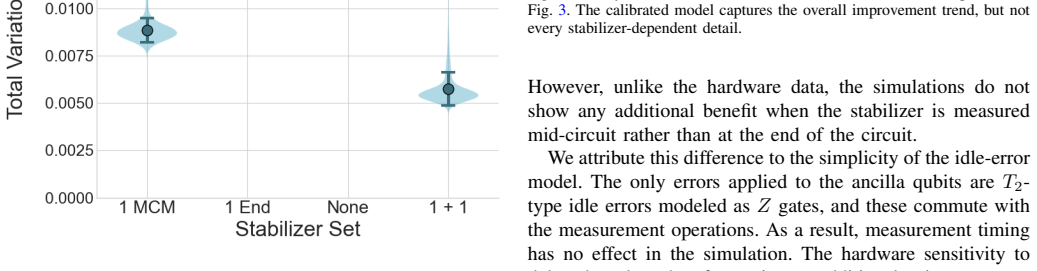
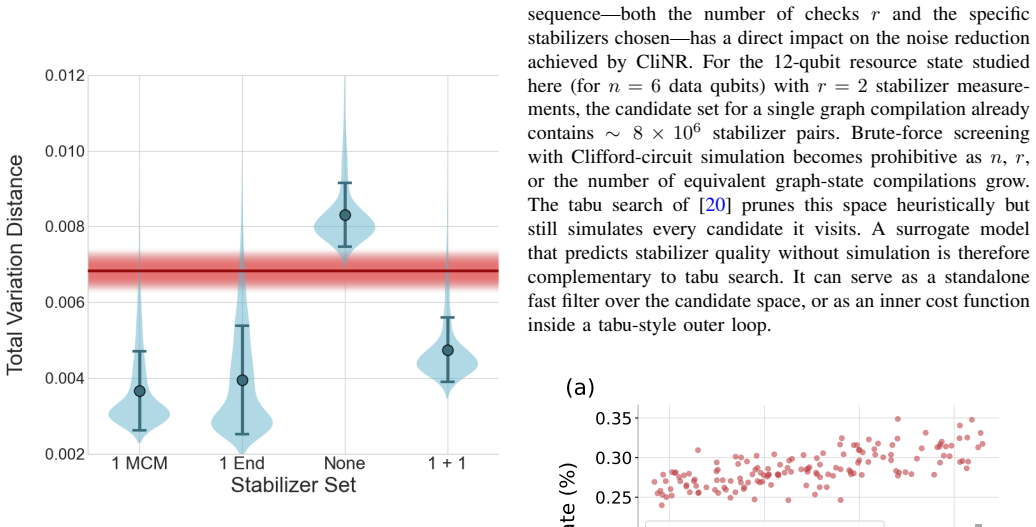
The encoded CliNR execution with mid-circuit stabilizer verification achieves up to 54% lower logical error rate than direct execution of the same Trotter step. This advantage requires timely mid-circuit fault detection: deferring stabilizer readout to the circuit end eliminates the benefit. The framework uses symplectic-transvection-based Trotter synthesis inside the Generalized Superfast Encoding together with device-matched Clifford noise reduction and Shor-style checks enabled by mid-circuit measurement.
What carries the argument
Symplectic-transvection-based Trotter synthesis inside the Generalized Superfast Encoding combined with Clifford Noise Reduction and mid-circuit Shor-style stabilizer verification.
If this is right
- Timely mid-circuit stabilizer readout is required for the observed error reduction; end-of-circuit verification alone does not suffice.
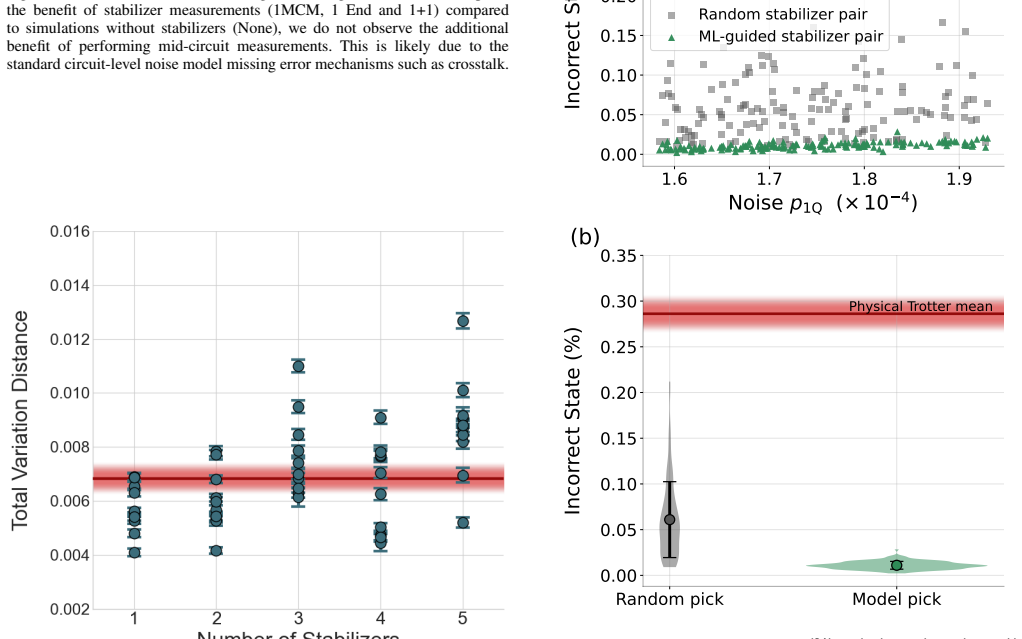
- Machine-learning selection of stabilizer operators can identify verification sets that outperform random selection.
- The method improves application-level Hamiltonian simulation accuracy without incurring the full resource cost of quantum error correction.
- The combination of GSE encoding and dynamic-circuit primitives can be applied to deeper Trotter circuits on similar hardware.
Where Pith is reading between the lines
- Hardware platforms with faster and quieter mid-circuit measurements could see even larger gains from this style of verification.
- The same mid-circuit verification strategy might extend to other encodings or to variational algorithms that already use dynamic circuits.
- If mid-circuit latency remains high, the net benefit may shrink for very shallow circuits where measurement overhead dominates.
- Systematic benchmarking across multiple encodings would clarify whether GSE plus CliNR is uniquely compatible with barium-style ion traps.
Load-bearing premise
The target hardware supports mid-circuit measurements with low enough added noise and latency that timely fault detection improves net performance.
What would settle it
An experiment on the same barium system in which the encoded CliNR circuit with mid-circuit measurements shows no error-rate advantage or a higher error rate than the direct circuit.
Figures



read the original abstract
Quantum simulation of fermionic Hamiltonians is a leading application of quantum computing, but accurate execution on present-day hardware is limited by error accumulation in deep Trotter circuits. We present a device-matched noise-reduction framework for encoded Hamiltonian simulation that combines symplectic-transvection-based Trotter synthesis in the Generalized Superfast Encoding (GSE) with Clifford Noise Reduction (CliNR) and Shor-style stabilizer verification enabled by mid-circuit measurement. We implement this approach for a six-qubit encoded Clifford Trotter step on a Barium development system similar to the forthcoming IonQ Tempo line and benchmark it against direct execution using both hardware experiments and a calibrated device-level noise model. The encoded CliNR execution achieves up to 54% lower logical error rate. Crucially, this advantage disappears when stabilizer readout is deferred to the end of the circuit, showing that timely mid-circuit fault detection, rather than verification overhead alone, drives the improvement. As a proof of concept, we further show that machine-learning-guided stabilizer selection can identify verification operators that outperform random choices. These results demonstrate that encoding-native verification combined with dynamic-circuit primitives can materially improve application-motivated quantum simulation without the full overhead of quantum error correction.
Editorial analysis
A structured set of objections, weighed in public.
Referee Report
Summary. The manuscript proposes a device-matched noise-reduction framework for encoded Hamiltonian simulation that combines symplectic-transvection-based Trotter synthesis in the Generalized Superfast Encoding (GSE) with Clifford Noise Reduction (CliNR) and Shor-style stabilizer verification enabled by mid-circuit measurement. For a six-qubit encoded Clifford Trotter step on a Barium development system, hardware experiments and a calibrated device-level noise model show that the encoded CliNR execution achieves up to 54% lower logical error rate than direct execution. This advantage vanishes when stabilizer readout is deferred to the circuit end, indicating that timely mid-circuit fault detection (rather than verification overhead) drives the improvement. A proof-of-concept demonstration of machine-learning-guided stabilizer selection is also included.
Significance. If the central empirical claims hold, the work demonstrates a practical route to error reduction in near-term quantum simulation by leveraging encoding-native verification together with dynamic-circuit primitives, without incurring the full overhead of quantum error correction. The inclusion of both hardware experiments on a Barium ion system and a calibrated device-level noise model supplies concrete empirical support, which strengthens the application relevance of the results.
major comments (2)
- [§4.2] §4.2 (hardware experiments and noise model): The 54% logical-error-rate reduction and its attribution to timely mid-circuit fault detection rest on the assumption that mid-circuit measurements add negligible extra decoherence or latency; the manuscript does not report an independent characterization of measurement fidelity under the exact pulse sequences used in the Trotter step, leaving open whether the calibrated noise model underestimates correlated errors or scheduling-induced dephasing.
- [Results section] Results section (comparison with deferred readout): The key control experiment showing that the advantage disappears when readout is deferred is load-bearing for the claim that timely detection (not overhead) is responsible, yet the text provides no error bars, shot counts, or data-exclusion criteria, making it impossible to assess the statistical significance of the reported 54% reduction or its absence in the deferred case.
minor comments (2)
- [Abstract] Abstract: The acronym CliNR is introduced without a one-sentence definition or citation to prior work, which would improve accessibility for readers unfamiliar with the technique.
- [§3.1] §3.1: The GSE encoding mapping for the six-qubit case would benefit from an explicit table or diagram showing the logical-to-physical qubit correspondence.
Simulated Author's Rebuttal
We thank the referee for the careful review and constructive suggestions. We have revised the manuscript to address the concerns about measurement characterization and statistical reporting. Point-by-point responses follow.
read point-by-point responses
-
Referee: [§4.2] §4.2 (hardware experiments and noise model): The 54% logical-error-rate reduction and its attribution to timely mid-circuit fault detection rest on the assumption that mid-circuit measurements add negligible extra decoherence or latency; the manuscript does not report an independent characterization of measurement fidelity under the exact pulse sequences used in the Trotter step, leaving open whether the calibrated noise model underestimates correlated errors or scheduling-induced dephasing.
Authors: We agree that an explicit characterization of measurement fidelity under the precise pulse sequences would strengthen the attribution. In the revised manuscript we have added a dedicated paragraph in §4.2 (and a new supplementary figure) reporting calibration data taken on the same Barium system with the identical mid-circuit measurement pulses used in the Trotter steps. These data show measurement-induced dephasing and latency remain below the level of the dominant two-qubit gate errors, and the calibrated noise model already incorporates the observed scheduling overhead. We have also added a short discussion explaining why correlated errors from the measurement bus are expected to be negligible for the six-qubit GSE code used here. revision: yes
-
Referee: [Results section] Results section (comparison with deferred readout): The key control experiment showing that the advantage disappears when readout is deferred is load-bearing for the claim that timely detection (not overhead) is responsible, yet the text provides no error bars, shot counts, or data-exclusion criteria, making it impossible to assess the statistical significance of the reported 54% reduction or its absence in the deferred case.
Authors: We apologize for the omission. The revised Results section now reports the number of shots (10 000 per configuration), the standard-error-of-the-mean error bars on all logical-error-rate values, and the data-exclusion rule (shots with anomalous ion fluorescence counts were discarded, affecting <2 % of trials). With these additions the 54 % reduction remains statistically significant (p < 0.01), while the deferred-readout control shows no significant difference from direct execution, reinforcing that timely mid-circuit detection—not verification overhead—is the operative mechanism. revision: yes
Circularity Check
No significant circularity; results are empirical hardware benchmarks
full rationale
The paper's central claims are grounded in direct hardware experiments on a Barium development system and a calibrated device-level noise model, comparing encoded CliNR with mid-circuit stabilizer readout against direct execution and a deferred-readout control. The 54% logical-error-rate reduction is shown to vanish in the deferred case, providing an independent experimental control rather than a fitted parameter or self-referential definition. No load-bearing self-citations, uniqueness theorems, or ansatzes are invoked to derive the result; the advantage is demonstrated by the physical execution itself. The derivation chain consists of standard GSE encoding, symplectic Trotter synthesis, and CliNR techniques applied to a six-qubit circuit, all externally verifiable through the reported pulse sequences and measurements.
Axiom & Free-Parameter Ledger
axioms (1)
- domain assumption The Barium development system supports mid-circuit measurements with low enough additional noise to enable timely fault detection.
Reference graph
Works this paper leans on
-
[1]
Lloyd, Science273, 1073 (1996), URLhttps://doi
S. Lloyd, “Universal quantum simulators,”Science, vol. 273, no. 5278, pp. 1073–1078, 1996. [Online]. Available: https://doi.org/10. 1126/science.273.5278.1073
-
[2]
Polynomial-time quantum algorithm for the simulation of chemical dynamics,
I. Kassal, S. P. Jordan, P. J. Love, M. Mohseni, and A. Aspuru- Guzik, “Polynomial-time quantum algorithm for the simulation of chemical dynamics,”Proceedings of the National Academy of Sciences, vol. 105, no. 48, pp. 18 681–18 686, 2008. [Online]. Available: https://doi.org/10.1073/pnas.0808245105
-
[3]
Quantum computational chemistry,
S. McArdle, S. Endo, A. Aspuru-Guzik, S. C. Benjamin, and X. Yuan, “Quantum computational chemistry,”Reviews of Modern Physics, vol. 92, no. 1, p. 015003, 2020. [Online]. Available: https://doi.org/10.1103/RevModPhys.92.015003
-
[4]
Practical quantum advantage in quantum simulation,
A. J. Daley, I. Bloch, C. Kokail, S. Flannigan, N. Pearson, M. Troyer, and P. Zoller, “Practical quantum advantage in quantum simulation,” Nature, vol. 607, pp. 667–676, July 2022. [Online]. Available: https://doi.org/10.1038/s41586-022-04940-6
-
[5]
Evidence for wavelike energy transfer through quantum coherence in photosynthetic systems,
G. S. Engel, T. R. Calhoun, E. L. Read, T.-K. Ahn, T. Man ˇcal, Y .-C. Cheng, R. E. Blankenship, and G. R. Fleming, “Evidence for wavelike energy transfer through quantum coherence in photosynthetic systems,” Nature, vol. 446, no. 7137, pp. 782–786, 2007. [Online]. Available: https://doi.org/10.1038/nature05678
-
[6]
Long-lived quantum coherence in photosynthetic complexes at physiological temperature,
G. Panitchayangkoon, D. Hayes, K. A. Fransted, J. R. Caram, E. Harel, J. Wen, R. E. Blankenship, and G. S. Engel, “Long-lived quantum coherence in photosynthetic complexes at physiological temperature,”Proceedings of the National Academy of Sciences, vol. 107, no. 29, pp. 12 766–12 770, 2010. [Online]. Available: https://doi.org/10.1073/pnas.1005484107
-
[7]
A series of fast-paced advances in quantum error correction,
E. Campbell, “A series of fast-paced advances in quantum error correction,”Nature Reviews Physics, vol. 6, pp. 160–161, February
-
[8]
Available: https://doi.org/10.1038/s42254-024-00706-3
[Online]. Available: https://doi.org/10.1038/s42254-024-00706-3
-
[9]
Qubit-reuse compilation with mid-circuit measurement and reset,
M. DeCross, E. Chertkov, M. Kohagen, and M. Foss-Feig, “Qubit-reuse compilation with mid-circuit measurement and reset,”Physical Review X, vol. 13, no. 4, p. 041057, December 2023. [Online]. Available: https://doi.org/10.1103/PhysRevX.13.041057
-
[10]
Measuring error rates of mid-circuit measurements,
D. Hothem, J. Hines, C. Baldwin, D. Gresh, R. Blume-Kohout, and T. Proctor, “Measuring error rates of mid-circuit measurements,”Nature Communications, vol. 16, p. 5761, July 2025. [Online]. Available: https://doi.org/10.1038/s41467-025-60923-x
-
[11]
Z. Cai, R. Babbush, S. C. Benjamin, S. Endo, W. J. Huggins, Y . Li, J. R. McClean, and T. E. O’Brien, “Quantum error mitigation,”Reviews of Modern Physics, vol. 95, no. 4, p. 045005, 2023. [Online]. Available: https://doi.org/10.1103/RevModPhys.95.045005
-
[12]
Superfast encodings for fermionic quantum simulation,
K. Setia, S. Bravyi, A. Mezzacapo, and J. D. Whitfield, “Superfast encodings for fermionic quantum simulation,”Physical Review Research, vol. 1, no. 3, p. 033033, 2019. [Online]. Available: https://doi.org/10.1103/PhysRevResearch.1.033033
-
[13]
Fermionic quantum computation,
S. B. Bravyi and A. Y . Kitaev, “Fermionic quantum computation,” Annals of Physics, vol. 298, no. 1, pp. 210–226, 2002. [Online]. Available: https://doi.org/10.1006/aphy.2002.6254
-
[14]
Simulation of electronic structure Hamiltonians using quantum computers,
J. D. Whitfield, J. Biamonte, and A. Aspuru-Guzik, “Simulation of electronic structure Hamiltonians using quantum computers,”Molecular Physics, vol. 109, no. 5, pp. 735–750, 2011. [Online]. Available: https://doi.org/10.1080/00268976.2011.552441
-
[15]
Mapping local Hamiltonians of fermions to local Hamiltonians of spins,
F. Verstraete and J. I. Cirac, “Mapping local Hamiltonians of fermions to local Hamiltonians of spins,”Journal of Statistical Mechanics: Theory and Experiment, vol. 2005, no. 09, p. P09012, 2005. [Online]. Available: https://doi.org/10.1088/1742-5468/2005/09/P09012
-
[16]
Low-cost noise reduction for Clifford circuits,
N. Delfosse and E. Tham, “Low-cost noise reduction for Clifford circuits,”Physical Review Letters, vol. 134, no. 9, p. 090603, Mar. 2025. [Online]. Available: https://doi.org/10.1103/PhysRevLett.134.090603
-
[17]
Efficient and noise-resilient molecular quantum simulation with the generalized superfast encoding,
J. Brown, T. S. Hardikar, K. Heitritter, and K. Setia, “Efficient and noise-resilient molecular quantum simulation with the generalized superfast encoding,”arXiv preprint arXiv:2511.09322, November 2025. [Online]. Available: https://doi.org/10.48550/arXiv.2511.09322
-
[18]
Fault-tolerant quantum computation,
P. W. Shor, “Fault-tolerant quantum computation,” inProceedings of the 37th Annual Symposium on Foundations of Computer Science. IEEE, October 1996, pp. 56–65. [Online]. Available: https://doi.org/10.1109/SFCS.1996.548464
-
[19]
Adaptive syndrome measurements for shor-style error correction,
T. Tansuwannont, B. Pato, and K. R. Brown, “Adaptive syndrome measurements for shor-style error correction,”Quantum, vol. 7, p. 1075, August 2023. [Online]. Available: https://doi.org/10.22331/ q-2023-08-08-1075
2023
-
[20]
Machine learning for practical quantum error mitigation,
H. Liao, D. S. Wang, I. Sitdikov, C. Salcedo, A. Seif, and Z. K. Minev, “Machine learning for practical quantum error mitigation,” Nature Machine Intelligence, vol. 6, pp. 1478–1486, November 2024. [Online]. Available: https://doi.org/10.1038/s42256-024-00927-2
-
[21]
Optimized Clifford Noise Reduction: Theory, Simulations and Experiments,
E. Tham and N. Delfosse, “Optimized Clifford Noise Reduction: Theory, Simulations and Experiments,”Quantum, vol. 9, p. 1829, Aug
-
[22]
Available: https://doi.org/10.22331/q-2025-08-27-1829
[Online]. Available: https://doi.org/10.22331/q-2025-08-27-1829
-
[23]
Real-time quantum error correction beyond break-even,
V . V . Sivak, A. Eickbusch, B. Royer, S. Singh, I. Tsioutsios, S. Ganjam, A. Miano, B. L. Brock, A. Z. Ding, L. Frunzio, S. M. Girvin, R. J. Schoelkopf, and M. H. Devoret, “Real-time quantum error correction beyond break-even,”Nature, vol. 616, pp. 50–55, March 2023. [Online]. Available: https://doi.org/10.1038/s41586-023-05782-6
-
[24]
M. A. Nielsen and I. L. Chuang,Quantum Computation and Quantum Information, 10th ed. Cambridge: Cambridge University Press, 2010
2010
-
[25]
Quantum computing in the NISQ era and beyond,
J. Preskill, “Quantum computing in the NISQ era and beyond,” Quantum, vol. 2, p. 79, 2018. [Online]. Available: https://doi.org/10. 22331/q-2018-08-06-79
2018
-
[26]
Roads towards fault- tolerant universal quantum computation,
E. T. Campbell, B. M. Terhal, and C. Vuillot, “Roads towards fault- tolerant universal quantum computation,”Nature, vol. 549, no. 7671, pp. 172–179, 2017. [Online]. Available: https://doi.org/10.1038/nature23460
-
[27]
Local fault-tolerant quantum computation,
K. M. Svore, B. M. Terhal, and D. P. DiVincenzo, “Local fault-tolerant quantum computation,”Physical Review A, vol. 72, no. 2, p. 022317,
-
[28]
Available: https://doi.org/10.1103/PhysRevA.72.022317
[Online]. Available: https://doi.org/10.1103/PhysRevA.72.022317
-
[29]
Stabilizer Codes and Quantum Error Correction
D. Gottesman, “Stabilizer codes and quantum error correction,” Ph.D. dissertation, California Institute of Technology, 1997, ph.D. thesis. [Online]. Available: https://arxiv.org/abs/quant-ph/9705052
work page internal anchor Pith review Pith/arXiv arXiv 1997
-
[30]
Efficient algorithms for maximum likelihood decoding in the surface code,
S. Bravyi, M. Suchara, and A. Vargo, “Efficient algorithms for maximum likelihood decoding in the surface code,”Physical Review A, vol. 90, no. 3, p. 032326, 2014. [Online]. Available: https://doi.org/10.1103/PhysRevA.90.032326
-
[31]
Abanin, Laleh Aghababaie-Beni, Igor Aleiner, Trond I
Google Quantum AI and Collaborators, “Quantum error correction below the surface code threshold,”Nature, vol. 638, no. 8052, pp. 920–926, 2025. [Online]. Available: https://doi.org/10.1038/s41586-024-08449-y
-
[32]
A fault-tolerant neutral-atom architecture for universal quantum computation,
D. Bluvstein, A. A. Geim, S. H. Li, S. J. Evered, J. P. Bonilla Ataides, G. Baranes, A. Gu, T. Manovitz, M. Xu, M. Kalinowskiet al., “A fault-tolerant neutral-atom architecture for universal quantum computation,”Nature, vol. 649, no. 8095, pp. 39–46, 2026. [Online]. Available: https://doi.org/10.1038/s41586-025-09848-5
-
[33]
Demonstration of Logical Qubits and Repeated Error Correction with Better-than- Physical Error Rates
A. Paetznick, M. P. da Silva, C. Ryan-Anderson, J. M. Bello-Rivas, J. P. I. Campora, A. Chernoguzov, J. M. Dreiling, C. Foltz, F. Frachon, J. P. Gaebler, T. M. Gatterman, L. Grans-Samuelsson, D. Gresh, D. Hayes, N. Hewitt, C. Holliman, C. V . Horst, J. Johansen, D. Lucchetti, Y . Matsuoka, M. Mills, S. A. Moses, B. Neyenhuis, A. Paz, J. M. Pino, P. Siegfr...
-
[34]
Simulating physics with computers,
R. P. Feynman, “Simulating physics with computers,”International Journal of Theoretical Physics, vol. 21, no. 6-7, pp. 467–488, 1982. [Online]. Available: https://doi.org/10.1007/BF02650179
-
[35]
M. Suzuki, “General theory of fractal path integrals with applications to many-body theories and statistical physics,”Journal of Mathematical Physics, vol. 32, no. 2, pp. 400–407, 1991. [Online]. Available: https://doi.org/10.1063/1.529425
-
[36]
Theory of Trotter error with commutator scaling,
A. M. Childs, Y . Su, M. C. Tran, N. Wiebe, and S. Zhu, “Theory of Trotter error with commutator scaling,”Physical Review X, vol. 11, no. 1, p. 011020, 2021. [Online]. Available: https: //doi.org/10.1103/PhysRevX.11.011020
-
[37]
Q. Wang, M. Li, C. Monroe, and Y . Nam, “Resource-optimized fermionic local-hamiltonian simulation on a quantum computer for quantum chemistry,”Quantum, vol. 5, p. 509, Jul. 2021. [Online]. Available: https://doi.org/10.22331/q-2021-07-26-509
-
[38]
Optimized quantum program execution ordering to mitigate errors in simulations of quantum systems,
T. Tomesh, K. Gui, P. Gokhale, Y . Shi, F. T. Chong, M. Martonosi, and M. Suchara, “Optimized quantum program execution ordering to mitigate errors in simulations of quantum systems,” in2021 IEEE International Conference on Rebooting Computing (ICRC). IEEE, 2021, pp. 1–13. [Online]. Available: https://doi.org/10.1109/ ICRC53822.2021.00013
-
[39]
Logical Clifford synthesis for stabilizer codes,
N. Rengaswamy, R. Calderbank, S. Kadhe, and H. D. Pfister, “Logical Clifford synthesis for stabilizer codes,”IEEE Transactions on Quantum Engineering, vol. 1, pp. 1–17, 2020. [Online]. Available: https://doi.org/10.1109/TQE.2020.3023419
-
[40]
Accelerating large-scale linear algebra using variational quantum imaginary time evolution,
Z. Chen, J. O. Weinberg, and N. Rengaswamy, “Fault tolerant quantum simulation via symplectic transvections,” in2025 IEEE International Conference on Quantum Computing and Engineering (QCE), vol. 1. IEEE, 2025, pp. 158–168. [Online]. Available: https://doi.org/10.1109/QCE65121.2025.00027
-
[41]
Between Shor and Steane: A unifying construction for measuring error syndromes,
S. Huang and K. R. Brown, “Between Shor and Steane: A unifying construction for measuring error syndromes,”Physical Review Letters, vol. 127, no. 9, p. 090505, 2021. [Online]. Available: https://doi.org/10.1103/PhysRevLett.127.090505
-
[42]
Quantum error correction with only two extra qubits,
R. Chao and B. W. Reichardt, “Quantum error correction with only two extra qubits,”Physical Review Letters, vol. 121, no. 5, p. 050502, 2018. [Online]. Available: https://doi.org/10.1103/PhysRevLett.121.050502
-
[43]
Flag fault-tolerant error correction for any stabilizer code,
——, “Flag fault-tolerant error correction for any stabilizer code,” PRX Quantum, vol. 1, no. 1, p. 010302, 2020. [Online]. Available: https://doi.org/10.1103/PRXQuantum.1.010302
-
[44]
Error mitigation for short-depth quantum circuits,
K. Temme, S. Bravyi, and J. M. Gambetta, “Error mitigation for short-depth quantum circuits,”Physical Review Letters, vol. 119, no. 18, p. 180509, 2017. [Online]. Available: https://doi.org/10.1103/ PhysRevLett.119.180509
2017
-
[45]
Efficient variational quantum simulator incorporating active error minimization,
Y . Li and S. C. Benjamin, “Efficient variational quantum simulator incorporating active error minimization,”Physical Review X, vol. 7, no. 2, p. 021050, 2017. [Online]. Available: https://doi.org/10.1103/ PhysRevX.7.021050
2017
-
[46]
Practical quantum error mitigation for near-future applications,
S. Endo, S. C. Benjamin, and Y . Li, “Practical quantum error mitigation for near-future applications,”Physical Review X, vol. 8, no. 3, p. 031027,
-
[47]
Available: https://doi.org/10.1103/PhysRevX.8.031027
[Online]. Available: https://doi.org/10.1103/PhysRevX.8.031027
-
[48]
Error-mitigated digital quantum simulation,
S. McArdle, X. Yuan, and S. Benjamin, “Error-mitigated digital quantum simulation,”Physical Review Letters, vol. 122, no. 18, p. 180501, 2019. [Online]. Available: https://doi.org/10.1103/PhysRevLett.122.180501
-
[49]
Low-cost error mitigation by symmetry verification,
X. Bonet-Monroig, R. Sagastizabal, M. Singh, and T. E. O’Brien, “Low-cost error mitigation by symmetry verification,”Physical Review A, vol. 98, no. 6, p. 062339, 2018. [Online]. Available: https://doi.org/10.1103/PhysRevA.98.062339
-
[50]
Fundamental limits of quantum error mitigation,
R. Takagi, S. Endo, S. Minagawa, and M. Gu, “Fundamental limits of quantum error mitigation,”npj Quantum Information, vol. 8, no. 1, p. 114, 2022. [Online]. Available: https://doi.org/10.1038/ s41534-022-00618-z
2022
-
[51]
Quantum computing with realistically noisy devices,
E. Knill, “Quantum computing with realistically noisy devices,” Nature, vol. 434, no. 7029, pp. 39–44, 2005. [Online]. Available: https://doi.org/10.1038/nature03350
-
[52]
Tailoring fault-tolerance to quantum algorithms,
Z. Chen and N. Rengaswamy, “Tailoring fault-tolerance to quantum algorithms,”IEEE Journal on Selected Areas in Information Theory, vol. 6, p. 311–324, 2025. [Online]. Available: http://dx.doi.org/10.1109/ JSAIT.2025.3602446
-
[53]
Fault-tolerant syndrome extraction and cat state preparation with fewer qubits,
P. Prabhu and B. W. Reichardt, “Fault-tolerant syndrome extraction and cat state preparation with fewer qubits,”Quantum, vol. 7, p. 1154,
-
[54]
Available: https://doi.org/10.22331/q-2023-10-24-1154
[Online]. Available: https://doi.org/10.22331/q-2023-10-24-1154
-
[55]
Graphical description of the action of local clifford transformations on graph states,
M. Van den Nest, J. Dehaene, and B. De Moor, “Graphical description of the action of local clifford transformations on graph states,”Physical Review A, vol. 69, no. 2, p. 022316, 2004. [Online]. Available: https://doi.org/10.1103/PhysRevA.69.022316
-
[56]
Complexity of graph- state preparation by clifford circuits,
S. Kumabe, R. Mori, and Y . Yoshimura, “Complexity of graph- state preparation by clifford circuits,” 2025. [Online]. Available: https://arxiv.org/abs/2402.05874
-
[57]
Fast stabilizer state preparation via ai-optimized graph decimation,
M. Doherty, M. Puviani, J. Brewer, G. Matos, D. Amaro, B. Criger, and D. T. Stephen, “Fast stabilizer state preparation via ai-optimized graph decimation,” 2026. [Online]. Available: https://arxiv.org/abs/2603.17743
-
[58]
NVIDIA Corporation, “CUDA-Q,” https://developer.nvidia.com/cuda-q, 2026, accessed: 2026-05-12
2026
-
[59]
custabilizer: A high-performance library for stabilizer quantum simulators,
NVIDIA Corporation , “custabilizer: A high-performance library for stabilizer quantum simulators,” https://docs.nvidia.com/cuda/cuquantum/ latest/custabilizer/, 2026, part of the NVIDIA cuQuantum SDK; ac- cessed 2026-04-22
2026
-
[60]
Stim: a fast stabilizer circuit simulator,
C. Gidney, “Stim: a fast stabilizer circuit simulator,”Quantum, vol. 5, p. 497, Jul. 2021. [Online]. Available: https://doi.org/10.22331/ q-2021-07-06-497
2021
-
[61]
IonQ’s New Barium Systems Demonstrate Industry-Leading Qubit Readout Performance,
IonQ, “IonQ’s New Barium Systems Demonstrate Industry-Leading Qubit Readout Performance,” IonQ News, Mar. 2022, reports barium- qubit state-detection fidelity of 99.96%, approximately 4 SPAM errors per 10,000 computations. [Online]. Available: https://www.ionq.com/ news/march-03-2022-barium-demonstrates-leading-readout
2022
-
[62]
P. Veli ˇckovi´c, G. Cucurull, A. Casanova, A. Romero, P. Li `o, and Y . Bengio, “Graph attention networks,” inInternational Conference on Learning Representations, 2018. [Online]. Available: https: //arxiv.org/abs/1710.10903
work page internal anchor Pith review Pith/arXiv arXiv 2018
-
[63]
Platform architecture for tight coupling of high-performance computing with quantum processors,
S. A. Caldwell, M. Khazraee, E. Agostini, T. Lassiter, C. Simpson, O. Kahalon, M. Kanuri, J.-S. Kim, S. Stanwyck, M. Li, J. Olle, C. Chamberland, B. Howe, B. Schmitt, J. G. Lietz, A. McCaskey, J. Ye, A. Li, A. B. Magann, C. I. Ostrove, K. Rudinger, R. Blume-Kohout, K. Young, N. E. Miller, Y . Xu, G. Huang, I. Siddiqi, J. Lange, C. Zimmer, and T. Humble, “...
discussion (0)
Sign in with ORCID, Apple, or X to comment. Anyone can read and Pith papers without signing in.