Recognition: 2 theorem links
· Lean TheoremThe study of the circumnuclear environment of accreting supermassive black holes with realistic X-ray spectral models
Pith reviewed 2026-05-11 00:46 UTC · model grok-4.3
The pith
New X-ray models with realistic torus, cone, disk and line-region geometries better capture reprocessed emission around accreting supermassive black holes.
A machine-rendered reading of the paper's core claim, the machinery that carries it, and where it could break.
Core claim
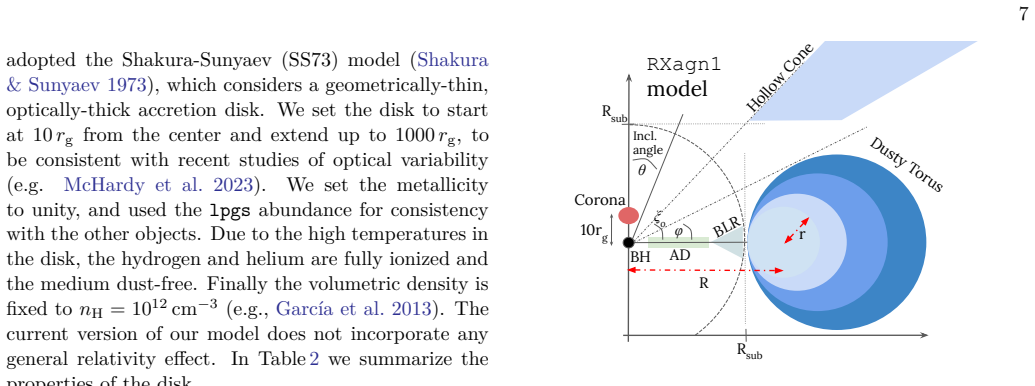
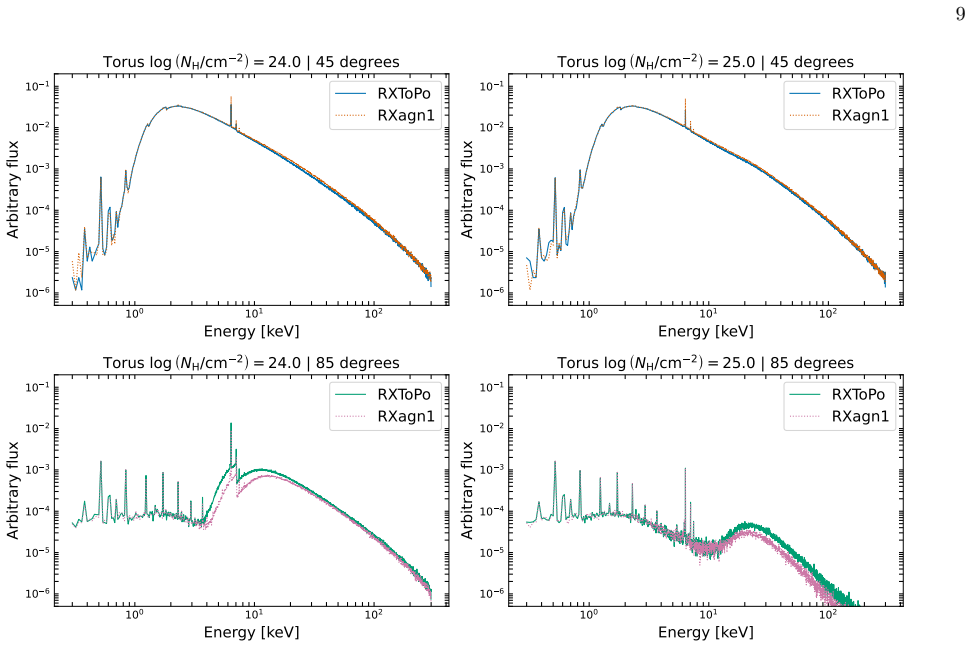
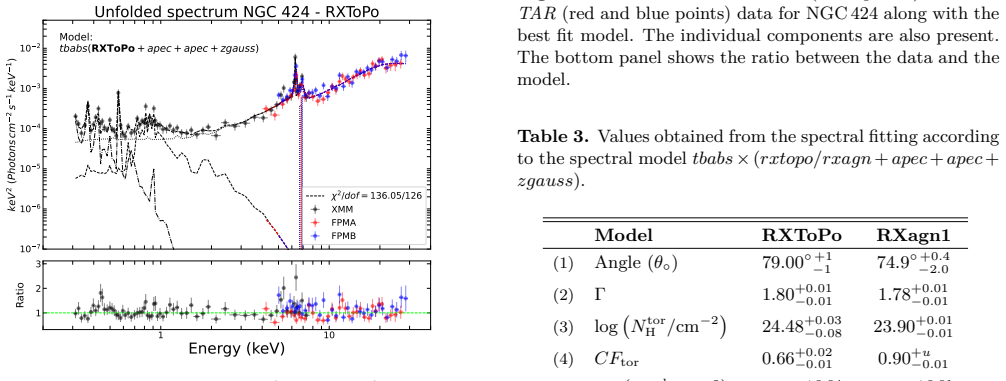
We introduce two new table models that are publicly available: the RXToPo model, which features an X-ray source along with a dusty torus and a polar hollow cone; and the RXagn1 model, which includes, besides the torus and polar cone, also the accretion disk and the broad line region. Both models were generated with the ray-tracing code RefleX over a wide X-ray energy band and were applied to the X-ray spectrum of NGC 424, demonstrating their potential to study sources whose X-ray emission is dominated by reprocessed radiation.
What carries the argument
Ray-tracing simulations with RefleX that generate spectral table models for a central X-ray source surrounded by a dusty torus, polar hollow cone, accretion disk, and broad line region.
If this is right
- The models can be fitted directly to X-ray spectra of other AGN to derive constraints on torus opening angle, column density, and viewing inclination.
- They allow separation of direct and reprocessed emission components over a broad energy range where previous simplified models could not.
- Public release makes the models immediately usable in standard X-ray fitting packages for sources dominated by reflected radiation.
Where Pith is reading between the lines
- Incorporating these fuller geometries may reduce some of the parameter degeneracies that appear when only slab or simple-torus models are used.
- The same ray-tracing approach could be extended to include time-dependent or outflowing components to model variable AGN.
- Large-scale application to survey data might reveal whether torus and cone properties correlate with black-hole mass or accretion rate.
Load-bearing premise
The specific geometries of the torus, polar cone, disk, and broad line region chosen for the models match the actual distribution of material around real supermassive black holes.
What would settle it
High-quality X-ray spectra of NGC 424 or similar AGN that show large, systematic mismatches with the predicted reprocessed features from either RXToPo or RXagn1 would demonstrate that the models do not accurately describe the circumnuclear environment.
Figures






read the original abstract
X-ray spectral modeling is a powerful tool for studying the immediate environment of accreting objects, including supermassive black holes. Several models, either phenomenological or physically driven, have been developed over the past decade to study X-ray spectra, delivering important insights into the properties of circumnuclear material of active galactic nuclei (AGN). Despite the fact that these models are able to reproduce the data well, they often lack realistic geometries, and most of them consist of simplified configurations such as a slab or a torus. We use the ray-tracing code \textsc{RefleX} to generate new spectral models that cover a wide energy range in the X-ray band, adopting a realistic configuration for the surrounding material. We introduce two new table models that are publicly available: 1) the RXToPo model, which features an X-ray source along with a dusty torus and a polar hollow cone; 2) the RXagn1 model, which includes, besides the torus and polar cone, also the accretion disk and the broad line region. Both models were applied to the X-ray spectrum of NGC 424, demonstrating their potential to study sources whose X-ray emission is dominated by reprocessed radiation.
Editorial analysis
A structured set of objections, weighed in public.
Referee Report
Summary. The paper uses the RefleX ray-tracing code to generate two new publicly available X-ray spectral table models for realistic circumnuclear geometries around accreting supermassive black holes: RXToPo (X-ray source + dusty torus + polar hollow cone) and RXagn1 (adding accretion disk + broad line region). Both models are applied to the X-ray spectrum of NGC 424 to illustrate their utility for sources dominated by reprocessed emission.
Significance. If the underlying simulations prove accurate, the models would advance beyond existing simplified geometries (slabs, single tori) by incorporating multi-component 3D structures, potentially yielding tighter constraints on reprocessing material in AGN. Public release of the tables is a clear community benefit.
major comments (1)
- [§3] §3 (Model construction and RefleX implementation): No benchmarks, analytic limits, or cross-code comparisons are reported for the ray-tracing outputs in the chosen multi-component geometries (torus + cone, or torus + cone + disk + BLR). Without such checks (e.g., slab/spherical limits, MYTorus/pexrav comparisons, or Monte-Carlo convergence metrics), systematic biases in the generated spectra cannot be ruled out and would directly affect the NGC 424 fits and the claimed advantage over simpler models.
minor comments (2)
- [Abstract and §4] The abstract and §4 (NGC 424 application) should explicitly state the energy range, parameter grid spacing, and interpolation method used in the table models.
- [Figures] Figure captions for the model spectra and NGC 424 fits would benefit from clearer labeling of the individual reprocessing components.
Simulated Author's Rebuttal
We thank the referee for their constructive review and positive assessment of the potential impact of our new models. We address the single major comment below and have revised the manuscript to incorporate additional validation as suggested.
read point-by-point responses
-
Referee: [§3] §3 (Model construction and RefleX implementation): No benchmarks, analytic limits, or cross-code comparisons are reported for the ray-tracing outputs in the chosen multi-component geometries (torus + cone, or torus + cone + disk + BLR). Without such checks (e.g., slab/spherical limits, MYTorus/pexrav comparisons, or Monte-Carlo convergence metrics), systematic biases in the generated spectra cannot be ruled out and would directly affect the NGC 424 fits and the claimed advantage over simpler models.
Authors: We agree that explicit benchmarks and cross-code comparisons are valuable to validate the RefleX outputs and strengthen confidence in the results. The original manuscript did not include these in §3. In the revised version we have added a new subsection 3.3 that reports (i) comparisons of RefleX spectra in simplified limiting cases (slab and spherical geometries) against analytic expectations and against pexrav, (ii) direct comparison of the toroidal component against MYTorus, and (iii) Monte-Carlo convergence tests obtained by increasing the number of simulated photons until spectral features stabilize to within 1 %. These checks show that systematic biases remain negligible across the 0.1–100 keV band relevant to the NGC 424 fits and therefore support the claimed advantages of the multi-component geometries. The text, figures, and discussion of the NGC 424 application have been updated accordingly. revision: yes
Circularity Check
No circularity: simulation-to-table-model chain is independent of fitted outputs
full rationale
The paper generates new table models (RXToPo, RXagn1) by running the RefleX ray-tracing code on chosen 3D geometries (torus + polar cone, plus disk + BLR) and then fits the resulting tables to the NGC 424 spectrum. This is a forward simulation followed by data application; no equation or parameter is defined in terms of the final fit result, no prediction is statistically forced by a prior fit, and no uniqueness theorem or ansatz is imported solely via self-citation to close the loop. The central claim (that the new models can study reprocessed emission) rests on the external validity of RefleX and the geometries, not on any internal reduction to the paper's own inputs. Self-citation of the RefleX code, if present, is not load-bearing in the sense that it would make the derivation tautological.
Axiom & Free-Parameter Ledger
axioms (1)
- domain assumption The ray-tracing code RefleX accurately models X-ray interactions in the specified geometries.
Lean theorems connected to this paper
-
IndisputableMonolith/Cost/FunctionalEquation.leanwashburn_uniqueness_aczel unclear?
unclearRelation between the paper passage and the cited Recognition theorem.
The free parameters of RXToPo are: the observing angle... photon index Γ... equatorial hydrogen column density... covering factor... polar cone column density.
What do these tags mean?
- matches
- The paper's claim is directly supported by a theorem in the formal canon.
- supports
- The theorem supports part of the paper's argument, but the paper may add assumptions or extra steps.
- extends
- The paper goes beyond the formal theorem; the theorem is a base layer rather than the whole result.
- uses
- The paper appears to rely on the theorem as machinery.
- contradicts
- The paper's claim conflicts with a theorem or certificate in the canon.
- unclear
- Pith found a possible connection, but the passage is too broad, indirect, or ambiguous to say the theorem truly supports the claim.
Reference graph
Works this paper leans on
-
[1]
2003, Nuclear Instruments and Methods in Physics Research Section A:
Agostinelli, S., Allison, J., Amako, K., et al. 2003, Nuclear Instruments and Methods in Physics Research Section A:
2003
-
[2]
Accelerators, Spectrometers, Detectors and Associated Equipment, 506, 250, doi: https://doi.org/10.1016/S0168-9002(03)01368-8
-
[3]
Alexander, D. M., Stern, D., Moro, A. D., et al. 2013, The Astrophysical Journal, 773, 125, doi: 10.1088/0004-637X/773/2/125
-
[4]
2009, A&A, 506, 1541, doi: 10.1051/0004-6361/200911813
Alonso-Herrero, A., Garc´ ıa-Mar´ ın, M., Monreal-Ibero, A., et al. 2009, A&A, 506, 1541, doi: 10.1051/0004-6361/200911813
-
[5]
Alonso-Herrero, A., Garc´ ıa-Burillo, S., H¨ onig, S. F., et al. 2021, A&A, 652, A99, doi: 10.1051/0004-6361/202141219
-
[6]
Antonucci, R. 1993, Annual Review of Astronomy and Astrophysics, 31, 473, doi: 10.1146/annurev.aa.31.090193.002353 Ar´ evalo, P., Bauer, F. E., Puccetti, S., et al. 2014, ApJ, 791, 81, doi: 10.1088/0004-637X/791/2/81
-
[7]
Arnaud, K. A. 1996, in Astronomical Society of the Pacific Conference Series, Vol. 101, Astronomical Data Analysis Software and Systems V, ed. G. H. Jacoby & J. Barnes, 17
1996
-
[8]
2019, MNRAS, 489, 2177, doi: 10.1093/mnras/stz2289
Asmus, D. 2019, MNRAS, 489, 2177, doi: 10.1093/mnras/stz2289
-
[9]
Asmus, D., H¨ onig, S. F., & Gandhi, P. 2016, The Astrophysical Journal, 822, 109, doi: 10.3847/0004-637X/822/2/109
-
[10]
2011, ApJS, 196, 22, doi: 10.1088/0067-0049/196/2/22
Baes, M., Verstappen, J., De Looze, I., et al. 2011, ApJS, 196, 22, doi: 10.1088/0067-0049/196/2/22
-
[11]
Baes, M., Davies, J. I., Dejonghe, H., et al. 2003, Monthly Notices of the Royal Astronomical Society, 343, 1081, doi: 10.1046/j.1365-8711.2003.06770.x Balokovi´ c, M., Comastri, A., Harrison, F. A., et al. 2014, ApJ, 794, 111, doi: 10.1088/0004-637X/794/2/111 Balokovi´ c, M., Brightman, M., Harrison, F. A., et al. 2018, ApJ, 854, 42, doi: 10.3847/1538-43...
-
[12]
Brightman, M., & Nandra, K. 2011, MNRAS, 413, 1206, doi: 10.1111/j.1365-2966.2011.18207.x
-
[13]
Bauer, F. E. 2019, A&A, 629, A16, doi: 10.1051/0004-6361/201834771
-
[14]
1989, ApJL, 340, L5, doi: 10.1086/185425 13
Cavaliere, A., & Padovani, P. 1989, ApJL, 340, L5, doi: 10.1086/185425 13
-
[15]
2009, ApJ, 693, 174, doi: 10.1088/0004-637X/693/1/174
Garmire, G. 2009, ApJ, 693, 174, doi: 10.1088/0004-637X/693/1/174
-
[16]
2008, A&A, 485, 417, doi: 10.1051/0004-6361:20077569
Dadina, M. 2008, A&A, 485, 417, doi: 10.1051/0004-6361:20077569
-
[17]
Davies, R. I., Burtscher, L., Rosario, D., et al. 2015, ApJ, 806, 127, doi: 10.1088/0004-637X/806/1/127 De Marco, B., Ponti, G., Cappi, M., et al. 2013, MNRAS, 431, 2441, doi: 10.1093/mnras/stt339 Del Moro, A., Alexander, D. M., Aird, J. A., et al. 2017, ApJ, 849, 57, doi: 10.3847/1538-4357/aa9115
-
[18]
2023, A&A, 669, A114, doi: 10.1051/0004-6361/202244678
Diaz, Y., Hern` andez-Garc´ ıa, L., Ar´ evalo, P., et al. 2023, A&A, 669, A114, doi: 10.1051/0004-6361/202244678
- [19]
-
[20]
McHardy, I. M. 2014, MNRAS, 439, 3931, doi: 10.1093/mnras/stu249
-
[21]
Fabian, A. C., Celotti, A., & Erlund, M. C. 2006, MNRAS, 373, L16, doi: 10.1111/j.1745-3933.2006.00234.x
-
[22]
, year = 2009, month = may, volume =
Fabian, A. C., Zoghbi, A., Ross, R. R., et al. 2009, Nature, 459, 540, doi: 10.1038/nature08007
-
[23]
Nahar, S. N. 1992, ApJ, 387, 95, doi: 10.1086/171063 Garc´ ıa, J., Dauser, T., Reynolds, C. S., et al. 2013, ApJ, 768, 146, doi: 10.1088/0004-637X/768/2/146 Garc´ ıa, J., & Kallman, T. R. 2010, ApJ, 718, 695, doi: 10.1088/0004-637X/718/2/695 Garc´ ıa, J., Dauser, T., Lohfink, A., et al. 2014, ApJ, 782, 76, doi: 10.1088/0004-637X/782/2/76
-
[24]
George, I. M., & Fabian, A. C. 1991a, MNRAS, 249, 352, doi: 10.1093/mnras/249.2.352 —. 1991b, MNRAS, 249, 352, doi: 10.1093/mnras/249.2.352
-
[26]
Goad, M. R., Korista, K. T., & Ruff, A. J. 2012, MNRAS, 426, 3086, doi: 10.1111/j.1365-2966.2012.21808.x Gravity Collaboration, Sturm, E., Dexter, J., et al. 2018, Nature, 563, 657, doi: 10.1038/s41586-018-0731-9 GRAVITY Collaboration, Amorim, A., Baub¨ ock, M., et al. 2020a, A&A, 643, A154, doi: 10.1051/0004-6361/202039067 GRAVITY Collaboration, Pfuhl, O...
-
[27]
K., Ricci, C., Tortosa, A., et al
Gupta, K. K., Ricci, C., Tortosa, A., et al. 2021, MNRAS, 504, 428, doi: 10.1093/mnras/stab839
-
[28]
1991, ApJL, 380, L51, doi: 10.1086/186171
Haardt, F., & Maraschi, L. 1991, ApJL, 380, L51, doi: 10.1086/186171 —. 1993, ApJ, 413, 507, doi: 10.1086/173020
-
[29]
Haidar, H., Rosario, D. J., Alonso-Herrero, A., et al. 2024, Dust beyond the torus: Revealing the mid-infrared heart of local Seyfert ESO 428-G14 with JWST/MIRI, arXiv. http://arxiv.org/abs/2404.16100
-
[30]
Hao, L., Spoon, H. W. W., Sloan, G. C., et al. 2005, The Astrophysical Journal, 625, L75, doi: 10.1086/431227
-
[31]
Hatziminaoglou, E., Hern´ an-Caballero, A., Feltre, A., & Pi˜ nol Ferrer, N. 2015, ApJ, 803, 110, doi: 10.1088/0004-637X/803/2/110 HI4PI Collaboration, Ben Bekhti, N., Fl¨ oer, L., et al. 2016, A&A, 594, A116, doi: 10.1051/0004-6361/201629178 H¨ onig, S. F., & Beckert, T. 2007, MNRAS, 380, 1172, doi: 10.1111/j.1365-2966.2007.12157.x H¨ onig, S. F., Kishim...
-
[32]
Jaffe, W., Meisenheimer, K., R¨ ottgering, H. J. A., et al. 2004, Nature, 429, 47, doi: 10.1038/nature02531
-
[33]
2005, ApJ, 629, 61, doi: 10.1086/431275
Kaspi, S., Maoz, D., Netzer, H., et al. 2005, ApJ, 629, 61, doi: 10.1086/431275
-
[34]
Kaspi, S., Smith, P. S., Netzer, H., et al. 2000, ApJ, 533, 631, doi: 10.1086/308704
-
[35]
Kormendy, J., & Ho, L. C. 2013, ARA&A, 51, 511, doi: 10.1146/annurev-astro-082708-101811
work page internal anchor Pith review doi:10.1146/annurev-astro-082708-101811 2013
-
[36]
2017, ApJ, 850, 74, doi: 10.3847/1538-4357/aa8ec9
Koss, M., Trakhtenbrot, B., Ricci, C., et al. 2017, ApJ, 850, 74, doi: 10.3847/1538-4357/aa8ec9
-
[37]
Krolik, J. H., & Begelman, M. C. 1988, ApJ, 329, 702, doi: 10.1086/166414
-
[38]
Laloux, B., Georgakakis, A., Alexander, D. M., et al. 2024, arXiv e-prints, arXiv:2403.07109, doi: 10.48550/arXiv.2403.07109
-
[39]
Lamer, G., Uttley, P., & McHardy, I. M. 2000, MNRAS, 319, 949, doi: 10.1046/j.1365-8711.2000.03921.x
-
[40]
Lightman, A. P., & Zdziarski, A. A. 1987, ApJ, 319, 643, doi: 10.1086/165485
-
[41]
2014, ApJ, 787, 52, doi: 10.1088/0004-637X/787/1/52
Liu, Y., & Li, X. 2014, ApJ, 787, 52, doi: 10.1088/0004-637X/787/1/52
-
[42]
Lodders, K., Palme, H., & Gail, H. P. 2009, Landolt Börnstein, 4B, 712, doi: 10.1007/978-3-540-88055-4 34 L´ opez-Gonzaga, N., Jaffe, W., Burtscher, L., Tristram, K. R. W., & Meisenheimer, K. 2014, A&A, 565, A71, doi: 10.1051/0004-6361/201323002
-
[43]
1969, Nature, 223, 690, doi: 10.1038/223690a0
Lynden-Bell, D. 1969, Nature, 223, 690, doi: 10.1038/223690a0 14
-
[44]
Magdziarz, P., & Zdziarski, A. A. 1995a, MNRAS, 273, 837, doi: 10.1093/mnras/273.3.837 —. 1995b, MNRAS, 273, 837, doi: 10.1093/mnras/273.3.837
-
[45]
2019, ApJ, 872, 8, doi: 10.3847/1538-4357/aafbeb
Marchesi, S., Ajello, M., Zhao, X., et al. 2019, ApJ, 872, 8, doi: 10.3847/1538-4357/aafbeb
-
[46]
2004, MNRAS, 351, 1379, doi: 10.1111/j.1365-2966.2004.07876.x
Marconi, A., Risaliti, G., Gilli, R., et al. 2004, MNRAS, 351, 169, doi: 10.1111/j.1365-2966.2004.07765.x
-
[47]
2011, A&A, 526, A36, doi: 10.1051/0004-6361/201015358
Marinucci, A., Bianchi, S., Matt, G., et al. 2011, A&A, 526, A36, doi: 10.1051/0004-6361/201015358
-
[48]
Matt, G., Fabian, A. C., Guainazzi, M., et al. 2000, MNRAS, 318, 173, doi: 10.1046/j.1365-8711.2000.03721.x
-
[49]
M., Beard, M., Breedt, E., et al
McHardy, I. M., Beard, M., Breedt, E., et al. 2023, MNRAS, 519, 3366, doi: 10.1093/mnras/stac3651
-
[50]
Mehdipour, M., & Costantini, E. 2018, A&A, 619, A20, doi: 10.1051/0004-6361/201833706 Mendoza-Castrej´ on, S., Dultzin, D., Krongold, Y., Gonz´ alez, J. J., & Elitzur, M. 2015, MNRAS, 447, 2437, doi: 10.1093/mnras/stu2566
-
[51]
1908, Annalen der Physik, 330, 377, doi: 10.1002/andp.19083300302
Mie, G. 1908, Annalen der Physik, 330, 377, doi: 10.1002/andp.19083300302
-
[52]
2009, ApJ, 705, 298, doi: 10.1088/0004-637X/705/1/298
Mor, R., Netzer, H., & Elitzur, M. 2009, ApJ, 705, 298, doi: 10.1088/0004-637X/705/1/298
-
[53]
Murphy, K. D., & Yaqoob, T. 2009, MNRAS, 397, 1549, doi: 10.1111/j.1365-2966.2009.15025.x
-
[54]
Nandra, K., George, I. M., Mushotzky, R. F., Turner, T. J., & Yaqoob, T. 1997, ApJ, 477, 602, doi: 10.1086/303721
-
[55]
M., Ivezi´ c,ˇZ., & Elitzur, M
Nenkova, M., Sirocky, M. M., Ivezi´ c,ˇZ., & Elitzur, M. 2008, ApJ, 685, 147, doi: 10.1086/590482
-
[56]
Netzer, H. 2015, Annual Review of Astronomy and Astrophysics, 53, 365, doi: 10.1146/annurev-astro-082214-122302
-
[57]
D., & Thorne, K
Novikov, I. D., & Thorne, K. S. 1973, in Black Holes (Les Astres Occlus), 343–450
1973
-
[58]
2011, ApJ, 740, 103, doi: 10.1088/0004-637X/740/2/103
Odaka, H., Aharonian, F., Watanabe, S., et al. 2011, ApJ, 740, 103, doi: 10.1088/0004-637X/740/2/103
-
[59]
2017, A&A, 607, A31, doi: 10.1051/0004-6361/201629623
Paltani, S., & Ricci, C. 2017, A&A, 607, A31, doi: 10.1051/0004-6361/201629623
-
[60]
Peterson, B. M. 1993, PASP, 105, 247, doi: 10.1086/133140
-
[61]
Peterson, B. M., Balonek, T. J., Barker, E. S., et al. 1991, ApJ, 368, 119, doi: 10.1086/169675
-
[62]
Peterson, B. M., Ferrarese, L., Gilbert, K. M., et al. 2004, ApJ, 613, 682, doi: 10.1086/423269
-
[63]
2005, A&A, 432, 15, doi: 10.1051/0004-6361:20041621
Piconcelli, E., Jimenez-Bail´ on, E., Guainazzi, M., et al. 2005, A&A, 432, 15, doi: 10.1051/0004-6361:20041621
-
[64]
2024, arXiv e-prints, arXiv:2411.02270, doi: 10.48550/arXiv.2411.02270 Ramos Almeida, C., & Ricci, C
Psaradaki, I., Mehdipour, M., Rogantini, D., et al. 2024, arXiv e-prints, arXiv:2411.02270, doi: 10.48550/arXiv.2411.02270 Ramos Almeida, C., & Ricci, C. 2017, Nature Astronomy, 1, 679, doi: 10.1038/s41550-017-0232-z Ramos Almeida, C., Levenson, N. A., Rodr´ ıguez Espinosa, J. M., et al. 2009, ApJ, 702, 1127, doi: 10.1088/0004-637X/702/2/1127
-
[65]
Reynolds, C. S., & Fabian, A. C. 2008, ApJ, 675, 1048, doi: 10.1086/527344
-
[66]
2023, ApJ, 945, 55, doi: 10.3847/1538-4357/acb5a6
Ricci, C., & Paltani, S. 2023, ApJ, 945, 55, doi: 10.3847/1538-4357/acb5a6
-
[67]
Ricci, C., Ueda, Y., Koss, M. J., et al. 2015, ApJL, 815, L13, doi: 10.1088/2041-8205/815/1/L13
-
[68]
Ricci, C., Trakhtenbrot, B., Koss, M. J., et al. 2017a, Nature, 549, 488, doi: 10.1038/nature23906 —. 2017b, ApJS, 233, 17, doi: 10.3847/1538-4365/aa96ad
-
[69]
Ricci, C., Ho, L. C., Fabian, A. C., et al. 2018, MNRAS, 480, 1819, doi: 10.1093/mnras/sty1879
-
[70]
Ricci, C., Ananna, T. T., Temple, M. J., et al. 2022, ApJ, 938, 67, doi: 10.3847/1538-4357/ac8e67
-
[71]
1995, MNRAS, 272, 737, doi: 10.1093/mnras/272.4.737
Rowan-Robinson, M. 1995, MNRAS, 272, 737, doi: 10.1093/mnras/272.4.737
-
[72]
1998, in Astronomical Society of the Pacific Conference Series, Vol
Rowan-Robinson, M. 1998, in Astronomical Society of the Pacific Conference Series, Vol. 133, Science With The NGST, ed. E. P. Smith & A. Koratkar, 119
1998
-
[73]
Saha, T., Markowitz, A. G., & Buchner, J. 2021, Monthly Notices of the Royal Astronomical Society, 509, 5485, doi: 10.1093/mnras/stab3250
-
[74]
Salpeter, E. E. 1964, ApJ, 140, 796, doi: 10.1086/147973
-
[75]
I., & Sunyaev, R
Shakura, N. I., & Sunyaev, R. A. 1973, A&A, 24, 337
1973
-
[76]
Shapiro, S. L., Lightman, A. P., & Eardley, D. M. 1976, ApJ, 204, 187, doi: 10.1086/154162
-
[77]
Shu, X. W., Yaqoob, T., & Wang, J. X. 2010, The Astrophysical Journal Supplement Series, 187, 581, doi: 10.1088/0067-0049/187/2/581
-
[78]
Shu, X. W., Yaqoob, T., & Wang, J. X. 2011, ApJ, 738, 147, doi: 10.1088/0004-637X/738/2/147
-
[80]
Stalevski, M., Asmus, D., & Tristram, K. R. W. 2017, MNRAS, 472, 3854, doi: 10.1093/mnras/stx2227
-
[81]
2016, Monthly Notices of the Royal Astronomical Society, 458, 2288, doi: 10.1093/mnras/stw444
Stalevski, M., Ricci, C., Ueda, Y., et al. 2016, Monthly Notices of the Royal Astronomical Society, 458, 2288, doi: 10.1093/mnras/stw444
-
[82]
Stalevski, M., Tristram, K. R. W., & Asmus, D. 2019, MNRAS, 484, 3334, doi: 10.1093/mnras/stz220
discussion (0)
Sign in with ORCID, Apple, or X to comment. Anyone can read and Pith papers without signing in.