Recognition: no theorem link
Disentangling bulk and surface electronic structure using targeted cleave planes in RuO₂
Pith reviewed 2026-05-11 00:46 UTC · model grok-4.3
The pith
Targeted cleaving of specific crystal planes shows ARPES spectra of RuO2 are dominated by surface electronic states.
A machine-rendered reading of the paper's core claim, the machinery that carries it, and where it could break.
Core claim
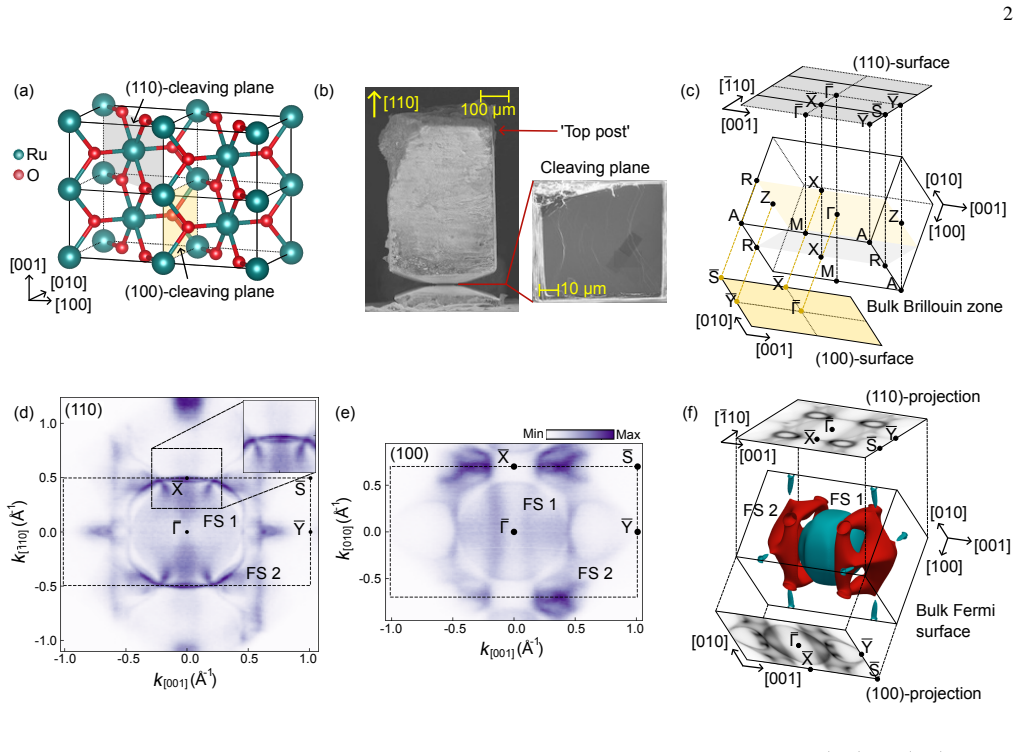
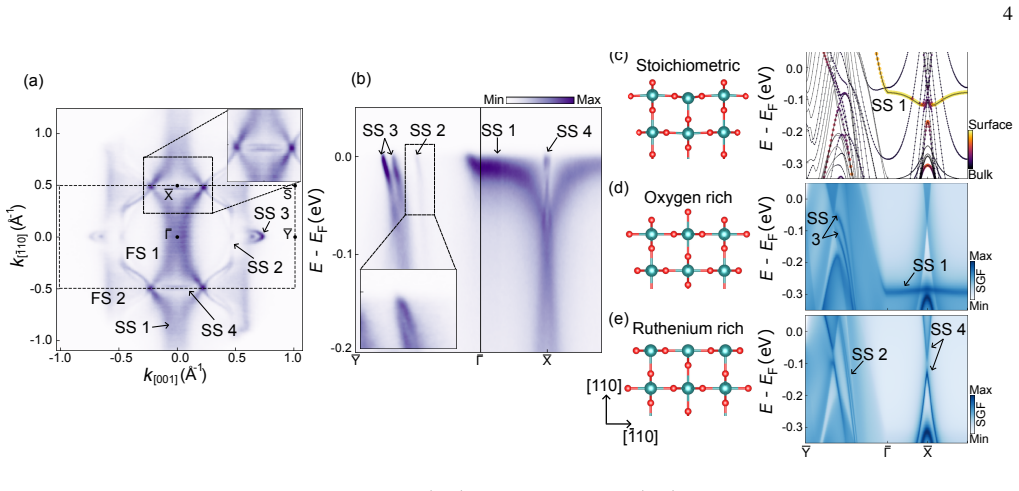
By preparing targeted (110) and (100) surfaces via focused ion beam engineered cleaving, ARPES spectra of RuO2 are shown to be largely dominated by signatures of distinct surface electronic states. These states are disentangled from highly three-dimensional bulk states and surface resonances through direct comparison with density-functional theory, revealing termination-dependent variations and a marked role of Ru 4d spin-orbit coupling that produces Rashba-type spin splittings where inversion symmetry is broken.
What carries the argument
FIB-engineered cleaving to access specific (110) and (100) surfaces, allowing ARPES to isolate and compare surface states against bulk bands via DFT modeling.
If this is right
- ARPES on RuO2 primarily captures surface rather than bulk electronic features.
- Observed surface states change with the choice of crystal termination.
- Broken inversion symmetry at the surface produces observable Rashba-type spin splittings from Ru 4d spin-orbit coupling.
- Correct interpretation of the material's electronic and magnetic properties requires separating surface and bulk contributions.
Where Pith is reading between the lines
- The same surface dominance could appear in ARPES studies of other strongly three-dimensional rutile oxides.
- This cleaving approach may help resolve similar bulk-versus-surface ambiguities in other correlated materials.
- Future work on superconductivity or magnetism in RuO2 should account for possible surface-state contributions to transport or spectroscopic signals.
Load-bearing premise
Focused ion beam cleaving produces atomically clean surfaces whose electronic structure matches the intrinsic material without added defects or strain that would alter the spectra beyond what density-functional theory can correct.
What would settle it
If ARPES spectra from conventionally prepared RuO2 surfaces match the FIB-prepared ones without surface-specific features appearing in the DFT models, or if the measured bands show no termination dependence and no Rashba splittings, the claim of surface dominance would not hold.
Figures


read the original abstract
Rutile RuO$_2$ has attracted significant interest due to its putative unconventional electronic and magnetic properties and its proximity to superconductivity. However, the measurement and interpretation of its electronic structure has been complicated by a strongly three-dimensional crystal structure. Here, we demonstrate how the preparation of targeted $(110)$ and $(100)$ surfaces via focused ion beam (FIB)-engineered cleaving allows the acquisition of high-quality measurements of the electronic structure using angle-resolved photoemission spectroscopy. Our results demonstrate that ARPES spectra of RuO$_2$ are, in fact, largely dominated by signatures of distinct surface electronic states. From comparison with density-functional theory, we resolve a surface termination-dependent variation of these, and disentangle them from highly-three-dimensional bulk states and surface resonances. Moreover, we find a marked role of the substantial spin-orbit coupling of the Ru 4$d$ orbitals in the surface region, where a breaking of spatial inversion symmetry leads to significant Rashba-type spin splittings of the surface bands.
Editorial analysis
A structured set of objections, weighed in public.
Referee Report
Summary. The paper claims that FIB-engineered cleaving of targeted (110) and (100) planes in rutile RuO2 enables high-quality ARPES measurements that reveal spectra largely dominated by distinct surface electronic states. Comparison to termination-dependent DFT calculations allows disentanglement of these from highly 3D bulk bands and surface resonances, while also identifying significant Rashba-type spin splittings arising from SOC and inversion symmetry breaking at the surface.
Significance. If the central claim holds, the work is significant for resolving interpretive ambiguities in ARPES studies of RuO2, a material of interest for its putative altermagnetism and proximity to superconductivity. The targeted cleave-plane approach offers a generalizable route to surface-bulk separation in complex 3D crystals, and the reported SOC-driven Rashba effects add concrete insight into surface electronic structure in 4d transition-metal oxides.
major comments (2)
- [Methods] Methods section on FIB cleaving: No post-cleavage surface characterization (e.g., LEED patterns, core-level XPS, or STM) is presented to confirm the absence of Ga implantation, amorphization, or strain. This is load-bearing because the claim that ARPES spectra are 'largely dominated by signatures of distinct surface electronic states' assumes the measured dispersions and splittings are intrinsic rather than preparation-induced; ideal DFT slabs cannot correct for such artifacts.
- [Results] Results section on ARPES-DFT comparison: The disentanglement of bulk, surface resonances, and termination-dependent states is shown via visual overlay only, without quantitative metrics such as band-position RMS deviations, error bars on extracted dispersions, or goodness-of-fit values. This weakens the ability to assess how cleanly the highly 3D bulk states have been isolated, particularly when the abstract emphasizes 'high-quality data and DFT comparison'.
minor comments (2)
- [Figures] Figure 3 (or equivalent ARPES images): The raw data panels would benefit from explicit indication of the Fermi level and momentum cuts used for the extracted dispersions to aid reproducibility.
- [Discussion] Notation: The distinction between 'surface resonances' and 'surface states' is used interchangeably in the text without a clear definition or reference to prior literature on the distinction in RuO2.
Simulated Author's Rebuttal
We thank the referee for their careful reading and constructive comments on our manuscript. We address each major comment below and indicate the revisions we will incorporate.
read point-by-point responses
-
Referee: [Methods] Methods section on FIB cleaving: No post-cleavage surface characterization (e.g., LEED patterns, core-level XPS, or STM) is presented to confirm the absence of Ga implantation, amorphization, or strain. This is load-bearing because the claim that ARPES spectra are 'largely dominated by signatures of distinct surface electronic states' assumes the measured dispersions and splittings are intrinsic rather than preparation-induced; ideal DFT slabs cannot correct for such artifacts.
Authors: We acknowledge the referee's concern that additional post-cleavage characterization would strengthen the interpretation. The FIB cleaving was performed using low ion energies and minimal doses to limit potential damage, and the ARPES spectra display sharp, well-resolved dispersions without evidence of broadening or disorder that would indicate amorphization or strain. While LEED, XPS, or STM were not performed on the cleaved surfaces in this work, the close correspondence between the measured bands and our termination-dependent DFT calculations provides supporting evidence that the features are intrinsic. We will revise the Methods section to include a detailed discussion of the FIB parameters, the rationale for expecting negligible Ga implantation, and arguments based on spectral quality for the absence of preparation artifacts. This is a partial revision, as new experimental characterization data cannot be added retroactively. revision: partial
-
Referee: [Results] Results section on ARPES-DFT comparison: The disentanglement of bulk, surface resonances, and termination-dependent states is shown via visual overlay only, without quantitative metrics such as band-position RMS deviations, error bars on extracted dispersions, or goodness-of-fit values. This weakens the ability to assess how cleanly the highly 3D bulk states have been isolated, particularly when the abstract emphasizes 'high-quality data and DFT comparison'.
Authors: We agree that quantitative metrics would improve the assessment of the ARPES-DFT comparison. In the revised manuscript, we will add root-mean-square deviations between experimental and calculated positions for the principal surface and bulk bands, along with error bars on dispersions extracted from momentum distribution curve fits. Where feasible, we will also include a quantitative goodness-of-fit measure to better demonstrate the isolation of the termination-dependent surface states from the three-dimensional bulk bands. revision: yes
Circularity Check
No circularity in derivation chain
full rationale
The paper reports experimental ARPES spectra acquired on FIB-targeted (110) and (100) surfaces of RuO2, then compares those spectra directly to independent DFT slab calculations for the corresponding terminations. No equations, fitted parameters, or self-citations are used to derive the central claim that surface states dominate; the disentanglement follows from the observed match (or mismatch) between measured dispersions and the termination-specific DFT bands. The result is externally falsifiable against the DFT models and does not reduce to any input by construction.
Axiom & Free-Parameter Ledger
axioms (2)
- domain assumption ARPES is highly surface-sensitive and probes only the top few atomic layers
- domain assumption DFT calculations can accurately model both bulk bands and surface terminations in RuO2
Reference graph
Works this paper leans on
-
[1]
cross- ing
= 0k k = π/2 k = π FIG. 2. Reconciling apparent bulk band crossing from surface projections. (a) Schematic of how the bulk Brillouin zones stack together and project onto the surface Brillouin zone. The coloured lines show the bulk Fermi surface contours extracted from DFT. (b–d) Dispersions along ΓX at photon energies of 50 eV , 68 eV , and 87 eV . These...
2018
-
[2]
Over, Surface chemistry of ruthenium dioxide in heteroge- neous catalysis and electrocatalysis: From fundamental to ap- plied research, Chemical Reviews112, 3356 (2012)
H. Over, Surface chemistry of ruthenium dioxide in heteroge- neous catalysis and electrocatalysis: From fundamental to ap- plied research, Chemical Reviews112, 3356 (2012)
2012
-
[3]
J. P. Ruf, H. Paik, N. J. Schreiber, H. P. Nair, L. Miao, J. K. Kawasaki, J. N. Nelson, B. D. Faeth, Y . Lee, B. H. Goodge, B. Pamuk, C. J. Fennie, L. F. Kourkoutis, D. G. Schlom, and K. M. Shen, Strain-stabilized superconductivity, Nature Com- munications12, 59 (2021)
2021
-
[4]
Wadehra, B
N. Wadehra, B. Z. Gregory, S. Zhang, N. Schnitzer, Y . Iguchi, Y . E. Li, B. Pamuk, D. A. Muller, A. Singer, K. M. Shen, and D. G. Schlom, Strain-induced superconductivity in RuO2(100) thin-films, Communications Materials6, 135 (2025)
2025
-
[5]
Y . Sun, Y . Zhang, C.-X. Liu, C. Felser, and B. Yan, Dirac nodal lines and induced spin hall effect in metallic rutile oxides, Phys- ical Review B95, 235104 (2017)
2017
-
[6]
ˇSmejkal, J
L. ˇSmejkal, J. Sinova, and T. Jungwirth, Beyond conventional ferromagnetism and antiferromagnetism: A phase with nonrel- ativistic spin and crystal rotation symmetry, Physical Review X 12, 031042 (2022)
2022
-
[7]
Gonz ´alez-Hern´andez, L
R. Gonz ´alez-Hern´andez, L. ˇSmejkal, K. V ´yborn´ y, Y . Yahagi, J. Sinova, T. s. Jungwirth, and J. ˇZelezn´y, Efficient electri- cal spin splitter based on nonrelativistic collinear antiferromag- netism, Physical Review Letters126, 127701 (2021)
2021
-
[8]
Z. Feng, X. Zhou, L. ˇSmejkal, L. Wu, Z. Zhu, H. Guo, R. Gonz ´alez-Hern´andez, X. Wang, H. Yan, P. Qin, X. Zhang, H. Wu, H. Chen, Z. Meng, L. Liu, Z. Xia, J. Sinova, T. Jung- wirth, and Z. Liu, An anomalous Hall effect in altermagnetic ruthenium dioxide, Nature Electronics5, 735 (2022)
2022
-
[9]
Tschirner, P
T. Tschirner, P. Keßler, R. D. Gonzalez Betancourt, T. Kotte, D. Kriegner, B. B ¨uchner, J. Dufouleur, M. Kamp, V . Jovic, L. Smejkal, J. Sinova, R. Claessen, T. Jungwirth, S. Moser, H. Reichlova, and L. Veyrat, Saturation of the anomalous Hall effect at high magnetic fields in altermagnetic RuO2, APL Ma- terials11, 101103 (2023)
2023
-
[10]
H. Bai, Y . C. Zhang, Y . J. Zhou, P. Chen, C. H. Wan, L. Han, W. X. Zhu, S. X. Liang, Y . C. Su, X. F. Han, F. Pan, and C. Song, Efficient spin-to-charge conversion via altermagnetic spin split- ting effect in antiferromagnet RuO 2, Physical Review Letters 130, 216701 (2023)
2023
-
[11]
Karube, T
S. Karube, T. Tanaka, D. Sugawara, N. Kadoguchi, M. Kohda, and J. Nitta, Observation of spin-splitter torque in collinear an- tiferromagnetic RuO 2, Physical Review Letters129, 137201 (2022)
2022
-
[12]
Hiraishi, H
M. Hiraishi, H. Okabe, A. Koda, R. Kadono, T. Muroi, D. Hi- rai, and Z. Hiroi, Nonmagnetic ground state in RuO 2 revealed by muon spin rotation, Physical Review Letters132, 166702 (2024)
2024
-
[13]
Keßler, L
P. Keßler, L. Garcia-Gassull, A. Suter, T. Prokscha, Z. Salman, D. Khalyavin, P. Manuel, F. Orlandi, I. I. Mazin, R. Valent´ı, and S. Moser, Absence of magnetic order in RuO2: insights from µSR spectroscopy and neutron diffraction, npj Spintronics2, 50 (2024)
2024
-
[14]
Kiefer, F
L. Kiefer, F. Wirth, A. Bertin, P. Becker, L. Bohat ´y, K. Schmalzl, A. Stunault, J. A. Rodr ´ıguez-Velamazan, O. Fa- belo, and M. Braden, Crystal structure and absence of mag- netic order in single-crystalline RuO2, Journal of Physics: Con- densed Matter37, 135801 (2025)
2025
-
[15]
D. Q. Ho, D. Q. To, R. Hu, G. W. Bryant, and A. Janotti, Symmetry-breaking induced surface magnetization in nonmag- netic RuO 2, Physical Review Materials9, 094406 (2025)
2025
-
[16]
Torun, C
E. Torun, C. M. Fang, G. A. de Wijs, and R. A. de Groot, Role of magnetism in catalysis: RuO 2 (110) surface, The Journal of Physical Chemistry C117, 6353 (2013)
2013
-
[17]
Jovic, R
V . Jovic, R. J. Koch, S. K. Panda, H. Berger, P. Bugnon, A. Ma- grez, K. E. Smith, S. Biermann, C. Jozwiak, A. Bostwick, E. Rotenberg, and S. Moser, Dirac nodal lines and flat-band sur- face state in the functional oxide RuO2, Physical Review B98, 241101 (2018)
2018
-
[18]
Jovic, A
V . Jovic, A. Consiglio, K. E. Smith, C. Jozwiak, A. Bostwick, E. Rotenberg, D. Di Sante, and S. Moser, Momentum for catal- ysis: How surface reactions shape the RuO 2 flat surface state, ACS Catalysis11, 1749 (2021)
2021
-
[19]
J. Liu, J. Zhan, T. Li, J. Liu, S. Cheng, Y . Shi, L. Deng, M. Zhang, C. Li, J. Ding, Q. Jiang, M. Ye, Z. Liu, Z. Jiang, S. Wang, Q. Li, Y . Xie, Y . Wang, S. Qiao, J. Wen, Y . Sun, and D. Shen, Absence of altermagnetic spin splitting character in ru- tile oxide RuO 2, Physical Review Letters133, 176401 (2024)
2024
-
[20]
Osumi, K
T. Osumi, K. Yamauchi, S. Souma, S. Paul, A. Honma, K. Nakayama, K. Ozawa, M. Kitamura, K. Horiba, H. Kumi- gashira, C. Bigi, F. Bertran, T. Oguchi, T. Takahashi, Y . Maeno, and T. Sato, Spin-degenerate bulk bands and topological sur- face states associated with dirac nodal lines in RuO 2, Physical Review B113, 085116 (2026)
2026
-
[21]
Z. Lin, D. Chen, W. Lu, X. Liang, S. Feng, K. Yamagami, J. Osiecki, M. Leandersson, B. Thiagarajan, J. Liu, C. Felser, and J. Ma, Bulk band structure of RuO 2 measured with soft x-ray angle-resolved photoemission spectroscopy, Physical Re- view B111, 134450 (2025)
2025
-
[22]
J. E. Graebner, E. S. Greiner, and W. D. Ryden, Magnetother- mal oscillations in RuO 2, OsO2, and IrO 2, Physical Review B 13, 2426 (1976)
1976
-
[23]
Yavorsky, O
B. Yavorsky, O. Krasovska, E. Krasovskii, A. Yaresko, and V . Antonov, Ab initio calculation of the fermi surface of RuO2, Physica B: Condensed Matter225, 243 (1996)
1996
-
[24]
Z. Wu, M. Long, H. Chen, S. Paul, H. Matsuki, O. Zheliuk, U. Zeitler, G. Li, R. Zhou, Z. Zhu, D. Graf, T. I. Weinberger, F. M. Grosche, Y . Maeno, and A. G. Eaton, Fermi surface of RuO2 measured by quantum oscillations, Physical Review X 15, 031044 (2025)
2025
-
[25]
Hunter, C
A. Hunter, C. Putzke, I. Gaponenko, A. Tamai, F. Baumberger, and P. J. W. Moll, Controlling crystal cleavage in focused ion beam shaped specimens for surface spectroscopy, Review of Scientific Instruments95, 033905 (2024)
2024
-
[26]
H. Over, A. Seitsonen, E. Lundgren, M. Schmid, and P. Varga, Experimental and simulated STM images of stoichiometric and partially reduced RuO2(110) surfaces including adsorbates, Surface Science515, 143 (2002)
2002
-
[27]
Oppermann and M
H. Oppermann and M. Ritschel, Zum chemischen transport der ¨Ubergangsmetalldioxide mit tellurhalogeniden, Kristall und Technik10, 485 (1975)
1975
- [28]
-
[29]
Giannozzi, S
P. Giannozzi, S. Baroni, N. Bonini, M. Calandra, R. Car, C. Cavazzoni, D. Ceresoli, G. L. Chiarotti, M. Cococ- cioni, I. Dabo, A. Dal Corso, S. de Gironcoli, S. Fab- ris, G. Fratesi, R. Gebauer, U. Gerstmann, C. Gougoussis, A. Kokalj, M. Lazzeri, L. Martin-Samos, N. Marzari, F. Mauri, R. Mazzarello, S. Paolini, A. Pasquarello, L. Paulatto, C. Sbrac- cia, ...
2009
-
[30]
Giannozzi, O
P. Giannozzi, O. Andreussi, T. Brumme, O. Bunau, M. Buon- giorno Nardelli, M. Calandra, R. Car, C. Cavazzoni, D. Ceresoli, M. Cococcioni, N. Colonna, I. Carnimeo, A. Dal Corso, S. de Gironcoli, P. Delugas, R. A. DiStasio, A. Ferretti, A. Floris, G. Fratesi, G. Fugallo, R. Gebauer, U. Gerstmann, F. Giustino, T. Gorni, J. Jia, M. Kawamura, H.-Y . Ko, A. Kok...
2017
-
[31]
D. R. Hamann, Optimized norm-conserving vanderbilt pseu- dopotentials, Phys. Rev. B88, 085117 (2013)
2013
-
[32]
Materials data on RuO 2 by materials project 10.17188/1307989 (2020)
-
[33]
Prandini, A
G. Prandini, A. Marrazzo, I. E. Castelli, N. Mounet, and N. Marzari, Precision and efficiency in solid-state pseudopo- tential calculations, npj Computational Materials4, 72 (2018)
2018
-
[34]
Pizzi, V
G. Pizzi, V . Vitale, R. Arita, S. Bl ¨ugel, F. Freimuth, G. G ´eranton, M. Gibertini, D. Gresch, C. Johnson, T. Koret- sune, J. Iba ˜nez-Azpiroz, H. Lee, J.-M. Lihm, D. Marchand, A. Marrazzo, Y . Mokrousov, J. I. Mustafa, Y . Nohara, Y . No- mura, L. Paulatto, S. Ponc ´e, T. Ponweiser, J. Qiao, F. Th ¨ole, S. S. Tsirkin, M. g. Wierzbowska, N. Marzari, D....
2020
-
[35]
the cleaver
Q. Wu, S. Zhang, H.-F. Song, M. Troyer, and A. A. Soluyanov, Wanniertools: An open-source software package for novel topological materials, Computer Physics Communications224, 405 (2018). Supplementary Information: Disentangling bulk and surface electronic structure using targeted cleave planes in RuO 2 Maria H. Visscher, 1, 2 Sebastian Buchberger,2 Bruno...
2018
discussion (0)
Sign in with ORCID, Apple, or X to comment. Anyone can read and Pith papers without signing in.