Recognition: 2 theorem links
· Lean TheoremOn the origin of the environmental step: A BayeSN view of the ZTF SN Ia DR2
Pith reviewed 2026-05-12 03:29 UTC · model grok-4.3
The pith
BayeSN analysis of ZTF supernovae data shows the environmental magnitude step is intrinsic to the explosions rather than caused by dust.
A machine-rendered reading of the paper's core claim, the machinery that carries it, and where it could break.
Core claim
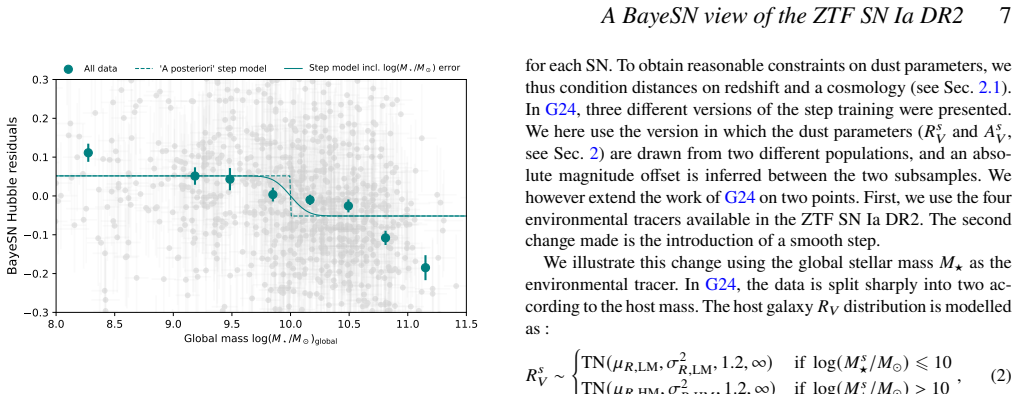
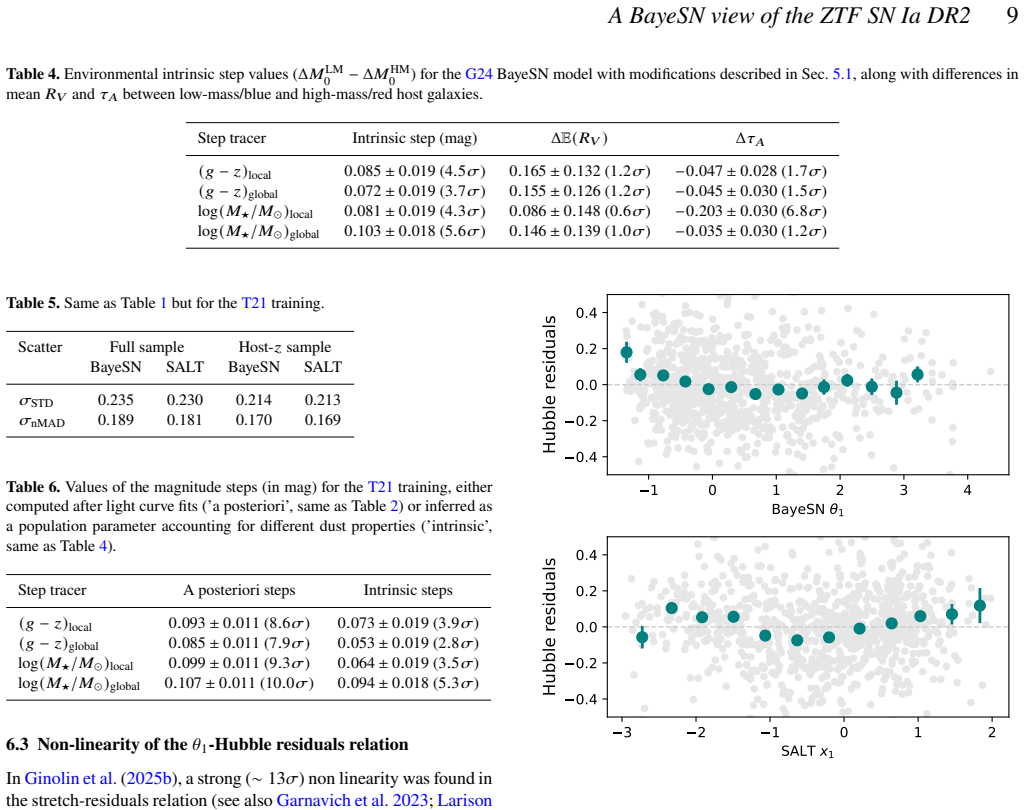
Using a new training of BayeSN we obtain smaller Hubble-residual scatter than with SALT. When the model simultaneously includes an intrinsic magnitude step and differing dust properties, we recover a posteriori steps of 0.103±0.018 mag (5.6σ) for global stellar mass and 0.085±0.019 mag (4.5σ) for local color. The means of the R_V distributions remain similar between environments, with differences ≤0.2 and significances 0.6σ to 1.2σ. This constitutes a strong signal that SN Ia absolute magnitude depends intrinsically on environment.
What carries the argument
The extended BayeSN hierarchical Bayesian model for SN Ia SEDs that jointly fits an intrinsic magnitude step and environment-dependent dust parameters (R_V distributions).
If this is right
- The magnitude step is independent of the choice of light-curve fitter (SALT versus BayeSN).
- Dust properties do not differ significantly across host environments at the precision of the current sample.
- Accounting for the intrinsic step reduces scatter in Hubble residuals and therefore tightens cosmological constraints.
- Population-level studies with large surveys can isolate intrinsic supernova variations from observational systematics.
Where Pith is reading between the lines
- Future standardization pipelines for next-generation surveys may need to treat host-galaxy environment as an explicit standardization parameter rather than a post-hoc correction.
- If the intrinsic step is confirmed, it could be used to test whether SN Ia progenitor channels vary systematically with galaxy type or metallicity.
- Repeating the analysis on other large datasets (e.g., LSST or Roman) would test whether the result is universal or survey-specific.
Load-bearing premise
The BayeSN model accurately separates intrinsic supernova properties from dust extinction without residual biases or unmodeled correlations between environment and other parameters.
What would settle it
A larger independent sample in which the magnitude step vanishes once the same extended BayeSN model is applied, or a direct spectroscopic measurement of progenitor or explosion properties showing no environment dependence.
Figures




read the original abstract
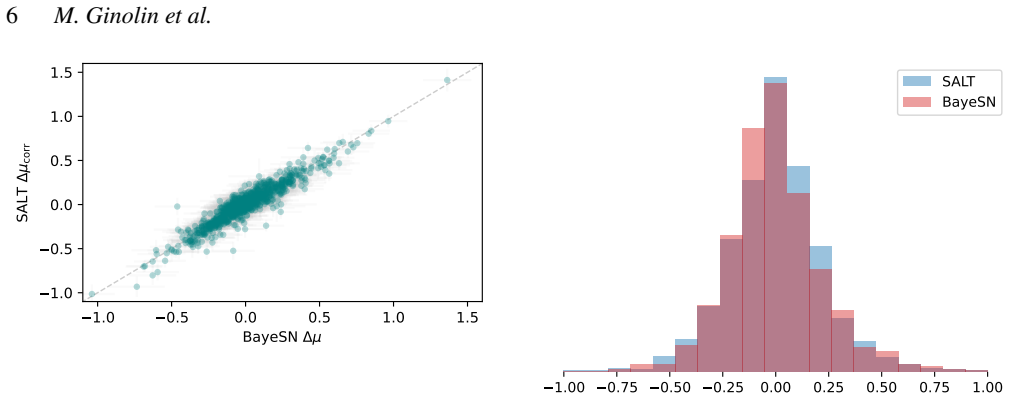
Astrophysical variabilities of Type Ia supernovae (SNe Ia), such as their link with their birth environment, are now one of the leading sources of systematic uncertainties on the measurement of the dark energy equation-of-state parameter $w$. Population studies of SNe Ia, using large samples, give precious insights into these variabilities. We analyse a volume-limited subsample of the ZTF SN Ia DR2 with BayeSN, a hierarchical Bayesian model for SN Ia SEDs. We investigate the distributions of SN Ia light curve parameters and their link with SN environment. Using a new training of BayeSN released in a companion paper, we find a smaller scatter of Hubble residuals compared to SALT. We then investigate the magnitude step, which accounts for the correlation between SN Ia standardised absolute magnitude and host environments. We find a posteriori steps of $0.103\pm0.010$ mag (a $10.1\sigma$ difference from 0) when using global stellar mass as an environmental proxy, and $0.086\pm0.010$ mag ($8.3\sigma$) when using local colour, in accordance with steps computed using SALT light curve fits. This confirms that the large step seen in the ZTF SN Ia DR2 data was not due to the SALT fit or the associated standardisation process. We then investigate the origin of the step, using a BayeSN model which accounts for both an intrinsic magnitude step and differing dust properties with the SN environment. We find a $0.103\pm0.018$ mag ($5.6\sigma$) step in global mass and a $0.085\pm0.019$ mag ($4.5\sigma$) step in local colour. The means of the $R_V$ distribution are similar between different host environments, with $\Delta\mathbb{E}(R_V)\leq0.2$ across all environment proxies, with significances ranging from $0.6\sigma$ to $1.2\sigma$. This is a strong signal of the existence of an intrinsic dependence of SN Ia absolute magnitude on environment.
Editorial analysis
A structured set of objections, weighed in public.
Referee Report
Summary. The manuscript analyzes a volume-limited subsample of the ZTF SN Ia DR2 using the BayeSN hierarchical Bayesian SED model. It reports statistically significant magnitude steps with global stellar mass (0.103±0.010 mag, 10.1σ) and local color (0.086±0.010 mag, 8.3σ) proxies, consistent with SALT fits. Extending the model to include both an intrinsic magnitude step and environment-dependent R_V distributions yields persistent steps of 0.103±0.018 mag (5.6σ) and 0.085±0.019 mag (4.5σ), with insignificant mean R_V differences (ΔE(R_V)≤0.2 at 0.6–1.2σ), interpreted as evidence for an intrinsic environmental dependence of SN Ia absolute magnitudes.
Significance. If the hierarchical separation of intrinsic and dust effects holds, the result provides important evidence that the environmental step is not primarily dust-driven, with direct implications for reducing systematics in SN Ia cosmological standardization and w measurements. Strengths include the use of a full SED model (with smaller Hubble residual scatter than SALT), consistency across two environment proxies, and the explicit model extension that keeps the step amplitude unchanged while increasing its uncertainty. The work builds on a companion BayeSN training paper.
major comments (2)
- [results on extended BayeSN model] Abstract and results on extended model: the intrinsic step central value remains exactly 0.103 mag for global mass (and 0.086→0.085 mag for local color) after adding environment-dependent R_V parameters, with uncertainty increasing from ±0.010 to ±0.018 mag. This lack of shift in the point estimate, despite added degrees of freedom, requires explicit demonstration (e.g., via posterior correlations or corner plots in the methods/results) that the intrinsic step amplitude is not partially degenerate with the R_V distribution parameters; otherwise the 5.6σ claim rests on an unverified partition.
- [methods and results on dust properties] Abstract and model description: the conclusion that ΔE(R_V)≤0.2 (0.6–1.2σ) supports no dust difference, and thus a strong intrinsic signal, assumes the hierarchical model has sufficient power to detect R_V shifts of that size in the ZTF DR2 subsample. The manuscript should include a simulation study or power analysis (e.g., injecting known ΔE(R_V) and recovering posteriors) to show that the low significance is not due to limited constraining power or unmodeled correlations between environment and other SED parameters such as intrinsic color.
minor comments (2)
- [abstract and results] The notation E(R_V) for the mean of the R_V distribution should be defined explicitly on first use to avoid ambiguity with extinction.
- [introduction] The manuscript references a companion paper for the new BayeSN training; a brief summary of key differences from prior versions would improve self-containment.
Simulated Author's Rebuttal
We are grateful to the referee for their insightful comments on our manuscript. These have prompted us to strengthen the presentation of our results on the extended BayeSN model. We respond to each major comment in turn below.
read point-by-point responses
-
Referee: [results on extended BayeSN model] Abstract and results on extended model: the intrinsic step central value remains exactly 0.103 mag for global mass (and 0.086→0.085 mag for local color) after adding environment-dependent R_V parameters, with uncertainty increasing from ±0.010 to ±0.018 mag. This lack of shift in the point estimate, despite added degrees of freedom, requires explicit demonstration (e.g., via posterior correlations or corner plots in the methods/results) that the intrinsic step amplitude is not partially degenerate with the R_V distribution parameters; otherwise the 5.6σ claim rests on an unverified partition.
Authors: We thank the referee for pointing out the need to explicitly verify the lack of degeneracy. In the revised manuscript, we now include corner plots of the relevant posterior distributions in a new figure (Figure 8) and report the correlation coefficients in the text of Section 3.3. The plots confirm that the intrinsic step amplitude has negligible correlation with the R_V mean parameters (coefficients < 0.1), validating the separation in the hierarchical model and supporting the reported significance. revision: yes
-
Referee: [methods and results on dust properties] Abstract and model description: the conclusion that ΔE(R_V)≤0.2 (0.6–1.2σ) supports no dust difference, and thus a strong intrinsic signal, assumes the hierarchical model has sufficient power to detect R_V shifts of that size in the ZTF DR2 subsample. The manuscript should include a simulation study or power analysis (e.g., injecting known ΔE(R_V) and recovering posteriors) to show that the low significance is not due to limited constraining power or unmodeled correlations between environment and other SED parameters such as intrinsic color.
Authors: We agree that a dedicated power analysis would be ideal to quantify the model's sensitivity. However, conducting a full simulation study by injecting known R_V differences and recovering them is computationally intensive and not completed in time for this revision. We have instead added a paragraph in the discussion section explaining the constraining power based on the observed posterior uncertainties on R_V (typically 0.1-0.2 mag), which indicate that differences of 0.4 mag or more would be detectable at high significance. Additionally, we have checked and report that correlations between environment and intrinsic color parameters are weak in our fits. This supports our interpretation, though we acknowledge a simulation would provide stronger evidence. revision: partial
Circularity Check
BayeSN hierarchical fit yields persistent environmental magnitude step after allowing R_V variation; minor companion-paper self-citation for model training
full rationale
The paper trains BayeSN in a companion paper (likely overlapping authors) then applies the hierarchical model to ZTF DR2 data, fitting an explicit intrinsic magnitude step parameter jointly with environment-dependent dust (R_V distributions). Reported values (0.103±0.018 mag at 5.6σ for global mass) are posterior means driven by the data likelihood and independent environmental proxies; they do not reduce by construction to the fitted parameters or to any self-cited result. The central claim that the step remains after marginalizing dust is a direct fit outcome, not a definitional or renamed tautology. The single self-citation to the training procedure is not load-bearing for the environmental-step inference itself.
Axiom & Free-Parameter Ledger
free parameters (2)
- intrinsic magnitude step amplitude
- R_V distribution parameters per environment
axioms (1)
- domain assumption BayeSN hierarchical model assumptions on SN Ia SED variability and dust extinction laws
Lean theorems connected to this paper
-
IndisputableMonolith/Cost/FunctionalEquation.leanwashburn_uniqueness_aczel unclear?
unclearRelation between the paper passage and the cited Recognition theorem.
We find a 0.103±0.018 mag (5.6σ) step in global mass ... ΔE(R_V)≤0.2 ... strong signal of the existence of an intrinsic dependence
-
IndisputableMonolith/Foundation/AlphaCoordinateFixation.leanJ_uniquely_calibrated_via_higher_derivative unclear?
unclearRelation between the paper passage and the cited Recognition theorem.
BayeSN model ... A_V ξ(λ; R_V) + ... θ1 W1 ... population-level dust parameters
What do these tags mean?
- matches
- The paper's claim is directly supported by a theorem in the formal canon.
- supports
- The theorem supports part of the paper's argument, but the paper may add assumptions or extra steps.
- extends
- The paper goes beyond the formal theorem; the theorem is a base layer rather than the whole result.
- uses
- The paper appears to rely on the theorem as machinery.
- contradicts
- The paper's claim conflicts with a theorem or certificate in the canon.
- unclear
- Pith found a possible connection, but the passage is too broad, indirect, or ambiguous to say the theorem truly supports the claim.
Reference graph
Works this paper leans on
-
[1]
UNITY: Confronting Supernova Cosmology's Statistical and Systematic Uncertainties in a Unified Bayesian Framework. , keywords =. doi:10.1088/0004-637X/813/2/137 , archivePrefix =. 1507.01602 , primaryClass =
-
[2]
Measuring Type Ia Supernova Populations of Stretch and Color and Predicting Distance Biases. , keywords =. doi:10.3847/2041-8205/822/2/L35 , archivePrefix =. 1603.01559 , primaryClass =
-
[3]
Correcting Type Ia Supernova Distances for Selection Biases and Contamination in Photometrically Identified Samples. , keywords =. doi:10.3847/1538-4357/836/1/56 , archivePrefix =. 1610.04677 , primaryClass =
-
[4]
, archivePrefix = "arXiv", eprint =
Cosmic Star-Formation History. , keywords =. doi:10.1146/annurev-astro-081811-125615 , archivePrefix =. 1403.0007 , primaryClass =
work page internal anchor Pith review Pith/arXiv arXiv doi:10.1146/annurev-astro-081811-125615
-
[5]
Predicted and Observed Evolution in the Mean Properties of Type Ia Supernovae with Redshift. , keywords =. doi:10.1086/522030 , archivePrefix =. astro-ph/0701912 , primaryClass =
-
[6]
The Morphology of Type IA Supernovae Light Curves. , keywords =. doi:10.1086/118193 , archivePrefix =. astro-ph/9609063 , primaryClass =
-
[7]
Type IA Supernovae in Elliptical and Spiral Galaxies: Possible Differences in Photometric Homogeneity. , keywords =. doi:10.1086/132472 , adsurl =
-
[8]
Redshift evolution of the underlying type Ia supernova stretch distribution. , keywords =. doi:10.1051/0004-6361/202038447 , archivePrefix =. 2005.09441 , primaryClass =
-
[9]
Accuracy of environmental tracers and consequences for determining the Type Ia supernova magnitude step. , keywords =. doi:10.1051/0004-6361/202141160 , archivePrefix =. 2109.02456 , primaryClass =
-
[10]
Strong dependence of Type Ia supernova standardization on the local specific star formation rate. , keywords =. doi:10.1051/0004-6361/201730404 , archivePrefix =. 1806.03849 , primaryClass =
-
[11]
It's Dust: Solving the Mysteries of the Intrinsic Scatter and Host-galaxy Dependence of Standardized Type Ia Supernova Brightnesses. , keywords =. doi:10.3847/1538-4357/abd69b , archivePrefix =. 2004.10206 , primaryClass =
-
[12]
Observational Evidence from Supernovae for an Accelerating Universe and a Cosmological Constant
Observational Evidence from Supernovae for an Accelerating Universe and a Cosmological Constant. , keywords =. doi:10.1086/300499 , archivePrefix =. astro-ph/9805201 , primaryClass =
work page internal anchor Pith review Pith/arXiv arXiv doi:10.1086/300499
-
[13]
Measurements of Omega and Lambda from 42 High-Redshift Supernovae
Measurements of and from 42 High-Redshift Supernovae. , keywords =. doi:10.1086/307221 , archivePrefix =. astro-ph/9812133 , primaryClass =
work page internal anchor Pith review Pith/arXiv arXiv doi:10.1086/307221
-
[14]
The Absolute Magnitudes of Type IA Supernovae. , keywords =. doi:10.1086/186970 , adsurl =
- [15]
-
[16]
Hubble Residuals of Nearby Type Ia Supernovae are Correlated with Host Galaxy Masses. , keywords =. doi:10.1088/0004-637X/715/2/743 , archivePrefix =. 0912.0929 , primaryClass =
-
[17]
The dependence of Type Ia Supernovae luminosities on their host galaxies. , keywords =. doi:10.1111/j.1365-2966.2010.16731.x , archivePrefix =. 1003.5119 , primaryClass =
-
[18]
SNLS3: Constraints on Dark Energy Combining the Supernova Legacy Survey Three-year Data with Other Probes. , keywords =. doi:10.1088/0004-637X/737/2/102 , archivePrefix =. 1104.1444 , primaryClass =
-
[19]
Host Galaxy Properties and Hubble Residuals of Type Ia Supernovae from the Nearby Supernova Factory. , keywords =. doi:10.1088/0004-637X/770/2/108 , archivePrefix =. 1304.4720 , primaryClass =
-
[20]
2014, , 568, A22, 10.1051/0004-6361/201423413
Improved cosmological constraints from a joint analysis of the SDSS-II and SNLS supernova samples. , keywords =. doi:10.1051/0004-6361/201423413 , archivePrefix =. 1401.4064 , primaryClass =
-
[21]
2007, , 466, 11, 10.1051/0004-6361:20066930
SALT2: using distant supernovae to improve the use of type Ia supernovae as distance indicators. , keywords =. doi:10.1051/0004-6361:20066930 , archivePrefix =. astro-ph/0701828 , primaryClass =
-
[22]
Galaxy And Mass Assembly (GAMA): stellar mass estimates. , keywords =. doi:10.1111/j.1365-2966.2011.19536.x , archivePrefix =. 1108.0635 , primaryClass =
-
[23]
The Complete Light-curve Sample of Spectroscopically Confirmed SNe Ia from Pan-STARRS1 and Cosmological Constraints from the Combined Pantheon Sample. , keywords =. doi:10.3847/1538-4357/aab9bb , archivePrefix =. 1710.00845 , primaryClass =
-
[24]
Determining the Type, Redshift, and Age of a Supernova Spectrum. , keywords =. doi:10.1086/520494 , archivePrefix =. 0709.4488 , primaryClass =
-
[25]
The SED Machine: A Robotic Spectrograph for Fast Transient Classification. , keywords =. doi:10.1088/1538-3873/aaa53f , archivePrefix =. 1710.02917 , primaryClass =
-
[26]
Fully automated integral field spectrograph pipeline for the SEDMachine: pysedm. , keywords =. doi:10.1051/0004-6361/201935344 , archivePrefix =. 1902.08526 , primaryClass =
- [27]
-
[28]
The Zwicky Transient Facility: Observing System. , keywords =. doi:10.1088/1538-3873/ab4ca2 , archivePrefix =. 2008.04923 , primaryClass =
-
[29]
Planck 2018 results. VI. Cosmological parameters. , keywords =. doi:10.1051/0004-6361/201833910 , archivePrefix =. 1807.06209 , primaryClass =
work page internal anchor Pith review Pith/arXiv arXiv doi:10.1051/0004-6361/201833910 2018
-
[30]
A 2.4\. , keywords =. doi:10.3847/0004-637X/826/1/56 , archivePrefix =. 1604.01424 , primaryClass =
-
[31]
First cosmological results using Type Ia supernovae from the Dark Energy Survey: measurement of the Hubble constant. , keywords =. doi:10.1093/mnras/stz978 , archivePrefix =. 1811.02376 , primaryClass =
-
[32]
Prospects for Resolving the Hubble Constant Tension with Standard Sirens. , keywords =. doi:10.1103/PhysRevLett.122.061105 , archivePrefix =. 1802.03404 , primaryClass =
-
[33]
The Carnegie-Chicago Hubble Program. VIII. An Independent Determination of the Hubble Constant Based on the Tip of the Red Giant Branch. , keywords =. doi:10.3847/1538-4357/ab2f73 , archivePrefix =. 1907.05922 , primaryClass =
-
[34]
The supernova rate per unit mass. , keywords =. doi:10.1051/0004-6361:20041411 , archivePrefix =. astro-ph/0411450 , primaryClass =
-
[35]
Two populations of progenitors for Type Ia supernovae?. , keywords =. doi:10.1111/j.1365-2966.2006.10501.x , archivePrefix =. astro-ph/0510315 , primaryClass =
-
[36]
Rates and Properties of Type Ia Supernovae as a Function of Mass and Star Formation in Their Host Galaxies. , keywords =. doi:10.1086/506137 , archivePrefix =. astro-ph/0605455 , primaryClass =
-
[37]
Chemistry and Star Formation in the Host Galaxies of Type Ia Supernovae. , keywords =. doi:10.1086/491664 , archivePrefix =. astro-ph/0508180 , primaryClass =
-
[38]
Confirmation of a Star Formation Bias in Type Ia Supernova Distances and its Effect on the Measurement of the Hubble Constant. , keywords =. doi:10.1088/0004-637X/802/1/20 , archivePrefix =. 1412.6501 , primaryClass =
-
[39]
L. Knox and M. Millea , title =. doi:10.1103/physrevd.101.043533 , url =
-
[40]
A Gravitational-wave Measurement of the Hubble Constant Following the Second Observing Run of Advanced LIGO and Virgo. , keywords =. doi:10.3847/1538-4357/abdcb7 , archivePrefix =. 1908.06060 , primaryClass =
-
[41]
Type Ia supernova bolometric light curves and ejected mass estimates from the Nearby Supernova Factory. , keywords =. doi:10.1093/mnras/stu350 , archivePrefix =. 1402.6842 , primaryClass =
-
[42]
Low R _ V from Circumstellar Dust around Supernovae. , keywords =. doi:10.1086/593060 , archivePrefix =. 0809.1094 , primaryClass =
-
[43]
The Zwicky Transient Facility: System Overview, Performance, and First Results. , keywords =. doi:10.1088/1538-3873/aaecbe , archivePrefix =. 1902.01932 , primaryClass =
-
[44]
The Zwicky Transient Facility: Science Objectives. , keywords =. doi:10.1088/1538-3873/ab006c , archivePrefix =. 1902.01945 , primaryClass =
-
[45]
R., Kuhlmann , S., Kovacs , E., et al
Host Galaxy Identification for Supernova Surveys. , keywords =. doi:10.3847/0004-6256/152/6/154 , archivePrefix =. 1604.06138 , primaryClass =
-
[46]
Hans Dembinski and Piti Ongmongkolkul et al. , title=. 2020 , month=. doi:10.5281/zenodo.3949207 , publisher=
-
[47]
Astropy: A community Python package for astronomy. , keywords =. doi:10.1051/0004-6361/201322068 , archivePrefix =. 1307.6212 , primaryClass =
-
[48]
The Astronomical Journal , author =
The Astropy Project: Building an Open-science Project and Status of the v2.0 Core Package. , keywords =. doi:10.3847/1538-3881/aabc4f , archivePrefix =. 1801.02634 , primaryClass =
-
[49]
The effect of environment on Type Ia supernovae in the Dark Energy Survey three-year cosmological sample. , keywords =. doi:10.1093/mnras/staa3924 , archivePrefix =. 2008.12101 , primaryClass =
-
[50]
The Effect of Host Galaxies on Type Ia Supernovae in the SDSS-II Supernova Survey. , keywords =. doi:10.1088/0004-637X/722/1/566 , archivePrefix =. 1005.4687 , primaryClass =
-
[51]
Spectroscopic Properties of Star-forming Host Galaxies and Type Ia Supernova Hubble Residuals in a nearly Unbiased Sample. , keywords =. doi:10.1088/0004-637X/743/2/172 , archivePrefix =. 1110.5517 , primaryClass =
-
[52]
SDSS-II Supernova Survey: An Analysis of the Largest Sample of Type Ia Supernovae and Correlations with Host-galaxy Spectral Properties. , keywords =. doi:10.3847/0004-637X/821/2/115 , archivePrefix =. 1602.02674 , primaryClass =
-
[53]
Improved Distances to Type Ia Supernovae with Multicolor Light-Curve Shapes: MLCS2k2. , keywords =. doi:10.1086/512054 , archivePrefix =. astro-ph/0612666 , primaryClass =
-
[54]
Type Ia Supernova Light-Curve Inference: Hierarchical Bayesian Analysis in the Near-Infrared. , keywords =. doi:10.1088/0004-637X/704/1/629 , archivePrefix =. 0908.0536 , primaryClass =
-
[55]
Type Ia Supernova Light Curve Inference: Hierarchical Models in the Optical and Near-infrared. , keywords =. doi:10.1088/0004-637X/731/2/120 , archivePrefix =. 1011.5910 , primaryClass =
-
[56]
Near-infrared Supernova Ia Distances: Host Galaxy Extinction and Mass-step Corrections Revisited. , keywords =. doi:10.3847/1538-4357/ac2f9e , archivePrefix =. 2105.06236 , primaryClass =
-
[57]
The Carnegie Supernova Project-I: Correlation between Type Ia Supernovae and Their Host Galaxies from Optical to Near-infrared Bands. , keywords =. doi:10.3847/1538-4357/abafb7 , archivePrefix =. 2006.15164 , primaryClass =
-
[58]
Average Spectral Properties of Type Ia Supernova Host Galaxies. , keywords =. doi:10.3847/1538-4357/aa93e9 , archivePrefix =. 1710.05208 , primaryClass =
-
[59]
Journal of Korean Astronomical Society , keywords =
Environmental Dependence of Type Ia Supernova Luminosities from the YONSEI Supernova Catalog. Journal of Korean Astronomical Society , keywords =. doi:10.5303/JKAS.2019.52.5.181 , archivePrefix =. 1908.10375 , primaryClass =
-
[60]
The host galaxies of Type Ia supernovae discovered by the Palomar Transient Factory. , keywords =. doi:10.1093/mnras/stt2287 , archivePrefix =. 1311.6344 , primaryClass =
-
[61]
The dependence of Type Ia Supernovae SALT2 light-curve parameters on host galaxy morphology. , keywords =. doi:10.1093/mnras/staa3173 , archivePrefix =. 2006.09433 , primaryClass =
-
[62]
The influence of host galaxy morphology on the properties of Type Ia supernovae from the JLA compilation. , keywords =. doi:10.1016/j.newast.2016.08.009 , archivePrefix =. 1608.03674 , primaryClass =
-
[63]
Evidence of environmental dependencies of Type Ia supernovae from the Nearby Supernova Factory indicated by local H. , keywords =. doi:10.1051/0004-6361/201322104 , archivePrefix =. 1309.1182 , primaryClass =
-
[64]
Reconsidering the Effects of Local Star Formation on Type Ia Supernova Cosmology. , keywords =. doi:10.1088/0004-637X/812/1/31 , archivePrefix =. 1506.02637 , primaryClass =
-
[65]
Should Type Ia Supernova Distances Be Corrected for Their Local Environments?. , keywords =. doi:10.3847/1538-4357/aae2b9 , archivePrefix =. 1805.05911 , primaryClass =
-
[66]
Concerning colour: The effect of environment on type Ia supernova colour in the dark energy survey. , keywords =. doi:10.1093/mnras/stac3711 , archivePrefix =. 2208.01357 , primaryClass =
-
[67]
2021, , 913, 49, 10.3847/1538-4357/abf14f
Improved Treatment of Host-galaxy Correlations in Cosmological Analyses with Type Ia Supernovae. , keywords =. doi:10.3847/1538-4357/abf14f , archivePrefix =. 2102.01776 , primaryClass =
-
[68]
Measurements of the Hubble Constant: Tensions in Perspective. , keywords =. doi:10.3847/1538-4357/ac0e95 , archivePrefix =. 2106.15656 , primaryClass =
-
[69]
A Comprehensive Measurement of the Local Value of the Hubble Constant with 1 km s ^ -1 Mpc ^ -1 Uncertainty from the Hubble Space Telescope and the SH0ES Team. , keywords =. doi:10.3847/2041-8213/ac5c5b , archivePrefix =. 2112.04510 , primaryClass =
-
[70]
The Supernova Legacy Survey 3-year sample: Type Ia supernovae photometric distances and cosmological constraints. , keywords =. doi:10.1051/0004-6361/201014468 , archivePrefix =. 1010.4743 , primaryClass =
-
[71]
SALT3: An Improved Type Ia Supernova Model for Measuring Cosmic Distances. , keywords =. doi:10.3847/1538-4357/ac30d8 , archivePrefix =. 2104.07795 , primaryClass =
-
[72]
A Spectroscopic Model of the Type Ia Supernova - Host Galaxy Mass Correlation from SALT3. arXiv e-prints , keywords =
-
[73]
SNEMO: Improved Empirical Models for Type Ia Supernovae. , keywords =. doi:10.3847/1538-4357/aaec7e , archivePrefix =. 1810.09476 , primaryClass =
-
[74]
SUGAR: An improved empirical model of Type Ia supernovae based on spectral features. , keywords =. doi:10.1051/0004-6361/201834954 , archivePrefix =. 1909.11239 , primaryClass =
-
[75]
The H _ 0 Olympics: A fair ranking of proposed models. , keywords =. doi:10.1016/j.physrep.2022.07.001 , archivePrefix =. 2107.10291 , primaryClass =
-
[76]
Biases from Non-simultaneous Regression with Correlated Covariates: A Case Study from Supernova Cosmology. , keywords =. doi:10.1088/1538-3873/abef78 , archivePrefix =. 2103.09195 , primaryClass =
-
[77]
The Twins Embedding of Type Ia Supernovae. I. The Diversity of Spectra at Maximum Light. , keywords =. doi:10.3847/1538-4357/abec3c , archivePrefix =. 2105.02676 , primaryClass =
-
[78]
The Twins Embedding of Type Ia Supernovae. II. Improving Cosmological Distance Estimates. , keywords =. doi:10.3847/1538-4357/abec3b , archivePrefix =. 2105.02204 , primaryClass =
-
[79]
SNCosmo: Python library for supernova cosmology
-
[80]
The Dark Energy Camera. , keywords =. doi:10.1088/0004-6256/150/5/150 , archivePrefix =. 1504.02900 , primaryClass =
discussion (0)
Sign in with ORCID, Apple, or X to comment. Anyone can read and Pith papers without signing in.