Recognition: 2 theorem links
· Lean TheoremBounding Fixed Points of Non-Monotone Processes: Theory to Practice
Pith reviewed 2026-05-11 00:53 UTC · model grok-4.3
The pith
An abstract interpretation with controlled unsoundness provides sound approximations to fixed points of non-monotone operators.
A machine-rendered reading of the paper's core claim, the machinery that carries it, and where it could break.
Core claim
The core claim is that an abstract interpretation soundly approximates operators, and carefully introducing controlled unsoundness allows partitioning and tightening of AFT approximations to produce a sound anytime algorithm that terminates on finite-height lattices, with a polynomial-time modification available.
What carries the argument
The central mechanism is the abstract interpretation of non-monotone operators together with a partitioning algorithm that uses controlled unsoundness to refine approximations from Approximation Fixpoint Theory.
Load-bearing premise
The premise that controlled unsoundness can be added without compromising the overall soundness of the approximation, together with the finite height of the lattices.
What would settle it
Finding a specific non-monotone operator on a finite-height lattice where the algorithm either produces an incorrect approximation or fails to terminate would falsify the main claims.
Figures


read the original abstract
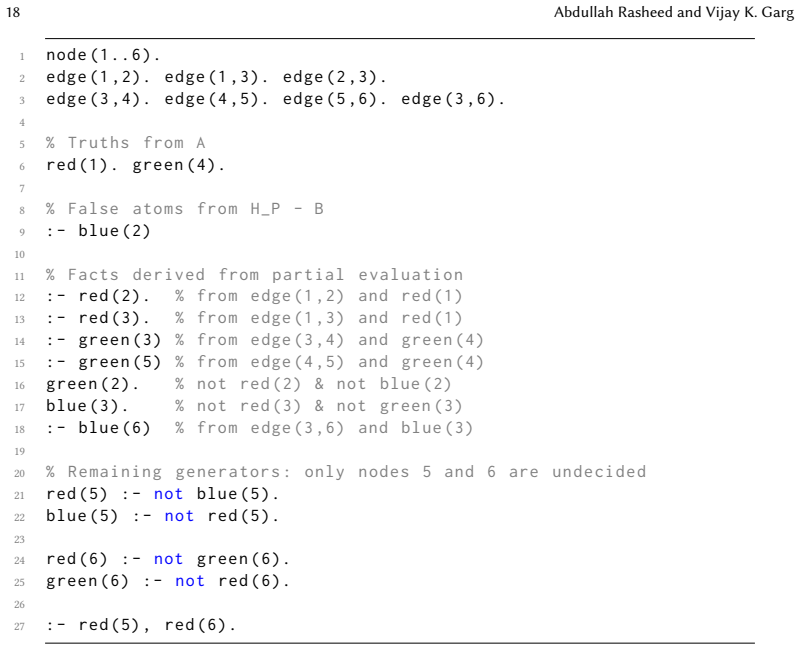
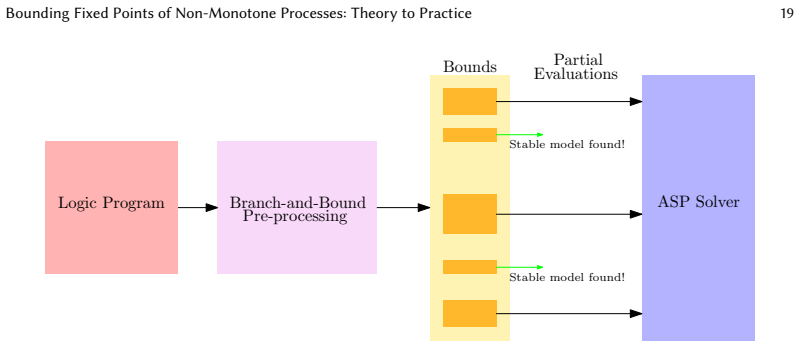
Many modern solvers and program analyzers rely on non-monotone reasoning (e.g. negation-as-failure, speculative updates, backtracking) for which classical monotone fixed-point methods do not apply. The general problem of finding the fixed points of these processes is a difficult one. For this reason, there have been theoretical efforts in existing Approximation Fixpoint Theory (AFT) from the domain of logic programming to approximate fixed points of non-monotone operators. Tight approximations of these fixed points are highly useful for accelerating non-monotonic computations by restricting the search space. In practice, however, even the best approximations obtained through AFT can be coarse and computationally expensive. We aim to address both issues to make AFT approximation methods practical for use in programming languages (PL) settings. To mitigate inefficiency, we prove the soundness of an abstract interpretation for approximating operators. To improve upon coarse approximations, we carefully introduce controlled unsoundness to design an effective yet practical algorithm for partitioning and tightening AFT's best approximations. This algorithm is sound, anytime, and guarantees termination on finite-height lattices. We further present a modification that ensures polynomial-time complexity. We instantiate these methods in two settings: (1) answer set programming, where it serves as a convergence-accelerating pre-processor, and (2) speculative program analysis, where it reduces rollback while preserving soundness. In both settings, we focus on implementation-level details to demonstrate the practical applicability of our methods.
Editorial analysis
A structured set of objections, weighed in public.
Referee Report
Summary. The manuscript claims to make Approximation Fixpoint Theory (AFT) practical for bounding fixed points of non-monotone operators by proving the soundness of an abstract interpretation for approximating such operators and by introducing an algorithm that incorporates controlled unsoundness into partitioning and tightening steps. The algorithm is asserted to remain sound overall, to be anytime, and to guarantee termination on finite-height lattices, with a polynomial-time variant also presented. The methods are instantiated in answer set programming (as a convergence-accelerating pre-processor) and in speculative program analysis (to reduce rollback while preserving soundness), with emphasis on implementation details.
Significance. If the soundness claims after controlled unsoundness and the termination/polynomial-complexity guarantees are established, the work would offer a concrete advance in applying AFT to non-monotonic reasoning tasks in programming languages, potentially tightening approximations that are currently coarse and expensive and thereby accelerating solvers and analyzers.
major comments (1)
- Abstract: the central claim that 'controlled unsoundness' can be introduced in the partitioning and tightening algorithm while preserving overall soundness (and the anytime/termination properties) is load-bearing for the entire contribution, yet the abstract supplies no proof sketch, reduction argument, or demonstration that local unsound operations do not enlarge the set of possible fixed points beyond the original AFT operators; without this bridge the soundness assertion cannot be evaluated.
Simulated Author's Rebuttal
We thank the referee for the careful reading and constructive feedback on our manuscript. We address the major comment below.
read point-by-point responses
-
Referee: Abstract: the central claim that 'controlled unsoundness' can be introduced in the partitioning and tightening algorithm while preserving overall soundness (and the anytime/termination properties) is load-bearing for the entire contribution, yet the abstract supplies no proof sketch, reduction argument, or demonstration that local unsound operations do not enlarge the set of possible fixed points beyond the original AFT operators; without this bridge the soundness assertion cannot be evaluated.
Authors: We agree that the abstract, owing to length constraints, does not include a proof sketch or reduction argument demonstrating how local unsound operations preserve overall soundness. The full manuscript establishes this via detailed arguments showing that the controlled unsoundness is confined to partitioning and tightening steps whose effects remain bounded by the original AFT over-approximations, ensuring the set of possible fixed points is not enlarged; the anytime and termination properties are preserved by the finite-height lattice and the algorithm's monotonic progress guarantees. In the revised manuscript we will augment the abstract with a concise high-level indication of this argument (e.g., a single sentence noting that deviations are bounded within the AFT framework). revision: yes
Circularity Check
No circularity; derivation chain is self-contained.
full rationale
The paper extends Approximation Fixpoint Theory (AFT) by proving soundness of a new abstract interpretation for operator approximation and by designing a partitioning/tightening algorithm that introduces controlled unsoundness while claiming to preserve overall soundness, anytime behavior, and termination on finite-height lattices (plus a polynomial-time variant). These are presented as new contributions instantiated in answer-set programming and speculative analysis. No quoted equations or self-citations reduce any central result to its own inputs by construction, nor do any 'predictions' collapse to fitted parameters. The soundness argument for the unsoundness steps is asserted via proof rather than tautology or prior self-work. The chain therefore rests on independent theoretical development rather than self-referential reduction.
Axiom & Free-Parameter Ledger
Lean theorems connected to this paper
-
IndisputableMonolith/Foundation/AbsoluteFloorClosure.leanabsolute_floor_iff_bare_distinguishability unclearWe carefully introduce controlled unsoundness to design an effective yet practical algorithm for partitioning and tightening AFT's best approximations. This algorithm is sound, anytime, and guarantees termination on finite-height lattices.
-
IndisputableMonolith/Cost/FunctionalEquation.leanwashburn_uniqueness_aczel unclearTheorem 5.9 (abstract interpretation for the approximation operator F via Galois insertions)
Reference graph
Works this paper leans on
-
[1]
Patrick Cousot and Radhia Cousot. 1979. Systematic design of program analysis frameworks. InProceedings of the 6th ACM SIGACT-SIGPLAN Symposium on Principles of Programming Languages(San Antonio, Texas)(POPL ’79). Association for Computing Machinery, New York, NY, USA, 269–282. doi:10.1145/567752.567778
-
[2]
Steven Dawson, C. R. Ramakrishnan, and David S. Warren. 1996. Practical program analysis using general purpose logic programming systems—a case study. InProceedings of the ACM SIGPLAN 1996 Conference on Programming Language Design and Implementation(Philadelphia, Pennsylvania, USA)(PLDI ’96). Association for Computing Machinery, New York, NY, USA, 117–126...
-
[3]
2012.Approximation fixpoint theory and the semantics of logic and answers set programs
Marc Denecker, Maurice Bruynooghe, and Joost Vennekens. 2012.Approximation fixpoint theory and the semantics of logic and answers set programs. Springer-Verlag, Berlin, Heidelberg, 178–194
2012
-
[4]
Marc Denecker, Victor Marek, and Mirosław Truszczyński. 2000.Approximations, Stable Operators, Well-Founded Fixpoints and Applications in Nonmonotonic Reasoning. Springer US, Boston, MA, 127–144. doi:10.1007/978-1-4615- 1567-8_6
-
[5]
Marc Denecker, Victor W. Marek, and Mirosław Truszczyński. 2004. Ultimate approximation and its application in nonmonotonic knowledge representation systems.Information and Computation192, 1 (2004), 84–121. doi:10.1016/j. ic.2004.02.004
work page doi:10.1016/j 2004
-
[6]
Chen, Jason Flinn, and Satish Narayanasamy
David Devecsery, Peter M. Chen, Jason Flinn, and Satish Narayanasamy. 2018. Optimistic Hybrid Analysis: Accelerating Dynamic Analysis through Predicated Static Analysis. InProceedings of the Twenty-Third International Conference on Architectural Support for Programming Languages and Operating Systems(Williamsburg, VA, USA)(ASPLOS ’18). Association for Com...
-
[7]
Thomas Eiter, Michael Fink, Hans Tompits, and Stefan Woltran. 2004. Simplifying Logic Programs Under Uniform and Strong Equivalence. InLogic Programming and Nonmonotonic Reasoning, Vladimir Lifschitz and Ilkka Niemelä (Eds.). Springer Berlin Heidelberg, Berlin, Heidelberg, 87–99
2004
-
[8]
Thomas Eiter and Georg Gottlob. 1995. On the computational cost of disjunctive logic programming: Propositional case.Annals of Mathematics and Artificial Intelligence15, 3 (01 Sep 1995), 289–323. doi:10.1007/BF01536399
-
[9]
Esra Erdem, Michael Gelfond, and Nicola Leone. 2016. Applications of Answer Set Programming.AI Mag.37, 3 (Sept. 2016), 53–68. doi:10.1609/aimag.v37i3.2678
-
[10]
Olivier Flückiger, Gabriel Scherer, Ming-Ho Yee, Aviral Goel, Amal Ahmed, and Jan Vitek. 2017. Correctness of speculative optimizations with dynamic deoptimization.Proc. ACM Program. Lang.2, POPL, Article 49 (Dec. 2017), 28 pages. doi:10.1145/3158137
-
[11]
Michael Gelfond and Vladimir Lifschitz. 1988. The Stable Model Semantics for Logic Programming. InProceedings of International Logic Programming Conference and Symposium, Robert Kowalski, Bowen, and Kenneth (Eds.). MIT Press, 20 Abdullah Rasheed and Vijay K. Garg 1070–1080. http://www.cs.utexas.edu/users/ai-lab?gel88
1988
-
[12]
Keijo Heljanko and Ilkka Niemelä. 2003. Bounded LTL model checking with stable models.Theory Pract. Log. Program. 3, 4 (July 2003), 519–550. doi:10.1017/S1471068403001790
-
[13]
Urs Hölzle, Craig Chambers, and David Ungar. 1992. Debugging optimized code with dynamic deoptimization. In Proceedings of the ACM SIGPLAN 1992 Conference on Programming Language Design and Implementation(San Francisco, California, USA)(PLDI ’92). Association for Computing Machinery, New York, NY, USA, 32–43. doi:10.1145/143095. 143114
-
[14]
Fangfang Liu and Jia-Huai You. 2022. Alternating Fixpoint Operator for Hybrid MKNF Knowledge Bases as an Approximator of AFT.Theory and Practice of Logic Programming22, 2 (2022), 305 – 334. doi:10.1017/S1471068421000168 Cited by: 9; All Open Access, Green Open Access, Hybrid Gold Open Access
-
[15]
Marek and Miroslaw Truszczyński
Victor W. Marek and Miroslaw Truszczyński. 1999.Stable Models and an Alternative Logic Programming Paradigm. Springer Berlin Heidelberg, Berlin, Heidelberg, 375–398. doi:10.1007/978-3-642-60085-2_17
-
[16]
Marek and M
Wiktor W. Marek and M. Truszczynski. 1997.Nonmonotonic Logic: Context-Dependent Reasoning. Springer-Verlag, Berlin, Heidelberg
1997
-
[17]
Joao Marques-Silva, Inês Lynce, and Sharad Malik. 2009. Conflict-driven clause learning SAT solvers.Handbook of satisfiability(2009), 131–153
2009
-
[18]
Hannes Strass. 2013. Approximating operators and semantics for abstract dialectical frameworks.Artificial Intelligence 205 (2013), 39–70. doi:10.1016/j.artint.2013.09.004
-
[19]
Allen Van Gelder. 1993. The alternating fixpoint of logic programs with negation.J. Comput. System Sci.47, 1 (1993), 185–221. doi:10.1016/0022-0000(93)90024-Q
-
[20]
Allen Van Gelder, Kenneth A. Ross, and John S. Schlipf. 1991. The well-founded semantics for general logic programs. J. ACM38, 3 (July 1991), 619–649. doi:10.1145/116825.116838 Proof of Theorem 5.9. Proof. We begin by proving that 𝛼 ℓ (lfp𝐵 (𝑓 ℓ 𝐵 )) ≥lfp 𝛼(𝐵) ((𝑓 ♭)ℓ 𝛼(𝐵) ) for all 𝐵=[𝑥 ℓ, 𝑥𝑢] ∈𝔅 𝐶 which is equivalent to proving that 𝛼 ℓ (lfp(𝜑 ℓ 𝐵)) ≥lf...
discussion (0)
Sign in with ORCID, Apple, or X to comment. Anyone can read and Pith papers without signing in.