Recognition: no theorem link
Big AI's Regulatory Capture: Mapping Industry Interference and Government Complicity
Pith reviewed 2026-05-11 01:03 UTC · model grok-4.3
The pith
Big AI and governments capture AI regulation through 27 mechanisms shown in news analysis.
A machine-rendered reading of the paper's core claim, the machinery that carries it, and where it could break.
Core claim
The authors develop a taxonomy consisting of 27 mechanisms across five categories to map how the AI industry interferes with regulation. Through manual annotation of 100 news articles, they document 249 instances of these mechanisms, with the most frequent being those related to shaping public discourse and eluding legal requirements. They argue that this capture, involving both industry and government actors, should be treated as an emergency, and provide lessons and tactics from other sectors to counter it.
What carries the argument
A taxonomy of 27 regulatory capture mechanisms across five categories, derived from design science research and scoping review, which is applied to annotate and quantify instances in 100 news articles.
Load-bearing premise
The scoping review of existing literature and media reports provides a comprehensive and unbiased basis for identifying all relevant regulatory capture mechanisms.
What would settle it
An independent scoping review using alternate sources or search criteria that identifies substantially fewer than 27 mechanisms or different dominant categories would undermine the taxonomy.
Figures


read the original abstract
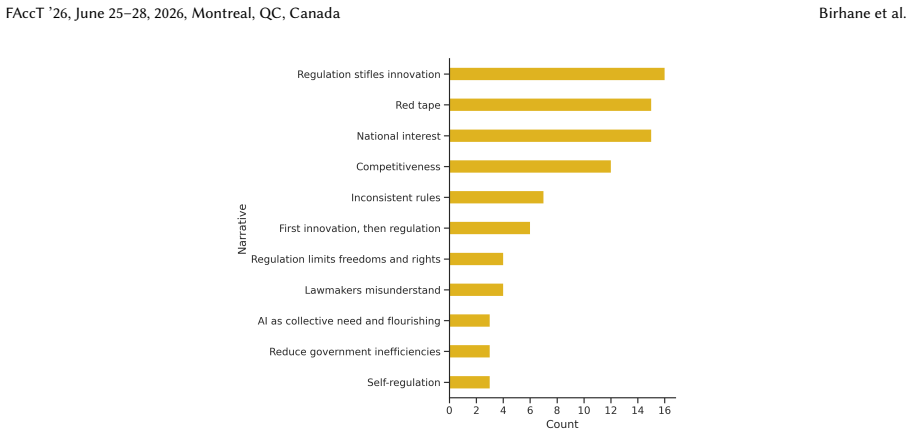
Over the past decade, the AI industry has come to exert an unprecedented economic, political and societal power and influence. It is therefore critical that we comprehend the extent and depth of pervasive and multifaceted capture of AI regulation by corporate actors in order to contend and challenge it. In this paper, we first develop a taxonomy of mechanisms enabling capture to provide a comprehensive understanding of the problem. Grounded in design science research (DSR) methodologies and extensive scoping review of existing literature and media reports, our taxonomy of capture consists of 27 mechanisms across five categories. We then develop an annotation template incorporating our taxonomy, and manually annotate and analyse 100 news articles. The purpose behind this analysis is twofold: validate our taxonomy and provide a novel quantification of capture mechanisms and dominant narratives. Our analysis identifies 249 instances of capture mechanisms, often co-occurring with narratives that rationalise such capture. We find that the most recurring categories of mechanisms are Discourse & Epistemic Influence, concerning narrative framing, and Elusion of law, related to violations and contentious interpretations of antitrust, privacy, copyright and labour laws. We further find that Regulation stifles innovation, Red tape and National Interest are the most frequently invoked narratives used to rationalise capture. We emphasize the extent and breadth of regulatory capture by coalescing forces -- Big AI and governments -- as something policy makers and the public ought to treat as an emergency. Finally, we put forward key lessons learned from other industries along with transferable tactics for uncovering, resisting and challenging Big AI capture as well as in envisioning counter narratives.
Editorial analysis
A structured set of objections, weighed in public.
Referee Report
Summary. The manuscript develops a taxonomy of 27 mechanisms of regulatory capture by Big AI, organized into five categories, using design science research methodologies and a scoping review of literature and media reports. It then applies this taxonomy via an annotation template to manually analyze 100 news articles, identifying 249 instances of capture mechanisms. The analysis finds that Discourse & Epistemic Influence and Elusion of law are the most recurring categories, with narratives such as 'Regulation stifles innovation', 'Red tape', and 'National Interest' most frequently invoked to rationalize capture. The paper frames the coalescing of Big AI and government forces as an emergency and offers lessons and tactics from other industries for resistance and counter-narratives.
Significance. If the methodological transparency issues are resolved, this work would provide a structured taxonomy that could aid researchers and policymakers in mapping regulatory capture in the AI sector, a timely contribution given the industry's influence. The attempt to quantify mechanisms through annotation and to identify dominant narratives adds empirical grounding, while the transferable tactics section draws useful parallels to other industries. The paper's grounding in DSR and scoping review represents a systematic effort to catalog interference mechanisms.
major comments (3)
- [empirical analysis / annotation section] The section describing the selection and annotation of the 100 news articles does not report the sampling method, including search strings, databases, date range, or inclusion/exclusion criteria. This is load-bearing for the central claim that Discourse & Epistemic Influence and Elusion of law are the 'most recurring' categories, as the distribution of the 249 instances could be shaped by unstated selection choices rather than the underlying corpus.
- [annotation methodology] The annotation procedure lacks any report of inter-rater reliability, double-coding, or agreement metrics, despite the authors performing the manual annotation themselves. This directly affects the reliability of the quantified findings (249 instances and category frequencies) that support the 'emergency' framing and policy recommendations.
- [taxonomy development / scoping review] The scoping review used to derive the 27-mechanism taxonomy does not specify the search strategy, number of sources screened, or inclusion criteria. This raises a risk of selection or interpretation bias in the taxonomy itself, which is foundational to both the validation step and the frequency claims.
minor comments (2)
- [abstract] The abstract could more explicitly separate the taxonomy construction phase from the empirical annotation phase and clarify how the annotation serves as validation.
- [introduction] Ensure early definition of 'Big AI' and consistent terminology across sections to aid readability for readers outside the immediate field.
Simulated Author's Rebuttal
We thank the referee for their thoughtful and constructive review. The comments correctly identify gaps in methodological transparency that we agree require addressing to strengthen the paper's claims. We will revise the manuscript to incorporate detailed descriptions of the sampling, annotation, and scoping review procedures. Our point-by-point responses follow.
read point-by-point responses
-
Referee: [empirical analysis / annotation section] The section describing the selection and annotation of the 100 news articles does not report the sampling method, including search strings, databases, date range, or inclusion/exclusion criteria. This is load-bearing for the central claim that Discourse & Epistemic Influence and Elusion of law are the 'most recurring' categories, as the distribution of the 249 instances could be shaped by unstated selection choices rather than the underlying corpus.
Authors: We acknowledge that the manuscript did not provide sufficient detail on the article selection process. In the revised version, we will add a new subsection under the empirical analysis that explicitly reports the search strings (e.g., combinations of terms like 'AI regulation', 'Big Tech lobbying', 'antitrust AI'), the databases and sources used (Google News, major outlets via LexisNexis), the date range (2018–2024), and the inclusion/exclusion criteria (e.g., articles must discuss AI policy or industry influence and be from reputable sources). This addition will allow readers to evaluate potential selection effects on the observed frequencies and support the 'most recurring' claims with greater transparency. revision: yes
-
Referee: [annotation methodology] The annotation procedure lacks any report of inter-rater reliability, double-coding, or agreement metrics, despite the authors performing the manual annotation themselves. This directly affects the reliability of the quantified findings (249 instances and category frequencies) that support the 'emergency' framing and policy recommendations.
Authors: The annotation was conducted by the author team through iterative discussion and consensus to apply the taxonomy consistently. We agree that the absence of formal reliability metrics is a limitation for the quantified results. In revision, we will expand the methodology to describe the annotation template, coding rules, and resolution process in detail. We will also note the single-team approach as a limitation and, where possible, report a post-hoc agreement check on a subsample. This will improve credibility without altering the exploratory nature of the quantification. revision: partial
-
Referee: [taxonomy development / scoping review] The scoping review used to derive the 27-mechanism taxonomy does not specify the search strategy, number of sources screened, or inclusion criteria. This raises a risk of selection or interpretation bias in the taxonomy itself, which is foundational to both the validation step and the frequency claims.
Authors: The taxonomy was iteratively developed following design science research principles, synthesizing academic literature, policy reports, and media sources on regulatory capture. We accept that the scoping review protocol details were omitted. The revised manuscript will include a methods subsection specifying the search strategy (keywords such as 'AI regulatory capture', 'tech industry influence'), databases (Google Scholar, Web of Science, arXiv), approximate number of sources screened, and inclusion criteria (focus on mechanisms of industry-government interaction in AI or analogous sectors). A flow diagram will be added to document the process and reduce concerns of bias. revision: yes
Circularity Check
No significant circularity detected
full rationale
The paper constructs its taxonomy of 27 mechanisms via design science research and scoping review of external literature and media reports, then applies an annotation template derived from that taxonomy to a separate set of 100 news articles to produce frequency counts and validation. This chain relies on external data sources and interpretive coding rather than any self-definitional loop, fitted parameter renamed as prediction, self-citation that bears the central load, or mathematical derivation that reduces outputs to inputs by construction. No equations, uniqueness theorems, or ansatzes are present; the quantified claims (249 instances, dominant categories) emerge directly from applying the taxonomy to the annotated corpus without tautological reduction.
Axiom & Free-Parameter Ledger
axioms (1)
- domain assumption The scoping review of existing literature and media reports is comprehensive and unbiased in identifying capture mechanisms.
Reference graph
Works this paper leans on
-
[1]
Mohamed Abdalla and Moustafa Abdalla. 2021. The grey hoodie project: Big tobacco, big tech, and the threat on academic integrity. In Proceedings of the 2021 AAAI/ACM Conference on AI, Ethics, and Society. 287–297
2021
-
[2]
AFP. 2025. Concentration of corporate power a ’huge’ concern: UN rights chief. (Nov. 2025). https://us.afpnews.com/article/ ?concentration-of-corporate-power-a-huge-concern-un-rights-chief,83MG3CQ
2025
-
[3]
Agrell and Axel Gautier
Per J. Agrell and Axel Gautier. 2012. Rethinking regulatory capture. InRecent advances in the analysis of competition policy and regulation. Edward Elgar Publishing
2012
-
[4]
Nur Ahmed, Muntasir Wahed, and Neil C Thompson. 2023. The growing influence of industry in AI research.Science379, 6635 (2023), 884–886
2023
-
[5]
AI Now Institute. 2024. Lessons from the FDA for AI. https://ainowinstitute.org/publications/research/lessons-from-the-fda-for-ai
2024
-
[6]
AI Now Institute. 2025. People’s AI Action Plan Launches to Provide Counter-Weight to Trump’s Industry-Backed AI Plan and EOs. https://ainowinstitute.org/news/announcement/peoples-ai-action-plan-launches-to-provide-counter-weight-to-trumps- industry-backed-ai-plan-and-eos
2025
-
[7]
Shocking
Lucas Amin. 2025. Revealed: “Shocking” scale of Big Tech’s influence over Labour — democracyforsale.substack.com. https:// democracyforsale.substack.com/p/revealed-shocking-scale-of-big-tech-influence-labour-peter-kyle-amazon-google-meta. [Accessed 26-12-2025]
2025
-
[8]
Advait Arun. 2025. Bubble or Nothing. https://publicenterprise.org/report/bubble-or-nothing/
2025
-
[9]
sound science
Annamaria Baba, Daniel M Cook, Thomas O McGarity, and Lisa A Bero. 2005. Legislating “sound science”: the role of the tobacco industry.American Journal of Public Health95, S1 (2005), S20–S27
2005
- [10]
-
[11]
H Barakat. 2024. Selective perspectives: A content analysis of The New York Times’ reporting on artificial intelligence.Computer Says Maybe(2024). Big AI’s Regulatory Capture FAccT ’26, June 25–28, 2026, Montreal, QC, Canada
2024
-
[12]
Burcu Baykurt. 2025. Gov-tech as capture: public infrastructures under data capitalism.Information, Communication & Society(2025), 1–16
2025
-
[13]
BBC. 2025. UK social media campaigners among five denied US visas — bbc.com. https://www.bbc.com/news/articles/cp39kngz008o. [Accessed 26-12-2025]
2025
-
[14]
Rebecca Bellan. 2025. Silicon Valley is pouring millions into pro-AI PACs to sway midterms | TechCrunch — techcrunch.com. https://techcrunch.com/2025/08/25/silicon-valley-is-pouring-millions-into-pro-ai-pacs-to-sway-midterms/. [Accessed 27-12-2025]
2025
-
[15]
Bellingcat. 2026. https://www.bellingcat.com/
2026
-
[16]
European Consumer Organisation (BEUC). 2026. Open Joint Letter on the Digital Omnibus on AI Preserving the Scope and Integrity of the AI Act. https://www.beuc.eu/letters/open-joint-letter-digital-omnibus-ai-preserving-scope-and-integrity-ai-act
2026
-
[17]
Abeba Birhane, Ryan Steed, Victor Ojewale, Briana Vecchione, and Inioluwa Deborah Raji. 2024. AI auditing: The Broken Bus on the Road to AI Accountability. In2024 IEEE Conference on Secure and Trustworthy Machine Learning (SaTML)(Toronto, ON, Canada, 2024-04-09). IEEE, 612–643. doi:10.1109/SaTML59370.2024.00037
-
[18]
Cabrera, L
L. Cabrera, L. Caroli, and D.E. Harris. 2025. Human rights are universal, not optional: don’t undermine the EU AI act with a faulty code of practice
2025
-
[19]
Carole Cadwalladr. 2026. The Nerve. https://www.thenerve.news/
2026
-
[20]
2013.Preventing regulatory capture: Special interest influence and how to limit it
Daniel Carpenter and David A Moss. 2013.Preventing regulatory capture: Special interest influence and how to limit it. Cambridge University Press
2013
-
[21]
David M Carr. 2003. Pfizer’s epidemic: a need for international regulation of human experimentation in developing countries.Case W. Res. J. Int’l L.35 (2003), 15
2003
-
[22]
Laurens Cerulus, Hanne Cokelaere, Marianne Gros, and Bartosz Brzeziński. 2025. Ranked: The 10 most intensely lobbied EU laws
2025
-
[23]
Public Citizen. 2025. Deleting Tech Enforcement - Public Citizen — citizen.org. https://www.citizen.org/article/deleting-enforcement- trump-big-tech-billion-report/. [Accessed 27-12-2025]
2025
-
[24]
Public Citizen. 2025. How Trump Is Halting Enforcement Against Corporate Lawbreakers — citizen.org. https://www.citizen.org/ article/corporate-clemency-trump-enforcement-report/. [Accessed 27-12-2025]
2025
-
[25]
European Commission. 2025. Speech by President von der Leyen at the Copenhagen Competitiveness Summit — luxem- bourg.representation.ec.europa.eu. https://luxembourg.representation.ec.europa.eu/actualites-et-evenements/actualites/speech- president-von-der-leyen-copenhagen-competitiveness-summit-2025-10-01_en. [Accessed 27-12-2025]
2025
-
[26]
Corporate Europe Observatory. 2025. Bias baked in: How Big Tech sets its own AI standards. https://corporateeurope.org/en/2025/01/ bias-baked
2025
-
[27]
Carl F Cranor. 2008. The tobacco strategy entrenched
2008
-
[28]
Ernesto Dal Bó. 2006. Regulatory capture: A review.Oxford review of economic policy22, 2 (2006), 203–225
2006
-
[29]
Kevin De Liban. 2024. Inescapable AI: The Ways AI Decides How Low-Income People Work, Live, Learn, and Survive
2024
-
[30]
Somaiyeh Dehghan, Mehmet Umut Sen, and Berrin Yanikoglu. 2025. Dealing with Annotator Disagreement in Hate Speech Classification. doi:10.48550/arXiv.2502.08266 arXiv:2502.08266 [cs]
-
[31]
Roel Dobbe. 2022. System safety and artificial intelligence. InProceedings of the 2022 ACM Conference on Fairness, Accountability, and Transparency. 1584–1584
2022
-
[32]
The Economist. 2025. Investors expect AI use to soar. That’s not happening.The Economist(26 Nov. 2025). https://www.economist. com/finance-and-economics/2025/11/26/investors-expect-ai-use-to-soar-thats-not-happening
2025
-
[33]
European Digital Rights (EDRi). 2025. The EU must uphold hard-won protections for digital human rights. https://edri.org/wp- content/uploads/2025/11/The-EU-must-uphold-hard-won-protections-for-digital-human-rights.pdf
2025
-
[34]
Ruben Enikolopov and Maria Petrova. 2015. Media capture: Empirical evidence. InHandbook of media economics. Vol. 1. Elsevier, 687–700
2015
-
[35]
Antonio Estache, Liam Wren-Lewis, S Rose-Ackerman, and T Soreide. 2011. Anti-corruption policy in theories of sector regulation. Chapter9 (2011), 269–299
2011
-
[36]
EU. 2018. Antitrust: Commission fines Google€4.34 billion for illegal practices regarding Android mobile devices to strengthen dominance of Googleś search engine — ec.europa.eu. https://ec.europa.eu/commission/presscorner/detail/en/ip_18_4581. [Accessed 23-12-2025]
2018
- [37]
-
[38]
European Center for Not-for-Profit Law (ECNL) and European AI & Society Fund. 2024. Towards an AI Act that serves people and society: Strategic actions for civil society and funders on the enforcement of the EU AI Act. https://ecnl.org/sites/default/files/2024- 08/241508_AIAct%20implementation_ECNL%20report_final%20design.pdf
2024
-
[39]
European Commission. 2025. Simpler digital rules to help EU businesses grow. (Nov. 2025). https://commission.europa.eu/news-and- media/news/simpler-digital-rules-help-eu-businesses-grow-2025-11-19_en
2025
-
[40]
2019.The global expansion of AI surveillance
Steven Feldstein. 2019.The global expansion of AI surveillance. Vol. 17. Carnegie Endowment for International Peace Washington, DC. FAccT ’26, June 25–28, 2026, Montreal, QC, Canada Birhane et al
2019
-
[41]
Irish Council for Civil Liberties. 2023. The European Commission must follow Ireland’s lead, and switch off Big Tech’s toxic algorithms. https://www.iccl.ie/2023/the-european-commission-must-follow-irelands-lead-and-switch-off-big-techs-toxic-algorithms/
2023
-
[42]
Center for Democracy & Technology. 2026. Joint Open Letter: Preserving the Scope and Integrity of the AI Act. https://cdt.org/insights/joint-open-letter-preserving-the-scope-and-integrity-of-the-ai-act/
2026
-
[43]
Center for Democracy & Technology. 2026. This is what corporate capture looks like! Report: How corporations run the EU deregulation agenda. https://corporateeurope.org/en/2026/04/what-corporate-capture-looks
2026
-
[44]
FragDenStaat. 2025. Koalitionsverhandlungen CDU/CSU/SPD AG 3 - Digitales — fragdenstaat.de. https://fragdenstaat.de/dokumente/ 258016-koalitionsverhandlungen-cdu-csu-spd-ag-3-digitales/. [Accessed 27-12-2025]
2025
-
[45]
Damien Gayle. 2025. Cop30 was meant to be a turning point, so why do some say the climate summit is broken?
2025
-
[46]
Robert Gorwa, Grzegorz Lechowski, and Daniel Schneiß. 2024. Platform lobbying: Policy influence strategies and the EU’s Digital Services Act.Internet Policy Review13, 2 (2024), 1–26
2024
-
[47]
Green Screen Coalition. 2025. Within Bounds: Limiting AI’s environmental impact. https://greenscreen.network/en/blog/within- bounds-limiting-ai-environmental-impact/ Section: blog
2025
-
[48]
Andrew B Hall, Anna Sun, and GSB Stanford. 2025. Investing in Political Expertise: The Remarkable Scale of Corporate Policy Teams. (2025)
2025
-
[49]
Ryan Harvey and Melanie Foley. 2021. How to Fight Big Pharma — and Win. (2021). https://truthout.org/articles/how-to-fight-big- pharma-and-win/
2021
-
[50]
Health, Education, Labor, and Pensions Committee (Chair: Bernard Sanders). 2024. Big Pharma’s Business Model: Corporate Greed. https://www.help.senate.gov/imo/media/doc/big_pharmas_business_model_report.pdf
2024
-
[51]
Alan R. Hevner. 2007. A three cycle view of design science research.Scandinavian journal of information systems19, 2 (2007), 4
2007
-
[52]
Hevner, Salvatore T
Alan R. Hevner, Salvatore T. March, Jinsoo Park, and Sudha Ram. 2004. Design Science in Information Systems Research.MIS quarterly (2004), 75–105
2004
-
[53]
Ghofran Hilal, Thawab Hilal, and Mohammad Al-Fawareh. 2024. Misinformation and the demonization of human Rights: the Jordanian Child Rights Law.Cogent Education11, 1 (2024), 2329417
2024
-
[54]
Sofia Hiltner, Emily Eaton, Noel Healy, Andrew Scerri, Jennie C Stephens, and Geoffrey Supran. 2024. Fossil fuel industry influence in higher education: a review and a research agenda.Wiley Interdisciplinary Reviews: Climate Change15, 6 (2024), e904
2024
-
[55]
Hurt, M.E
R.D. Hurt, M.E. Muggli, and L.B. Becker. 2004. Turning free speech into commercial speech: Philip Morris’ use of journalists to discredit the EPA report on secondhand smoke.Journal of Clinical Oncology22, 14_suppl (2004), 6151–6151
2004
-
[56]
AI Now Institute. 2025. Artificial Power: 2025 Landscape Report - AI Now Institute — ainowinstitute.org. https://ainowinstitute.org/ publications/research/ai-now-2025-landscape-report. [Accessed 23-12-2025]
2025
-
[57]
The Ada Lovelace Institute and The Alan Turing Institute. 2025. The Ada Lovelace Institute and The Alan Turing Institute, How do people feel about AI? Wave two of a nationally representative survey of UK attitudes to AI.The Ada Lovelace Institute(2025)
2025
-
[58]
Pratyusha Ria Kalluri, William Agnew, Myra Cheng, Kentrell Owens, Luca Soldaini, and Abeba Birhane. 2025. Computer-vision research powers surveillance technology.Nature(2025), 1–7
2025
-
[59]
Sheldon Krimsky. 1985. The corporate capture of academic science and its social costs. InGenetics and the Law III. Springer, 45–55
1985
-
[60]
2004.Science in the private interest: Has the lure of profits corrupted biomedical research?Bloomsbury Publishing PLC
Sheldon Krimsky. 2004.Science in the private interest: Has the lure of profits corrupted biomedical research?Bloomsbury Publishing PLC
2004
-
[61]
Paul Lachapelle, Patrick Belmont, Marco Grasso, Roslynn McCann, Dawn H Gouge, Jerri Husch, Cheryl de Boer, Daniela Molzbichler, and Sarah Klain. 2024. Academic capture in the Anthropocene: a framework to assess climate action in higher education.Climatic Change177, 3 (2024), 40
2024
-
[62]
Filippo Lancieri, Laura Edelson, and Stefan Bechtold. 2024. AI Regulation: Competition, Arbitrage & Regulatory Capture.Center for Law & Economics Working Paper Series11 (2024)
2024
-
[63]
Kelley Lee. 2025. Engaging policymakers on the Commercial Determinants of Health: Lessons from Global Tobacco Control. https: //www.publichealthontario.ca/-/media/Event-Presentations/25/07/engaging-policymakers-global-tobacco-control.pdf
2025
-
[64]
2024.AN OPEN LETTER: Europe needs regulatory certainty on AI
Open Letter. 2024.AN OPEN LETTER: Europe needs regulatory certainty on AI. https://euneedsai.com//
2024
-
[65]
2011.Handbook on the Politics of Regulation
David Levi-Faur. 2011.Handbook on the Politics of Regulation. Edward Elgar Publishing
2011
-
[66]
Wendy Y. Li. 2023. Regulatory capture’s third face of power.Socio-Economic Review21, 2 (2023), 1217–1245
2023
-
[67]
Hause Lin, Jana Lasser, Stephan Lewandowsky, Rocky Cole, Andrew Gully, David G Rand, and Gordon Pennycook. 2023. High level of correspondence across different news domain quality rating sets.PNAS Nexus2, 9 (Sept. 2023), pgad286. doi:10.1093/pnasnexus/pgad286
-
[68]
LobbyFacts. 2026. LobbyFacts - exposing lobbying in the European institutions. https://www.lobbyfacts.eu/
2026
-
[69]
Samuel Loewenberg. 2008. Drug company trials come under increasing scrutiny.The Lancet371, 9608 (2008), 191–192
2008
-
[70]
Parliament Politics Magazine. 2025. Britain delays AI regulations to align with Trump’s policies — parliamentnews.co.uk. https: //parliamentnews.co.uk/britain-delays-ai-regulations-to-align-with-trumps-policies. [Accessed 29-12-2025]
2025
-
[71]
2022.Resisting AI: an anti-fascist approach to artificial intelligence
Dan McQuillan. 2022.Resisting AI: an anti-fascist approach to artificial intelligence. Bristol University Press
2022
-
[72]
2026.404 Media
404 Media. 2026.404 Media. https://www.404media.co/ Big AI’s Regulatory Capture FAccT ’26, June 25–28, 2026, Montreal, QC, Canada
2026
-
[73]
Brian Merchant. 2025. Hundreds of workers mobilize to ’Stop Gen AI’ and help each other survive AI automation.Blood in the Machine (June 2025). https://www.bloodinthemachine.com/p/hundreds-of-workers-mobilize-to-stop
2025
-
[74]
2008.Doubt is their product: how industry’s assault on science threatens your health
David Michaels. 2008.Doubt is their product: how industry’s assault on science threatens your health. Oxford University Press
2008
-
[75]
Gabby Miller. 2025. Data centers have a political problem — and Big Tech wants to fix it. https://www.politico.com/news/2025/12/17/data- centers-have-a-political-problem-and-big-tech-wants-to-fix-it-00693695. [Accessed 27-12-2025]
2025
-
[76]
Julie Margetta Morgan and Devin Duffy. 2019. The cost of capture: how the pharmaceutical industry has corrupted policymakers and harmed patients.The Roosevelt Institute(2019)
2019
-
[77]
Adriana Moro and Noela Invernizzi. 2017. The thalidomide tragedy: the struggle for victims’ rights and improved pharmaceutical regulation.História, Ciências, Saúde-Manguinhos24 (2017), 603–622
2017
-
[78]
Madhumita Murgia. 2019. AI academics under pressure to do commercial research.Financial Times13 (2019)
2019
-
[79]
2004.Degrees of capture: Universities, the oil industry and climate change
Greg Muttitt. 2004.Degrees of capture: Universities, the oil industry and climate change. New Economics Foundation
2004
-
[80]
Meta Newsroom. 2024. Building AI Technology for Europeans in a Transparent and Responsible Way. https://about.fb.com/news/ 2024/06/building-ai-technology-for-europeans-in-a-transparent-and-responsible-way/ [Accessed 29-12-2025]
2024
discussion (0)
Sign in with ORCID, Apple, or X to comment. Anyone can read and Pith papers without signing in.