Recognition: 2 theorem links
· Lean TheoremA 0.08 pJ/bit 56 GBaud Monolithic Optical Receiver Front End for IMDD Photonic Links
Pith reviewed 2026-05-11 00:46 UTC · model grok-4.3
The pith
A monolithically integrated optical receiver front end achieves 28.9 GHz bandwidth and 0.08 pJ/bit at 56 Gbaud in a silicon photonics platform.
A machine-rendered reading of the paper's core claim, the machinery that carries it, and where it could break.
Core claim
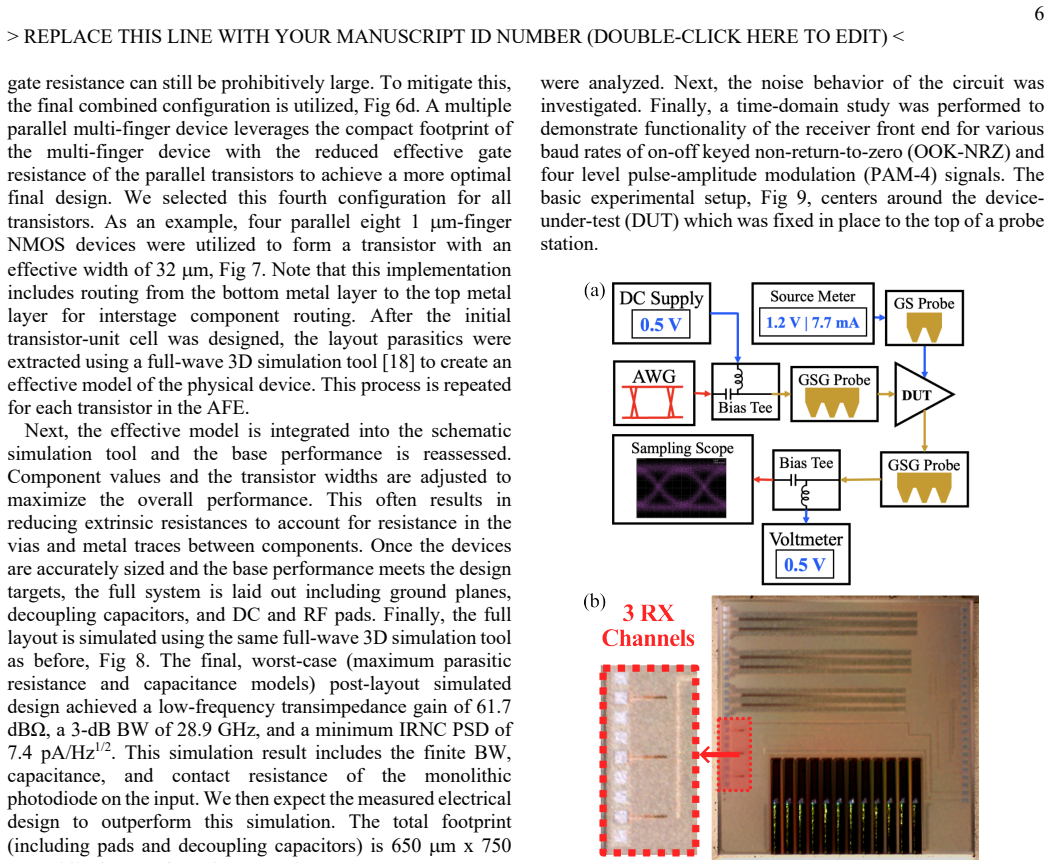
The post-layout analog front end achieves a 28.9 GHz bandwidth with a low-frequency gain of 61.7 dBΩ while consuming 9.22 mW from a 1.2 V supply, with less than 737 nA RMS integrated input referred noise current and 0.08 pJ/bit energy efficiency; measurements on the fabricated device in the GlobalFoundries Fotonix platform validate DC operation, noise performance, and time-domain behavior to 64 GBaud.
What carries the argument
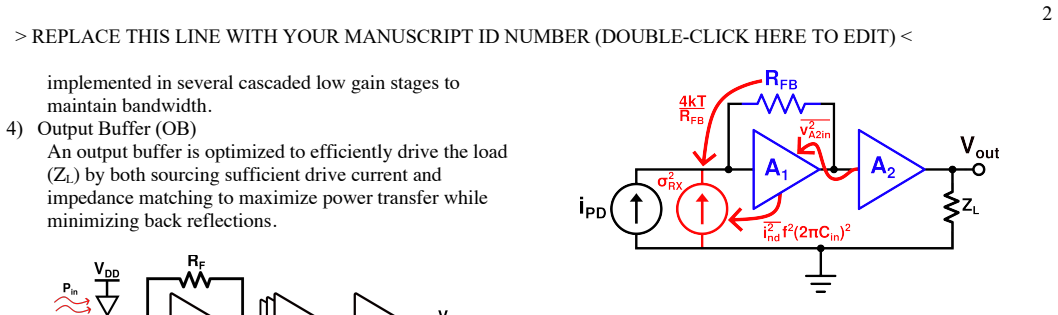
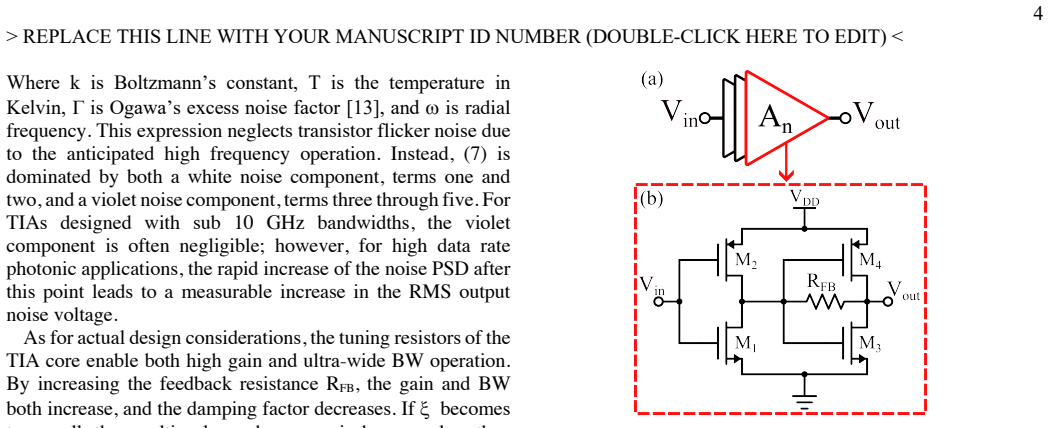
Monolithically integrated optical receiver analog front end using optimized transistor unit-cell layouts to minimize parasitics within the GlobalFoundries Fotonix silicon photonics platform.
If this is right
- The receiver supports 56 Gbaud IMDD operation with measured eye diagrams for both OOK and PAM-4 formats up to 64 GBaud.
- Total power draw remains under 10 mW while meeting the noise and bandwidth targets required for high-speed photonic links.
- Monolithic integration reduces parasitics compared to discrete designs, enabling the reported energy efficiency of 0.08 pJ/bit.
- The layout-driven design flow demonstrates how circuit topology and unit-cell choices directly control the achieved analog bandwidth of 28.9 GHz.
Where Pith is reading between the lines
- Further scaling of this approach could support even higher baud rates if additional parasitic reduction techniques are applied in the same platform.
- Co-integration with photonic modulators or lasers on the same chip becomes more practical once the electrical front end meets these power and noise budgets.
- The measured energy efficiency suggests potential system-level savings in data-center interconnects that rely on many parallel 56 Gbaud channels.
Load-bearing premise
The chosen transistor unit-cell layouts and monolithic integration in the silicon photonics platform sufficiently suppress parasitics to deliver the simulated bandwidth and noise performance once fabricated.
What would settle it
A fabricated device measurement showing either bandwidth below 28.9 GHz, integrated input referred noise above 737 nA RMS, or power consumption exceeding 9.22 mW would falsify the performance claims.
Figures




read the original abstract
We present the design, fabrication, and measurement of a monolithically integrated optical receiver analog front end, where low power operation is a primary consideration with a goal of supporting 56 Gbaud intensity modulated direct detect transceivers. The need for low-power consumption and low-noise operation motivates a monolithic, layout driven design approach which begins with circuit topology selection and analysis. Various transistor unit cell layout configurations are explored, minimizing parasitics, enabling wide analog bandwidth and reduced input referred noise. The post-layout analog front end achieves a 28.9 GHz bandwidth with a low-frequency gain of 61.7 dB{\Omega}. This circuit was designed within the GlobalFoundries FotonixTM monolithic silicon photonics platform. The fabricated device is characterized by its DC operation, noise characteristics, and time domain behavior. The final design was validated by on-off keyed and PAM-4 electrical eye diagram measurements to 64 GBaud, consuming 9.22 mW of power from a 1.2 V supply with less than 737 nA RMS integrated input referred noise current and 0.08 pJ/bit.
Editorial analysis
A structured set of objections, weighed in public.
Referee Report
Summary. The manuscript presents the design, post-layout simulation, fabrication, and experimental characterization of a monolithic optical receiver analog front end in the GlobalFoundries Fotonix silicon photonics platform. It claims a post-layout bandwidth of 28.9 GHz with 61.7 dBΩ gain, and fabricated device performance including DC characteristics, noise, and eye diagrams up to 64 GBaud, with 9.22 mW power consumption from 1.2 V, integrated input-referred noise <737 nA RMS, and energy efficiency of 0.08 pJ/bit at 56 GBaud.
Significance. If the measured results confirm the simulated performance, this work provides a valuable demonstration of low-power, high-speed monolithic photonic receivers enabled by layout optimizations to reduce parasitics. It contributes to the development of efficient IMDD photonic links by achieving competitive energy efficiency and supporting high baud rates.
major comments (2)
- [Abstract] Abstract: The post-layout simulation reports 28.9 GHz bandwidth and the fabricated device is said to achieve <737 nA RMS integrated input referred noise current. However, the manuscript does not appear to include a measured frequency response or S21 data to verify that the actual bandwidth in silicon matches the simulated value. Since the integrated noise depends on the effective bandwidth, this comparison is necessary to substantiate the noise performance claim.
- [Fabricated device characterization] Fabricated device characterization section: The time-domain eye diagrams validate operation to 64 GBaud, but without a direct sim-to-meas comparison for bandwidth and noise, the assumption that the chosen transistor unit-cell layouts sufficiently suppress parasitics remains the weakest link in supporting the headline metrics of 28.9 GHz bandwidth and <737 nA RMS noise.
minor comments (1)
- [Abstract] The abstract states that 'various transistor unit cell layout configurations are explored' but provides no details on the number of configurations tested or the selection criteria for the final design.
Simulated Author's Rebuttal
We thank the referee for the constructive feedback on our manuscript. We address each major comment below with honest responses and indicate where revisions to the text are feasible.
read point-by-point responses
-
Referee: [Abstract] Abstract: The post-layout simulation reports 28.9 GHz bandwidth and the fabricated device is said to achieve <737 nA RMS integrated input referred noise current. However, the manuscript does not appear to include a measured frequency response or S21 data to verify that the actual bandwidth in silicon matches the simulated value. Since the integrated noise depends on the effective bandwidth, this comparison is necessary to substantiate the noise performance claim.
Authors: We agree that a measured S21 frequency response would enable a more direct sim-to-meas comparison of bandwidth. Our experimental focus was on DC characteristics, direct integrated input-referred noise measurements, and time-domain eye diagrams to 64 GBaud, which provide functional validation of the receiver's ability to support the target rates. The reported noise figure is a measured integrated value rather than a simulation-derived quantity. We will revise the abstract and characterization section to explicitly note the lack of S21 data and clarify the measurement approach, but we cannot add measured S21 curves without new experiments. revision: partial
-
Referee: [Fabricated device characterization] Fabricated device characterization section: The time-domain eye diagrams validate operation to 64 GBaud, but without a direct sim-to-meas comparison for bandwidth and noise, the assumption that the chosen transistor unit-cell layouts sufficiently suppress parasitics remains the weakest link in supporting the headline metrics of 28.9 GHz bandwidth and <737 nA RMS noise.
Authors: The post-layout simulations include parasitic extraction from the optimized unit-cell layouts. Measured power consumption, noise, and eye quality at high baud rates are consistent with these simulations, indicating that parasitics were adequately controlled. We will expand the discussion in the revised manuscript to better articulate this consistency and the role of the layout choices, while acknowledging the absence of direct bandwidth measurements. revision: partial
- We do not possess measured S21 or frequency-response data from the fabricated device, preventing a direct sim-to-meas bandwidth comparison.
Circularity Check
No circularity: experimental design-and-measurement paper
full rationale
The manuscript presents circuit topology selection, transistor layout exploration for parasitic minimization, post-layout simulation results, fabrication in GlobalFoundries Fotonix, and direct measurements (DC, noise, eye diagrams). No equations, derivations, or predictions are offered that reduce by construction to fitted parameters, self-citations, or ansatzes imported from prior work. Performance numbers (28.9 GHz BW, 61.7 dBΩ gain, 9.22 mW, <737 nA RMS noise, 0.08 pJ/bit) are reported from simulation and measurement without any self-referential loop. The central assumption about parasitic suppression is an engineering claim subject to experimental validation, not a mathematical self-definition.
Axiom & Free-Parameter Ledger
free parameters (2)
- transistor unit cell layout configurations
- bias currents and transistor sizing
axioms (2)
- domain assumption Foundry-provided compact models and parasitic extraction tools accurately predict fabricated circuit behavior
- standard math Standard small-signal analysis applies to the receiver front-end at the target data rates
Reference graph
Works this paper leans on
-
[1]
F. Fayza, C. Demirkiran, S. P. Rao, D. Bunandar, U. Gupta, and A. Joshi, “Photonics for sustainable AI,” Communications Physics, vol. 8, Art. no. 403, 2025, doi: 10.1038/s42005-025-02300-0
-
[2]
Wayne DT, Rahimzadeh S, Cote N, Kepler D, Butterfield M, Smith J, et al. Connecting the warfighter with lasers in Space: The space development agency and the Optical Communications Terminal Standard. Free-Space Laser Communications XXXVI. 2024 Mar 12; doi:10.1117/12.3005520
-
[3]
Plant J, Lee B. Environmental conditions for space flight hardware: A survey - NASA technical reports server (NTRS) [Internet]. NASA; 2005 [cited 2024 Jul 26]. Available from: https://ntrs.nasa.gov/citations/20060013394
-
[4]
Industry insight: Photonics to scale AI data centers,
L. Torrijos-Morán and D. Pérez-López, “Industry insight: Photonics to scale AI data centers,” npj Nanophotonics, vol. 3, Art. no. 8, 2026, doi: 10.1038/s44310-025-00105-1
-
[5]
Integrated Sensing and communication for seamless fiber-optic and free-space optical networks,
M. Liu, L. Pei, and Z. Hu, “Integrated Sensing and communication for seamless fiber-optic and free-space optical networks,” 2025 Photonics Global Conference (PGC), pp. 1–3, Dec
2025
-
[6]
doi:10.1109/pgc68487.2025.11319468
-
[7]
(2025) This Work Process 40 nm CMOS 65 nm CMOS 130 nm SiGe BiCMOS 28 nm CMOS 28 nm CMOS 55 nm SiGe BiCMOS 40 nm CMOS ft (GHz) 250a 160a 260 300a 300a 320a 280 TIA Architecture AVCF AVCF Shunt Feedback Multistage Inverter Multistage Inverter Travelling Wave AVCF Supply Voltage (V) 1 1.2 3.3 1/0.7 1.05 2.5 1.2 ZT (dBΩ) 63.8 70.7 74 82 92 77 61.7 BW (GHz) 24...
2025
-
[8]
doi:10.1109/access.2022.3227934
-
[9]
doi:10.1109/jlt.2025.3533200
-
[10]
300-mm Monolithic Silicon Photonics Foundry Technology,
K. Giewont et al., "300-mm Monolithic Silicon Photonics Foundry Technology," in IEEE Journal of Selected Topics in Quantum Electronics, vol. 25, no. 5, pp. 1-11, Sept.-Oct. 2019, Art no. 8200611, doi: 10.1109/JSTQE.2019.2908790
-
[11]
A review of Transimpedance amplifiers used in biomedical applications
Kumar S, Vanita. A review of Transimpedance amplifiers used in biomedical applications. 2021 5th International Conference on Computing Methodologies and Communication (ICCMC). 2021 Apr 8; doi:10.1109/iccmc51019.2021.9418377
-
[12]
A 30Gbps 1.25PJ/B CMOS receiver analog front-end with low supply voltage
Zhou G, Mao L, Xie S, Min C. A 30Gbps 1.25PJ/B CMOS receiver analog front-end with low supply voltage. IEICE Electronics Express. 2021 Apr 25;18(8):20210114–20210114. doi:10.1587/elex.18.20210114
-
[13]
Miller JM. The dependence of the input impedance of a three-electrode vacuum tube upon the load in the plate circuit. Journal of the Franklin Institute. 1919 Dec;188(6):814. doi:10.1016/s0016-0032(19)90474-1
-
[14]
Low-power, 25-GB/s active voltage current feedback transimpedance amplifier in 65-NM CMOS
Tominaga K, Takahashi Y. Low-power, 25-GB/s active voltage current feedback transimpedance amplifier in 65-NM CMOS. 2024 International Conference on Electronics, Information, and Communication (ICEIC). 2024 Jan 28; doi:10.1109/iceic61013.2024.10457095
-
[15]
On the Excess Noise Factor Γ of a FET Driven by a Capacitive Source,
E. Sackinger, "On the Excess Noise Factor Γ of a FET Driven by a Capacitive Source," in IEEE Transactions on Circuits and Systems I: Regular Papers, vol. 58, no. 9, pp. 2118-2126, Sept. 2011, doi: 10.1109/TCSI.2011.2112870.Maekawa T, Amakawa
-
[16]
Design of CMOS inverter-based output buffers adapting the cherry-hooper broadbanding technique
S, Ishihara N, Masu K. Design of CMOS inverter-based output buffers adapting the cherry-hooper broadbanding technique. 2009 European Conference on Circuit Theory and Design. 2009 Oct 2; doi:10.1109/ecctd.2009.5275025
-
[17]
U. Kalita, C. Tueckmantel, T. Riedl and U. R. Pfeiffer, "A Multi-Finger GHz Frequency Doubler Based on Amorphous Indium Gallium Zinc Oxide Thin Film Transistors," in IEEE Access, vol. 11, pp. 70668-70678, 2023, doi: 10.1109/ACCESS.2023.3294428
-
[18]
Impact of distributed gate resistance on the performance of MOS devices,
B. Razavi, Ran-Hong Yan and K. F. Lee, "Impact of distributed gate resistance on the performance of MOS devices," in IEEE Transactions on Circuits and Systems I: Fundamental Theory and Applications, vol. 41, no. 11, pp. 750-754, Nov. 1994, doi: 10.1109/81.331530
-
[19]
EMX: Overcoming Silicon Chip EM Simulation Challenges for Passive Circuit Analysis and Model Development,
J. M. Dunn, S. Kapur and D. Long, "EMX: Overcoming Silicon Chip EM Simulation Challenges for Passive Circuit Analysis and Model Development," 2021 International Applied Computational Electromagnetics Society Symposium (ACES), Hamilton, ON, Canada, 2021, pp. 1-4
2021
-
[20]
A 40-Gb/s Optical Transceiver Front-End in 45 nm SOI CMOS,
J. Kim and J. F. Buckwalter, "A 40-Gb/s Optical Transceiver Front-End in 45 nm SOI CMOS," in IEEE Journal of Solid-State Circuits, vol. 47, no. 3, pp. 615-626, March 2012, doi: 10.1109/JSSC.2011.2178723
-
[21]
A 4 × 56-Gbaud PAM-4 Optical Receiver Integrated With SiGe-BiCMOS TIA,
W. Chen et al., "A 4 × 56-Gbaud PAM-4 Optical Receiver Integrated With SiGe-BiCMOS TIA," in IEEE Photonics Technology Letters, vol. 36, no. 24, pp. 1481-1484, 15 Dec.15, 2024, doi: 10.1109/LPT.2024.3482566
-
[22]
doi:10.21203/rs.3.rs-2557778/v1
-
[23]
A 10-Gb/s 3.6-pA/√ Hz Input Noise Optical Receiver in 28-nm CMOS,
S. Ma et al., "A 10-Gb/s 3.6-pA/√ Hz Input Noise Optical Receiver in 28-nm CMOS," in IEEE Transactions on Circuits and Systems II: Express Briefs, vol. 72, no. 11, pp. 1585-1589, Nov. 2025, doi: 10.1109/TCSII.2025.3575733
-
[24]
Compact Monolithic Arrayed Optical Receivers for Ultra-High Density Photonic Interconnects,
R. P. Pesch, J. J. Wong and S. E. Ralph, "Compact Monolithic Arrayed Optical Receivers for Ultra-High Density Photonic Interconnects," 2025 Optical Interconnects and Packaging Conference (OIP), Fort Collins, CO, USA, 2025, pp. 1-2, doi: 10.1109/OIP65843.2025.11081609. Robert P. Pesch (M’24) received the B.S. (2024) and M.S. (2025) degrees in electrical en...
-
[25]
student working with Dr
Since then, he has been a Ph.D. student working with Dr. Stephen Ralph specializing in optical 3D heterogeneous integration and novel VCESL architectures. This is strongly backed by his extensive internship experiences at Dallas Quantum Devices and Finisar Corporation. He has authored several publications relating to photonics inverse design and novel VCS...
2023
-
[26]
in ECE at Georgia Tech under the advisement of Dr
He is currently pursuing in Ph.D. in ECE at Georgia Tech under the advisement of Dr. Stephen E. Ralph. His research interests include integrated photonics, inverse design, solid-state physics, and electromagnetics. Joshua is a graduate student member of the IEEE and a recipient of the National Defense Science and Engineering Graduate (NDSEG) Fellowship. J...
2022
-
[27]
In 1988, he began a postdoctoral position at AT&T Bell Laboratories
His research focused on the optical detection of highly nonequilibrium transport in heterojunction devices. In 1988, he began a postdoctoral position at AT&T Bell Laboratories. In 1990, he joined the IBM T. J. Watson Research Center, Yorktown Heights, NY, USA. In 1992, he joined as a Faculty Member with the Physics Department, Emory University, Atlanta. I...
1988
discussion (0)
Sign in with ORCID, Apple, or X to comment. Anyone can read and Pith papers without signing in.