Recognition: 2 theorem links
· Lean TheoremPlumbed 3-Manifolds and Neumann Moves
Pith reviewed 2026-05-11 01:04 UTC · model grok-4.3
The pith
Every weakly negative definite plumbing tree can be transformed into a negative definite one by a finite sequence of Neumann moves.
A machine-rendered reading of the paper's core claim, the machinery that carries it, and where it could break.
Core claim
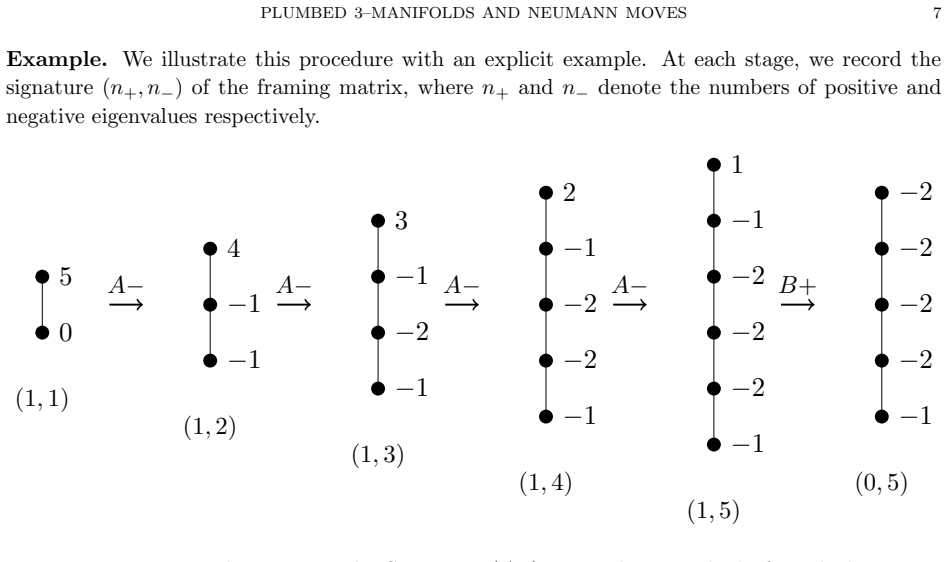
The central claim is that positive eigenvalues of the framing matrix always appear on linear branches of a weakly negative definite plumbing tree. These can be removed systematically by a controlled sequence of Neumann moves that adjust the relevant framings and connections while leaving the rest of the tree and the diffeomorphism type of the plumbed 3-manifold unchanged, until the matrix becomes negative definite.
What carries the argument
Neumann moves on plumbing trees, which are local graph operations that preserve the diffeomorphism type of the associated 3-manifold while modifying the framing matrix in a controlled way.
If this is right
- Results that require a negative definite plumbing representation now apply after a finite reduction to any weakly negative definite tree.
- The transformation supplies a concrete, step-by-step algorithm rather than a non-constructive existence statement.
- Any two weakly negative definite trees that represent the same 3-manifold can be reduced independently and compared in their negative definite forms.
- Invariants computed from the framing matrix can be evaluated on the simplified negative definite representative.
Where Pith is reading between the lines
- The localization of positive eigenvalues on linear branches suggests that the obstruction to negative definiteness is always removable by operations that act only on those branches.
- The algorithm may be implemented directly to produce a canonical negative definite representative for any given weakly negative definite tree.
- This reduction could be used to compare different plumbings of the same manifold by first normalizing both to negative definite form.
Load-bearing premise
Any positive eigenvalues of the framing matrix appear only on linear branches of the tree so that targeted moves can eliminate them without affecting other parts of the structure.
What would settle it
A counterexample would be a weakly negative definite plumbing tree whose framing matrix has a positive eigenvalue located at a branch point rather than on a linear branch, or any tree in which no finite sequence of Neumann moves succeeds in removing all positive eigenvalues.
Figures


read the original abstract
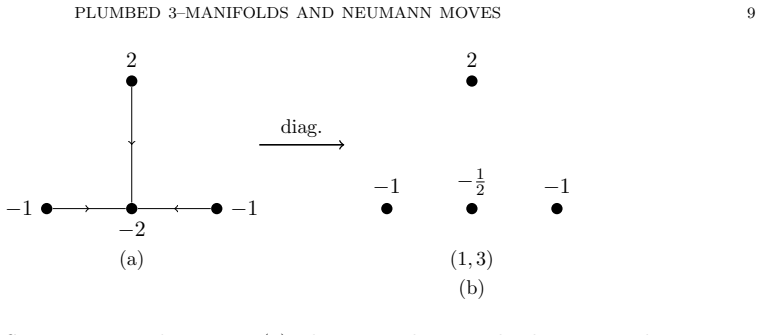
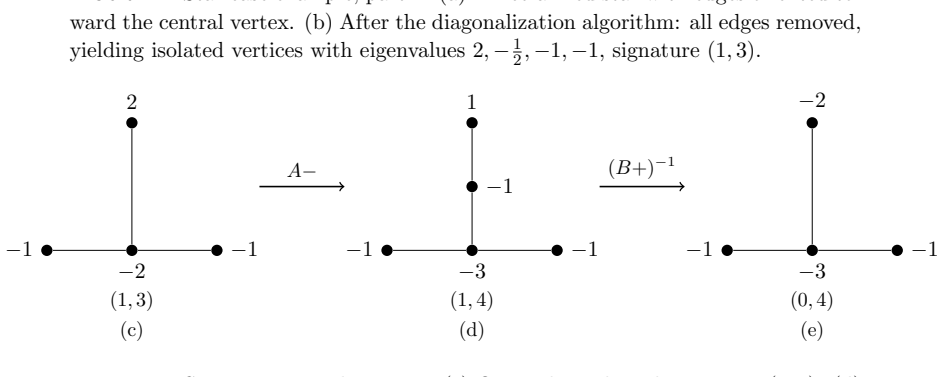
We give a constructive proof that every weakly negative definite plumbing tree can be transformed into a negative definite one by a finite sequence of Neumann moves. The argument combines Neumann's plumbing calculus with the diagonalization algorithm of Duchon, Eisenbud, and Neumann, which extracts the eigenvalues of the framing matrix directly from the combinatorics of the tree. We show that any positive eigenvalues are supported on linear branches and can be eliminated systematically via controlled applications of Neumann moves. This provides an explicit algorithm reducing weakly negative definite plumbing trees to negative definite ones.
Editorial analysis
A structured set of objections, weighed in public.
Referee Report
Summary. The paper gives a constructive proof that every weakly negative definite plumbing tree can be transformed into a negative definite one by a finite sequence of Neumann moves. The argument combines Neumann's plumbing calculus with the Duchon-Eisenbud-Neumann diagonalization algorithm, which extracts eigenvalues from the tree combinatorics, to show that positive eigenvalues lie on linear branches and can be eliminated systematically while preserving the underlying 3-manifold.
Significance. If the result holds, the explicit algorithm provides a practical reduction procedure for weakly negative definite plumbings, which should simplify calculations of Seifert invariants, correction terms, and other topological invariants for plumbed 3-manifolds. The combination of two established tools into a verifiable, finite-step procedure is a clear strength.
minor comments (3)
- §3, Algorithm 1: the pseudocode for the reduction step could include a brief invariant check (e.g., that the signature or the number of positive eigenvalues decreases) to make the termination argument more immediate for readers.
- Figure 2: the tree diagrams would benefit from explicit labels on the linear branches where the Duchon-Eisenbud-Neumann diagonalization identifies positive eigenvalues, to match the textual description in §4.
- References: the citation to Duchon-Eisenbud-Neumann should include the precise theorem number used for the eigenvalue extraction, as the current reference list entry is only the paper title.
Simulated Author's Rebuttal
We thank the referee for their positive assessment of the manuscript and for the recommendation to accept. The provided summary correctly identifies the constructive nature of the proof and the utility of combining the two established tools.
Circularity Check
No significant circularity
full rationale
The paper presents a constructive proof by combining two external, independently established algorithms: Neumann's plumbing calculus and the Duchon-Eisenbud-Neumann diagonalization procedure for extracting eigenvalues from the tree combinatorics. No equations, fitted parameters, self-definitional relations, or load-bearing self-citations appear in the derivation chain. The reduction from weakly negative definite to negative definite trees is achieved by applying these external tools to locate and eliminate positive eigenvalues on linear branches, without any step that reduces by construction to the paper's own inputs or prior results by the same author.
Axiom & Free-Parameter Ledger
axioms (2)
- domain assumption The framing matrix of a plumbing tree is symmetric and its eigenvalues can be read combinatorially from the tree via the Duchon-Eisenbud-Neumann procedure.
- standard math Neumann moves preserve the diffeomorphism type of the associated 3-manifold.
Lean theorems connected to this paper
-
IndisputableMonolith/Foundation/AlexanderDuality.leanalexander_duality_circle_linking unclearWe show that any positive eigenvalues are supported on linear branches and can be eliminated systematically via controlled applications of Neumann moves.
-
IndisputableMonolith/Foundation/Cost/FunctionalEquation.leanwashburn_uniqueness_aczel unclearThe argument combines Neumann’s plumbing calculus with the diagonalization algorithm of Duchon, Eisenbud, and Neumann, which extracts the eigenvalues of the framing matrix directly from the combinatorics of the tree.
Reference graph
Works this paper leans on
-
[1]
Akhmechet, P
R. Akhmechet, P. K. Johnson, and V. Krushkal,Lattice cohomology andq-series invariants of3–manifolds, Journal f¨ ur die reine und angewandte Mathematik (Crelle’s Journal)798(2023), 269–294
2023
-
[2]
Duchon,Th` ese de doctorat, University of Maryland, 1982
N. Duchon,Th` ese de doctorat, University of Maryland, 1982
1982
-
[3]
Eisenbud and W
D. Eisenbud and W. D. Neumann,Three-Dimensional Link Theory and Invariants of Plane Curve Singularities, Annals of Mathematics Studies, Vol. 110, Princeton University Press, Princeton, NJ, 1985. 0This paper has been submitted in partial fulfillment of the requirements for the master’s degree at Virginia Commonwealth University. 0Supported in part by NSF G...
1985
-
[4]
R. E. Gompf and A. I. Stipsicz,4–Manifolds and Kirby Calculus, Graduate Studies in Mathematics, Vol. 20, American Mathematical Society, Providence, RI, 1999
1999
-
[5]
Grauert, ¨Uber Modifikationen und exzeptionelle analytische Mengen, Mathematische Annalen146(1962), 331–368
H. Grauert, ¨Uber Modifikationen und exzeptionelle analytische Mengen, Mathematische Annalen146(1962), 331–368
1962
-
[6]
Gukov, L
S. Gukov, L. Katzarkov, and J. Svoboda, bZand splice diagrams, Symmetry, Integrability and Geometry: Methods and Applications21(2025), 073
2025
-
[7]
Gukov and C
S. Gukov and C. Manolescu,A two-variable series for knot complements, Quantum Topology12(2021), no. 1
2021
-
[8]
Gukov, D
S. Gukov, D. Pei, P. Putrov, and C. Vafa,BP Sspectra and3–manifold invariants, Journal of Knot Theory and Its Ramifications29(2020), no. 2, 2040003
2020
-
[9]
S. Harichurn, A. N´ emethi, and J. Svoboda, ∆invariants of plumbed manifolds, arXiv:2412.02042 [math.GT], 2024
-
[10]
A. H. Moore and N. Tarasca,Root lattices and invariant series for plumbed3–manifolds, arXiv:2405.14972 [math.GT], 2024
work page internal anchor Pith review Pith/arXiv arXiv 2024
-
[11]
W. D. Neumann,An invariant of plumbed homology spheres, in Topology Symposium, Siegen 1979 (U. Koschorke and W. D. Neumann, eds.), Lecture Notes in Mathematics, vol. 788, Springer, Berlin, 1980, pp. 125–144
1979
discussion (0)
Sign in with ORCID, Apple, or X to comment. Anyone can read and Pith papers without signing in.