Recognition: 2 theorem links
· Lean TheoremGuidelines for Cultivating a Sense of Belonging to Reduce Developer Burnout
Pith reviewed 2026-05-11 01:17 UTC · model grok-4.3
The pith
Guidelines synthesized from prior research on belongingness characteristics and factors to help reduce developer burnout in software organizations and OSS communities.
A machine-rendered reading of the paper's core claim, the machinery that carries it, and where it could break.
Core claim
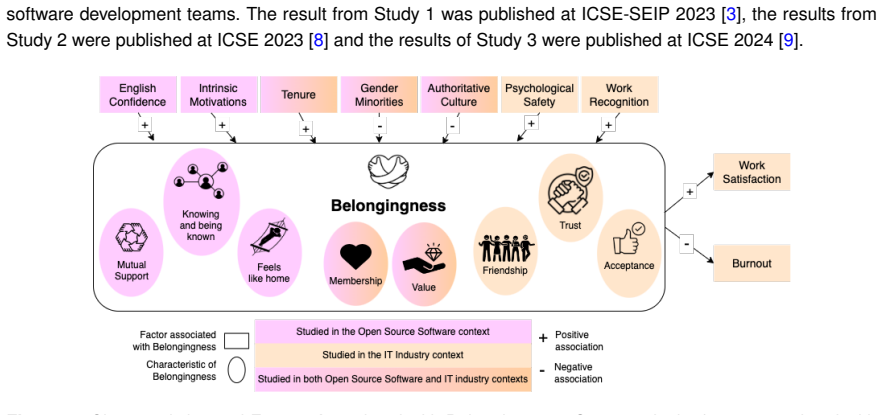
Based on these findings, we propose practical guidelines for leaders and communities, including timely and consistent recognition, transparent promotion rules, inclusive benefits and initiatives, intentional connections through collaborative tools, blameless postmortems, optional in-person opportunities, informal newcomer gatherings, and continuous monitoring of belongingness and burnout. These guidelines can help software organizations and open-source communities foster healthier, more inclusive environments that support developer well-being.
Load-bearing premise
That the observed associations between belongingness factors and lower burnout levels in prior studies will translate into causal reductions in burnout when the proposed guidelines are implemented.
Figures


read the original abstract
Burnout affects software developers' mental and physical well-being and contributes to turnover, generating strong concerns in the software industry. Prior research has shown that lack of belonging is associated with higher levels of burnout among software developers, while a sense of belonging is linked to resilience, job satisfaction, engagement, and well-being. In this paper, we revisit recent studies on belongingness in software development teams, including proprietary software organizations and open-source software communities, to offer evidence-based guidelines for cultivating belongingness and reducing developer burnout. We summarize characteristics of belongingness, such as trust, acceptance, value recognition, friendship, membership, mutual support, and being known by others, as well as factors associated with belongingness, including recognition, psychological safety, intrinsic motivation, English confidence, tenure, gender, and cultural power distance. Based on these findings, we propose practical guidelines for leaders and communities, including timely and consistent recognition, transparent promotion rules, inclusive benefits and initiatives, intentional connections through collaborative tools, blameless postmortems, optional in-person opportunities, informal newcomer gatherings, and continuous monitoring of belongingness and burnout. These guidelines can help software organizations and open-source communities foster healthier, more inclusive environments that support developer well-being.
Editorial analysis
A structured set of objections, weighed in public.
Referee Report
Summary. The paper synthesizes prior research showing associations between lack of belonging and higher burnout among software developers, as well as positive links between belongingness and resilience, satisfaction, and well-being. Drawing from studies in proprietary organizations and open-source communities, it summarizes characteristics (trust, acceptance, value recognition) and factors (recognition, psychological safety, gender, tenure) of belongingness, then proposes practical guidelines for leaders and communities—including timely recognition, transparent promotions, inclusive initiatives, blameless postmortems, and continuous monitoring—with the aim of cultivating belonging to reduce developer burnout.
Significance. If the guidelines prove effective, the paper could deliver actionable, literature-grounded advice for improving developer well-being and retention in industry and OSS settings. Its value lies in consolidating recent empirical findings on belongingness into a coherent practitioner-oriented framework, which may stimulate further work on well-being interventions in software engineering.
major comments (1)
- [Abstract and guidelines proposal] The central prescriptive claim (Abstract; guidelines paragraph) asserts that implementing the listed practices (timely and consistent recognition, blameless postmortems, optional in-person opportunities, etc.) will cultivate belongingness and thereby reduce burnout. This rests entirely on correlational associations reported in the cited prior studies, with no reference to intervention studies, RCTs, pre/post measurements, or causal evidence demonstrating that these exact practices produce the intended effects. The move from 'associated with' to 'to reduce' is load-bearing for the contribution and requires either supporting citations, explicit caveats, or reframing as testable hypotheses.
minor comments (1)
- [Abstract] The abstract and introduction could more explicitly qualify the evidence base as associative rather than interventional to manage reader expectations about the strength of the recommendations.
Simulated Author's Rebuttal
We thank the referee for their constructive feedback, which helps us strengthen the clarity of our contribution. We have revised the manuscript to address the concern about the strength of evidence for the proposed guidelines.
read point-by-point responses
-
Referee: The central prescriptive claim (Abstract; guidelines paragraph) asserts that implementing the listed practices (timely and consistent recognition, blameless postmortems, optional in-person opportunities, etc.) will cultivate belongingness and thereby reduce burnout. This rests entirely on correlational associations reported in the cited prior studies, with no reference to intervention studies, RCTs, pre/post measurements, or causal evidence demonstrating that these exact practices produce the intended effects. The move from 'associated with' to 'to reduce' is load-bearing for the contribution and requires either supporting citations, explicit caveats, or reframing as testable hypotheses.
Authors: We agree that the cited studies primarily report correlational associations rather than causal evidence from interventions. Our paper synthesizes these associations to identify characteristics and factors of belongingness and then proposes practical guidelines as evidence-informed recommendations for leaders and communities. To address the referee's point, we have revised the abstract and the guidelines section to replace prescriptive language with explicit caveats, such as 'Drawing on these associations, we propose the following guidelines as testable recommendations...' We have also added a paragraph noting the absence of direct intervention studies and calling for future work to evaluate the guidelines through RCTs or pre/post designs. This maintains the paper's value in consolidating the literature while accurately reflecting the evidence base. revision: yes
Circularity Check
No circularity: literature synthesis with external citations and no derivations or self-referential predictions
full rationale
The paper contains no equations, fitted parameters, predictions, or derivation chains. It summarizes characteristics and factors from prior (externally cited) studies on belongingness and burnout, then proposes practical guidelines as an application of those associations. No step reduces to a self-definition, a fitted input renamed as prediction, or a load-bearing self-citation chain. The move from observational associations to prescriptive guidelines is an interpretive leap, not a circular reduction by construction.
Axiom & Free-Parameter Ledger
axioms (1)
- domain assumption Associations between belongingness and burnout levels imply that targeted interventions to increase belonging will causally reduce burnout.
Lean theorems connected to this paper
-
IndisputableMonolith/Foundation/Cost/FunctionalEquation.leanwashburn_uniqueness_aczel unclearWe revisit recent studies on belongingness... propose practical guidelines... timely recognition, blameless postmortems, continuous monitoring of belongingness and burnout.
-
IndisputableMonolith/Foundation/AbsoluteFloorClosure.leanabsolute_floor_iff_bare_distinguishability unclearKey Finding: Psychological safety and work appreciation positively correlate with a sense of belonging...
Reference graph
Works this paper leans on
-
[1]
D. Fletcher and M. Sarkar, “Psychological resilience,” European psychologist, 2013
work page 2013
-
[2]
Developing a sense of virtual com- munity measure,
A. L. Blanchard, “Developing a sense of virtual com- munity measure,”CyberPsychology & Behavior, vol. 10, no. 6, pp. 827–830, 2007
work page 2007
-
[3]
A model for understanding and reducing developer burnout,
B. Trinkenreich, K.-J. Stol, I. Steinmacher, M. A. Gerosa, A. Sarma, M. Lara, M. Feathers, N. Ross, and K. Bishop, “A model for understanding and reducing developer burnout,” in2023 IEEE/ACM 45th Interna- tional Conference on Software Engineering: Software Engineering in Practice. IEEE, 2023, pp. 48–60
work page 2023
-
[4]
Anxiety and mental health of software professionals and mechanical professionals,
R. D. Nayak, “Anxiety and mental health of software professionals and mechanical professionals,”Int. j. soc. sci. humanit. invent., vol. 3, no. 2, 2014
work page 2014
-
[5]
Developing a measure of sense of belonging,
B. M. Hagerty and K. Patusky, “Developing a measure of sense of belonging,”Nursing research, vol. 44, no. 1, pp. 9–13, 1995
work page 1995
-
[6]
A. H. Maslow, “A theory of human motivation.”Psycho- logical review, vol. 50, no. 4, p. 370, 1943
work page 1943
-
[7]
Why do women opt out? sense of belonging and women’s representa- tion in mathematics
C. Good, A. Rattan, and C. S. Dweck, “Why do women opt out? sense of belonging and women’s representa- tion in mathematics.”Journal of personality and social psychology, vol. 102, no. 4, p. 700, 2012
work page 2012
-
[8]
Do i belong? model- ing sense of virtual community among linux kernel con- tributors,
B. Trinkenreich, K.-J. Stol, A. Sarma, D. M. German, M. A. Gerosa, and I. Steinmacher, “Do i belong? model- ing sense of virtual community among linux kernel con- tributors,” in2023 IEEE/ACM 45th International Confer- ence on Software Engineering (ICSE). IEEE, 2023
work page 2023
-
[9]
B. Trinkenreich, M. Gerosa, and I. Steinmacher, “Unrav- eling the drivers of sense of belonging in software deliv- ery teams: Insights from a large-scale survey,” in2024 IEEE/ACM 46th International Conference on Software Engineering (ICSE). IEEE, 2024
work page 2024
-
[10]
R. M. Ryan and E. L. Deci,Self-determination theory: Basic psychological needs in motivation, development, and wellness. Guilford Publications, 2017
work page 2017
-
[11]
G. Hofstede,Culture’s consequences: Comparing val- ues, behaviors, institutions and organizations across nations. Sage publications, 2001
work page 2001
-
[12]
3 ways to build a sense of belonging in the workplace,
J. Wiles and J. Turner, “3 ways to build a sense of belonging in the workplace,” https://www.gartner.com/smarterwithgartner/build- a-sense-of-belonging-in-the-workplace
-
[13]
Pots of gold at the end of the rainbow: What is success for open source contributors,
B. Trinkenreich, M. Guizani, I. S. Wiese, T. Conte, M. Gerosa, A. Sarma, and I. Steinmacher, “Pots of gold at the end of the rainbow: What is success for open source contributors,”IEEE T ransactions on Software Engineering, pp. 1–1, 2021
work page 2021
-
[14]
Sustainable soft- ware development through overlapping pair rotation,
T. Sedano, P . Ralph, and C. P´eraire, “Sustainable soft- ware development through overlapping pair rotation,” inProceedings of the 10th ACM/IEEE International Symposium on Empirical Software Engineering and Measurement, 2016, pp. 1–10
work page 2016
-
[15]
What happens to psychological safety when going remote?
A. Tkalich, D. ˇSmite, N. H. Andersen, and N. B. Moe, “What happens to psychological safety when going remote?”IEEE Software, 2022
work page 2022
-
[16]
N. Raman, M. Cao, Y . Tsvetkov, C. K ¨astner, and B. Vasilescu, “Stress and burnout in open source: To- ward finding, understanding, and mitigating unhealthy May/June 2022 7 interactions,” inACM/IEEE 42nd International Confer- ence on Software Engineering: New Ideas and Emerg- ing Results, 2020, pp. 57–60. Bianca Trinkenreichis an Assistant Professor at C...
work page 2022
discussion (0)
Sign in with ORCID, Apple, or X to comment. Anyone can read and Pith papers without signing in.