Recognition: 2 theorem links
· Lean TheoremIntrinsic Linking of 2-complexes in mathbb{R}⁴
Pith reviewed 2026-05-11 02:21 UTC · model grok-4.3
The pith
Any embedding of the suspension of a K6-minor graph into R^4 contains a non-trivially linked 1-cycle and 2-cycle.
A machine-rendered reading of the paper's core claim, the machinery that carries it, and where it could break.
Core claim
The paper produces an infinite family of 2-complexes that are intrinsically linked when embedded into four dimensions. In particular, the suspension of any graph containing K6 as a minor must contain a non-trivially linked 1-cycle and 2-cycle in every embedding into R^4.
What carries the argument
The suspension of a graph containing K6 as a minor, which forces non-trivial linking between a 1-cycle and a 2-cycle in any embedding into R^4.
If this is right
- The construction yields an infinite family of 2-complexes that are intrinsically linked in four dimensions.
- Every embedding of these suspended complexes into R^4 is obstructed by the presence of linked 1-cycles and 2-cycles.
- The linking property is inherited from the K6 minor through the suspension operation.
Where Pith is reading between the lines
- The same minor-based obstruction might be checked for other small graphs or for higher-dimensional complexes.
- One could test whether removing the K6 minor allows embeddings of the suspension without any 1-2 linking.
- The result supplies concrete test cases for algorithms that decide embeddability of 2-complexes in R^4.
Load-bearing premise
The suspension operation applied to a graph with a K6 minor always produces non-trivial linking between some 1-cycle and some 2-cycle no matter how the resulting 2-complex is embedded in R^4.
What would settle it
An explicit embedding of the suspension of K6 into R^4 in which no 1-cycle is non-trivially linked with any 2-cycle.
Figures



read the original abstract
We produce an infinite family of $2$-complexes that are intrinsically linked when embedded into four dimensions. In particular, we show that any embedding into $\mathbb{R}^4$ of the suspension of a graph containing $K_6$ as a minor contains a non-trivially linked 1 and 2-cycle.
Editorial analysis
A structured set of objections, weighed in public.
Referee Report
Summary. The manuscript claims to produce an infinite family of 2-complexes that are intrinsically linked when embedded in R^4. In particular, it proves that the suspension of any graph containing K_6 as a minor has the property that every embedding into R^4 contains a non-trivially linked 1-cycle and 2-cycle.
Significance. If correct, the result extends the classical minor-based characterization of intrinsic linking from graphs in R^3 to 2-complexes in R^4 via the suspension construction, generating an infinite family from the single minor K_6 without additional parameters or ad-hoc constructions. The approach is grounded in standard definitions of embeddings, minors, and linking numbers (via intersection or degree), which avoids circularity or invented entities and provides a clean, falsifiable extension of known results.
minor comments (2)
- The abstract states the central claim but supplies no proof sketch or explicit definition of 'non-trivially linked' for a 1-cycle/2-cycle pair in R^4; the introduction or §1 should include a brief recall of the linking number (or intersection number) used, with a reference to a standard source such as Rolfsen or a topology text.
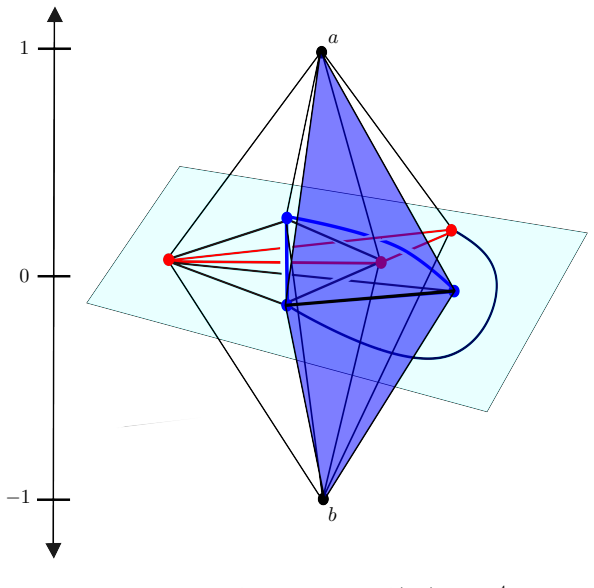
- A single illustrative figure showing the suspension of K_6 (or a small K_6-minor graph) together with an explicit pair of linked 1-cycle and 2-cycle in an R^4 embedding would improve readability and help verify the cone-construction argument.
Simulated Author's Rebuttal
We thank the referee for the positive assessment of our manuscript, the accurate summary of our main result, and the recommendation for minor revision. We appreciate the recognition that the suspension construction provides a clean extension of the classical minor-based characterization of intrinsic linking.
Circularity Check
No significant circularity; derivation extends standard minor theory independently
full rationale
The paper establishes that suspensions of K6-minor graphs are intrinsically linked in R^4 by combining the known intrinsic linking of K6-minors in R^3 with the suspension (cone) construction. This relies on standard definitions of embeddings, minors, and linking numbers (via intersection or degree) drawn from external references in geometric topology, without any reduction to self-citations, fitted parameters, or ansatzes introduced by the authors. The infinite family is generated directly from larger K6-minor graphs, and the argument preserves the linking property under suspension without hidden assumptions or self-referential steps. The derivation is self-contained against external benchmarks.
Axiom & Free-Parameter Ledger
Lean theorems connected to this paper
-
IndisputableMonolith/Foundation/AlexanderDuality.leanalexander_duality_circle_linking echoes?
echoesECHOES: this paper passage has the same mathematical shape or conceptual pattern as the Recognition theorem, but is not a direct formal dependency.
by Alexander duality H1(R4 − C2) ≃ Z. An isomorphism is determined by choosing an orientation on the surface C2 – this specifies a “positively oriented” meridian to C2 that generates H1(R4 − C2)
-
IndisputableMonolith/Foundation/AlexanderDuality.leanD3_admits_circle_linking unclear?
unclearRelation between the paper passage and the cited Recognition theorem.
Theorem 1.1. The suspension of any graph containing K6 as a minor is an intrinsically linked 2-complex in R4.
What do these tags mean?
- matches
- The paper's claim is directly supported by a theorem in the formal canon.
- supports
- The theorem supports part of the paper's argument, but the paper may add assumptions or extra steps.
- extends
- The paper goes beyond the formal theorem; the theorem is a base layer rather than the whole result.
- uses
- The paper appears to rely on the theorem as machinery.
- contradicts
- The paper's claim conflicts with a theorem or certificate in the canon.
- unclear
- Pith found a possible connection, but the passage is too broad, indirect, or ambiguous to say the theorem truly supports the claim.
Reference graph
Works this paper leans on
-
[1]
C. Adams. Knotted tilings. InThe Mathematics of Long-Range Aperiodic Order (Waterloo, ON, 1995), volume 489 ofNATO Adv. Sci. Inst. Ser. C: Math. and Phys. Sci., pages 1–8. Kluwer Academic Publishers, Dordrecht, 1997
work page 1995
-
[2]
Adams.The Knot Book: An Elementary Introduction to the Mathemat- ical Theory of Knots
C. Adams.The Knot Book: An Elementary Introduction to the Mathemat- ical Theory of Knots. American Mathematical Society, 2004
work page 2004
-
[3]
Andrew Brouwer, Rachel Davis, Abel Larkin, Daniel Studenmund, and Cherith Tucker. Intrinsically s1 3-linked graphs and other aspects of s1 embeddings.Rose-Hulman Undergraduate Mathematics Journal, 8, 2007
work page 2007
-
[4]
J. H. Conway and C. McA. Gordon. Knots and links in spatial graphs.J. Graph Theory, 7:445–453, 1983
work page 1983
-
[5]
Intrinsic knotting and linking of complete graphs.Algebr
Erica Flapan. Intrinsic knotting and linking of complete graphs.Algebr. Geom. Topol., 2:371–380, 2002
work page 2002
-
[6]
Intrinsic linking and knot- ting are arbitrarily complex.Fund
Erica Flapan, Blake Mellor, and Ramin Naimi. Intrinsic linking and knot- ting are arbitrarily complex.Fund. Math., 201:131–148, 2008
work page 2008
-
[7]
David Gabai. The 4-dimensional light bulb theorem.Journal of the Amer- ican Mathematical Society, 33:609–652, 2020
work page 2020
-
[8]
Agelos Georgakopoulos and Martin Winter. On 2-complexes embeddable in 4-space, and the excluded minors of their underlying graphs.ArXiv, abs/2408.12681, 2024
-
[9]
E. R. Kampen. Komplexe in euklidischen raumen.Abhandlungen aus dem Mathematischen Seminar der Universit¨ at Hamburg, 1933. 10
work page 1933
-
[10]
L´ aszl´ o Lov´ asz and Alexander Schrijver. A borsuk theorexm for antipodal links and a spectral characterization of linklessly embeddable graphs.Pro- ceedings of the American Mathematical Society, 126(5):1275–1285, 1998
work page 1998
-
[11]
On higher dimensional light bulb theorem.Kobe journal of mathematics, 3:71–75, 1986
Yoshihiko Marumoto. On higher dimensional light bulb theorem.Kobe journal of mathematics, 3:71–75, 1986
work page 1986
-
[12]
An intrinsically linked simplicialn-complex, 2025
Ryo Nikkuni. An intrinsically linked simplicialn-complex, 2025
work page 2025
-
[13]
N. Robertson, P. Seymour, and R. Thomas. Sachs linkless embedding conjecture.Journal of Combinatorial Theory, Series B, 64(2):185–227, 1995
work page 1995
-
[14]
On spatial representations of finite graphs
Horst Sachs. On spatial representations of finite graphs. InTopological Methods in Graph Theory, pages 165–176. Klaus-Rauhe-Verl, 1983
work page 1983
-
[15]
Embedding products of graphs into euclidean spaces
Mikhail Skopenkov. Embedding products of graphs into euclidean spaces. Fundamenta Mathematicae, 179:191 – 198, 09 2008
work page 2008
- [16]
-
[17]
Christopher Tuffley. Some ramsey-type results on intrinsic linking of n- complexes.Rose-Human Undergraduate Mathematics Journal, 12:1–26, 2012. 11
work page 2012
discussion (0)
Sign in with ORCID, Apple, or X to comment. Anyone can read and Pith papers without signing in.