Recognition: 2 theorem links
· Lean TheoremSimplicial Regularizability of the Pseudo-Moment Cone and Carath\'eodory-Type Atomic Decomposition of Moment Matrices
Pith reviewed 2026-05-11 02:06 UTC · model grok-4.3
The pith
Moment matrices from O(n^d) generic atoms have simplicial minimal faces in the pseudo-moment cone generated by their atoms.
A machine-rendered reading of the paper's core claim, the machinery that carries it, and where it could break.
Core claim
If a moment matrix is formed by O(n^d) generically chosen weighted atoms, then its minimal face in the matrix realization of the pseudo-moment cone is simplicial and generated by the planted rank-one atoms. Based on this geometric result, a Carathéodory-type extreme-ray decomposition algorithm is developed for spectrahedral cones and specializes to an efficient atomic decomposition method for generically generated moment matrices in the same regime.
What carries the argument
The simplicial minimal face of the moment matrix inside the pseudo-moment cone, which is spanned by the planted rank-one atoms and serves as the basis for the extreme-ray decomposition algorithm.
If this is right
- The algorithm recovers the original atoms efficiently for generic moment matrices in the O(n^d) regime.
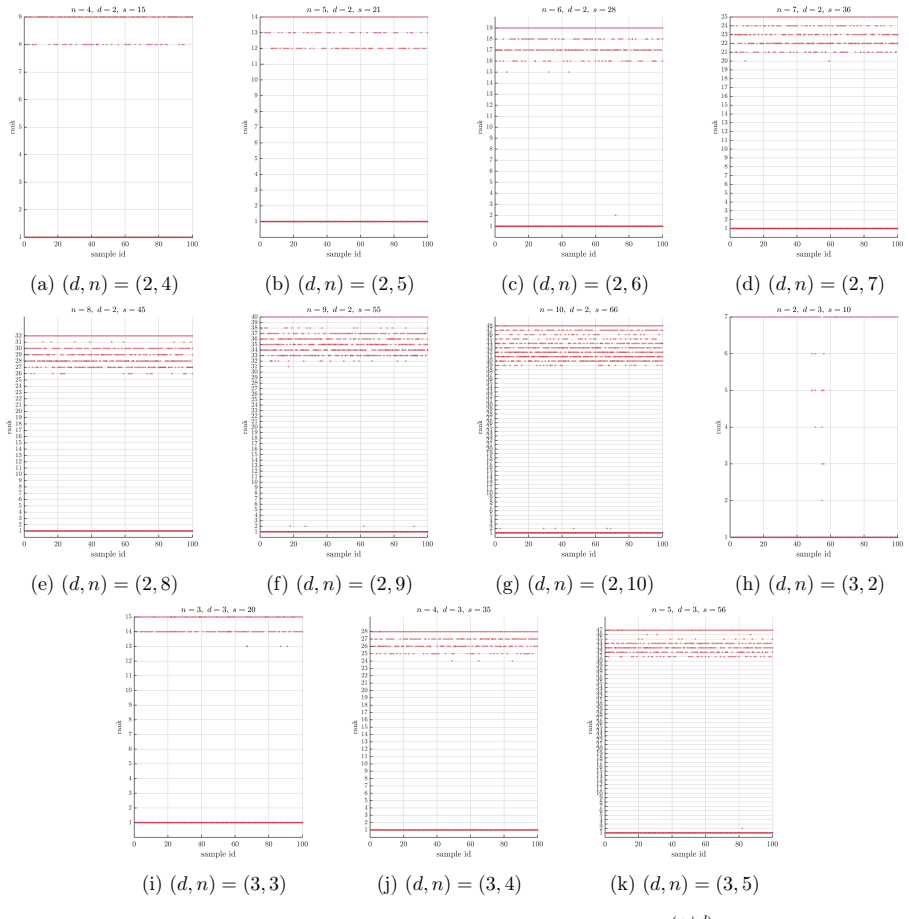
- Numerical implementation shows strong recovery performance on tested instances.
- Outside the proven regime the same procedure can still sample high-rank extreme rays of the cone.
Where Pith is reading between the lines
- The simpliciality property may extend to other spectrahedral cones with similar facial structure.
- The decomposition method could improve practical solvers for polynomial optimization problems that rely on moment relaxations.
- Stabilization techniques used in the numerics suggest the approach remains usable for mildly non-generic data.
Load-bearing premise
The atoms must be chosen generically and their number must remain at most O(n^d) for fixed d at least 2.
What would settle it
A single explicit example of O(n^d) generic atoms whose moment matrix has a minimal face that is not simplicial or not generated solely by those atoms would falsify the claim.
Figures


read the original abstract
We study the facial geometry of the homogeneous pseudo-moment cone \(\Sigma_{n,2d}^*\) and its implications for atomic decomposition of moment matrices. For fixed \(d \ge 2\), we show that if a moment matrix is formed by \(O(n^d)\) generically chosen weighted atoms, then its minimal face in the matrix realization of the pseudo-moment cone is \emph{simplicial} and generated by the planted rank-one atoms. Based on this geometric result, we develop a Carath\'eodory-type extreme-ray decomposition algorithm for spectrahedral cones and show that, when specialized to the pseudo-moment cone, it yields an efficient atomic decomposition method for generically generated moment matrices in the same regime. A stabilized numerical implementation demonstrates strong recovery performance and suggests that, outside the guaranteed regime, the algorithm may serve as a practical sampler of high-rank extreme rays.
Editorial analysis
A structured set of objections, weighed in public.
Referee Report
Summary. The paper studies the facial geometry of the homogeneous pseudo-moment cone Σ_{n,2d}^*. For fixed d ≥ 2, it proves that if a moment matrix is formed by O(n^d) generically chosen weighted atoms, then its minimal face in the matrix realization of the cone is simplicial and generated by the planted rank-one atoms. This geometric result is used to derive a Carathéodory-type extreme-ray decomposition algorithm for spectrahedral cones; when specialized to the pseudo-moment cone, the algorithm yields an efficient atomic decomposition method for generically generated moment matrices in the same regime. A stabilized numerical implementation is presented to demonstrate recovery performance and to suggest utility as a sampler of high-rank extreme rays outside the guaranteed regime.
Significance. If the central claim holds, the work provides a rigorous geometric foundation for atomic decompositions of moment matrices via the facial structure of the pseudo-moment cone, advancing understanding in polynomial optimization, semidefinite programming, and the moment problem. The dimension-counting argument establishing that configurations admitting extraneous extreme rays form a proper algebraic subvariety of the configuration space is a clear strength, as is the direct derivation of the decomposition algorithm from the resulting simplicial facial structure. The empirical illustration of performance outside the O(n^d) regime adds practical value. These elements together offer both theoretical insight and an algorithmic tool with potential applications in high-dimensional atomic recovery.
minor comments (4)
- The definition and basic properties of the homogeneous pseudo-moment cone Σ_{n,2d}^* and its matrix realization should be recalled or referenced explicitly in the introduction or the section containing the main theorem to improve accessibility for readers outside the immediate subfield.
- In the section deriving the Carathéodory-type algorithm, the specialization step from general spectrahedral cones to the pseudo-moment cone would benefit from a short explicit statement of how the simpliciality implies the decomposition terminates with exactly the planted atoms.
- The numerical experiments section presents the implementation as an empirical illustration; adding a brief discussion of the stabilization technique (e.g., regularization parameter choice or pivoting strategy) would enhance reproducibility without altering the theoretical focus.
- A small number of typographical inconsistencies appear in the notation for the atom weights and the dimension count O(n^d); a final consistency pass on symbols would improve readability.
Simulated Author's Rebuttal
We thank the referee for their positive and constructive review of our manuscript on the facial geometry of the pseudo-moment cone and the associated Carathéodory-type atomic decomposition algorithm. The recommendation for minor revision is appreciated, as is the recognition of the dimension-counting argument and the practical value of the numerical implementation. Since the report contains no specific major comments requiring point-by-point response, we have no substantive revisions to propose at this time.
Circularity Check
No significant circularity detected
full rationale
The central claim is a geometric theorem: for fixed d ≥ 2 and O(n^d) generically chosen atoms, the minimal face of the moment matrix in the pseudo-moment cone is simplicial and generated by the planted rank-1 atoms. This rests on a dimension-counting argument that the locus of configurations admitting an extraneous extreme ray is a proper algebraic subvariety of the configuration space. The Carathéodory-type algorithm is then derived directly from the resulting facial structure. No self-definitional steps, fitted parameters renamed as predictions, load-bearing self-citations, uniqueness theorems imported from the authors' prior work, or ansätze smuggled via citation appear in the derivation. The numerical section is presented only as empirical illustration. The argument is self-contained against external algebraic-geometry benchmarks and does not reduce to its inputs by construction.
Axiom & Free-Parameter Ledger
axioms (1)
- standard math Standard properties of spectrahedral cones and their facial geometry in convex optimization
Lean theorems connected to this paper
-
IndisputableMonolith/Cost/FunctionalEquation.lean (J-uniqueness, Aczél classification)washburn_uniqueness_aczel unclearTheorem 1 (Simplicial regularizability...) and its proof via Theorem 2 (Generic mixed-term avoidance [20, Theorem 15]) on span{v_i ∨ v_j | i<j} ∩ K = {0} for generic atoms
-
IndisputableMonolith/Foundation/AbsoluteFloorClosure.leanreality_from_one_distinction unclearAlgorithm 1 (Carathéodory-type extreme-ray decomposition) and facial lemmas (Lemma 6–7, 9–11) on minface(X, S_+^N) and simplicial cones
Reference graph
Works this paper leans on
-
[1]
MOSEK optimization toolbox for MATLAB.User’s Guide and Reference Manual, Version, 4(1), 2019
Mosek ApS. MOSEK optimization toolbox for MATLAB.User’s Guide and Reference Manual, Version, 4(1), 2019
work page 2019
-
[2]
Alessandra Bernardi, Jerome Brachat, Pierre Comon, and Bernard Mourrain. General tensor decompo- sition, moment matrices and applications.Journal of Symbolic Computation, 52:51–71, 2013
work page 2013
-
[3]
Grigoriy Blekherman. Nonnegative polynomials and sums of squares.Journal of the American Mathe- matical Society, 25(3):617–635, 2012
work page 2012
-
[4]
Positive gorenstein ideals.Proceedings of the American Mathematical Society, 143(1):69–86, 2015
Grigoriy Blekherman. Positive gorenstein ideals.Proceedings of the American Mathematical Society, 143(1):69–86, 2015
work page 2015
-
[5]
Algebraic boundaries of hilbert’s sos cones.Compositio Mathematica, 148(6):1717–1735, 2012
Grigoriy Blekherman, Jonathan Hauenstein, John Christian Ottem, Kristian Ranestad, and Bernd Sturmfels. Algebraic boundaries of hilbert’s sos cones.Compositio Mathematica, 148(6):1717–1735, 2012
work page 2012
-
[6]
Grigoriy Blekherman, Pablo A Parrilo, and Rekha R Thomas.Semidefinite optimization and convex algebraic geometry. SIAM, 2012
work page 2012
-
[7]
Grigoriy Blekherman and Rainer Sinn. Extreme rays of hankel spectrahedra for ternary forms.Journal of Symbolic Computation, 79:23–42, 2017
work page 2017
-
[8]
JonMBorweinandHenryWolkowicz. Facialreductionforacone-convexprogrammingproblem.Journal of the Australian Mathematical Society, 30(3):369–380, 1981
work page 1981
-
[9]
Jeshu Dastidar, Tait Weicht, and Alexander S Wein. Improving the threshold for finding rank-1 matrices in a subspace.arXiv preprint arXiv:2504.17947, 2025
-
[10]
Lieven De Lathauwer. A link between the canonical decomposition in multilinear algebra and simul- taneous matrix diagonalization.SIAM journal on Matrix Analysis and Applications, 28(3):642–666, 2006. 22
work page 2006
-
[11]
Philipp J di Dio and Mario Kummer. The multidimensional truncated moment problem: Carathéodory numbers from hilbert functions.Mathematische Annalen, 380(1):267–291, 2021
work page 2021
-
[12]
Philipp J di Dio and Konrad Schmüdgen. The multidimensional truncated moment problem: atoms, determinacy, and core variety.Journal of Functional Analysis, 274(11):3124–3148, 2018
work page 2018
-
[13]
The multidimensional truncated moment problem: The moment cone.arXiv preprint arXiv:1809.00584, 2018
Philipp J di Dio and Konrad Schmüdgen. The multidimensional truncated moment problem: The moment cone.arXiv preprint arXiv:1809.00584, 2018
-
[14]
Lawrence Fialkow and Srdjan Petrovic. A moment matrix approach to multivariable cubature.Integral Equations and Operator Theory, 52(1):85–124, 2005
work page 2005
-
[15]
Jean Gallier and Jocelyn Quaintance.Differential Geometry and Lie Groups: A Computational Per- spective, volume 12 ofGeometry and Computing. Springer, Cham, 2020
work page 2020
-
[16]
Robin Hartshorne.Algebraic Geometry, volume 52 ofGraduate Texts in Mathematics. Springer, New York, 1977
work page 1977
-
[17]
Didier Henrion. Positively not sos: pseudo-moments and extreme rays in exact arithmetic.arXiv preprint arXiv:2509.01382, 2025
-
[18]
Detecting global optimality and extracting solutions in gloptipoly
Didier Henrion and Jean-Bernard Lasserre. Detecting global optimality and extracting solutions in gloptipoly. InPositive polynomials in control, pages 293–310. Springer, 2005
work page 2005
-
[19]
A bound on the carathéodory number.Linear Algebra and its Applications, 532:347–363, 2017
Masaru Ito and Bruno F Lourenço. A bound on the carathéodory number.Linear Algebra and its Applications, 532:347–363, 2017
work page 2017
-
[20]
Computing linear sections of varieties: quantum entanglement, tensor decompositions and beyond
Nathaniel Johnston, Benjamin Lovitz, and Aravindan Vijayaraghavan. Computing linear sections of varieties: quantum entanglement, tensor decompositions and beyond. In2023 IEEE 64th Annual Sym- posium on Foundations of Computer Science (FOCS), pages 1316–1336. IEEE, 2023
work page 2023
-
[21]
Minimizer extraction in polynomial optimization is robust
Igor Klep, Janez Povh, and Jurij Volcic. Minimizer extraction in polynomial optimization is robust. SIAM Journal on Optimization, 28(4):3177–3207, 2018
work page 2018
-
[22]
Jean B Lasserre. Global optimization with polynomials and the problem of moments.SIAM Journal on Optimization, 11(3):796–817, 2001
work page 2001
-
[23]
Sue E Leurgans, Robert T Ross, and Rebecca B Abel. A decomposition for three-way arrays.SIAM Journal on Matrix Analysis and Applications, 14(4):1064–1083, 1993
work page 1993
-
[24]
Eigenvalue-constrained faces.Linear Algebra and its Applications, 269(1-3):159– 181, 1998
Adrian Stephen Lewis. Eigenvalue-constrained faces.Linear Algebra and its Applications, 269(1-3):159– 181, 1998
work page 1998
-
[25]
The a-truncated k-moment problem.Foundations of Computational Mathematics, 14(6):1243–1276, 2014
Jiawang Nie. The a-truncated k-moment problem.Foundations of Computational Mathematics, 14(6):1243–1276, 2014
work page 2014
-
[26]
Jiawang Nie. Generating polynomials and symmetric tensor decompositions.Foundations of Computa- tional Mathematics, 17(2):423–465, 2017
work page 2017
-
[27]
Dávid Papp and Sercan Yildiz. Sum-of-squares optimization without semidefinite programming.SIAM Journal on Optimization, 29(1):822–851, 2019
work page 2019
-
[28]
Pablo A Parrilo. Semidefinite programming relaxations for semialgebraic problems.Mathematical programming, 96(2):293–320, 2003
work page 2003
-
[29]
Strong duality for semidefinite program- ming.SIAM Journal on Optimization, 7(3):641–662, 1997
Motakuri V Ramana, Levent Tunçel, and Henry Wolkowicz. Strong duality for semidefinite program- ming.SIAM Journal on Optimization, 7(3):641–662, 1997. 23
work page 1997
-
[30]
Cambridge University Press, Cambridge, 2nd edition, 2013
Rolf Schneider.Convex Bodies: The Brunn–Minkowski Theory, volume 151 ofEncyclopedia of Mathe- matics and its Applications. Cambridge University Press, Cambridge, 2nd edition, 2013
work page 2013
-
[31]
Efficient tensor decomposition via moment matrix extension
Bobby Shi, Julia Lindberg, and Joe Kileel. Efficient tensor decomposition via moment matrix extension. arXiv preprint arXiv:2506.22564, 2025
-
[32]
Semidefinite programming.SIAM review, 38(1):49–95, 1996
Lieven Vandenberghe and Stephen Boyd. Semidefinite programming.SIAM review, 38(1):49–95, 1996
work page 1996
-
[33]
Jie Wang, Victor Magron, and Jean-Bernard Lasserre. Tssos: A moment-sos hierarchy that exploits term sparsity.SIAM Journal on Optimization, 31(1):30–58, 2021
work page 2021
-
[34]
Multi-subspace power method for decom- posing all tensors.arXiv preprint arXiv:2510.18627, 2025
Kexin Wang, João M Pereira, Joe Kileel, and Anna Seigal. Multi-subspace power method for decom- posing all tensors.arXiv preprint arXiv:2510.18627, 2025
-
[35]
Kluwer Academic Publishers, Boston, MA, 2000
Henry Wolkowicz, Romesh Saigal, and Lieven Vandenberghe, editors.Handbook of Semidefinite Pro- gramming: Theory, Algorithms, and Applications, volume 27 ofInternational Series in Operations Research & Management Science. Kluwer Academic Publishers, Boston, MA, 2000. 24
work page 2000
discussion (0)
Sign in with ORCID, Apple, or X to comment. Anyone can read and Pith papers without signing in.