Recognition: no theorem link
AdpSplit: Error-Driven Adaptive Splitting for Faster Geometry Discovery in 3D Gaussian Splatting
Pith reviewed 2026-05-11 01:22 UTC · model grok-4.3
The pith
Error-driven adaptive splitting replaces fixed random splits in 3D Gaussian Splatting to reach full rendering quality with fewer densification steps.
A machine-rendered reading of the paper's core claim, the machinery that carries it, and where it could break.
Core claim
AdpSplit determines the number of split children adaptively and initializes their parameters from L1-pixel-error region statistics. It replaces the standard fixed-cardinality random split operator inside adaptive density control, enabling fewer densification iterations while preserving the rendering quality achieved by full-schedule training.
What carries the argument
The error-driven adaptive split operator that sets child count and seeds parameters directly from current L1 error region statistics rather than fixed random choices.
If this is right
- Training time falls 9.2 to 22.3 percent when the operator is swapped into multiple accelerated 3DGS pipelines on MipNeRF360, Deep-Blending, and Tanks&Temples.
- Paired with FastGS it matches full-schedule PSNR on MipNeRF360 after 16.4 percent less time, for a 12.6 times overall speedup versus vanilla 3DGS.
- The replacement requires no changes to the surrounding optimization or rendering loop.
- Rendering quality remains equivalent to the quality obtained by running the original full iteration count.
Where Pith is reading between the lines
- Fixed short training budgets could become reliable defaults if the error-based initialization stays stable across diverse scenes.
- Error maps could serve as a general cheap signal for allocating modeling effort in other iterative point-based reconstruction techniques.
- The same principle of error-guided child creation might reduce iteration counts in related radiance-field or surfel methods without separate hyper-parameter searches.
Load-bearing premise
Child Gaussians started from current L1 error statistics will converge to useful geometry without creating new artifacts that later steps must spend extra time to remove.
What would settle it
Apply the shortened schedule to a scene whose high-error pixels do not align with missing geometric detail, then measure whether final PSNR drops below the full-iteration baseline.
Figures


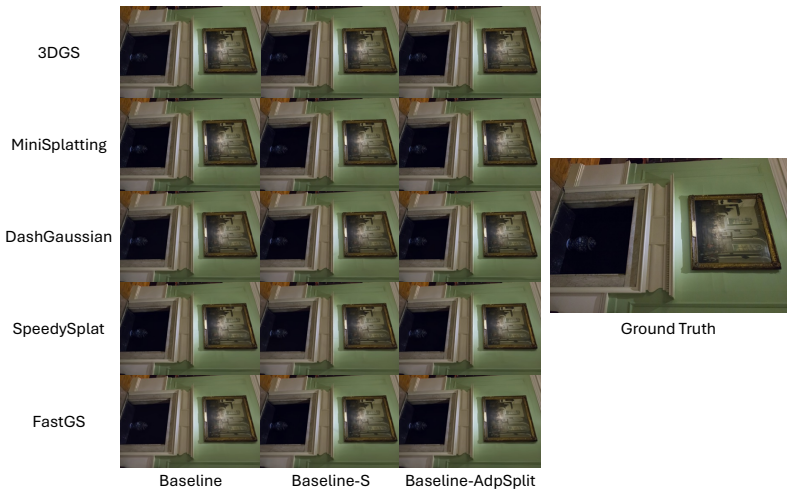


read the original abstract
Adaptive density control in 3D Gaussian Splatting (3DGS) repeatedly grows the Gaussian population through fixed-cardinality random splitting to discover useful scene structure. However, in vanilla 3DGS, its binary split operator requires many densification rounds to expose fine details, making it a bottleneck for efficient training schedules with fewer iterations. We introduce AdpSplit, an error-driven adaptive split operator that determines the number of split children and initializes the child parameters from L1-pixel-error region statistics, enabling fewer densification iterations, thus reduced training time, while preserving the rendering quality of full-schedule training. Across the MipNeRF360, Deep-Blending, and Tanks&Temples datasets, AdpSplit reduces the training time of multiple accelerated 3DGS pipelines by 9.2%-22.3% as a simple drop-in replacement for the standard split operator. With FastGS, AdpSplit matches the full-schedule PSNR on MipNeRF360 while reducing training time by 16.4%, corresponding to a 12.6x acceleration over vanilla 3DGS.
Editorial analysis
A structured set of objections, weighed in public.
Referee Report
Summary. The paper introduces AdpSplit, an error-driven adaptive split operator for 3D Gaussian Splatting that selects split cardinality and initializes child Gaussian parameters (means, scales, opacities) from L1-pixel-error region statistics. This is intended to accelerate geometry discovery, enabling fewer densification iterations and reduced training time while preserving full-schedule rendering quality. Empirical results across MipNeRF360, Deep-Blending, and Tanks&Temples show 9.2%-22.3% training time reductions as a drop-in replacement, with FastGS+AdpSplit matching full-schedule PSNR on MipNeRF360 at 16.4% time savings (12.6x over vanilla 3DGS).
Significance. If the performance claims hold under more rigorous validation, AdpSplit offers a lightweight, practical enhancement to existing accelerated 3DGS pipelines with measurable wall-clock benefits on standard benchmarks. The drop-in nature and focus on empirical speed/quality tradeoffs could see adoption in efficient scene reconstruction workflows. However, the purely empirical nature, lack of theoretical analysis, and unaddressed robustness questions limit its broader significance beyond incremental engineering improvement.
major comments (3)
- [§3.2] §3.2 (initialization procedure): Direct initialization of child parameters from L1-pixel-error region statistics is load-bearing for the quality-parity claim under reduced iterations, yet no targeted experiments demonstrate that this avoids persistent artifacts or slower late-stage convergence on scenes with specular highlights or thin structures. The reported PSNR matches do not rule out masked quality loss.
- [Experimental evaluation] Experimental evaluation (results tables): The 9.2%-22.3% time reductions and 16.4% savings with FastGS are presented without ablations isolating adaptive cardinality from the initialization strategy, without multiple-run statistics or standard deviations, and without sensitivity analysis on the error-region threshold. This prevents verification that the central speedup claim is robust rather than dataset- or seed-specific.
- [§4] §4 (comparison setup): The method is evaluated only against a limited set of accelerated 3DGS baselines; no comparison is made to alternative adaptive densification approaches in the recent literature, leaving open whether the observed gains are unique to the L1-error-driven design or could be achieved by simpler cardinality adjustments.
minor comments (2)
- [Abstract] The abstract and method section could more explicitly list all baselines and pipelines tested beyond the FastGS example to improve reproducibility.
- [Figures/Tables] Figure captions and table headers would benefit from clearer indication of whether metrics are averaged over multiple seeds or single runs.
Simulated Author's Rebuttal
We thank the referee for the constructive feedback. We address each major comment below and indicate the revisions planned for the manuscript.
read point-by-point responses
-
Referee: [§3.2] §3.2 (initialization procedure): Direct initialization of child parameters from L1-pixel-error region statistics is load-bearing for the quality-parity claim under reduced iterations, yet no targeted experiments demonstrate that this avoids persistent artifacts or slower late-stage convergence on scenes with specular highlights or thin structures. The reported PSNR matches do not rule out masked quality loss.
Authors: We acknowledge that targeted experiments on specular highlights and thin structures would provide stronger support. MipNeRF360 contains such elements and our method matches full-schedule PSNR, but to rule out masked loss we will add focused qualitative comparisons, error maps, and late-stage convergence plots on challenging regions in the revision. revision: yes
-
Referee: [Experimental evaluation] Experimental evaluation (results tables): The 9.2%-22.3% time reductions and 16.4% savings with FastGS are presented without ablations isolating adaptive cardinality from the initialization strategy, without multiple-run statistics or standard deviations, and without sensitivity analysis on the error-region threshold. This prevents verification that the central speedup claim is robust rather than dataset- or seed-specific.
Authors: We agree these additions would improve verification. In revision we will add ablations separating adaptive cardinality from initialization, report standard deviations over multiple runs with varied seeds, and include sensitivity analysis on the error-region threshold to confirm robustness. revision: yes
-
Referee: [§4] §4 (comparison setup): The method is evaluated only against a limited set of accelerated 3DGS baselines; no comparison is made to alternative adaptive densification approaches in the recent literature, leaving open whether the observed gains are unique to the L1-error-driven design or could be achieved by simpler cardinality adjustments.
Authors: Our experiments target drop-in use within leading accelerated 3DGS pipelines. We will expand the related-work and discussion sections to cover recent adaptive densification methods, clarifying distinctions from simpler cardinality adjustments via the use of pixel-error statistics for both count and initialization. Additional comparisons will be added where space allows. revision: partial
Circularity Check
No circularity: AdpSplit is an empirical algorithmic heuristic with independent experimental validation
full rationale
The paper presents AdpSplit as a drop-in replacement for the standard binary split in 3DGS, using L1-pixel-error region statistics to choose split cardinality and initialize child Gaussians. No mathematical derivation, first-principles prediction, or uniqueness theorem is claimed; the method is a heuristic whose value is demonstrated solely through empirical timing and PSNR comparisons on MipNeRF360, Deep-Blending, and Tanks&Temples against public baselines. No equations reduce to fitted quantities defined by the method itself, no self-citation chains bear the central claim, and no ansatz or renaming of known results occurs. The reported speedups (9.2-22.3%) and matched quality are external measurements, not tautological outputs of the initialization rule, rendering the work self-contained against external benchmarks.
Axiom & Free-Parameter Ledger
free parameters (1)
- error-region threshold or scaling factor for split cardinality
Reference graph
Works this paper leans on
-
[1]
Mildenhall, Ben and Srinivasan, Pratul P. and Tancik, Matthew and Barron, Jonathan T. and Ramamoorthi, Ravi and Ng, Ren , title =. Commun. ACM , month = dec, pages =. 2021 , issue_date =. doi:10.1145/3503250 , abstract =
-
[2]
Kerbl, Bernhard and Kopanas, Georgios and Leimkuehler, Thomas and Drettakis, George , title =. ACM Trans. Graph. , month = jul, articleno =. 2023 , issue_date =. doi:10.1145/3592433 , abstract =
-
[3]
GS-SLAM: Dense Visual SLAM with 3D Gaussian Splatting , year=
Yan, Chi and Qu, Delin and Xu, Dan and Zhao, Bin and Wang, Zhigang and Wang, Dong and Li, Xuelong , booktitle=. GS-SLAM: Dense Visual SLAM with 3D Gaussian Splatting , year=
-
[4]
4D Gaussian Splatting for Real-Time Dynamic Scene Rendering , year=
Wu, Guanjun and Yi, Taoran and Fang, Jiemin and Xie, Lingxi and Zhang, Xiaopeng and Wei, Wei and Liu, Wenyu and Tian, Qi and Wang, Xinggang , booktitle=. 4D Gaussian Splatting for Real-Time Dynamic Scene Rendering , year=
-
[5]
The Twelfth International Conference on Learning Representations , year=
DreamGaussian: Generative Gaussian Splatting for Efficient 3D Content Creation , author=. The Twelfth International Conference on Learning Representations , year=
-
[6]
GaussianAvatars: Photorealistic Head Avatars with Rigged 3D Gaussians , year=
Qian, Shenhan and Kirschstein, Tobias and Schoneveld, Liam and Davoli, Davide and Giebenhain, Simon and Nießner, Matthias , booktitle=. GaussianAvatars: Photorealistic Head Avatars with Rigged 3D Gaussians , year=
-
[7]
and Szeliski, Richard , title =
Snavely, Noah and Seitz, Steven M. and Szeliski, Richard , title =. ACM SIGGRAPH 2006 Papers , pages =. 2006 , isbn =. doi:10.1145/1179352.1141964 , abstract =
-
[8]
EAGLES: Efficient Accelerated 3D Gaussians with Lightweight EncodingS
Girish, Sharath and Gupta, Kamal and Shrivastava, Abhinav. EAGLES: Efficient Accelerated 3D Gaussians with Lightweight EncodingS. Computer Vision -- ECCV 2024. 2025
work page 2024
-
[9]
Compact 3D Gaussian Representation for Radiance Field , year=
Lee, Joo Chan and Rho, Daniel and Sun, Xiangyu and Ko, Jong Hwan and Park, Eunbyung , booktitle=. Compact 3D Gaussian Representation for Radiance Field , year=
-
[10]
LP-3DGS: Learning to Prune 3D Gaussian Splatting , url =
Zhang, Zhaoliang and Song, Tianchen and Lee, Yongjae and Yang, Li and Peng, Cheng and Chellappa, Rama and Fan, Deliang , booktitle =. LP-3DGS: Learning to Prune 3D Gaussian Splatting , url =. doi:10.52202/079017-3891 , editor =
-
[11]
Scaffold-GS: Structured 3D Gaussians for View-Adaptive Rendering , year=
Lu, Tao and Yu, Mulin and Xu, Linning and Xiangli, Yuanbo and Wang, Limin and Lin, Dahua and Dai, Bo , booktitle=. Scaffold-GS: Structured 3D Gaussians for View-Adaptive Rendering , year=
-
[12]
Speedy-Splat: Fast 3D Gaussian Splatting with Sparse Pixels and Sparse Primitives , year=
Hanson, Alex and Tu, Allen and Lin, Geng and Singla, Vasu and Zwicker, Matthias and Goldstein, Tom , booktitle=. Speedy-Splat: Fast 3D Gaussian Splatting with Sparse Pixels and Sparse Primitives , year=
-
[13]
Mini-Splatting: Representing Scenes with a Constrained Number of Gaussians
Fang, Guangchi and Wang, Bing. Mini-Splatting: Representing Scenes with a Constrained Number of Gaussians. Computer Vision -- ECCV 2024. 2024
work page 2024
-
[14]
Proceedings of the 41st International Conference on Machine Learning , articleno =
Cheng, Kai and Long, Xiaoxiao and Yang, Kaizhi and Yao, Yao and Yin, Wei and Ma, Yuexin and Wang, Wenping and Chen, Xuejin , title =. Proceedings of the 41st International Conference on Machine Learning , articleno =. 2024 , publisher =
work page 2024
-
[15]
Steepest Descent Density Control for Compact 3D Gaussian Splatting , year=
Wang, Peihao and Wang, Yuehao and Wang, Dilin and Mohan, Sreyas and Fan, Zhiwen and Wu, Lemeng and Cai, Ruisi and Yeh, Yu-Ying and Wang, Zhangyang and Liu, Qiang and Ranjan, Rakesh , booktitle=. Steepest Descent Density Control for Compact 3D Gaussian Splatting , year=
-
[16]
FastGS: Training 3D Gaussian Splatting in 100 Seconds , author=. 2025 , eprint=
work page 2025
-
[17]
LightGaussian: Unbounded 3D Gaussian Compression with 15x Reduction and 200+ FPS , url =
Fan, Zhiwen and Wang, Kevin and Wen, Kairun and Zhu, Zehao and Xu, Dejia and Wang, Zhangyang , booktitle =. LightGaussian: Unbounded 3D Gaussian Compression with 15x Reduction and 200+ FPS , url =. doi:10.52202/079017-4447 , editor =
-
[18]
PUP 3D-GS: Principled Uncertainty Pruning for 3D Gaussian Splatting , year=
Hanson, Alex and Tu, Allen and Singla, Vasu and Jayawardhana, Mayuka and Zwicker, Matthias and Goldstein, Tom , booktitle=. PUP 3D-GS: Principled Uncertainty Pruning for 3D Gaussian Splatting , year=
-
[19]
Compact 3D Scene Representation via Self-Organizing Gaussian Grids
Morgenstern, Wieland and Barthel, Florian and Hilsmann, Anna and Eisert, Peter. Compact 3D Scene Representation via Self-Organizing Gaussian Grids. Computer Vision -- ECCV 2024. 2025
work page 2024
-
[20]
Compressed 3D Gaussian Splatting for Accelerated Novel View Synthesis , year=
Niedermayr, Simon and Stumpfegger, Josef and Westermann, Rüdiger , booktitle=. Compressed 3D Gaussian Splatting for Accelerated Novel View Synthesis , year=
-
[21]
Ali, Muhammad Salman and Bae, Sung-Ho and Tartaglione, Enzo , booktitle=. ELMGS: Enhancing Memory and Computation Scalability Through coMpression for 3D Gaussian Splatting , year=
-
[22]
Niemeyer, Michael and Manhardt, Fabian and Rakotosaona, Marie-Julie and Oechsle, Michael and Duckworth, Daniel and Gosula, Rama and Tateno, Keisuke and Bates, John and Kaeser, Dominik and Tombari, Federico , booktitle=. RadSplat: Radiance Field-Informed Gaussian Splatting for Robust Real- Time Rendering with 900+ FPS , year=
-
[23]
3D Gaussian Rendering Can Be Sparser: Efficient Rendering via Learned Fragment Pruning , url =
Ye, Zhifan and Wan, Chenxi and Li, Chaojian and Hong, Jihoon and Li, Sixu and Li, Leshu and Zhang, Yongan and Lin, Yingyan (Celine) , booktitle =. 3D Gaussian Rendering Can Be Sparser: Efficient Rendering via Learned Fragment Pruning , url =. doi:10.52202/079017-0190 , editor =
-
[24]
Revising Densification in Gaussian Splatting
Rota Bul \`o , Samuel and Porzi, Lorenzo and Kontschieder, Peter. Revising Densification in Gaussian Splatting. Computer Vision -- ECCV 2024. 2025
work page 2024
-
[25]
3D Gaussian Splatting as Markov Chain Monte Carlo , url =
Kheradmand, Shakiba and Rebain, Daniel and Sharma, Gopal and Sun, Weiwei and Tseng, Yang-Che and Isack, Hossam and Kar, Abhishek and Tagliasacchi, Andrea and Yi, Kwang Moo , booktitle =. 3D Gaussian Splatting as Markov Chain Monte Carlo , url =. doi:10.52202/079017-2573 , editor =
-
[26]
DashGaussian: Optimizing 3D Gaussian Splatting in 200 Seconds , year=
Chen, Youyu and Jiang, Junjun and Jiang, Kui and Tang, Xiao and Li, Zhihao and Liu, Xianming and Nie, Yinyu , booktitle=. DashGaussian: Optimizing 3D Gaussian Splatting in 200 Seconds , year=
-
[27]
Bart. Cone. Thirteenth International Conference on 3D Vision , year=
-
[28]
and Mildenhall, Ben and Verbin, Dor and Srinivasan, Pratul P
Barron, Jonathan T. and Mildenhall, Ben and Verbin, Dor and Srinivasan, Pratul P. and Hedman, Peter , booktitle=. Mip-NeRF 360: Unbounded Anti-Aliased Neural Radiance Fields , year=
-
[29]
Knapitsch, Arno and Park, Jaesik and Zhou, Qian-Yi and Koltun, Vladlen , title =. ACM Trans. Graph. , month = jul, articleno =. 2017 , issue_date =. doi:10.1145/3072959.3073599 , abstract =
-
[30]
ACM Transactions on Graphics , author =
Hedman, Peter and Philip, Julien and Price, True and Frahm, Jan-Michael and Drettakis, George and Brostow, Gabriel , title =. ACM Trans. Graph. , month = dec, articleno =. 2018 , issue_date =. doi:10.1145/3272127.3275084 , abstract =
-
[31]
Octree-GS: Towards Consistent Real-time Rendering with LOD-Structured 3D Gaussians , year=
Ren, Kerui and Jiang, Lihan and Lu, Tao and Yu, Mulin and Xu, Linning and Ni, Zhangkai and Dai, Bo , journal=. Octree-GS: Towards Consistent Real-time Rendering with LOD-Structured 3D Gaussians , year=
-
[32]
HAC: Hash-Grid Assisted Context for 3D Gaussian Splatting Compression
Chen, Yihang and Wu, Qianyi and Lin, Weiyao and Harandi, Mehrtash and Cai, Jianfei. HAC: Hash-Grid Assisted Context for 3D Gaussian Splatting Compression. Computer Vision -- ECCV 2024. 2025
work page 2024
-
[33]
HAC++: Towards 100X Compression of 3D Gaussian Splatting , year=
Chen, Yihang and Wu, Qianyi and Lin, Weiyao and Harandi, Mehrtash and Cai, Jianfei , journal=. HAC++: Towards 100X Compression of 3D Gaussian Splatting , year=
-
[34]
EasySplat: View-Adaptive Learning makes 3D Gaussian Splatting Easy , year=
Gao, Ao and Guo, Luosong and Chen, Tao and Wang, Zhao and Tai, Ying and Yang, Jian and Zhang, Zhenyu , booktitle=. EasySplat: View-Adaptive Learning makes 3D Gaussian Splatting Easy , year=
discussion (0)
Sign in with ORCID, Apple, or X to comment. Anyone can read and Pith papers without signing in.