Recognition: 2 theorem links
· Lean TheoremToward Quantum-Safe 6G: Experimental Evaluation of Post-Quantum Cryptography Techniques
Pith reviewed 2026-05-11 01:07 UTC · model grok-4.3
The pith
Post-quantum cryptography algorithms keep computation acceptable but enlarge messages enough to impair handshake reliability and bandwidth use in 6G edge networks.
A machine-rendered reading of the paper's core claim, the machinery that carries it, and where it could break.
Core claim
Benchmarks conducted with OpenSSL and the OQS provider on heterogeneous platforms demonstrate that ML-KEM (Kyber), ML-DSA (Dilithium), and Falcon deliver acceptable computational performance, yet their expanded ciphertext and signature sizes significantly reduce handshake reliability and bandwidth efficiency in bandwidth- and latency-limited wireless systems, with the strongest effects appearing at the network edge.
What carries the argument
Experimental measurement of computational cost, ciphertext size, signature size, and handshake success rates for NIST-selected PQC algorithms on varied hardware platforms.
If this is right
- 6G protocol stacks will need adjustments to accommodate larger PQC payloads without losing handshake success.
- Edge nodes and IoT devices will require additional bandwidth allocation or compression techniques for quantum-safe security.
- Deployment strategies must weigh the acceptable computation times against the observed size penalties in wireless settings.
- Optimization of PQC algorithms or hybrid classical-PQC approaches becomes necessary to maintain efficiency at the network edge.
Where Pith is reading between the lines
- Real-time wireless channel effects such as packet loss may amplify the handshake reliability problems beyond what platform benchmarks capture.
- Standardization efforts for 6G security could incorporate message-size limits as an explicit selection criterion for PQC algorithms.
- Hybrid schemes that combine classical and post-quantum methods might offer a practical middle ground for early 6G rollouts.
Load-bearing premise
That results from OpenSSL and OQS benchmarks on mixed hardware platforms will accurately reflect how the same algorithms behave inside live 6G wireless networks that operate under real-time constraints and connect diverse IoT devices.
What would settle it
A test in an actual 6G prototype that records handshake failure rates and bandwidth consumption when PQC algorithms replace classical cryptography and shows no measurable degradation from increased message sizes.
Figures


read the original abstract
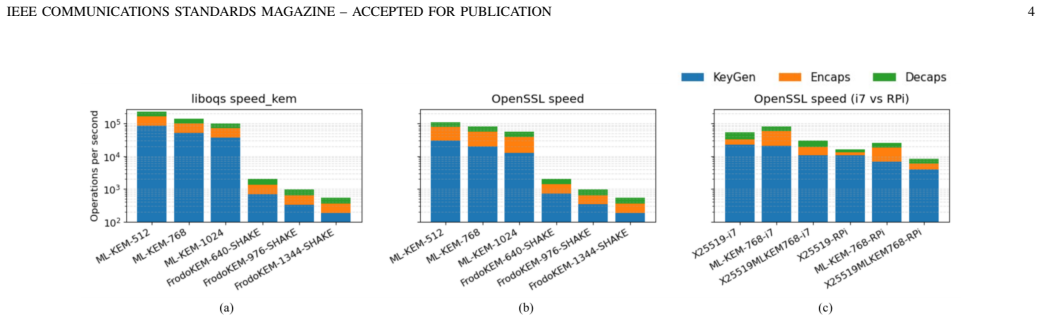
6G networks will require quantum-secure cryptography deployed across core infrastructure, edge nodes, resource-constrained IoT devices. Although post-quantum cryptographic (PQC) algorithms have been standardized by NIST, their practical deployability in bandwidth and latency limited wireless systems remains unclear. This paper presents a practical evaluation of NIST selected PQC schemes, including ML-KEM (Kyber), ML-DSA (Dilithium), and Falcon. Benchmarks conducted with OpenSSL and the OQS provider on heterogeneous platforms show that while computational performance is acceptable, ciphertext and signature size expansion significantly impact handshake reliability and bandwidth efficiency, particularly at the network edge. The results highlight key system-level trade-offs and motivate the need for PQC optimization and deployment-aware design for future quantum-secure 6G networks.
Editorial analysis
A structured set of objections, weighed in public.
Referee Report
Summary. The manuscript presents an experimental evaluation of NIST-standardized post-quantum cryptographic schemes (ML-KEM/Kyber, ML-DSA/Dilithium, and Falcon) for 6G networks. Benchmarks performed with OpenSSL and the OQS provider on heterogeneous platforms indicate acceptable computational performance, but the authors conclude that the resulting increases in ciphertext and signature sizes significantly degrade handshake reliability and bandwidth efficiency, especially at the network edge, and call for PQC optimization and deployment-aware design.
Significance. If the size-based inferences are validated, the work is significant for highlighting concrete system-level trade-offs in deploying quantum-safe cryptography in bandwidth- and latency-constrained 6G environments. It supplies practical benchmark data on standard tools that can guide early design decisions for core, edge, and IoT components, complementing purely theoretical analyses of PQC.
major comments (1)
- [Abstract] Abstract: the claim that ciphertext and signature size expansion 'significantly impact handshake reliability and bandwidth efficiency, particularly at the network edge' is not supported by direct evidence. The described evaluation consists of size and CPU-cycle measurements on heterogeneous platforms; no end-to-end handshake experiments under wireless conditions (MTU limits, packet loss, variable latency, or 6G PHY/MAC models) are reported, so the reliability impact is inferred rather than observed.
minor comments (2)
- [Abstract] Abstract and methodology description: no raw data, error bars, or platform-specific quantitative results (e.g., exact byte expansions or cycle counts) are provided, which reduces verifiability of the performance claims.
- The manuscript would benefit from a summary table comparing key/signature sizes and handshake overheads across the evaluated schemes to make the trade-off analysis more transparent.
Simulated Author's Rebuttal
We thank the referee for the detailed review and constructive feedback on our manuscript. We address the major comment below, clarifying the scope of our experimental results and inferences while proposing targeted revisions to improve precision.
read point-by-point responses
-
Referee: [Abstract] Abstract: the claim that ciphertext and signature size expansion 'significantly impact handshake reliability and bandwidth efficiency, particularly at the network edge' is not supported by direct evidence. The described evaluation consists of size and CPU-cycle measurements on heterogeneous platforms; no end-to-end handshake experiments under wireless conditions (MTU limits, packet loss, variable latency, or 6G PHY/MAC models) are reported, so the reliability impact is inferred rather than observed.
Authors: We agree that the system-level claims regarding handshake reliability and bandwidth efficiency are inferences drawn from our direct measurements of ciphertext/signature sizes and CPU cycles using OpenSSL and the OQS provider, rather than from end-to-end wireless handshake experiments incorporating MTU constraints, packet loss, or 6G PHY/MAC models. The manuscript's focus was on benchmarking the standardized PQC primitives (ML-KEM, ML-DSA, Falcon) across heterogeneous platforms to quantify the concrete size overheads (e.g., ML-KEM-768 ciphertexts of ~1 KB versus 32 bytes for classical ECDH) and their computational costs. These size increases can be expected to affect reliability in edge scenarios due to well-established networking effects such as IP fragmentation when exceeding typical wireless MTUs and increased transmission times. However, we did not perform the full wireless channel simulations the referee correctly notes are absent. To address this, we will revise the abstract to replace 'significantly impact' with 'are expected to impact' or equivalent phrasing that distinguishes measured results from inferred implications. We will also expand the discussion section to explicitly state the inferential basis, reference standard MTU and fragmentation models, and outline future work on end-to-end evaluations under realistic 6G conditions. revision: yes
Circularity Check
Empirical benchmark study with no derivations or self-referential modeling
full rationale
This is an experimental evaluation paper that reports direct benchmarks of PQC algorithms (ML-KEM, ML-DSA, Falcon) using OpenSSL and OQS on heterogeneous platforms. No equations, fitted parameters, predictions derived from models, or derivation chains appear in the provided text or abstract. Claims about performance and size impacts rest on measured data rather than any self-definitional, fitted-input, or self-citation reduction. The work is self-contained as an empirical study with no load-bearing circular steps.
Axiom & Free-Parameter Ledger
Reference graph
Works this paper leans on
-
[1]
A Vision of 6G Wireless Systems: Applications, Trends, Technologies, and Open Research Problems,
W. Saad, M. Bennis, and M. Chen, “A Vision of 6G Wireless Systems: Applications, Trends, Technologies, and Open Research Problems,” IEEE Network, vol. 34, no. 3, pp. 134–142, May/Jun. 2020
2020
-
[2]
Automatically Secure: How We Upgraded 6,000,000 Domains by Default to Get Ready for the Quantum Future,
A. Krivit, S. Ahmad, and Y . Jamal, “Automatically Secure: How We Upgraded 6,000,000 Domains by Default to Get Ready for the Quantum Future,” Cloudflare Blog, Sep. 2025, accessed: Dec. 24, 2025. [Online]. Available: https://blog.cloudflare.com/automatically-secure/
2025
-
[3]
Announcing Quantum-Safe Key Encapsulation Mechanisms in Cloud KMS,
I. Tzialla and S. Schmieg, “Announcing Quantum-Safe Key Encapsulation Mechanisms in Cloud KMS,” Google Cloud Blog, Oct. 2025, accessed: Dec. 24, 2025. [Online]. Available: https://cloud.google.com/blog/products/identity-security/ announcing-quantum-safe-key-encapsulation-mechanisms-in-cloud-kms/
2025
-
[4]
ML-KEM Post-Quantum TLS Now Supported in AWS KMS, ACM, and Secrets Manager,
A. Weibel, “ML-KEM Post-Quantum TLS Now Supported in AWS KMS, ACM, and Secrets Manager,” AWS Security Blog
-
[5]
QCS-6G: A Standards-Aligned Quantum- Resilient Cryptographic Stack for Next-Generation Wireless Networks,
A. Sharma and S. Rani, “QCS-6G: A Standards-Aligned Quantum- Resilient Cryptographic Stack for Next-Generation Wireless Networks,” IEEE Communications Standards Magazine, 2025
2025
-
[6]
An Applied Analysis of Securing 5G/6G Core Networks with Post-Quantum Key Encapsulation Methods,
P. Scaliseet al., “An Applied Analysis of Securing 5G/6G Core Networks with Post-Quantum Key Encapsulation Methods,”Electronics, vol. 13, no. 21, p. 4258, 2024
2024
-
[7]
Open6GCore Demonstration: A Next Generation R&D Core Network,
H. Buhret al., “Open6GCore Demonstration: A Next Generation R&D Core Network,” inProc. IEEE INFOCOM Workshops, London, United Kingdom, 2025, pp. 1–2
2025
-
[8]
Module-Lattice-Based Key-Encapsulation Mechanism Performance Measurements,
N. Nagyet al., “Module-Lattice-Based Key-Encapsulation Mechanism Performance Measurements,”Sci, vol. 7, no. 3, p. 91, 2025
2025
-
[9]
Integrating and Benchmarking KpqC in TLS/X.509,
M. Simet al., “Integrating and Benchmarking KpqC in TLS/X.509,” Electronics, vol. 14, no. 18, p. 3717, 2025
2025
-
[10]
Open Quantum Safe,
Open Quantum Safe Project, “Open Quantum Safe,” accessed: Mar
-
[11]
Available: https://openquantumsafe.org
[Online]. Available: https://openquantumsafe.org
-
[12]
Semi-Compressed CRYSTALS-Kyber,
S. Liu and A. Sakzad, “Semi-Compressed CRYSTALS-Kyber,” inProc. Provable and Practical Security (ProvSec), Singapore, 2025, pp. 65–82
2025
-
[13]
Telecom’s Quantum-Safe Imperative: Challenges in Adopting Post-Quantum Cryptography,
M. Marin, “Telecom’s Quantum-Safe Imperative: Challenges in Adopting Post-Quantum Cryptography,” Post-Quantum.com, Feb. 2024, accessed: Dec. 27, 2025. [Online]. Available: https://postquantum.com/ post-quantum/telecom-pqc-challenges/
2024
-
[14]
Module-Lattice- Based Key-Encapsulation Mechanism Standard,
National Institute of Standards and Technology, “Module-Lattice- Based Key-Encapsulation Mechanism Standard,” National Institute of Standards and Technology, FIPS 203, Aug. 2024. [Online]. Available: https://csrc.nist.gov/pubs/fips/203/final
2024
-
[15]
CRYSTALS-Kyber with Lattice Quantizer,
S. Liu and A. Sakzad, “CRYSTALS-Kyber with Lattice Quantizer,” in Proc. IEEE Int. Symp. Inf. Theory (ISIT), Athens, Greece, 2024, pp. 2886–2891
2024
-
[16]
ML-KEM is Great! What’s Missing?
J. P. Mattssonet al., “ML-KEM is Great! What’s Missing?” Ericsson Research, White Paper, 2024, [Online]. Ananya Kudalooris a Research Engineer with the Bristol Research and Innovation Laboratory of Toshiba. Her work focuses on analysis, optimization, and implementation of PQC techniques. Adnan Aijazcurrently holds the positions of Chief Research Fellow an...
2024
discussion (0)
Sign in with ORCID, Apple, or X to comment. Anyone can read and Pith papers without signing in.