Recognition: no theorem link
Leveraging fNIRS to Evaluate Workload for Adaptive Training in Virtual Reality
Pith reviewed 2026-05-11 01:04 UTC · model grok-4.3
The pith
fNIRS brain imaging distinguishes intrinsic cognitive workload from extraneous demands in virtual reality training tasks.
A machine-rendered reading of the paper's core claim, the machinery that carries it, and where it could break.
Core claim
Thirty-six participants completed a VR shape assembly training task while wearing near-full head coverage fNIRS and providing NASA TLX workload ratings. Significant activation appeared in cortical regions associated with working memory, short term memory buffers, multisensory integration, and attention under conditions varying intrinsic load. These fNIRS signals aligned with the subjective mental workload scores. Conditions varying extraneous load instead produced activation limited to the right angular gyrus, a region considered irrelevant to task mastery.
What carries the argument
Functional near-infrared spectroscopy monitoring of prefrontal cortex and angular gyrus activity, compared against NASA TLX subjective ratings, inside a VR task engineered to separately manipulate intrinsic and extraneous cognitive load.
If this is right
- Real-time fNIRS data can support adaptive VR training systems that automatically raise or lower task difficulty to maintain optimal workload.
- Subjective NASA TLX ratings of mental workload align closely with fNIRS measures when intrinsic load is manipulated.
- Extraneous load produces limited and localized brain activity that is distinct from the patterns tied to intrinsic load.
- Workload profiles captured during practice can inform later skill retention testing.
- The method offers a neuro-ergonomic evaluation tool for designing future VR training and education environments.
Where Pith is reading between the lines
- The same fNIRS approach could be tested in other VR domains such as medical procedure training or industrial assembly to check whether the intrinsic-extraneous distinction remains consistent.
- Pairing fNIRS with performance metrics or eye-tracking might help confirm that activations truly index cognitive load rather than motor demands.
- If the limited right angular gyrus response to extraneous load generalizes, interface designers could use it as a quick check for whether added instructions or visuals are creating unnecessary burden.
Load-bearing premise
The VR shape assembly task cleanly isolated the cognitive demands required to learn the skill from demands introduced by the interface or instructions, and the recorded brain activations specifically reflect those two load types rather than movement, visual processing, or other factors.
What would settle it
No measurable difference in fNIRS activation between high and low intrinsic load conditions, or comparable widespread activation appearing in the extraneous load condition, would show that the distinction does not hold as described.
Figures


read the original abstract
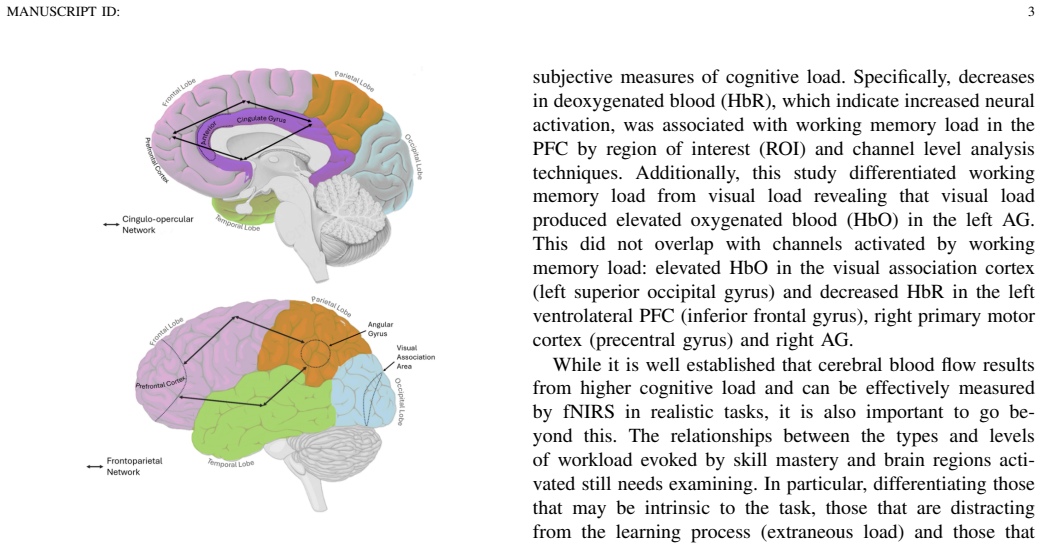
Advance in technology offer the potential for future adoption of a combination of virtual reality (VR) and real-time adaptivity to enhance training and education. Providing a valid neuro-ergonomic measure of cognitive load can enable an adaptive training regime to continuously adjust tas difficulty to an optimal level as training progresses. The current study validated the functional near-infrared spectroscopy (fNIRS) measure of cognitive load to reflect the demands of two different forms of lad within Cognitive Load Theory: extraneous and intrinsic to he task to be mastered. Thirty-six participants completed a VR shape assembly training task followed by a test of their skill retention They wore near-full head coverage fNIRS and provided subjective ratings of ther workload. The fNIRS findings largely corroborate intrinsic workload literature with significant activation in cortical regions (dorsolateral and rostral prefrontal cortex and left angular gyrus) associated with working memory, short term memory buffers, multisensory integration, and attention. These fNIRS results were tracked closely by NASA TLS measures of mental workload. The results also revealed far less brain activity associated with extraneous load, namely just the right angular gyrus, deemed irrelevant to the mastery of the task.
Editorial analysis
A structured set of objections, weighed in public.
Referee Report
Summary. The paper reports an empirical validation study with 36 participants performing a VR shape-assembly training task while wearing full-head fNIRS and completing NASA TLX ratings. It claims that fNIRS shows significant activation in dorsolateral and rostral prefrontal cortex plus left angular gyrus under intrinsic load conditions (linked to working memory, attention, and multisensory integration), minimal activation (only right angular gyrus) under extraneous load, and close tracking by NASA TLX mental workload scores, supporting fNIRS for distinguishing Cognitive Load Theory load types to enable adaptive VR training.
Significance. If the VR task manipulations successfully isolated intrinsic versus extraneous load without motor, visual, or hemodynamic confounds, the work would provide useful neuroergonomic evidence for real-time fNIRS-based workload monitoring in VR training systems. The sample size is adequate and the reported regional activations align with existing literature on working memory and attention; however, the absence of detailed statistics and the risk of entangled physical demands limit the strength of the contribution to adaptive training applications.
major comments (2)
- [Abstract] The abstract and task description report directional fNIRS activations and NASA TLX correlations but supply no p-values, effect sizes, error bars, or explicit statistical controls for confounds; this prevents verification of the central claim that fNIRS distinguishes intrinsic from extraneous load.
- [Methods (VR Task)] The VR shape-assembly task design does not appear to hold motor execution, controller movements, gaze patterns, or visual complexity constant when varying intrinsic load (e.g., shape complexity) versus extraneous load (e.g., added irrelevant elements); this risks confounding the reported activations in dorsolateral/rostral PFC and angular gyrus with physical demands or superficial hemodynamics rather than Cognitive Load Theory constructs.
minor comments (2)
- [Abstract] Abstract contains multiple typos: 'lad' for 'load', 'he' for 'the', 'ther' for 'their', and 'TLS' for 'TLX'.
- [Results] The claim that right angular gyrus activation is 'deemed irrelevant to the mastery of the task' requires explicit justification or reference to prior literature on its functional role.
Simulated Author's Rebuttal
We thank the referee for the constructive and detailed feedback on our manuscript. We address each major comment below and outline the revisions we will make to strengthen the presentation of our findings and address methodological concerns.
read point-by-point responses
-
Referee: [Abstract] The abstract and task description report directional fNIRS activations and NASA TLX correlations but supply no p-values, effect sizes, error bars, or explicit statistical controls for confounds; this prevents verification of the central claim that fNIRS distinguishes intrinsic from extraneous load.
Authors: We agree that the abstract would benefit from including key statistical details to make the central claims more verifiable on first reading. The full Results section of the manuscript reports the relevant p-values, effect sizes (e.g., partial eta-squared), and statistical controls (including checks for motion artifacts and baseline corrections). In the revised version, we will update the abstract to incorporate representative p-values, effect sizes, and a concise statement on confound controls while preserving the word limit. revision: yes
-
Referee: [Methods (VR Task)] The VR shape-assembly task design does not appear to hold motor execution, controller movements, gaze patterns, or visual complexity constant when varying intrinsic load (e.g., shape complexity) versus extraneous load (e.g., added irrelevant elements); this risks confounding the reported activations in dorsolateral/rostral PFC and angular gyrus with physical demands or superficial hemodynamics rather than Cognitive Load Theory constructs.
Authors: We acknowledge this as a substantive methodological concern. Our task design attempted to equate motor demands by using the same number of assembly steps and controller interactions across conditions, with intrinsic load manipulated solely through shape complexity (number of unique features to integrate) and extraneous load added via non-interactive visual overlays that did not alter movement requirements. Gaze patterns were monitored via the VR headset but not explicitly equated. We will revise the Methods section to provide a more detailed account of these controls, including quantitative descriptions of movement counts and visual element counts, and we will add an explicit limitations paragraph discussing residual risks of physical and hemodynamic confounds in naturalistic VR settings. revision: partial
Circularity Check
No circularity: purely empirical validation with independent measurements
full rationale
The paper reports an empirical fNIRS study of cognitive load in a VR shape-assembly task, with activations compared to NASA TLX ratings. No equations, fitted parameters, predictions, or derivation chain exist. No self-citations are invoked as load-bearing uniqueness theorems or ansatzes. All central claims rest on direct, falsifiable observations of regional hemodynamics and subjective scales, which are independent of each other and of any prior definitions within the paper.
Axiom & Free-Parameter Ledger
axioms (2)
- domain assumption fNIRS hemodynamic signals reliably index cognitive workload as defined by Cognitive Load Theory
- domain assumption The VR task manipulations cleanly separate intrinsic from extraneous load
Reference graph
Works this paper leans on
-
[1]
The extended classroom: Meeting students’ needs using a virtual environment,
A. Loureiro and T. Bettencourt, “The extended classroom: Meeting students’ needs using a virtual environment,”Procedia Soc. Behav. Sci., vol. 15, pp. 2667–2672, 2011
2011
-
[2]
Systematic review of augmented reality training systems,
I. I. M. Butaslac, III, Y . Fujimoto, T. Sawabe, M. Kanbara, and H. Kato, “Systematic review of augmented reality training systems,”IEEE Trans. Vis. Comput. Graph., vol. 29, no. 12, pp. 5062–5082, Dec. 2023
2023
-
[3]
A review on virtual reality skill training applications,
B. Xie, H. Liu, R. Alghofaili, Y . Zhang, Y . Jiang, F. D. Loboet al., “A review on virtual reality skill training applications,”Front. Virtual Real., vol. 2, p. 645153, 2021
2021
-
[4]
The impact of avatar and environment congruence on plausibility, embodiment, presence, and the Proteus effect in virtual reality,
D. Mal, E. Wolf, N. Döllinger, C. Wienrich, and M. E. Latoschik, “The impact of avatar and environment congruence on plausibility, embodiment, presence, and the Proteus effect in virtual reality,”IEEE Trans. Vis. Comput. Graph., vol. 29, no. 5, pp. 2358–2368, May 2023
2023
-
[5]
Examining virtual reality as an alternative to in-person and online learning environments,
P. Shinde, A. Murillo, and Z. M. Wood, “Examining virtual reality as an alternative to in-person and online learning environments,” inProc. Future Technol. Conf. (FTC) 2023, K. Arai, Ed., vol. 813. Cham, Switzerland: Springer, 2023
2023
-
[6]
The effects of virtual reality, augmented reality, and mixed reality as training enhancement methods: A meta-analysis,
A. D. Kaplan, J. Cruit, M. Endsley, S. M. Beers, B. D. Sawyer, and P. A. Hancock, “The effects of virtual reality, augmented reality, and mixed reality as training enhancement methods: A meta-analysis,”Hum. Factors, vol. 63, no. 4, pp. 706–726, Jun. 2021
2021
-
[7]
Cognitive load during problem solving: Effects on learning,
J. Sweller, “Cognitive load during problem solving: Effects on learning,” Cogn. Sci., vol. 12, no. 2, pp. 257–285, 1988
1988
-
[8]
Cognitive load theory,
——, “Cognitive load theory,”Psychol. Learn. Motiv., vol. 55, pp. 37– 76, 2011
2011
-
[9]
Cognitive load theory: New conceptualizations, specifications, and integrated research perspectives,
F. Paas, T. Van Gog, and J. Sweller, “Cognitive load theory: New conceptualizations, specifications, and integrated research perspectives,” Educ. Psychol. Rev., vol. 22, no. 2, pp. 115–121, 2010
2010
-
[10]
Should self-regulated learning be integrated with cognitive load theory? A commentary,
J. Sweller and F. Paas, “Should self-regulated learning be integrated with cognitive load theory? A commentary,”Learn. Instr ., vol. 51, pp. 85–89, 2017
2017
-
[11]
Effectiveness of part-task training and increasing-difficulty training strategies,
C. D. Wickens, S. Hutchins, T. Carolan, and J. Cumming, “Effectiveness of part-task training and increasing-difficulty training strategies,”Hum. Factors, 2012
2012
-
[12]
Test-enhanced learning: Taking memory tests improves long-term retention,
H. L. Roediger, III and J. D. Karpicke, “Test-enhanced learning: Taking memory tests improves long-term retention,”Psychol. Sci., vol. 17, no. 3, pp. 249–255, Mar. 2006
2006
-
[13]
Development of NASA-TLX (Task Load Index): Results of empirical and theoretical research,
S. G. Hart and L. E. Staveland, “Development of NASA-TLX (Task Load Index): Results of empirical and theoretical research,”Adv. Psy- chol., vol. 52, pp. 139–183, 1988
1988
-
[14]
The Subjective Workload Assessment Technique: A scaling procedure for measuring mental workload,
G. B. Reid and T. E. Nygren, “The Subjective Workload Assessment Technique: A scaling procedure for measuring mental workload,”Adv. Psychol., vol. 52, pp. 185–218, 1988
1988
-
[15]
C. S. Jordan and S. D. Brennen,Instantaneous Self-Assessment of Workload Technique (ISA). Portsmouth, U.K.: Defence Research Agency, 1992
1992
-
[16]
Neuroergonomics,
H. Ayaz and F. Dehais, “Neuroergonomics,” inHandbook of Human Factors and Ergonomics, 2021, pp. 816–841
2021
-
[17]
Toward workload-based adaptive automation: The utility of fNIRS for measuring load in multiple resources in the brain,
L. M. Hirshfield, C. Wickens, E. Doherty, C. Spencer, T. Williams, and L. Hayne, “Toward workload-based adaptive automation: The utility of fNIRS for measuring load in multiple resources in the brain,”Int. J. Hum. Comput. Interact., vol. 40, no. 22, pp. 7404–7430, 2024
2024
-
[18]
Review of adaptive training system techniques,
C. R. Landsberg, R. S. Astwood, Jr., W. L. Van Buskirk, L. N. Townsend, N. B. Steinhauser, and A. D. Mercado, “Review of adaptive training system techniques,”Mil. Psychol., vol. 24, no. 2, pp. 96–113, 2012
2012
-
[19]
Cognitive load theory, learning difficulty, and instructional design,
J. Sweller, “Cognitive load theory, learning difficulty, and instructional design,”Learn. Instr ., vol. 4, no. 4, pp. 295–312, 1994
1994
-
[20]
Desirable difficulties in theory and practice,
R. A. Bjork and E. L. Bjork, “Desirable difficulties in theory and practice,”J. Appl. Res. Mem. Cogn., vol. 9, no. 4, pp. 475–479, 2020
2020
-
[21]
Does one-size training fit all? Evaluating adaptive learning for VR assembly training,
A. Verstraete, E. Geurts, and M. Wijnants, “Does one-size training fit all? Evaluating adaptive learning for VR assembly training,”Proc. ACM Hum. Comput. Interact., vol. 9, no. 4, pp. 1–26, 2025
2025
-
[22]
Towards user-aware VR learning environments: Combining brain-computer interfaces with vir- tual reality for mental state decoding,
K. Lingelbach, D. Diers, and M. Vukeli ´c, “Towards user-aware VR learning environments: Combining brain-computer interfaces with vir- tual reality for mental state decoding,” inExt. Abstr . CHI Conf. Hum. Factors Comput. Syst., 2023, pp. 1–8, article 292
2023
-
[23]
The effects of VR and TP visual cues on motor imagery subjects and performance,
J. Yang, S. Zhu, P. Ding, F. Wang, A. Gong, and Y . Fu, “The effects of VR and TP visual cues on motor imagery subjects and performance,” Electronics (Basel), vol. 12, no. 11, p. 2381, 2023
2023
-
[24]
Performance monitoring via functional near infrared spec- troscopy for virtual reality based basic life support training,
E. Aksoy, K. Izzetoglu, E. Baysoy, A. Agrali, D. Kitapcioglu, and B. Onaral, “Performance monitoring via functional near infrared spec- troscopy for virtual reality based basic life support training,”Front. Neurosci., vol. 13, p. 1336, Dec. 2019
2019
-
[25]
Toward a new cognitive neuroscience: Modeling natural brain dynamics,
K. Gramann, T.-P. Jung, D. P. Ferris, C.-T. Lin, and S. Makeig, “Toward a new cognitive neuroscience: Modeling natural brain dynamics,”Front. Hum. Neurosci., vol. 8, p. 444, Jun. 2014
2014
-
[26]
Hybrid fNIRS-EEG based classification of auditory and visual perception processes,
F. Putze, S. Hesslinger, C.-Y . Tse, Y . Huang, C. Herff, C. Guan et al., “Hybrid fNIRS-EEG based classification of auditory and visual perception processes,”Front. Neurosci., vol. 8, p. 373, Nov. 2014
2014
-
[27]
A systematic review of physiological measurements, factors, methods, and applications in virtual reality,
A. Halbig and M. E. Latoschik, “A systematic review of physiological measurements, factors, methods, and applications in virtual reality,” Front. Virtual Real., vol. 2, p. 694567, 2021
2021
-
[28]
Assessing cognitive load in virtual reality: A comparative analysis of objective and subjective measures,
L. Lacroix, O. Augereau, and N. Le Bigot, “Assessing cognitive load in virtual reality: A comparative analysis of objective and subjective measures,” HAL Archives, Preprint, 2024. [Online]. Available: https://hal.science/hal-04489219
2024
-
[29]
Applying functional near- infrared spectroscopy (fNIRS) in educational research: A systematic review,
Z. Zhan, Q. Yang, L. Luo, and X. Zhang, “Applying functional near- infrared spectroscopy (fNIRS) in educational research: A systematic review,”Curr . Psychol., vol. 43, no. 11, pp. 9676–9691, 2024
2024
-
[30]
Optical brain monitoring for operator training and mental workload assessment,
H. Ayaz, P. A. Shewokis, S. Bunce, K. Izzetoglu, B. Willems, and B. Onaral, “Optical brain monitoring for operator training and mental workload assessment,”Neuroimage, vol. 59, no. 1, pp. 36–47, Jan. 2012
2012
-
[31]
Demonstrating brain-level interactions between visuospatial attentional demands and working memory load while driving using functional near- infrared spectroscopy,
J. Scheunemann, A. Unni, K. Ihme, M. Jipp, and J. W. Rieger, “Demonstrating brain-level interactions between visuospatial attentional demands and working memory load while driving using functional near- infrared spectroscopy,”Front. Hum. Neurosci., vol. 12, p. 542, Jan. 2019
2019
-
[32]
Assessing the driver’s current level of working memory load with high density functional near- infrared spectroscopy: A realistic driving simulator study,
A. Unni, K. Ihme, M. Jipp, and J. W. Rieger, “Assessing the driver’s current level of working memory load with high density functional near- infrared spectroscopy: A realistic driving simulator study,”Front. Hum. Neurosci., vol. 11, p. 167, Apr. 2017
2017
-
[33]
The angular gyrus: Multiple functions and multiple subdivisions,
M. L. Seghier, “The angular gyrus: Multiple functions and multiple subdivisions,”Neuroscientist, vol. 19, no. 1, pp. 43–61, Feb. 2013
2013
-
[34]
Frontoparietal and cingulo-opercular networks play dissociable roles in control of working memory,
G. Wallis, M. Stokes, H. Cousijn, M. Woolrich, and A. C. Nobre, “Frontoparietal and cingulo-opercular networks play dissociable roles in control of working memory,”J. Cogn. Neurosci., vol. 27, no. 10, pp. 2019–2034, Oct. 2015
2019
-
[35]
Cingulo-opercular and frontoparietal control network connectivity and executive functioning in older adults,
H. K. Hausman, C. Hardcastle, A. Albizu, J. N. Kraft, N. D. Evan- gelista, E. M. Boutzoukaset al., “Cingulo-opercular and frontoparietal control network connectivity and executive functioning in older adults,” Geroscience, vol. 44, no. 2, pp. 847–866, Apr. 2022
2022
-
[36]
The multifaceted interplay between attention and multisensory integration,
D. Talsma, D. Senkowski, S. Soto-Faraco, and M. G. Woldorff, “The multifaceted interplay between attention and multisensory integration,” Trends Cogn. Sci., vol. 14, no. 9, pp. 400–410, Sep. 2010
2010
-
[37]
Cingulo-opercular subnetworks motivate frontoparietal subnetworks during distinct cognitive control demands,
J. L. Wood and D. E. Nee, “Cingulo-opercular subnetworks motivate frontoparietal subnetworks during distinct cognitive control demands,” J. Neurosci., vol. 43, no. 7, pp. 1225–1237, Feb. 2023
2023
-
[38]
The role of PFC networks in cognitive control and executive function,
V . Menon and M. D’Esposito, “The role of PFC networks in cognitive control and executive function,”Neuropsychopharmacology, vol. 47, no. 1, pp. 90–103, Jan. 2022
2022
-
[39]
An information theoretical approach to prefrontal executive function,
E. Koechlin and C. Summerfield, “An information theoretical approach to prefrontal executive function,”Trends Cogn. Sci., vol. 11, no. 6, pp. 229–235, Jun. 2007
2007
-
[40]
A uni- fying account of angular gyrus contributions to episodic and semantic cognition,
G. F. Humphreys, M. A. Lambon Ralph, and J. S. Simons, “A uni- fying account of angular gyrus contributions to episodic and semantic cognition,”Trends Neurosci., vol. 44, no. 6, pp. 452–463, Jun. 2021
2021
-
[41]
Multiple functions of the angular gyrus at high temporal resolution,
M. L. Seghier, “Multiple functions of the angular gyrus at high temporal resolution,”Brain Struct. Funct., vol. 228, no. 1, pp. 7–46, Jan. 2023. MANUSCRIPT ID: 10
2023
-
[42]
Angular default mode network connectivity across working memory load,
D. Vatansever, A. E. Manktelow, B. J. Sahakian, D. K. Menon, and E. A. Stamatakis, “Angular default mode network connectivity across working memory load,”Hum. Brain Mapp., vol. 38, no. 1, pp. 41–52, Jan. 2017
2017
-
[43]
The role of the angular gyrus in arithmetic processing: A literature review,
H. M. Sokolowski, A. A. Matejko, and D. Ansari, “The role of the angular gyrus in arithmetic processing: A literature review,”Brain Struct. Funct., vol. 228, no. 1, pp. 293–304, Jan. 2023
2023
-
[44]
Multimodal feature integration in the angular gyrus during episodic and semantic retrieval,
H. M. Bonnici, F. R. Richter, Y . Yazar, and J. S. Simons, “Multimodal feature integration in the angular gyrus during episodic and semantic retrieval,”J. Neurosci., vol. 36, no. 20, pp. 5462–5471, May 2016
2016
-
[45]
Dynamic difficulty using brain metrics of workload,
D. Afergan, E. M. Peck, E. T. Solovey, A. Jenkins, S. W. Hincks, E. T. Brownet al., “Dynamic difficulty using brain metrics of workload,” in Proc. SIGCHI Conf. Human Factors Comput. Syst., 2014, pp. 3797– 3806
2014
-
[46]
A probabilistic atlas and reference system for the human brain: International Consortium for Brain Mapping (ICBM),
J. Mazziotta, A. Toga, A. Evans, P. Fox, J. Lancaster, K. Zilles et al., “A probabilistic atlas and reference system for the human brain: International Consortium for Brain Mapping (ICBM),”Philos. Trans. R. Soc. Lond. B Biol. Sci., vol. 356, no. 1412, pp. 1293–1322, Aug. 2001
2001
-
[47]
NIRS-SPM: Statis- tical parametric mapping for near-infrared spectroscopy,
J. C. Ye, S. Tak, K. E. Jang, J. Jung, and J. Jang, “NIRS-SPM: Statis- tical parametric mapping for near-infrared spectroscopy,”Neuroimage, vol. 44, no. 2, pp. 428–447, Jan. 2009
2009
-
[48]
What do subjective workload scales really measure? Operational and representational solu- tions to divergence of workload measures,
G. Matthews, J. De Winter, and P. A. Hancock, “What do subjective workload scales really measure? Operational and representational solu- tions to divergence of workload measures,”Theor . Issues Ergon. Sci., vol. 21, no. 4, pp. 369–396, 2020
2020
-
[49]
Estimation of optical pathlength through tissue from direct time of flight measurement,
D. T. Delpy, M. Cope, P. van der Zee, S. Arridge, S. Wray, and J. Wyatt, “Estimation of optical pathlength through tissue from direct time of flight measurement,”Phys. Med. Biol., vol. 33, no. 12, pp. 1433–1442, Dec. 1988
1988
-
[50]
Autoregressive model based algorithm for correcting motion and serially correlated errors in fNIRS,
J. W. Barker, A. Aarabi, and T. J. Huppert, “Autoregressive model based algorithm for correcting motion and serially correlated errors in fNIRS,” Biomed. Opt. Express, vol. 4, no. 8, pp. 1366–1379, Jul. 2013
2013
-
[51]
K. J. Friston, J. T. Ashburner, S. J. Kiebel, T. E. Nichols, and W. D. Penny, Eds.,Statistical Parametric Mapping: The Analysis of Functional Brain Images. Academic Press, 2007
2007
-
[52]
Comparison of oxyhemoglobin and deoxyhemoglobin signal reliability with and without global mean removal for digit manipulation motor tasks,
S. Dravida, J. A. Noah, X. Zhang, and J. Hirsch, “Comparison of oxyhemoglobin and deoxyhemoglobin signal reliability with and without global mean removal for digit manipulation motor tasks,”Neurophoton- ics, vol. 5, no. 1, p. 011006, Jan. 2018
2018
-
[53]
End-tidal CO2: An important parameter for a correct interpretation in functional brain studies using speech tasks,
F. Scholkmann, U. Gerber, M. Wolf, and U. Wolf, “End-tidal CO2: An important parameter for a correct interpretation in functional brain studies using speech tasks,”Neuroimage, vol. 66, pp. 71–79, Feb. 2013
2013
-
[54]
The effect of inner speech on arterial CO2 and cerebral hemodynamics and oxygenation: A functional NIRS study,
F. Scholkmann, M. Wolf, and U. Wolf, “The effect of inner speech on arterial CO2 and cerebral hemodynamics and oxygenation: A functional NIRS study,” inAdvances in Experimental Medicine and Biology. New York, NY , USA: Springer, 2013, vol. 789, pp. 81–87
2013
-
[55]
The role of the lateral frontal cortex in mnemonic processing: The contribution of functional neuroimaging,
A. M. Owen, “The role of the lateral frontal cortex in mnemonic processing: The contribution of functional neuroimaging,”Exp. Brain Res., vol. 133, no. 1, pp. 33–43, Jul. 2000
2000
-
[56]
The role of the mid-dorsolateral prefrontal cortex in working memory,
M. Petrides, “The role of the mid-dorsolateral prefrontal cortex in working memory,”Exp. Brain Res., vol. 133, no. 1, pp. 44–54, Jul. 2000
2000
-
[57]
The role of dorsolateral prefrontal cortex in the selection of action as revealed by functional imaging,
C. D. Frith, “The role of dorsolateral prefrontal cortex in the selection of action as revealed by functional imaging,”Control of Cognitive Processes, vol. 18, pp. 544–565, 2000
2000
-
[58]
Willed action and the prefrontal cortex in man: A study with PET,
C. D. Frith, K. Friston, P. F. Liddle, and R. S. Frackowiak, “Willed action and the prefrontal cortex in man: A study with PET,”Proc. Biol. Sci., vol. 244, no. 1311, pp. 241–246, Jun. 1991
1991
-
[59]
The gateway hypothesis of rostral prefrontal cortex (area 10) function,
P. W. Burgess, I. Dumontheil, and S. J. Gilbert, “The gateway hypothesis of rostral prefrontal cortex (area 10) function,”Trends Cogn. Sci., vol. 11, no. 7, pp. 290–298, Jul. 2007
2007
-
[60]
Function and local- ization within rostral prefrontal cortex (area 10),
P. W. Burgess, S. J. Gilbert, and I. Dumontheil, “Function and local- ization within rostral prefrontal cortex (area 10),”Philos. Trans. R. Soc. Lond. B Biol. Sci., vol. 362, no. 1481, pp. 887–899, May 2007
2007
-
[61]
The cognitive and neuroanatomical correlates of multitasking,
P. W. Burgess, E. Veitch, A. de Lacy Costello, and T. Shallice, “The cognitive and neuroanatomical correlates of multitasking,”Neuropsy- chologia, vol. 38, no. 6, pp. 848–863, 2000
2000
-
[62]
Neuroanatomical dissociation between bottom-up and top-down processes of visuospatial selective attention,
B. Hahn, T. J. Ross, and E. A. Stein, “Neuroanatomical dissociation between bottom-up and top-down processes of visuospatial selective attention,”Neuroimage, vol. 32, no. 2, pp. 842–853, Aug. 2006
2006
-
[63]
Causal role of the angular gyrus in insight-driven memory reconfiguration,
A.-M. Grob, H. Heinbockel, B. Milivojevic, C. F. Doeller, and L. Schwabe, “Causal role of the angular gyrus in insight-driven memory reconfiguration,”eLife, vol. 12, p. RP91033, Feb. 2024
2024
-
[64]
Effects of a cognitive training on spatial learning and associated functional brain activations,
K. Hötting, K. Holzschneider, A. Stenzel, T. Wolbers, and B. Röder, “Effects of a cognitive training on spatial learning and associated functional brain activations,”BMC Neurosci., vol. 14, no. 1, p. 73, Jul. 2013
2013
-
[65]
Changes in brain activation during the acquisition of a new bimanual coordination task,
F. Debaere, N. Wenderoth, S. Sunaert, P. Van Hecke, and S. P. Swinnen, “Changes in brain activation during the acquisition of a new bimanual coordination task,”Neuropsychologia, vol. 42, no. 7, pp. 855–867, 2004
2004
-
[66]
The use of virtual reality alone does not promote training performance (but sense of presence does),
S. Grassini, K. Laumann, and M. Rasmussen Skogstad, “The use of virtual reality alone does not promote training performance (but sense of presence does),”Front. Psychol., vol. 11, p. 1743, Jul. 2020
2020
-
[67]
A novel mutual information-based approach for neurophysiological characterization of sense of presence in virtual reality,
V . Ronca, F. Babiloni, and P. Aricò, “A novel mutual information-based approach for neurophysiological characterization of sense of presence in virtual reality,”IEEE Trans. Biomed. Eng., vol. 72, no. 8, pp. 2313– 2320, Aug. 2025
2025
discussion (0)
Sign in with ORCID, Apple, or X to comment. Anyone can read and Pith papers without signing in.