Recognition: no theorem link
Topological superconductivity in a Hubbard model for twisted bilayer cuprates
Pith reviewed 2026-05-11 01:04 UTC · model grok-4.3
The pith
The Hubbard model for twisted bilayer cuprates develops topological superconductivity with Chern number eight only when electron-doped.
A machine-rendered reading of the paper's core claim, the machinery that carries it, and where it could break.
Core claim
Within the weak-interaction Hubbard model at U/t = 3.85 applied to a twisted bilayer cuprate, the superconducting state is topologically nontrivial with a Chern number of ±8 in the electron-doped regime while the Chern number is zero in the hole-doped regime. The nontrivial topology is confirmed by the presence of chiral edge states whose direction matches the sign of the Chern number in a ribbon geometry that retains full electron correlations.
What carries the argument
The Chern number of the Bogoliubov quasiparticle bands obtained from the mean-field solution of the Hubbard model on the moiré lattice, combined with direct computation of edge-state dispersion in a finite-width strip.
If this is right
- The topological phase is confined to the electron-doped side of the phase diagram.
- Chiral edge states appear with a specific handedness set by the Chern number sign.
- The result holds within the chosen interaction strength that permits reliable topology computation.
- Full correlations are kept in the edge-state analysis, strengthening the evidence beyond simple band topology.
Where Pith is reading between the lines
- Experiments on electron-doped twisted bilayer cuprates should look for quantized Hall conductance or protected edge currents at low temperature.
- Similar doping asymmetries might appear in other moiré superconductors if the underlying band structure is comparable.
- Testing the model at stronger coupling would check whether the high Chern number survives beyond the weak-interaction limit.
Load-bearing premise
The weak-interaction regime together with the specific ratio U/t = 3.85 still represents the essential physics of actual twisted bilayer cuprates.
What would settle it
A direct measurement of the Chern number via transport or the detection of chiral edge modes exclusively in electron-doped samples would confirm the claim; their absence would falsify it.
Figures

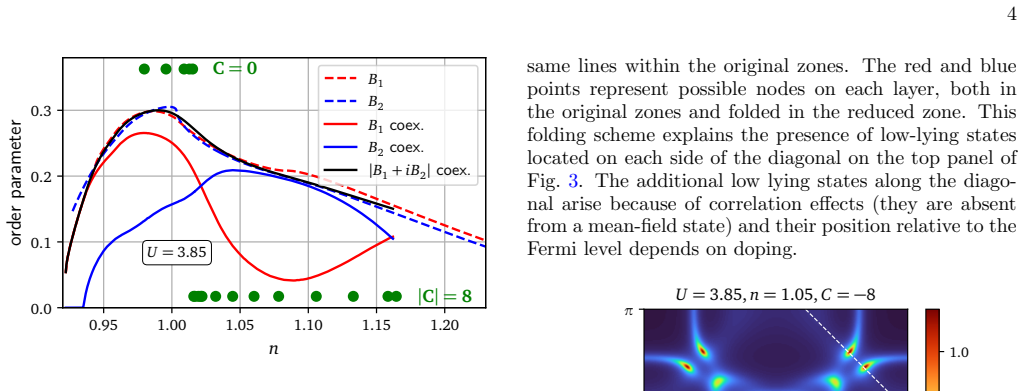


read the original abstract
We investigate the emergence of nontrivial topology in a twisted cuprate bilayer described by the Hubbard model in the weak-interaction regime. Our results show that the topological character depends sensitively on the doping level. For $U/t=3.85$, the Chern number assumes a value of $\pm 8$ in the electron-doped case, whereas it vanishes (0) in the hole-doped regime. The presence of nontrivial topology is further supported by an analysis the associated edge states and their chirality in a finite-width geometry, while keeping full correlations.
Editorial analysis
A structured set of objections, weighed in public.
Referee Report
Summary. The manuscript investigates the emergence of nontrivial topology in a twisted cuprate bilayer described by the Hubbard model in the weak-interaction regime. It reports that the topological character depends sensitively on the doping level: for U/t=3.85, the Chern number is ±8 in the electron-doped case and vanishes (0) in the hole-doped regime. The presence of nontrivial topology is supported by analysis of associated edge states and their chirality in a finite-width geometry while retaining full correlations.
Significance. If the reported Chern numbers are robust, the result would demonstrate doping-tunable topology in a Hubbard model relevant to high-Tc cuprates, bridging strong-correlation physics with topological invariants. This could have implications for understanding and engineering topological superconductivity in twisted bilayer systems. The retention of full correlations in the edge-state analysis is a methodological strength worth noting.
major comments (2)
- [Abstract] Abstract: The central numerical result states Chern number values of ±8 and 0 but supplies no information on the method used to extract the Chern number, the treatment of correlations, convergence checks, or possible finite-size effects. This makes it impossible to judge whether the stated values are supported by the calculation, particularly at U/t=3.85 which lies outside the deeply perturbative regime.
- [Results section on Chern number and edge states] The computation of the Chern number for the interacting many-body ground state at intermediate coupling U/t=3.85 likely involves an approximation (e.g., mean-field decoupling or projection onto an effective non-interacting band structure). The manuscript must explicitly describe this procedure, show consistency between the bulk invariant and the edge-state chirality, and quantify approximation errors, as these steps are load-bearing for the doping-dependent topology claim.
minor comments (1)
- [Abstract] The abstract would benefit from a brief clause indicating the numerical technique employed for the Chern number to aid immediate assessment by readers.
Simulated Author's Rebuttal
We thank the referee for the careful reading and constructive comments on our manuscript. We address each major comment below and indicate the planned revisions.
read point-by-point responses
-
Referee: [Abstract] Abstract: The central numerical result states Chern number values of ±8 and 0 but supplies no information on the method used to extract the Chern number, the treatment of correlations, convergence checks, or possible finite-size effects. This makes it impossible to judge whether the stated values are supported by the calculation, particularly at U/t=3.85 which lies outside the deeply perturbative regime.
Authors: We agree that the abstract should include more methodological information to allow readers to assess the results. In the revised manuscript we will expand the abstract to state that the Chern number is obtained from the interacting many-body ground state via direct integration of the Berry curvature under twisted boundary conditions, that the underlying wave functions retain full correlations, and that the values are corroborated by edge-state chirality in finite-width geometries together with convergence checks versus system size. revision: yes
-
Referee: [Results section on Chern number and edge states] The computation of the Chern number for the interacting many-body ground state at intermediate coupling U/t=3.85 likely involves an approximation (e.g., mean-field decoupling or projection onto an effective non-interacting band structure). The manuscript must explicitly describe this procedure, show consistency between the bulk invariant and the edge-state chirality, and quantify approximation errors, as these steps are load-bearing for the doping-dependent topology claim.
Authors: We thank the referee for this observation. The Chern number is computed directly from the fully interacting many-body ground state without mean-field decoupling or projection onto non-interacting bands; the many-body Berry curvature is evaluated by integrating over twisted boundary conditions using the same correlated solver employed for the bulk and edge calculations. Consistency with edge-state chirality is already demonstrated in the finite-width geometry while retaining full correlations. In the revision we will add an explicit subsection describing the numerical procedure, include finite-size scaling data, and report quantitative error estimates from cluster-size and boundary-condition convergence, thereby making the supporting evidence fully transparent. revision: yes
Circularity Check
No circularity: Chern number computed as output from Hubbard model
full rationale
The paper derives the doping-dependent Chern number (±8 electron-doped, 0 hole-doped) at fixed U/t=3.85 directly from the Hubbard model Hamiltonian via numerical methods that preserve interactions, with edge-state analysis as independent corroboration. No step reduces the invariant to a fitted parameter, self-definition, or load-bearing self-citation chain; the result is an output of the model rather than an input renamed or forced by construction. The derivation remains self-contained against the stated assumptions.
Axiom & Free-Parameter Ledger
free parameters (1)
- U/t =
3.85
axioms (2)
- domain assumption The twisted bilayer cuprate is adequately described by the single-band Hubbard model in the weak-interaction regime.
- domain assumption The Chern number can be computed from the occupied bands while retaining full correlations.
Reference graph
Works this paper leans on
-
[1]
+ i 2 B1i( ˆB1 − ˆB† 1) + 1 2 B2r( ˆB2 + ˆB†
-
[2]
Weiss fields
+ i 2 B2i( ˆB2 − ˆB† 2).(5) whereB 1 =B 1r +iB 1i andB 2 =B 2r +iB 2i are the “Weiss fields” that need to be set to some optimal value. We stress that these are added toH ′ only, not toH. In order to set the Weiss fields to their optimal value, we use Potthoff’s variational principle: The Potthoff self- energy functional is defined as Ωt(Σ) =F(Σ)−Tr ln(−G...
2020
-
[3]
Nadj-Perge, I
S. Nadj-Perge, I. K. Drozdov, J. Li, H. Chen, S. Jeon, J. Seo, A. H. MacDonald, B. A. Bernevig, and A. Yaz- dani, Observation of majorana fermions in ferromagnetic atomic chains on a superconductor, Science346, 602 (2014)
2014
-
[4]
Machida, Y
T. Machida, Y. Sun, S. Pyon, A. Takeda, Y. Kohsaka, and T. Hanaguri, Zero-energy vortex bound state in the superconducting topological surface state of fe(se,te), Na- ture Materials18, 811 (2019)
2019
-
[5]
Zhang, Z
P. Zhang, Z. Wang, X. Wu, K. Yaji, Y. Ishida, Y. Ko- hama, X. Dai, Z. Fang,et al., Observation of topological superconductivity on the surface of an iron-based super- conductor, Science360, 182 (2018)
2018
-
[6]
D. Wang, L. Kong, P. Fan, H. Chen, S. Zhu, W. Liu, L. Cao, Y. Sun,et al., Stm study on vortex states and ma- jorana zero modes in fese-based superconductors, Fron- tiers of Physics17, 63201 (2022)
2022
-
[7]
Hosur, P
P. Hosur, P. Ghaemi, R. S. K. Mong, and A. Vishwanath, Majorana modes at the ends of superconductor vortices in doped topological insulators, Physical Review Letters 107, 097001 (2011)
2011
-
[8]
Y. S. Hor, A. J. Williams, J. G. Checkelsky, P. Roushan, J. Seo, Q. Xu, H. W. Zandbergen, A. Yazdani, N. P. Ong, and R. J. Cava, Superconductivity in cuxbi2se3 and its implications for pairing symmetry, Physical Review Letters104, 057001 (2010)
2010
-
[9]
Fu and E
L. Fu and E. Berg, Odd-parity topological superconduc- tors: Theory and application to cu xbi2se3, Physical Re- view Letters105, 097001 (2010)
2010
-
[10]
A. Y. Kitaev, Unpaired Majorana fermions in quantum wires, Phys.-Usp.44, 131 (2001)
2001
-
[11]
Dumitrescu, B
E. Dumitrescu, B. Roberts, S. Tewari, J. D. Sau, and S. Das Sarma, Majorana fermions in chiral topologi- cal ferromagnetic nanowires, Phys. Rev. B91, 094505 7 (2015)
2015
-
[12]
O. Can, T. Tummuru, R. P. Day, I. Elfimov, A. Damas- celli, and M. Franz, High-temperature topological super- conductivity in twisted double layer copper oxides, Nat. Phys.17, 519 (2021)
2021
-
[13]
Y. Yu, L. Ma, P. Cai, R. Zhong, C. Ye, J. Shen, G. D. Gu, X. H. Chen, and Y. Zhang, High-temperature su- perconductivity in monolayer Bi2Sr2CaCu2O8+δ, Nature 575, 156 (2019)
2019
-
[14]
Kowalski, S
N. Kowalski, S. S. Dash, P. S´ emon, D. S´ en´ echal, and A.- M. Tremblay, Oxygen hole content, charge-transfer gap, covalency, and cuprate superconductivity, Proc. Natl. Acad. Sci. U.S.A.118, e2106476118 (2021)
2021
-
[15]
Lu and D
X. Lu and D. S´ en´ echal, Doping phase diagram of a Hub- bard model for twisted bilayer cuprates, Phys. Rev. B 105, 245127 (2022)
2022
-
[16]
B´ elanger and D
M. B´ elanger and D. S´ en´ echal, Doping dependence of chiral superconductivity in near 45 ◦ twisted bilayer cuprates, Phys. Rev. B109, 045111 (2024)
2024
-
[17]
B´ elanger and D
M. B´ elanger and D. S´ en´ echal, Interlayer bias effect on time-reversal symmetry breaking in twisted bilayer cuprates, Physical Review B109, 075111 (2024)
2024
-
[18]
Imriˇ ska, L
J. Imriˇ ska, L. Wang, and M. Troyer, First-order topo- logical phase transition of the haldane-hubbard model, Physical Review B94, 035109 (2016)
2016
-
[19]
I. N. Karnaukhov and E. E. Krasovskii, Topological states in a chain of interacting electrons, Scientific Re- ports16, 3750 (2026)
2026
-
[20]
Rachel and K
S. Rachel and K. Le Hur, Topological insulators and mott physics from the hubbard interaction, Physical Review B 82, 075106 (2010)
2010
-
[21]
Amaricci, J
A. Amaricci, J. C. Budich, M. Capone, B. Trauzettel, and G. Sangiovanni, Strong correlation effects on topological quantum phase transitions in three dimensions, Physical Review Letters114, 185701 (2015)
2015
-
[22]
J. Wu, J. P. L. Faye, D. S´ en´ echal, and J. Maciejko, Quan- tum cluster approach to the spinful Haldane-Hubbard model, Phys. Rev. B93, 075131 (2016)
2016
-
[23]
Potthoff, Self-energy-functional approach to systems of correlated electrons, The European Physical Journal B - Condensed Matter32, 429 (2003)
M. Potthoff, Self-energy-functional approach to systems of correlated electrons, The European Physical Journal B - Condensed Matter32, 429 (2003)
2003
-
[24]
Dahnken, M
C. Dahnken, M. Aichhorn, W. Hanke, E. Arrigoni, and M. Potthoff, Variational cluster approach to spontaneous symmetry breaking: The itinerant antiferromagnet in two dimensions, Physical Review B70, 245110 (2004)
2004
-
[25]
Potthoff, Variational Cluster Approximation, in DMFT at 25: Infinite dimensions, Lecture Notes of the Autumn School on Correlated Electrons 2014, edited by E
M. Potthoff, Variational Cluster Approximation, in DMFT at 25: Infinite dimensions, Lecture Notes of the Autumn School on Correlated Electrons 2014, edited by E. Pavarini, E. Koch, D. Vollhardt, and A. Lichtenstein (Forschungszentrum J¨ ulich, 2014)
2014
-
[26]
S´ en´ echal, D
D. S´ en´ echal, D. Perez, and M. Pioro-Ladri` ere, Spectral Weight of the Hubbard Model through Cluster Perturba- tion Theory, Phys. Rev. Lett.84, 522 (2000)
2000
-
[27]
T. N. Dionne, A. Foley, M. Rousseau, and D. S´ en´ echal, Pyqcm: An open-source python library for quantum clus- ter methods, SciPost Physics Codebases , 023 (2023)
2023
-
[28]
X.-L. Qi, T. L. Hughes, and S.-C. Zhang, Topological field theory of time-reversal invariant insulators, Physical Review B78, 195424 (2008)
2008
-
[29]
Lovesey, Topological insulators and topological super- conductors, by b
S. Lovesey, Topological insulators and topological super- conductors, by b. andrei bernevig with taylor l. hughes, Contemporary Physics55, 353 (2014)
2014
-
[30]
Leßnich,Interplay of Electronic Correlations and Topology in the Hubbard Model, Ph.D
D. Leßnich,Interplay of Electronic Correlations and Topology in the Hubbard Model, Ph.D. thesis, Goethe- Universit¨ at, Frankfurt am Main (2023)
2023
-
[31]
Wang and S.-C
Z. Wang and S.-C. Zhang, Strongly correlated topologi- cal superconductors and topological phase transitions via Green’s function, Phys. Rev. B86, 165116 (2012)
2012
discussion (0)
Sign in with ORCID, Apple, or X to comment. Anyone can read and Pith papers without signing in.