Recognition: no theorem link
Translation Surfaces arising from Right Regular Prisms
Pith reviewed 2026-05-11 00:50 UTC · model grok-4.3
The pith
Unfoldings of right regular n-prisms are never lattice surfaces except for n=4, yet they admit translation coverings to hyperelliptic surfaces that fix their orbit closures.
A machine-rendered reading of the paper's core claim, the machinery that carries it, and where it could break.
Core claim
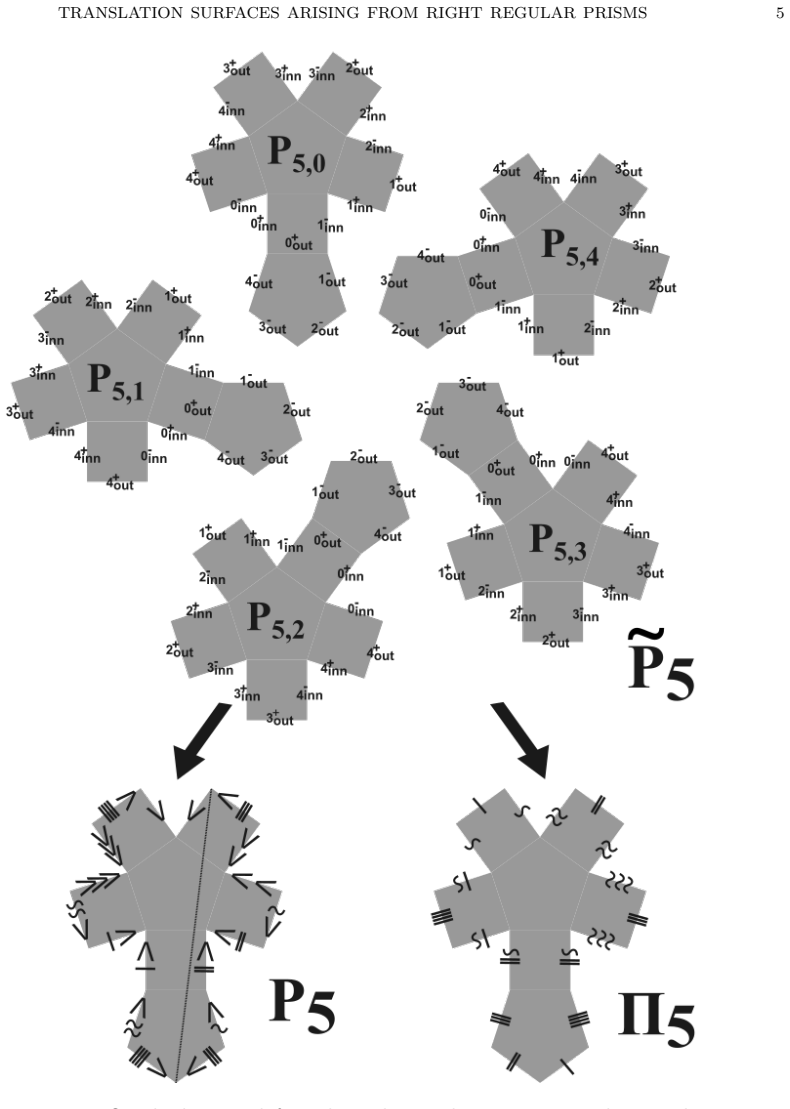
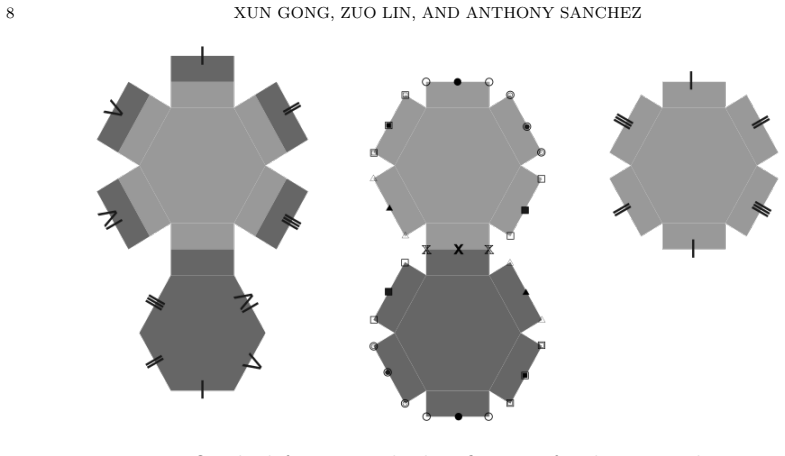
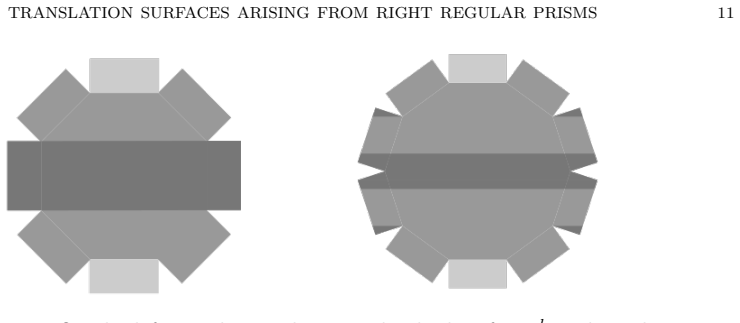
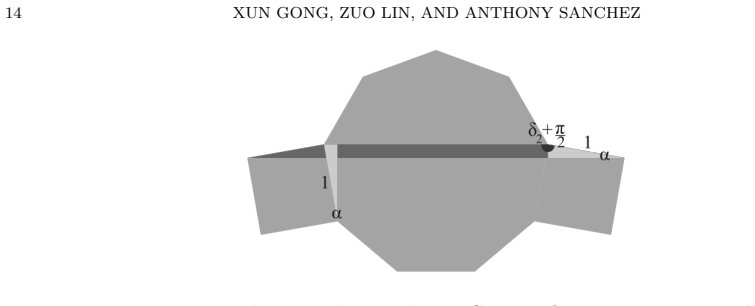
The unfolding of a right regular n-prism is never a lattice surface unless n=4. These unfoldings admit translation coverings to hyperelliptic surfaces. This allows us to determine their GL(2,R)-orbit closures using the classification of hyperelliptic components of strata. As a consequence we obtain exact quadratic asymptotics for a certain average of the number of saddle connections on the base surfaces, their unfoldings, and the original prisms, including their Siegel-Veech constants. This provides a natural infinite family of non-lattice surfaces for which orbit closures and counting problems can be computed explicitly.
What carries the argument
Translation coverings from the prism unfoldings to hyperelliptic surfaces in the strata of differentials, which preserve the flat structure and allow application of the existing classification of hyperelliptic components to determine orbit closures.
Load-bearing premise
The flat metrics induced by right regular n-prisms can be realized as n-differentials whose unfoldings admit translation coverings to hyperelliptic surfaces without introducing extra singularities or obstructions that would prevent direct application of the existing classification of hyperelliptic strata components.
What would settle it
An explicit computation or construction for some n greater than 4 showing that the unfolding does not admit a translation covering to any hyperelliptic surface or that its GL(2,R) orbit closure lies outside the classified hyperelliptic components.
Figures


read the original abstract
We study flat metrics arising from right regular $n$-prisms by viewing them as $n$-differentials and analyzing their associated unfoldings. We show that the unfolding of a right regular $n$-prism is never a lattice surface unless $n=4$, in contrast with the case of Platonic solids. Despite this, we prove that these surfaces admit translation coverings to hyperelliptic surfaces, allowing us to determine their $\mathrm{GL}(2,\mathbb{R})$-orbit closures using the classification of hyperelliptic components of strata. As a consequence, we obtain exact quadratic asymptotics for a certain average of the number of saddle connections on the base surfaces, their unfoldings, and the original prisms, including their Siegel--Veech constants. This provides a natural infinite family of non-lattice surfaces for which orbit closures and counting problems can be computed explicitly.
Editorial analysis
A structured set of objections, weighed in public.
Referee Report
Summary. The paper interprets right regular n-prisms as n-differentials, constructs their unfoldings as translation surfaces S, proves that S is a lattice surface only for n=4, and exhibits translation coverings from S to hyperelliptic surfaces X in known strata. Orbit closures of S are then read off from the classification of hyperelliptic components; this yields explicit quadratic asymptotics (including Siegel-Veech constants) for averaged saddle-connection counts on the prisms, unfoldings, and base surfaces.
Significance. If the covering maps are stratum-preserving and the non-lattice claim holds, the work supplies an explicit infinite family of non-lattice translation surfaces whose GL(2,R)-orbit closures and counting problems are completely determined by existing classifications. This is a concrete contribution to the study of orbit closures beyond lattice surfaces and to polyhedral realizations of flat metrics.
major comments (3)
- [§3] §3 (Construction of the translation covering): the argument that the covering S → X is unramified at singularities and that the pullback of the hyperelliptic differential reproduces the original n-differential (with orders determined by the prism's dihedral angles) must be verified explicitly. If ramification occurs at a zero or pole, the stratum of X would differ from the one assumed in the classification, invalidating direct application of the hyperelliptic-component results.
- [§2.3] §2.3 (Non-lattice claim for n≠4): the proof that the Veech group of the unfolding is not a lattice must be checked against the explicit unfolding construction; the reduction to the covering does not automatically imply non-lattice behavior unless the image surface X is itself non-lattice or the covering degree is accounted for in the stabilizer.
- [§4] §4 (Asymptotics and Siegel-Veech constants): the quadratic growth rates and constants are derived from the orbit-closure classification; any mismatch in the stratum or component between S and X would propagate directly into incorrect constants, so the equality of the relevant Siegel-Veech integrals must be justified by the covering.
minor comments (3)
- Notation for the n-differential on the sphere should be introduced with a clear local coordinate expression near the prism vertices.
- The abstract states 'exact quadratic asymptotics for a certain average'; the precise averaging measure (over directions or over the orbit) should be stated in the introduction.
- References to the hyperelliptic-component classification (e.g., the relevant theorem of the cited authors) should include the precise stratum and component labels used for each n.
Simulated Author's Rebuttal
We thank the referee for the careful and constructive reading of our manuscript. The comments highlight points where additional explicit verification would strengthen the presentation. We address each major comment below and indicate the revisions we will make.
read point-by-point responses
-
Referee: [§3] §3 (Construction of the translation covering): the argument that the covering S → X is unramified at singularities and that the pullback of the hyperelliptic differential reproduces the original n-differential (with orders determined by the prism's dihedral angles) must be verified explicitly. If ramification occurs at a zero or pole, the stratum of X would differ from the one assumed in the classification, invalidating direct application of the hyperelliptic-component results.
Authors: The covering is constructed explicitly in §3 by matching the unfolding of the prism to a translation cover of the hyperelliptic surface X, with local charts chosen so that the dihedral angles of the prism determine the orders of the zeros of the pulled-back n-differential. Because the prism has right angles at the lateral edges and the base is regular, the map is unramified over the singularities of X. We agree that a self-contained local-coordinate computation confirming the absence of ramification and the exact matching of orders would remove any ambiguity. We will insert a short lemma in the revised §3 supplying these calculations. revision: partial
-
Referee: [§2.3] §2.3 (Non-lattice claim for n≠4): the proof that the Veech group of the unfolding is not a lattice must be checked against the explicit unfolding construction; the reduction to the covering does not automatically imply non-lattice behavior unless the image surface X is itself non-lattice or the covering degree is accounted for in the stabilizer.
Authors: The non-lattice statement is proved directly in §2.3 by exhibiting an explicit infinite discrete subgroup of the Veech group of the unfolding S whose covolume is infinite for n≠4, using the affine maps induced by the prism symmetries. The covering to X is invoked only later to identify the orbit closure; it is not used to deduce non-lattice behavior. Nevertheless, we acknowledge that a brief remark relating the stabilizer of S to that of X (accounting for the covering degree) would make the logical separation clearer. We will add this remark in the revised §2.3. revision: partial
-
Referee: [§4] §4 (Asymptotics and Siegel-Veech constants): the quadratic growth rates and constants are derived from the orbit-closure classification; any mismatch in the stratum or component between S and X would propagate directly into incorrect constants, so the equality of the relevant Siegel-Veech integrals must be justified by the covering.
Authors: Because the map S→X is a finite unramified translation cover, the quadratic asymptotics for saddle-connection counts on S are obtained from those on X by multiplying by the covering degree. The Siegel-Veech constants therefore differ by the same explicit factor, which we compute from the degree of the cover. We will insert a short proposition in §4 that records this relation and verifies that the stratum and component of S are compatible with those of X, thereby justifying the transfer of the constants. revision: partial
Circularity Check
No circularity: orbit closures and asymptotics follow from external classification applied to independently constructed coverings.
full rationale
The paper constructs n-differentials from prism unfoldings, proves non-lattice property for n≠4 by direct argument, exhibits explicit translation coverings to hyperelliptic surfaces, and invokes an external classification of hyperelliptic stratum components (independent of the present work) to read off GL(2,R)-orbit closures. Siegel-Veech constants and quadratic asymptotics are then computed from those orbit closures. No step reduces a claimed prediction or uniqueness result to a self-fit, self-citation chain, or definitional renaming; the central claims remain non-tautological once the covering is granted. This is the normal case of a self-contained geometric construction feeding into prior results.
Axiom & Free-Parameter Ledger
axioms (1)
- domain assumption The classification of hyperelliptic components of strata of differentials is complete and directly applicable to the translation coverings arising from prism unfoldings.
Reference graph
Works this paper leans on
-
[1]
P. Apisa. GL 2Rorbit closures in hyperelliptic components of strata.Duke Math. J., 167(4):679–742, 2018
2018
-
[2]
P. Apisa. Rank one orbit closures inH hyp(g−1, g−1).Geom. Funct. Anal., 29(6):1617–1637, 2019
2019
-
[3]
J. S. Athreya and D. Aulicino. A trajectory from a vertex to itself on the dodecahedron.Amer. Math. Monthly, 126(2):161–162, 2019
2019
-
[4]
J. S. Athreya, D. Aulicino, and W. P. Hooper. Platonic solids and high genus covers of lattice surfaces. Exp. Math., 31(3):847–877, 2022. With an appendix by Anja Randecker. TRANSLATION SURF ACES ARISING FROM RIGHT REGULAR PRISMS 21
2022
- [5]
-
[6]
J. S. Athreya and D. Lee. Translation covers of some triply periodic Platonic surfaces.Conform. Geom. Dyn., 25:34–50, 2021
2021
-
[7]
J. S. Athreya and H. Masur.Translation surfaces, volume 242 ofGraduate Studies in Mathematics. American Mathematical Society, Providence, RI, [2024]©2024
2024
- [8]
-
[9]
Eskin and H
A. Eskin and H. Masur. Asymptotic formulas on flat surfaces.Ergodic Theory Dynam. Systems, 21(2):443–478, 2001
2001
-
[10]
Eskin, H
A. Eskin, H. Masur, and A. Zorich. Moduli spaces of abelian differentials: the principal boundary, counting problems, and the Siegel-Veech constants.Publ. Math. Inst. Hautes ´Etudes Sci., (97):61–179, 2003
2003
-
[11]
Eskin, M
A. Eskin, M. Mirzakhani, and A. Mohammadi. Isolation, equidistribution, and orbit closures for the SL(2,R) action on moduli space.Ann. of Math. (2), 182(2):673–721, 2015
2015
-
[12]
Gong and A
X. Gong and A. Sanchez. An arithmetic Kontsevich-Zorich monodromy of a symmetric origami in genus 4.New York J. Math., 29:1413–1424, 2023
2023
-
[13]
Guti´ errez-Romo, D
R. Guti´ errez-Romo, D. Lee, and A. Sanchez. Kontsevich-Zorich monodromy groups of translation covers of some platonic solids.Groups Geom. Dyn., 19(3):1129–1163, 2025
2025
-
[14]
Gutkin and C
E. Gutkin and C. Judge. Affine mappings of translation surfaces: geometry and arithmetic.Duke Mathematical Journal, 103(2):191 – 213, 2000
2000
-
[15]
W. P. Hooper. Grid graphs and lattice surfaces.Int. Math. Res. Not. IMRN, (12):2657–2698, 2013
2013
-
[16]
M¨ oller
M. M¨ oller. Periodic points on Veech surfaces and the Mordell-Weil group over a Teichm¨ uller curve. Invent. Math., 165(3):633–649, 2006
2006
-
[17]
W. A. Veech. Teichm¨ uller curves in moduli space, Eisenstein series and an application to triangular billiards.Invent. Math., 97(3):553–583, 1989
1989
-
[18]
Y. B. Vorobets. Planar structures and billiards in rational polygons: the veech alternative.Russian Mathematical Surveys, 51(5):779, oct 1996
1996
-
[19]
A. N. Zemlyakov and A. B. Katok. Topological transitivity of billiards in polygons. InThe collected works of Anatole Katok. Vol. 1, pages 387–392. World Sci. Publishing, Singapore, [2024]©2024. Reprint of the English translation of [0399423]. Department of Mathematics, The Ohio State University, 100 Math Tower, 231 W 18th A ve, Columbus, OH 43210, USA Ema...
2024
discussion (0)
Sign in with ORCID, Apple, or X to comment. Anyone can read and Pith papers without signing in.