Recognition: 2 theorem links
· Lean TheoremEfficient symplectic integrators for cubic and quartic potentials
Pith reviewed 2026-05-11 01:18 UTC · model grok-4.3
The pith
Symplectic integrators for cubic and quartic potentials achieve higher efficiency through fewer required order conditions.
A machine-rendered reading of the paper's core claim, the machinery that carries it, and where it could break.
Core claim
Polynomial potentials require fewer order conditions than general Hamiltonians, so new symplectic integrators can be built that reach a target order with reduced computational cost per step while remaining symplectic and outperforming standard symmetric compositions and RKN methods.
What carries the argument
Reduced order conditions derived for cubic and quartic potentials, which are then used to construct efficient high-order symplectic composition or splitting methods.
If this is right
- High-order symplectic integrators become cheaper to evaluate for these potentials because fewer stages satisfy the necessary conditions.
- Existing general-purpose RKN splitting methods can be improved upon by tailoring the coefficients to the polynomial degree.
- Long-term simulations of systems with cubic or quartic forces gain efficiency without sacrificing structural preservation.
- The same reduction principle may extend to other low-degree polynomial potentials in Hamiltonian problems.
Where Pith is reading between the lines
- The approach could be tested on time-dependent or perturbed polynomial potentials to check robustness beyond the autonomous case.
- Implementation in existing symplectic integrator libraries would allow direct benchmarking against non-polynomial potentials.
- If the reduced conditions generalize, similar efficiency gains might appear for other structured Hamiltonians such as separable kinetic-plus-potential forms with polynomial restrictions.
Load-bearing premise
That the order conditions reduced for these specific polynomial potentials still produce integrators that stay symplectic and do not introduce hidden instabilities or accuracy losses over long times.
What would settle it
A direct comparison on a cubic or quartic Hamiltonian where the new method produces larger global errors than a standard symmetric composition method at equal computational cost.
Figures


read the original abstract
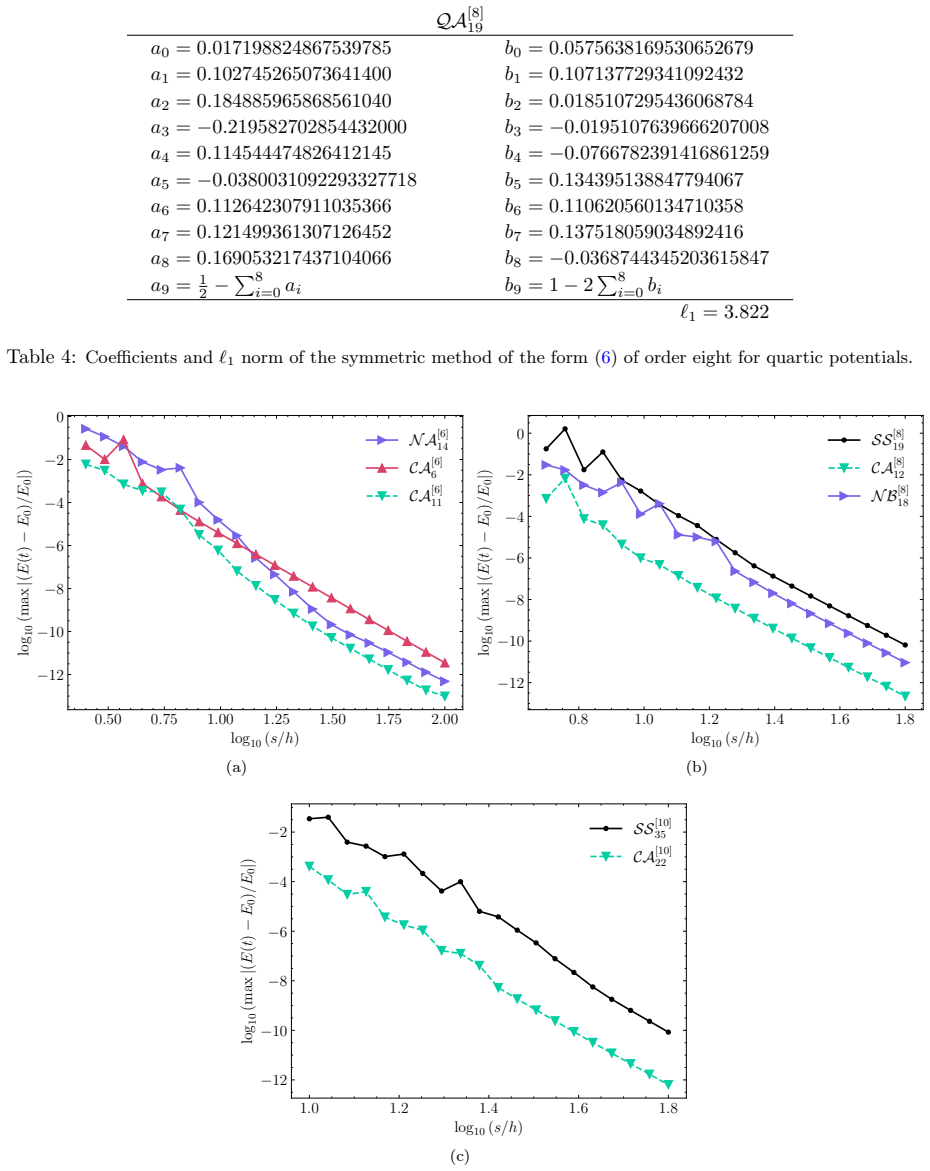
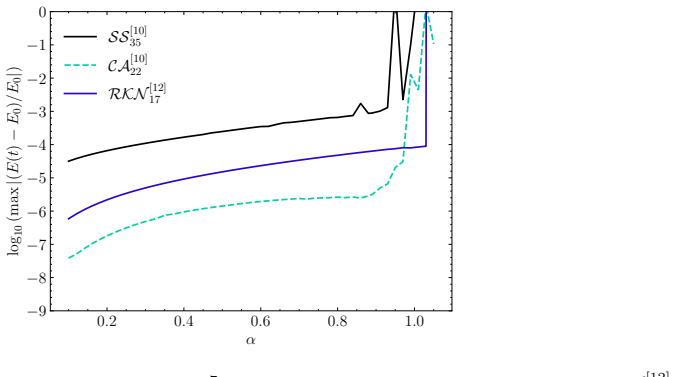
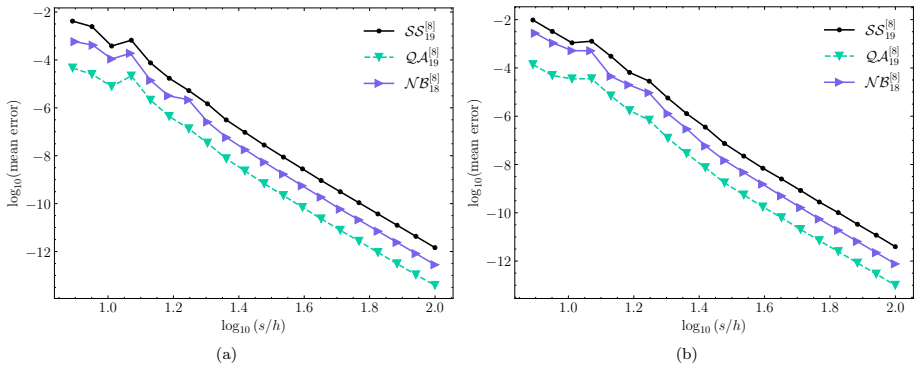
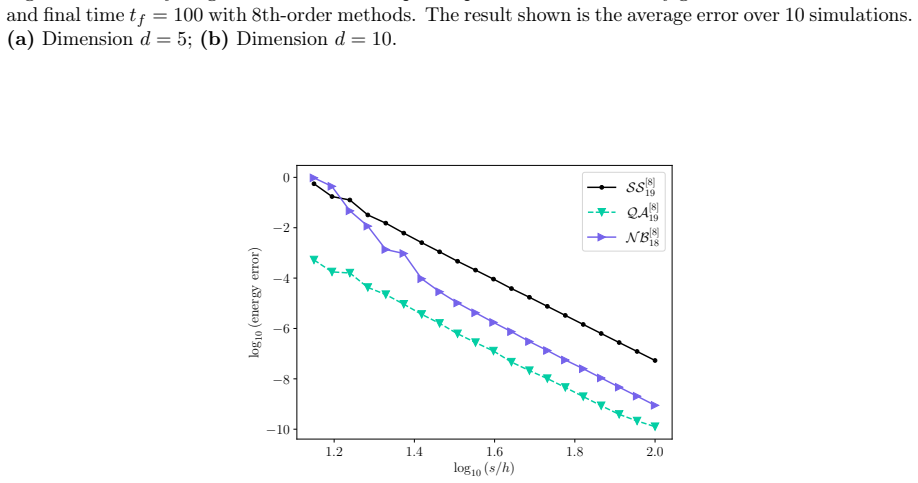
We present a set of new, efficient high-order symplectic methods designed for Hamiltonian systems with cubic or quartic potentials. By demonstrating that polynomial potentials require fewer order conditions, we develop schemes that outperform both standard symmetric compositions of second-order methods and existing RKN splitting methods. Numerical results confirm their improved efficiency over state-of-the-art alternatives found in the literature.
Editorial analysis
A structured set of objections, weighed in public.
Referee Report
Summary. The manuscript presents new high-order symplectic integrators for Hamiltonian systems with cubic or quartic potentials. It demonstrates that the polynomial structure reduces the number of independent order conditions relative to the general case, enabling construction of schemes that outperform both symmetric compositions of second-order methods and existing RKN splitting methods. Numerical experiments are claimed to confirm the efficiency gains.
Significance. If the reduced order conditions are shown to be complete and the resulting methods achieve the designed orders while remaining symplectic, the work offers a practical route to more efficient long-time integrations for polynomial potentials common in molecular dynamics and celestial mechanics. The structure-exploiting approach to order conditions is a useful addition to geometric numerical integration.
major comments (2)
- [§3] §3 (derivation of reduced order conditions for quartic potentials): the manuscript must explicitly enumerate all surviving elementary differentials or BCH commutators up to the target order (including terms such as [V,[T,[V,T]]] and fourth-derivative contributions in the RKN expansion) and verify that the solved coefficients annihilate every non-vanishing term. If even one such term is omitted, the actual local error order falls below the design order and the efficiency claim does not hold.
- [§5] §5 (numerical results): the efficiency plots and comparisons lack the explicit coefficient sets obtained from the reduced system and the full order-condition table. Without these, it is impossible to confirm that the observed gains arise from the claimed higher effective order rather than post-hoc tuning or test-problem specificity.
minor comments (2)
- [Abstract] The abstract should state the concrete orders attained by the new methods rather than the generic phrase 'high-order'.
- [§2] Notation for the splitting coefficients and the RKN trees should be introduced with a short table or diagram for clarity.
Simulated Author's Rebuttal
We thank the referee for the careful reading and constructive comments on our manuscript. We address each major comment below and will incorporate the requested clarifications and additions in the revised version to strengthen the presentation.
read point-by-point responses
-
Referee: §3 (derivation of reduced order conditions for quartic potentials): the manuscript must explicitly enumerate all surviving elementary differentials or BCH commutators up to the target order (including terms such as [V,[T,[V,T]]] and fourth-derivative contributions in the RKN expansion) and verify that the solved coefficients annihilate every non-vanishing term. If even one such term is omitted, the actual local error order falls below the design order and the efficiency claim does not hold.
Authors: We agree that explicit enumeration of all surviving terms is necessary for rigorous verification. Section 3 derives the reduced order conditions by exploiting the fact that cubic and quartic potentials cause many higher-order elementary differentials and BCH commutators to vanish identically. In the revision we will add a complete list (or table) of the non-vanishing commutators up to the target order, explicitly including terms such as [V,[T,[V,T]]] and the relevant fourth-derivative contributions that appear in the RKN expansion. For each surviving term we will show that the coefficients obtained from the reduced system annihilate it, thereby confirming that the designed order is attained. This material will be inserted as a new subsection or table in the revised §3. revision: yes
-
Referee: §5 (numerical results): the efficiency plots and comparisons lack the explicit coefficient sets obtained from the reduced system and the full order-condition table. Without these, it is impossible to confirm that the observed gains arise from the claimed higher effective order rather than post-hoc tuning or test-problem specificity.
Authors: We accept that the coefficient values and the complete order-condition table must be supplied for reproducibility and independent verification. In the revised manuscript we will include a table (or appendix) listing the explicit numerical coefficients for each new integrator. We will also provide the full order-condition table, marking which conditions are automatically satisfied or reduced by the polynomial structure of the potential and which are solved to obtain the coefficients. With these additions readers will be able to verify that the observed efficiency gains follow from the higher effective order rather than from problem-specific tuning. revision: yes
Circularity Check
No circularity; derivation starts from standard order conditions and applies potential-specific reductions independently.
full rationale
The paper begins with the established theory of symplectic integrators and order conditions for Hamiltonian systems (Runge-Kutta-Nyström or splitting methods). It then observes that for cubic/quartic potentials, higher-order derivatives of V vanish identically, which mathematically reduces the number of independent elementary differentials that must be cancelled. This reduction follows directly from the chain rule and the form of the potential; it is not obtained by fitting parameters to data or by redefining the target quantity in terms of itself. No load-bearing step relies on a self-citation whose content is unverified or on an ansatz smuggled from prior work by the same authors. Numerical experiments are presented only as empirical confirmation after the coefficients are derived, not as the justification for the order conditions themselves. The central claim therefore remains self-contained against external benchmarks of symplectic order theory.
Axiom & Free-Parameter Ledger
axioms (1)
- standard math Standard order conditions for symplectic integrators apply to general Hamiltonians and can be specialized for polynomial potentials.
Lean theorems connected to this paper
-
IndisputableMonolith/Cost/FunctionalEquation.leanwashburn_uniqueness_aczel unclearBy demonstrating that polynomial potentials require fewer order conditions, we develop schemes that outperform both standard symmetric compositions of second-order methods and existing RKN splitting methods.
-
IndisputableMonolith/Foundation/AlexanderDuality.leanalexander_duality_circle_linking unclearthe first commutator that vanishes due to this condition is E5,1 = [LA,LA,LA,LA,LB]=0
Reference graph
Works this paper leans on
-
[1]
E. Alberdi, M. Antoñana, J. Makazaga, and A. Murua. An algorithm based on continuation tech- niques for minimization problems with highly non-linear equality constraints. Technical Report arXiv:1909.07263, 2019
-
[2]
V. I. Arnold.Mathematical Methods of Classical Mechanics. Springer-Verlag, Second edition, 1989
work page 1989
-
[3]
S. Blanes and F. Casas.A Concise Introduction to Geometric Numerical Integration. Chapman and Hall/CRC, 2025
work page 2025
- [4]
- [5]
-
[6]
S. Blanes and P. Moan. Practical symplectic partitioned Runge–Kutta and Runge–Kutta–Nyström methods.J. Comput. Appl. Math., 142(2):313–330, 2002
work page 2002
-
[7]
J. Dormand, M. El-Mikkawy, and P. Prince. High-order embedded Runge-Kutta-Nyström formulae. IMA J. Numer. Anal., 7(4):423–430, 1987
work page 1987
- [8]
- [9]
-
[10]
C. R. Harris, K. J. Millman, S. J. van der Walt, R. Gommers, P. Virtanen, D. Cournapeau, E. Wieser, J. Taylor, S. Berg, N. J. Smith, R. Kern, M. Picus, S. Hoyer, M. H. van Kerkwijk, M. Brett, A. Haldane, J. F. del Río, M. Wiebe, P. Peterson, P. Gérard-Marchant, K. Sheppard, T. Reddy, W. Weckesser, H. Abbasi, C. Gohlke, and T. E. Oliphant. Array programmin...
work page 2020
-
[11]
M. Hénon and C. Heiles. The applicability of the third integral of motion: some numerical experi- ments.Astron. J., 69:73–79, 1964
work page 1964
-
[12]
A. Iserles, G. Ramaswami, and M. Sofroniou. Runge-Kutta methods for quadratic ordinary differ- ential equations.BIT Numer. Math., 38(2):315–346, 1998
work page 1998
-
[13]
Lubich.From Quantum to Classical Molecular Dynamics: Reduced Models and Numerical Anal- ysis
C. Lubich.From Quantum to Classical Molecular Dynamics: Reduced Models and Numerical Anal- ysis. European Mathematical Society, 2008
work page 2008
-
[14]
R. I. McLachlan and G. R. W. Quispel. Splitting methods.Acta Numer., 11:341–434, 2002
work page 2002
-
[15]
R. I. McLachlan and B. Ryland. The algebraic entropy of classical mechanics.J. Math. Phys., 44:3071–3087, 2003
work page 2003
-
[16]
J. J. More, B. S. Garbow, and K. E. Hillstrom. User guide for MINPACK-1. [in FORTRAN]. 8 1980
work page 1980
- [17]
-
[18]
W. H. Press, B. P. Flannery, S. A. Teukolsky, and W. T. Vetterling.Numerical Recipes in FORTRAN 77: The Art of Scientific Computing. Cambridge University Press, Sept. 1992. 13
work page 1992
-
[19]
M. Sofroniou and G. Spaletta. Derivation of symmetric composition constants for symmetric inte- grators.Optim. Methods Softw., 20(4-5):597–613, 2005
work page 2005
-
[20]
G. Van Rossum and F. L. Drake.Python 3 Reference Manual. CreateSpace, Scotts Valley, CA, 2009
work page 2009
-
[21]
V. S. Varadarajan.Lie Groups, Lie Algebras, and Their Representations. Springer-Verlag, 1984
work page 1984
-
[22]
P. Virtanen, R. Gommers, T. E. Oliphant, M. Haberland, T. Reddy, D. Cournapeau, E. Burovski, P. Peterson, W. Weckesser, J. Bright, S. J. van der Walt, M. Brett, J. Wilson, K. J. Millman, N. Mayorov, A. R. J. Nelson, E. Jones, R. Kern, E. Larson, C. J. Carey, İ. Polat, Y. Feng, E. W. Moore, J. VanderPlas, D. Laxalde, J. Perktold, R. Cimrman, I. Henriksen, ...
work page 2020
discussion (0)
Sign in with ORCID, Apple, or X to comment. Anyone can read and Pith papers without signing in.