Recognition: 2 theorem links
· Lean TheoremUniversality of the fluctuations of the free energy in generalized Sherrington-Kirkpatrick models and the log likelihood ratio in spiked Wigner models
Pith reviewed 2026-05-11 00:50 UTC · model grok-4.3
The pith
Fluctuations of the free energy in generalized Sherrington-Kirkpatrick models and the log likelihood ratio in spiked Wigner models converge to universal Gaussian limits in the high-temperature regime.
A machine-rendered reading of the paper's core claim, the machinery that carries it, and where it could break.
Core claim
We prove that the limiting laws of the fluctuations are Gaussian under suitable assumptions, and the result is universal in the sense that it does not depend on the distribution of the disorder or the prior except that the means and the variances of the limiting laws depend on a few parameters of the model. The proof is based on the multigraph expansion that provides a unified approach to analyze both models.
What carries the argument
The multigraph expansion, a unified technique for deriving Gaussian fluctuation limits by expanding in terms of multigraphs applicable to both free energy in spin glass models and log-likelihood ratios in inference models.
If this is right
- The same Gaussian limiting laws apply across a wide range of disorder distributions in the Sherrington-Kirkpatrick models, provided means and variances are fixed.
- Universality extends to the log likelihood ratio in spiked Wigner models whenever the signal strength stays below the critical threshold.
- Means and variances of the limiting Gaussians are determined by a small set of explicit model parameters rather than full distributional details.
- The multigraph expansion supplies a single proof structure for fluctuation results in both classes of models.
Where Pith is reading between the lines
- The approach may extend to other mean-field disordered systems whose partition functions admit similar perturbative expansions.
- In statistical inference settings, this suggests that detection thresholds and fluctuation statistics can often be analyzed without specifying exact noise distributions.
- Connections to random matrix theory could allow transfer of these limits to related eigenvalue problems in high dimensions.
Load-bearing premise
The models remain in the high-temperature or subcritical regime where the multigraph expansion produces Gaussian limits, with disorder and prior distributions satisfying the moment conditions needed for the expansion.
What would settle it
Numerical computation of the kurtosis of rescaled free energy fluctuations for large system size in a generalized Sherrington-Kirkpatrick model using a non-Gaussian disorder with finite variance; if the kurtosis fails to approach zero, the Gaussian limit claim is false.
Figures
read the original abstract
We consider the fluctuations of the free energy in generalized Sherrington-Kirkpatrick models and the log likelihood ratio of spiked Wigner models in the high temperature/subcritical regime. We prove that the limiting laws of the fluctuations are Gaussian under suitable assumptions, and the result is universal in the sense that it does not depend on the distribution of the disorder or the prior except that the means and the variances of the limiting laws depend on a few parameters of the model. The proof is based on the multigraph expansion that provides a unified approach to analyze both models.
Editorial analysis
A structured set of objections, weighed in public.
Referee Report
Summary. The paper proves that the fluctuations of the free energy in generalized Sherrington-Kirkpatrick models and the log-likelihood ratio in spiked Wigner models converge to Gaussian limits in the high-temperature/subcritical regime. The limiting distributions are universal in that they depend on the disorder and prior only through their means and variances; the proof proceeds via a multigraph expansion that controls the cumulant-generating function term by term.
Significance. If correct, the result strengthens the universality picture for fluctuations in mean-field spin glasses and related inference models by supplying a unified, rigorous multigraph-expansion argument that isolates the first two moments while showing higher cumulants vanish. The explicit control of remainders under moment and subcriticality assumptions is a technical asset that could extend to other high-temperature regimes.
minor comments (2)
- §3–5: the multigraph expansion is presented as controlling all cumulants beyond the second; an explicit display of the uniform bound on the remainder (in terms of the subcriticality parameter) would make the passage to the Gaussian limit fully transparent.
- Abstract and §1: the phrase 'does not depend on the distribution of the disorder or the prior' should be qualified immediately by 'except through the first two moments' to avoid any misreading.
Simulated Author's Rebuttal
We thank the referee for the positive assessment of our manuscript and for the recommendation of minor revision. The referee's summary correctly identifies the core results on Gaussian fluctuations and universality of the free energy and log-likelihood ratio in the high-temperature regime, proved via multigraph expansion.
Circularity Check
No significant circularity; derivation is self-contained via multigraph expansion
full rationale
The paper establishes Gaussian fluctuation limits for the free energy and log-likelihood ratio through an explicit multigraph expansion (Sections 3–5) that expands the cumulant-generating function term-by-term under high-temperature/subcritical assumptions. Higher-order cumulants vanish in the limit by direct moment bounds on the disorder and prior, leaving only the first two moments to determine the Gaussian mean and variance. This reduction is independent of the specific distributions beyond those moments and does not rely on fitted parameters, self-citations, or imported uniqueness theorems. The universality claim follows directly from the expansion's structure rather than from any redefinition or renaming of inputs.
Axiom & Free-Parameter Ledger
axioms (2)
- domain assumption Models are in the high temperature or subcritical regime
- domain assumption Suitable assumptions hold on the distribution of the disorder and the prior
Lean theorems connected to this paper
-
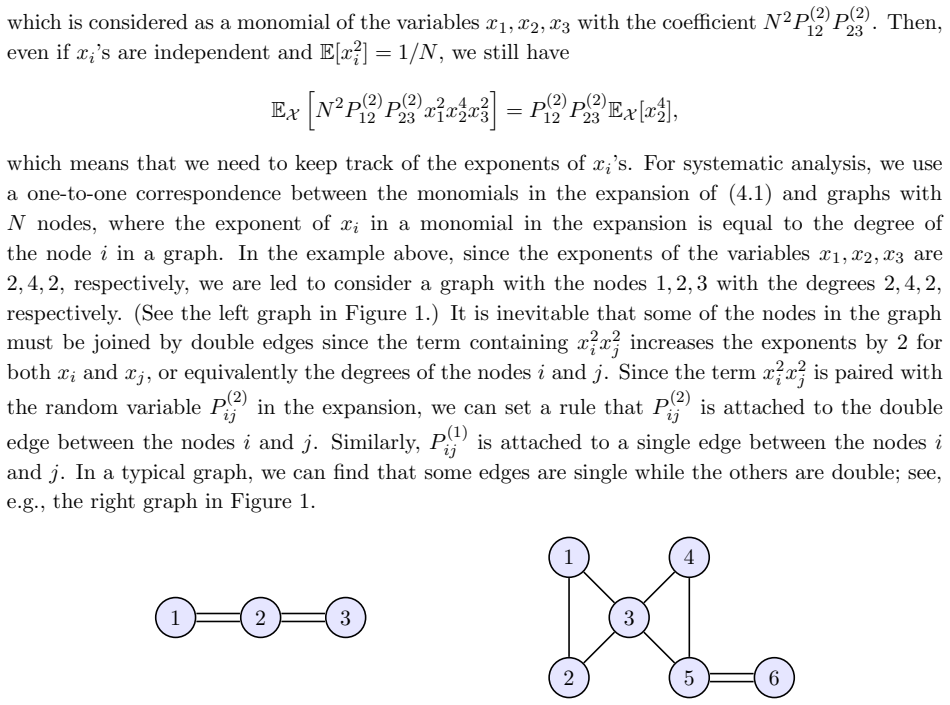
IndisputableMonolith/Foundation/ArithmeticFromLogic.leanLogicNat recovery and embed_injective unclearWe introduce a novel method based on the graph expansion... convert each term in the polynomial into a (multi-)graph... By estimating the L2-norm difference between the graphs from the given prior and the matching graphs from the Rademacher prior, we can prove the prior universality.
-
IndisputableMonolith/Cost/FunctionalEquation.leanwashburn_uniqueness_aczel unclearTheorem 2.5... N(FN(β)−F(β))⇒N(mF,VF) with mF,VF depending on w4 and m4
Reference graph
Works this paper leans on
-
[1]
Aizenman, J
M. Aizenman, J. L. Lebowitz, and D. Ruelle. Some rigorous results on the Sherrington– Kirkpatrick spin glass model.Communications in Mathematical Physics, 112(1):3–20, 1987. 47
1987
-
[2]
Baik and J
J. Baik and J. O. Lee. Fluctuations of the free energy of the spherical Sherrington–Kirkpatrick model.Journal of Statistical Physics, 165(2):185–224, 2016
2016
-
[3]
Bandeira, A
A. Bandeira, A. Perry, and A. S. Wein. Notes on computational-to-statistical gaps: Predictions using statistical physics.Portugaliae mathematica, 75(2):159–186, 2018
2018
-
[4]
Banerjee
D. Banerjee. Contiguity and non-reconstruction results for planted partition models: the dense case.Electronic Journal of Probability, 23(18):1–28, 2018
2018
-
[5]
Banerjee
D. Banerjee. Fluctuation of the free energy of Sherrington–Kirkpatrick model with Curie– Weiss interaction: the paramagnetic regime.Journal of Statistical Physics, 178(1), 2020
2020
-
[6]
Banks, C
J. Banks, C. Moore, J. Neeman, and P. Netrapalli. Information-theoretic thresholds for commu- nity detection in sparse networks. InConference on Learning Theory, pages 383–416. PMLR, 2016
2016
-
[7]
Ben Arous, A
G. Ben Arous, A. Dembo, and A. Guionnet. Aging of spherical spin glasses.Probability theory and related fields, 120(1):1–67, 2001
2001
-
[8]
L. Cam. Locally asymptotically normal families of distributions. Certain approximations to families of distributions and their use in the theory of estimation and testing hypotheses.Univ. California Publ. Statist., 3:37, 1960
1960
-
[9]
Carmona and Y
P. Carmona and Y. Hu. Universality in Sherrington–Kirkpatrick’s spin glass model.Annales de l’IHP Probabilit´ es et statistiques, 42(2):215–222, 2006
2006
-
[10]
W.-K. Chen, P. Dey, and D. Panchenko. Fluctuations of the free energy in the mixed p-spin models with external field.Probability Theory and Related Fields, 168(1):41–53, 2017
2017
-
[11]
H. W. Chung, J. Lee, and J. O. Lee. Asymptotic normality of log likelihood ratio and fun- damental limit of the weak detection for spiked Wigner matrices.Bernoulli, 31(3):2276–2301, 2025
2025
-
[12]
E. Collins-Woodfin and H. G. Le. Free energy fluctuations in SK and related spin glass models: A literature survey.arXiv:2510.26960, 2025
-
[13]
Comets and J
F. Comets and J. Neveu. The Sherrington-Kirkpatrick model of spin glasses and stochastic calculus: The high temperature case.Communications in Mathematical Physics, 166(3):549– 564, 1995
1995
-
[14]
Crisanti and H.-J
A. Crisanti and H.-J. Sommers. The spherical p-spin interaction spin glass model: The statics. Zeitschrift f¨ ur Physik B Condensed Matter, 87(3):341–354, 1992
1992
-
[15]
P. S. Dey and Q. Wu. Mean field spin glass models under weak external field.Communications in Mathematical Physics, 402(2):1205–1258, 2023
2023
-
[16]
El Alaoui, F
A. El Alaoui, F. Krzakala, and M. Jordan. Fundamental limits of detection in the spiked Wigner model.Annals of Statistics, 48(2):863–885, 2020. 48
2020
-
[17]
Erd˝ os, H.-T
L. Erd˝ os, H.-T. Yau, and J. Yin. Rigidity of eigenvalues of generalized Wigner matrices. Advances in Mathematics, 229(3):1435–1515, 2012
2012
-
[18]
Fr¨ ohlich and B
J. Fr¨ ohlich and B. Zegarlinski. Some comments on the Sherrington–Kirkpatrick model of spin glasses.Communications in mathematical physics, 112(4):553–566, 1987
1987
-
[19]
Guerra and F
F. Guerra and F. L. Toninelli. Central limit theorem for fluctuations in the high temperature region of the Sherrington–Kirkpatrick spin glass model.Journal of Mathematical Physics, 43(12):6224–6237, 2002
2002
-
[20]
Guerra and F
F. Guerra and F. L. Toninelli. The thermodynamic limit in mean field spin glass models. Communications in Mathematical Physics, 230(1):71–79, 2002
2002
-
[21]
J. M. Kosterlitz, D. J. Thouless, and R. C. Jones. Spherical model of a spin-glass.Physical Review Letters, 36(20):1217, 1976
1976
-
[22]
K¨ osters
H. K¨ osters. Fluctuations of the free energy in the diluted SK-model.Stochastic processes and their applications, 116(9):1254–1268, 2006
2006
-
[23]
Lesieur, F
T. Lesieur, F. Krzakala, and L. Zdeborov´ a. MMSE of probabilistic low-rank matrix estimation: Universality with respect to the output channel. In2015 53rd Annual Allerton Conference on Communication, Control, and Computing (Allerton), pages 680–687. IEEE, 2015
2015
-
[24]
Moitra and A
A. Moitra and A. S. Wein. Precise error rates for computationally efficient testing.The Annals of Statistics, 53(2):854–878, 2025
2025
-
[25]
Montanari, D
A. Montanari, D. Reichman, and O. Zeitouni. On the limitation of spectral methods: From the Gaussian hidden clique problem to rank one perturbations of Gaussian tensors.IEEE Transactions on Information Theory, 63(3):1572–1579, 2016
2016
-
[26]
Mossel, J
E. Mossel, J. Neeman, and A. Sly. Reconstruction and estimation in the planted partition model.Probability Theory and Related Fields, 162(3):431–461, 2015
2015
-
[27]
Neyman and E
J. Neyman and E. S. Pearson. IX. On the problem of the most efficient tests of statistical hypotheses.Philosophical Transactions of the Royal Society of London. Series A, Containing Papers of a Mathematical or Physical Character, 231(694-706):289–337, 1933
1933
-
[28]
Panchenko
D. Panchenko. Free energy in the generalized Sherrington–Kirkpatrick mean field model. Reviews in Mathematical Physics, 17(07):793–857, 2005
2005
-
[29]
Panchenko
D. Panchenko. Free energy in the Potts spin glass.The Annals of Probability, 46(2):829–864, 2018
2018
-
[30]
G. Parisi. Infinite number of order parameters for spin-glasses.Physical Review Letters, 43(23):1754, 1979
1979
-
[31]
G. Parisi. A sequence of approximated solutions to the SK model for spin glasses.Journal of Physics A: Mathematical and General, 13(4):L115–L121, 1980. 49
1980
-
[32]
Perry, A
A. Perry, A. S. Wein, A. S. Bandeira, and A. Moitra. Optimality and sub-optimality of PCA I: Spiked random matrix models.The Annals of Statistics, 46(5):2416–2451, 2018
2018
-
[33]
Sherrington and S
D. Sherrington and S. Kirkpatrick. Solvable model of a spin-glass.Physical review letters, 35(26):1792, 1975
1975
-
[34]
Sherrington and S
D. Sherrington and S. Kirkpatrick. 50 years of spin glass theory.Nature Reviews Physics, 7(10):528–529, 2025
2025
-
[35]
Talagrand
M. Talagrand. Free energy of the spherical mean field model.Probability theory and related fields, 134(3):339–382, 2006
2006
-
[36]
Talagrand
M. Talagrand. The Parisi formula.Annals of mathematics, 163(1):221–263, 2006
2006
-
[37]
Talagrand.Mean field models for spin glasses
M. Talagrand.Mean field models for spin glasses. Volume II: Advanced replica-symmetry and low temperature, volume 55. Springer Science & Business Media, 2011
2011
-
[38]
A. W. Van der Vaart.Asymptotic statistics, volume 3. Cambridge university press, 2000
2000
-
[39]
Vershynin.High-dimensional probability
R. Vershynin.High-dimensional probability. Cambridge university press, 2020
2020
-
[40]
Zdeborov´ a and F
L. Zdeborov´ a and F. Krzakala. Statistical physics of inference: Thresholds and algorithms. Advances in Physics, 65(5):453–552, 2016. 50
2016
discussion (0)
Sign in with ORCID, Apple, or X to comment. Anyone can read and Pith papers without signing in.