Recognition: 2 theorem links
· Lean TheoremAnomalous Phase-Coherence Scaling in a Quantum-Critical Dirac Semimetal
Pith reviewed 2026-05-11 01:07 UTC · model grok-4.3
The pith
Near the quantum critical point in a Dirac semimetal, the phase coherence length scales with temperature to a suppressed power of about 0.3 instead of the usual 0.5.
A machine-rendered reading of the paper's core claim, the machinery that carries it, and where it could break.
Core claim
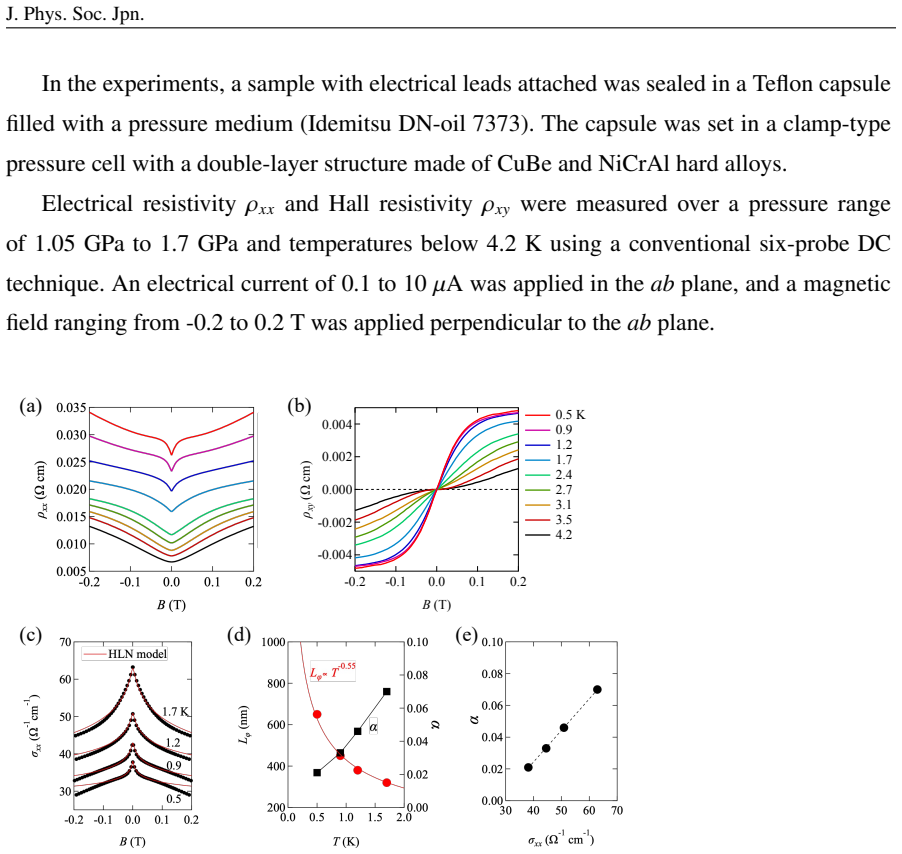
The phase coherence length L_φ extracted from weak antilocalization fits to the low-temperature magnetoconductivity scales as L_φ ∝ T^{-p} with p ≈ 1/2 in the high-pressure regime but with p ∼ 0.3 as pressure approaches Pc ∼ 1.2 GPa, while L_φ remains 700-800 nm at 0.5 K. This anomalous scaling is attributed to nontrivial inelastic scattering associated with Dirac electrons near the quantum critical point. The continued presence of weak antilocalization across the transition indicates a gapless or nearly gapless quantum phase transition.
What carries the argument
Weak antilocalization magnetoconductivity analysis that extracts the phase coherence length L_φ and its temperature power-law exponent across the pressure-tuned transition.
If this is right
- The dominant dephasing channel switches from conventional electron-electron scattering to one tied to quantum critical fluctuations.
- The quantum phase transition does not open a gap large enough to destroy coherent backscattering effects.
- Phase coherence lengths remain hundreds of nanometers near criticality, allowing other interference phenomena to remain observable.
- Standard diffusive-conductor dephasing models fail in the vicinity of this Dirac quantum critical point.
Where Pith is reading between the lines
- The same suppressed exponent could appear in other pressure- or doping-tuned Dirac systems near their quantum critical points.
- Theories of inelastic scattering for Dirac fermions must incorporate critical fluctuations to explain p ∼ 0.3.
- If the transition is truly gapless, it may host protected or critical modes whose signatures could be sought in spectroscopy or noise measurements.
Load-bearing premise
The standard two-dimensional weak-antilocalization fitting formulas remain valid and no other magnetoconductivity terms become dominant as the system approaches the charge-ordered state at the critical pressure.
What would settle it
Magnetoconductivity data at pressures very close to Pc that cannot be fit by the conventional two-dimensional weak-antilocalization form, or that show the weak-antilocalization signal vanishing at the transition, would falsify the reported anomalous scaling and gapless-transition claim.
Figures


read the original abstract
We have investigated the weak antilocalization (WAL) in the pressurized Dirac semimetal $\alpha$-(BEDT-TTF)$_2$I$_3$ across a correlation-driven quantum phase transition to a charge-ordered insulating state and evaluated the phase coherence length $L_{\phi}$ and its temperature scaling under various pressures from the low-temperature magnetoconductivity. In the high-pressure regime, the system exhibits the conventional two-dimensional dephasing behavior ($L_{\phi} \propto T^{-p}$ with $p \approx 1/2$), characteristic of electron-electron scattering in diffusive conductors. As the pressure approaches the critical pressure ($P_c \sim 1.2$ GPa), the temperature exponent is suppressed to $p \sim 0.3$, while $L_{\phi}$ remains large ($700\text{-}800$ nm at 0.5 K). This anomalous scaling suggests nontrivial inelastic scattering associated with Dirac electrons near the quantum critical point. The persistence of WAL across the transition supports a gapless or nearly gapless quantum phase transition.
Editorial analysis
A structured set of objections, weighed in public.
Referee Report
Summary. The manuscript reports low-temperature magnetoconductivity measurements on the pressurized Dirac semimetal α-(BEDT-TTF)₂I₃, tracking weak antilocalization (WAL) across a correlation-driven quantum phase transition to a charge-ordered insulator at P_c ≈ 1.2 GPa. From fits to the low-field data the authors extract the phase-coherence length L_φ(T) and find conventional dephasing (L_φ ∝ T^{-p} with p ≈ 1/2) at high pressure, but a suppressed exponent p ≈ 0.3 together with large L_φ (700–800 nm at 0.5 K) as pressure approaches P_c. They interpret the anomalous scaling as evidence for nontrivial inelastic scattering of Dirac electrons near the quantum critical point and cite the persistence of WAL as support for a gapless or nearly gapless transition.
Significance. If the fitting procedure remains valid, the reported suppression of the dephasing exponent near P_c would constitute a concrete experimental signature of unusual inelastic scattering tied to a correlation-driven Dirac quantum critical point. The observation that WAL survives into the vicinity of the insulator is also noteworthy and could constrain theories of the transition. The pressure-tuning approach itself is a clear experimental strength.
major comments (2)
- [§ Results (magnetoconductivity analysis near P_c)] § Results (magnetoconductivity analysis near P_c): the central claim of anomalous p ≈ 0.3 scaling rests on applying conventional 2D WAL fitting formulas (HLN or equivalent) to extract L_φ even at pressures closest to P_c. As the system approaches the charge-ordered insulating state the diffusive metallic assumptions (k_F l ≫ 1, purely inelastic dephasing) underlying those formulas may no longer hold; alternative low-field curvature from variable-range-hopping wave-function shrinkage or classical orbital effects could be misattributed to WAL and would artificially suppress the apparent exponent.
- [Data-analysis paragraph (temperature-exponent extraction)] Data-analysis paragraph (temperature-exponent extraction): no information is supplied on the precise fitting procedure, temperature window, error-bar estimation, data-exclusion rules, or tests for other conductivity contributions when determining p from L_φ(T). Without these details the reliability of the reported p ≈ 0.3 value cannot be assessed and the distinction from conventional p = 1/2 remains only partially supported.
minor comments (2)
- [Figure captions] Figure captions should explicitly state the functional form used for the WAL fits and list the pressure values corresponding to each data set.
- [Abstract] The abstract states L_φ remains 700–800 nm at 0.5 K near P_c but does not indicate whether this value is obtained from a single sample or averaged over multiple crystals.
Simulated Author's Rebuttal
We thank the referee for the careful and constructive review of our manuscript. The comments highlight important issues regarding the robustness of our magnetoconductivity analysis near the quantum critical point. We address each major comment below and indicate the revisions we will implement.
read point-by-point responses
-
Referee: § Results (magnetoconductivity analysis near P_c): the central claim of anomalous p ≈ 0.3 scaling rests on applying conventional 2D WAL fitting formulas (HLN or equivalent) to extract L_φ even at pressures closest to P_c. As the system approaches the charge-ordered insulating state the diffusive metallic assumptions (k_F l ≫ 1, purely inelastic dephasing) underlying those formulas may no longer hold; alternative low-field curvature from variable-range-hopping wave-function shrinkage or classical orbital effects could be misattributed to WAL and would artificially suppress the apparent exponent.
Authors: We acknowledge the referee's valid concern about the applicability of the HLN formula as the system approaches P_c. Our data nevertheless show that the characteristic low-field WAL cusp remains clearly resolved and that the zero-field conductivity stays metallic (no upturn indicative of VRH) down to the lowest temperatures at pressures within 0.1 GPa of P_c. From the measured conductivity we estimate k_F l ≈ 4–8, which still satisfies the diffusive condition. In the revised manuscript we will add an explicit paragraph in the Results section that (i) reports these k_F l values, (ii) demonstrates the absence of VRH signatures in ρ(T), and (iii) shows that subtracting a possible classical orbital term does not alter the extracted L_φ within experimental uncertainty. These additions will directly address the referee's point while preserving the central claim. revision: partial
-
Referee: Data-analysis paragraph (temperature-exponent extraction): no information is supplied on the precise fitting procedure, temperature window, error-bar estimation, data-exclusion rules, or tests for other conductivity contributions when determining p from L_φ(T). Without these details the reliability of the reported p ≈ 0.3 value cannot be assessed and the distinction from conventional p = 1/2 remains only partially supported.
Authors: We agree that the original manuscript omitted necessary methodological details. In the revised version we will expand the data-analysis paragraph to specify: the temperature window (0.5–4 K) over which the power-law fits were performed, the fitting algorithm (non-linear least-squares minimization of log L_φ versus log T), the source of error bars (covariance matrix of the fit parameters), the data-exclusion criteria (points with signal-to-noise ratio below 3 or where the WAL amplitude falls below the noise floor), and the robustness checks (fits performed both with and without an additional classical magnetoresistance term, as well as restricted temperature sub-ranges). These clarifications will allow readers to evaluate the reliability of p ≈ 0.3 independently. revision: yes
Circularity Check
No circularity: scaling exponent extracted empirically from data fits
full rationale
The paper extracts L_φ from low-field magnetoconductivity using standard 2D WAL formulas (HLN or equivalent) and then reports the observed temperature exponent p directly from those extracted values. This is a straightforward empirical measurement chain with no model whose parameters are fitted to the same data and then renamed as a prediction. No self-citations, uniqueness theorems, or ansatze are invoked as load-bearing steps for the central claim of anomalous p~0.3 scaling. The derivation is self-contained against external benchmarks (standard WAL theory) and does not reduce to its inputs by construction.
Axiom & Free-Parameter Ledger
free parameters (1)
- temperature exponent p
axioms (2)
- domain assumption Magnetoconductivity follows the standard Hikami-Larkin-Nagaoka formula for weak antilocalization in two dimensions
- domain assumption The system remains in the diffusive transport regime at the temperatures and pressures studied
Lean theorems connected to this paper
-
IndisputableMonolith/Foundation/AbsoluteFloorClosure.leanreality_from_one_distinction unclear?
unclearRelation between the paper passage and the cited Recognition theorem.
We analyze the magnetoconductivity σ_xx using the quasi-2D Hikami-Larkin-Nagaoka (HLN) model... L_ϕ ∝ T^{-p} with p≈1/2... suppressed to p∼0.3 near Pc
-
IndisputableMonolith/Cost/FunctionalEquation.leanwashburn_uniqueness_aczel unclear?
unclearRelation between the paper passage and the cited Recognition theorem.
The persistence of WAL across the transition supports a gapless or nearly gapless quantum phase transition
What do these tags mean?
- matches
- The paper's claim is directly supported by a theorem in the formal canon.
- supports
- The theorem supports part of the paper's argument, but the paper may add assumptions or extra steps.
- extends
- The paper goes beyond the formal theorem; the theorem is a base layer rather than the whole result.
- uses
- The paper appears to rely on the theorem as machinery.
- contradicts
- The paper's claim conflicts with a theorem or certificate in the canon.
- unclear
- Pith found a possible connection, but the passage is too broad, indirect, or ambiguous to say the theorem truly supports the claim.
Reference graph
Works this paper leans on
-
[1]
K. S. Novoselov, A. K. Geim, S. V . Morozov, D. Jiang, M. I. Katsnelson, I. V . Grigorieva, S. V . Dubonos, and A. A. Firsov, Nature438, 197 (2005)
2005
-
[2]
Zhang, Y
Y . Zhang, Y . W. Tan, H. Stormer, and P. Kim, Nature438, 201 (2005)
2005
-
[3]
I. F. Herbut, Phys. Rev. Lett.97, 146401 (2006)
2006
-
[4]
I. F. Herbut, V . Juriˇci´c, O. Vafek, Phys. Rev. B80, 075432 (2009)
2009
-
[5]
D. T. Son, Phys. Rev. B75, 235423 (2007)
2007
-
[6]
Gonz ´alez, F
J. Gonz ´alez, F. Guinea, M. A. H. V ozmediano, Nucl. Phys. B424, 595 (1994)
1994
-
[7]
B. Roy, I. F. Herbut, Phys. Rev. B82, 035429 (2010)
2010
-
[8]
Katayama, A
S. Katayama, A. Kobayashi, and Y . Suzumura, J. Phys. Soc. Jpn.75, 054705 (2006)
2006
-
[9]
Kino and T
H. Kino and T. Miyazaki, J. Phys. Soc. Jpn.75, 034704 (2006)
2006
-
[10]
Osada, J
T. Osada, J. Phys. Soc. Jpn.77, 084711 (2008)
2008
-
[11]
Tajima, S
N. Tajima, S. Sugawara, R. Kato, Y . Nishio, and K. Kajita, Phys. Rev. Lett.102, 176403 (2009)
2009
-
[12]
Kajita, Y
K. Kajita, Y . Nishio, N. Tajima, Y . Suzumura, A. Kobayashi, J. Phys. Soc. Jpn.83, 072002 (2014)
2014
-
[13]
Morinari, J
T. Morinari, J. Phys. Soc. Japan89, 073705 (2020)
2020
-
[14]
Tajima, Y
N. Tajima, Y . Kawasugi, T. Morinari, R. Oka, T. Naito, and R. Kato J. Phys. Soc. Jpn., 92, 013702 (2023)
2023
-
[15]
Tajima, Y
N. Tajima, Y . Kawasugi, T. Morinari, R. Oka, T. Naito, and R. Kato J. Phys. Soc. Jpn., 92, 123702 (2023)
2023
-
[16]
Hirata, K
M. Hirata, K. Ishikawa, K. Miyagawa, M. Tamura, C. Berthier, D. Basko, A. Kobayashi, G. Matsuno, K. Kanoda, Nature Commun.7, 12666 (2016)
2016
-
[17]
Hirata, K
M. Hirata, K. Ishikawa, G. Matsuno, A. Kobayashi, K. Miyagawa, M. Tamura, C. Berthier, K. Kanoda, Science358, 1403 (2017)
2017
-
[18]
Unozawa, Y
Y . Unozawa, Y . Kawasugi, M. Suda, H. M. Yamamoto, R. Kato, Y . Nishio, K. Kajita, T. Morinari, and N. Tajima, J. Phys. Soc. Jpn.,89, 123702 (2020)
2020
-
[19]
P. A. Lee and T. V . Ramakrishnan, Rev. Mod. Phys.57, 287 (1985)
1985
-
[20]
B. L. Altshuler, A. G. Aronov, D. E. Khmelnitskii, J. Phys. C15, 7367 (1982). 11/12 J. Phys. Soc. Jpn
1982
-
[21]
Kobara, S
R. Kobara, S. Igarashi, Y . Kawasugi, R. Doi, T. Naito, M. Tamura, R. Kato, Y . Nishio, K. Kajita, and N. Tajima, J. Phys. Soc. Jpn.,89, 113703 (2020)
2020
-
[22]
Hikami, A
S. Hikami, A. I. Larkin, and Y . Nagaoka, Prog. of Theor. Phys.63, 707 (1980)
1980
-
[23]
Kondo, S
R. Kondo, S. Kagoshima, N. Tajima, and R. Kato, J. Phys. Soc. Jpn.,78, 114714 (2009)
2009
-
[24]
S. M. Winter, K. Riedl, and R. Valent´ı, Phys. Rev. B95, 060404(R) (2017)
2017
-
[25]
Osada, J
T. Osada, J. Phys. Soc. Jpn.,93, 123703 (2024)
2024
-
[26]
Osada, J
T. Osada, J. Phys. Soc. Jpn.,94, 113701 (2025)
2025
-
[27]
McCann, K
E. McCann, K. Kechedzhi, V . I. Fal’ko, H. Suzuura, T. Ando, and B. L. Altshuler, Phys. Rev. Lett. 97, 146805 (2006)
2006
-
[28]
Fr ´erot, and T
I. Fr ´erot, and T. Roscilde, Nat. Commun.10, 577 (2019)
2019
-
[29]
Yu, and S
H. Yu, and S. Chakravarty, Phys. Rev. B,108, 155143 (2023)
2023
-
[30]
Nakamichi, Y
S. Nakamichi, Y . Kawasugi, and N. Tajima, to be reported elsewhere
-
[31]
Yoshimura, M
K. Yoshimura, M. Sato, and T. Osada, J. Phys. Soc. Jpn.,90, 033701 (2021)
2021
-
[32]
Osada, and A
T. Osada, and A. Kiswandhi, J. Phys. Soc. Jpn.,90, 053704 (2021)
2021
-
[33]
Kiswandhi, and T
A. Kiswandhi, and T. Osada, J. Phys.: Condens. Matter,34, 105602 (2022)
2022
-
[34]
H.-Z. Lu, J. Shi, and S.-Q. Shen, Phys. Rev. Lett.107, 076801 (2011)
2011
-
[35]
Hiramoto, K
S. Hiramoto, K. Funatsu, K. Konishi, H. Dekura, N. Tajima, and T. Naito, J. Phys. Chem. Lett., 16(35), 9116—9123 (2025)
2025
-
[36]
A. Mori, Y . Kawasugi, R. Doi, T. Naito, R. Kato, Y . Nishio, and N. Tajima, J. Phys. Soc. Jpn.,91, 045001 (2022). 12/12
2022
discussion (0)
Sign in with ORCID, Apple, or X to comment. Anyone can read and Pith papers without signing in.