Recognition: 2 theorem links
· Lean TheoremDecoherence without the state: A causal quantum Darwinist approach
Pith reviewed 2026-05-11 01:13 UTC · model grok-4.3
The pith
Decoherence defined solely by causal influences in unitary dynamics, together with its dual, selects a privileged consistent history set from which states and outcomes emerge.
A machine-rendered reading of the paper's core claim, the machinery that carries it, and where it could break.
Core claim
Decoherence is characterized purely as a feature of the unitary dynamics: the causal influences needed for information about observables to proliferate to other systems. Its dual, defined by reversing time in the dynamics, causes the quantum state to emerge. For arbitrary unitary circuits on multiple systems, these two processes together identify a unique consistent history set. In this set, decoherence produces the outcomes while dual decoherence produces the states. This dynamics-first perspective accounts for the suppression of off-diagonal elements in the density matrix, the direction of time in decoherence, and the stability of the pointer basis.
What carries the argument
Causal decoherence, defined via the unitary dynamics' information-proliferating causal influences on observables, along with its time-reversed dual that generates the state.
If this is right
- Any unitary circuit has a dynamically selected consistent history set without extra postulates.
- The quantum state is not fundamental but emerges from the dual decoherence process.
- Outcomes of measurements arise as a direct result of the decoherence mechanism.
- The pointer basis gains robustness from the causal proliferation of information.
- Time asymmetry appears naturally from distinguishing decoherence from its dual.
Where Pith is reading between the lines
- This view supports a causal interpretation of quantum mechanics where dynamics alone determine the classical realm.
- It could lead to new ways to compute consistent histories in complex circuits by tracing causal influences.
- The framework might extend to explain why certain observables become classical in open quantum systems without invoking environments explicitly.
- Testable predictions could arise in quantum information experiments tracking information flow in small circuits.
Load-bearing premise
That a definition of decoherence based only on causal influences required for information proliferation in the unitary dynamics is sufficient, without presupposing a quantum state or any additional selection rules.
What would settle it
Identification of a unitary circuit where decoherence and dual decoherence do not yield a single privileged consistent history set, or where the emerging state from dual decoherence contradicts standard quantum mechanical predictions for that circuit.
Figures


read the original abstract
The consistent histories formalism can be used to describe histories comprised of events across many systems, times, and places, plausibly rich enough to describe our experiences of the classical world; however, many consistent history sets are nonclassical and thus not obviously relevant to our experiences. Meanwhile, the program of environmentally induced decoherence identifies dynamically privileged classical degrees of freedom, but provides no general account of when or how many such degrees of freedom consistently combine to form histories. This work shows that the strengths of these two approaches can be combined by adopting a dynamics-first perspective on decoherence. Inspired by quantum causal models and quantum Darwinism, we define the process of decoherence in terms of the causal influences through unitary dynamics required for the proliferation of information about observables. We characterise decoherence as a property of the unitary dynamics, without presupposing the existence of any quantum state. Instead, we show that the state emerges from dual decoherence, related to decoherence by time-reversal of the unitary dynamics. Indeed, for any set of systems in an arbitrary unitary circuit, decoherence and its dual single out a privileged consistent history set -- and we demonstrate through examples that states emerge from dual decoherence while outcomes emerge from decoherence. Hence the idea that quantum states emerge from the process of decoherence turns out to be the key missing ingredient for unifying environmentally induced decoherence and consistent histories. Taking this idea ontologically seriously leads to a recently proposed causal interpretation of quantum theory or a dynamics-first version of the Everett interpretation. The causal approach also sheds light on the suppression of off-diagonal terms, time asymmetry, and robustness of the pointer basis.
Editorial analysis
A structured set of objections, weighed in public.
Referee Report
Summary. The manuscript proposes a dynamics-first definition of decoherence based on causal influences in unitary circuits enabling information proliferation about observables, without presupposing quantum states. It introduces dual decoherence via time-reversal of the dynamics, claiming that decoherence and its dual together select a privileged consistent history set for arbitrary unitary circuits. States are said to emerge from dual decoherence, while outcomes emerge from decoherence, as demonstrated in examples. This approach aims to unify environmentally induced decoherence with the consistent histories formalism and leads to a causal interpretation of quantum theory.
Significance. If the central construction holds without implicit selection rules, the work would be significant for providing a state-independent mechanism to select privileged classical histories from unitary dynamics, addressing a key gap between decoherence and consistent histories. It merits credit for grounding the emergence of both states and outcomes in causal processes and for offering perspectives on time asymmetry and pointer-basis robustness. The approach builds on quantum causal models and Darwinism ideas in a coherent way.
major comments (3)
- [Abstract and § on decoherence definition] Abstract and definition of decoherence: the claim that decoherence is defined solely via causal influences in the unitary dynamics (without presupposing states or additional selection rules) requires an explicit, basis-independent construction of 'information proliferation about observables' and 'causal influences'; without it, the selection of the privileged consistent history set may not be unique or may tacitly reintroduce the consistency conditions the framework aims to avoid.
- [Examples section] Examples demonstrating emergence: the demonstrations that states emerge from dual decoherence and outcomes from decoherence must include full derivations showing that identification of proliferating observables does not rely on any pre-chosen partitioning or state; otherwise the central claim that decoherence and dual select the history set for arbitrary circuits is not fully supported.
- [Unification and consistent histories discussion] Unification claim: the paper should explicitly compare the selected history set to standard consistent-histories consistency conditions (e.g., via the decoherence functional) to confirm it is not circular with prior literature on which the causal framework builds.
minor comments (2)
- [Notation and figures] Notation for dual decoherence and causal influences could be clarified with additional diagrams or explicit equations relating the time-reversed unitary to the emergence of states.
- [Introduction] A few sentences in the introduction repeat material from the abstract; tightening would improve readability.
Simulated Author's Rebuttal
We thank the referee for their thorough review and constructive feedback on our manuscript. We address each of the major comments in detail below, providing clarifications and indicating the revisions we will make to improve the manuscript.
read point-by-point responses
-
Referee: Abstract and § on decoherence definition: the claim that decoherence is defined solely via causal influences in the unitary dynamics (without presupposing states or additional selection rules) requires an explicit, basis-independent construction of 'information proliferation about observables' and 'causal influences'; without it, the selection of the privileged consistent history set may not be unique or may tacitly reintroduce the consistency conditions the framework aims to avoid.
Authors: We appreciate this point, as it touches on the core of our dynamics-first approach. The manuscript defines information proliferation via the causal influences in the unitary circuit, specifically through the ability of an observable to become correlated with multiple independent systems via the evolution, as formalized in the quantum causal model framework. This construction is basis-independent because it derives from the unitary operator's action on the circuit's causal graph, without reference to any Hilbert space basis or initial state. Regarding uniqueness, the set of such observables is determined uniquely by the circuit's structure for a given dynamics. We do not reintroduce consistency conditions; rather, the selected histories are shown to be consistent as a consequence. To strengthen this, we will include a more formal, explicit definition and a proof of uniqueness in the revised section on the decoherence definition. revision: partial
-
Referee: Examples section: the demonstrations that states emerge from dual decoherence and outcomes from decoherence must include full derivations showing that identification of proliferating observables does not rely on any pre-chosen partitioning or state; otherwise the central claim that decoherence and dual select the history set for arbitrary circuits is not fully supported.
Authors: We agree that the examples section would be strengthened by more detailed derivations. Currently, the examples demonstrate the emergence conceptually, but we acknowledge the need for explicit calculations. In the revised manuscript, we will provide full derivations for the key examples, explicitly tracing how the proliferating observables are identified solely from the causal structure of the unitary dynamics, without any pre-chosen partitioning or assumption of a quantum state. This will better support the generality of our claim for arbitrary circuits. revision: yes
-
Referee: Unification claim: the paper should explicitly compare the selected history set to standard consistent-histories consistency conditions (e.g., via the decoherence functional) to confirm it is not circular with prior literature on which the causal framework builds.
Authors: This suggestion is helpful for clarifying the relationship to existing literature. Our approach is not circular; the causal selection mechanism operates independently and yields histories that satisfy the consistency conditions. To make this explicit, we will add a comparison in the discussion section, including an analysis of the decoherence functional for the selected history sets in our examples. This will show how the vanishing of interference terms arises from the causal proliferation process, providing a dynamical basis for consistency without presupposing it. revision: yes
Circularity Check
No significant circularity detected; derivation remains self-contained
full rationale
The paper defines decoherence as a property of unitary dynamics via causal influences enabling information proliferation about observables, explicitly without presupposing any quantum state, and derives the emergence of states from the time-reversed dual process. This is used to select a privileged consistent-history set for arbitrary circuits. No equations or definitions in the abstract or described framework reduce the output (privileged histories, emergent states/outcomes) to the inputs by construction, nor do they rename known results or smuggle ansatzes via self-citation. References to prior causal interpretations and consistent-histories literature provide context but do not bear the load of the central unification claim, which is demonstrated through examples as having independent content. The approach is presented as dynamics-first and falsifiable in principle against standard decoherence and histories formalisms.
Axiom & Free-Parameter Ledger
axioms (2)
- standard math The evolution is given by unitary dynamics on a circuit of systems.
- domain assumption Causal influences can be identified from the unitary circuit structure without reference to a state.
invented entities (1)
-
dual decoherence
no independent evidence
Lean theorems connected to this paper
-
IndisputableMonolith/Foundation/RealityFromDistinction.leanreality_from_one_distinction unclear?
unclearRelation between the paper passage and the cited Recognition theorem.
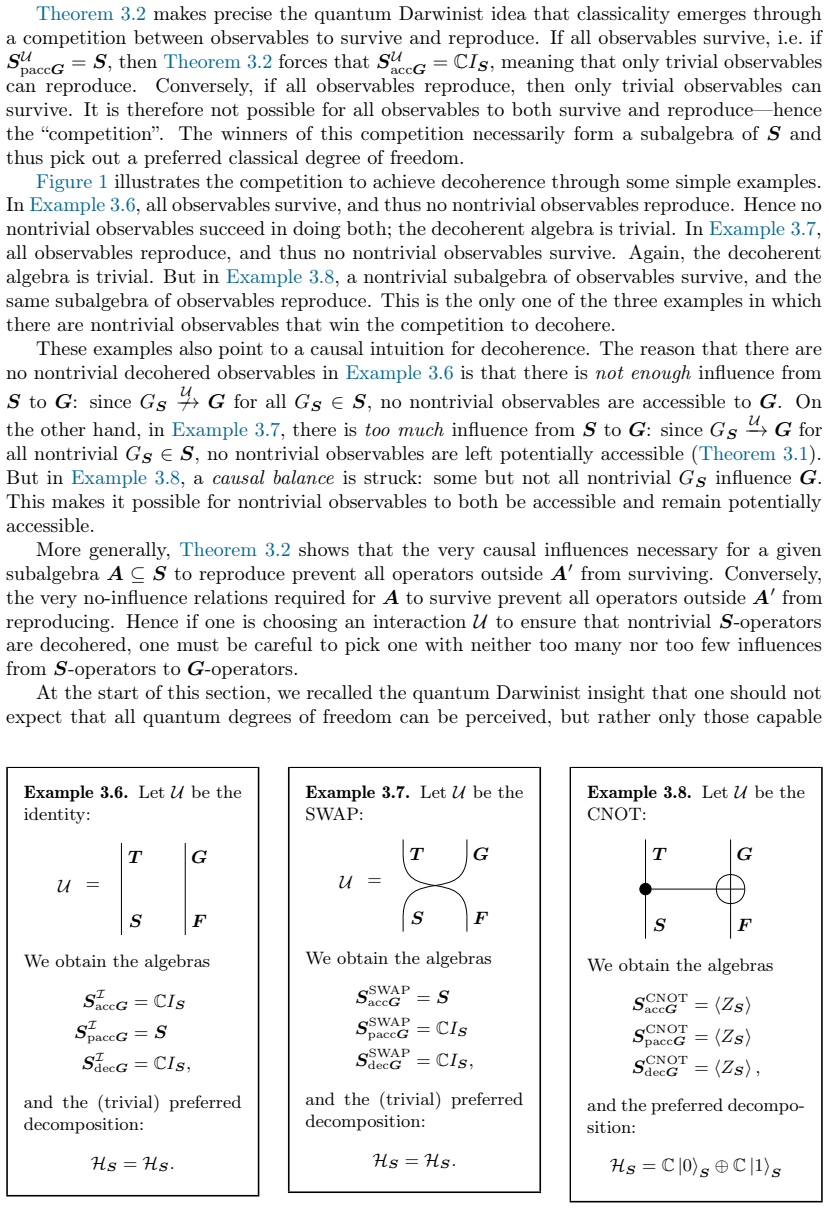
Definition 3.1. ... M influences N through U ... if [U^{-1}(N), M] ≠ 0. ... Theorem 3.2. ... SU_decG forms a commutative algebra ...
What do these tags mean?
- matches
- The paper's claim is directly supported by a theorem in the formal canon.
- supports
- The theorem supports part of the paper's argument, but the paper may add assumptions or extra steps.
- extends
- The paper goes beyond the formal theorem; the theorem is a base layer rather than the whole result.
- uses
- The paper appears to rely on the theorem as machinery.
- contradicts
- The paper's claim conflicts with a theorem or certificate in the canon.
- unclear
- Pith found a possible connection, but the passage is too broad, indirect, or ambiguous to say the theorem truly supports the claim.
Reference graph
Works this paper leans on
-
[1]
On the interpretation of measurement in quantum theory
H Dieter Zeh. “On the interpretation of measurement in quantum theory”.Foundations of Physics1.1 (1970), pp. 69–76
work page 1970
-
[2]
Toward a quantum theory of observation
H Dieter Zeh. “Toward a quantum theory of observation”.Foundations of Physics3.1 (1973), pp. 109–116
work page 1973
-
[3]
Pointer basis of quantum apparatus: Into what mixture does the wave packet collapse?
Wojciech H Zurek. “Pointer basis of quantum apparatus: Into what mixture does the wave packet collapse?”Physical review D24.6 (1981), p. 1516
work page 1981
-
[4]
Environment-induced superselection rules
Wojciech H Zurek. “Environment-induced superselection rules”.Physical review D26.8 (1982), p. 1862
work page 1982
-
[5]
Preferred States, Predictability, Classicality and the Environment- Induced Decoherence
Wojciech H. Zurek. “Preferred States, Predictability, Classicality and the Environment- Induced Decoherence”. In:Physical Origins of Time Asymmetry. Ed. by J. J. Halliwell, J. Pérez-Mercader, and W. H. Zurek. Cambridge University Press, 1994, pp. 175–221
work page 1994
-
[6]
Consistent histories and the interpretation of quantum mechanics
Robert B Griffiths. “Consistent histories and the interpretation of quantum mechanics”. Journal of Statistical Physics36 (1984), pp. 219–272
work page 1984
-
[7]
Cambridge University Press, 2003
Robert B Griffiths.Consistent Quantum Theory. Cambridge University Press, 2003
work page 2003
-
[8]
Complexity, entropy and the physics of informa- tion
Murray Gell-Mann and James Hartle. “Complexity, entropy and the physics of informa- tion”.SFI Studies in the Sciences of Complexity8 (1990), p. 425
work page 1990
-
[9]
On the consistent histories approach to quantum me- chanics
Fay Dowker and Adrian Kent. “On the consistent histories approach to quantum me- chanics”.Journal of Statistical Physics82 (1996), pp. 1575–1646
work page 1996
-
[10]
Decoherence, einselection, and the quantum origins of the classical
Wojciech H Zurek. “Decoherence, einselection, and the quantum origins of the classical”. Reviews of Modern Physics75.3 (2003), p. 715
work page 2003
-
[11]
Objective Properties from Sub- jective Quantum States: Environment as a Witness
Harold Ollivier, David Poulin, and Wojciech H. Zurek. “Objective Properties from Sub- jective Quantum States: Environment as a Witness”.Physical Review Letters93.22 (2004)
work page 2004
-
[12]
Quantum Darwinism and envariance
Wojciech H Zurek. “Quantum Darwinism and envariance”.Science and ultimate reality: Quantum theory, Cosmology, and Complexity(2004), pp. 121–137
work page 2004
-
[13]
Harold Ollivier, David Poulin, and Wojciech H. Zurek. “Environment as a witness: Se- lective proliferation of information and emergence of objectivity in a quantum universe”. Physical Review A72.4 (2005)
work page 2005
-
[14]
Wojciech H Zurek. “Quantum Darwinism”.Nature Physics5.3 (2009), pp. 181–188
work page 2009
-
[15]
Cambridge University Press, 2025
Wojciech Hubert Zurek.Decoherence and Quantum Darwinism: From Quantum Foun- dations to Classical Reality. Cambridge University Press, 2025
work page 2025
-
[16]
Objectivity in a noisy photonicenvironmentthroughquantumstateinformationbroadcasting
Jarosław Korbicz, Paweł Horodecki, and Ryszard Horodecki. “Objectivity in a noisy photonicenvironmentthroughquantumstateinformationbroadcasting”.Physical Review Letters112.12 (2014), p. 120402
work page 2014
-
[17]
Quantum origins of objectivity
Ryszard Horodecki, Jarosław K Korbicz, and Paweł Horodecki. “Quantum origins of objectivity”.Physical Review A91.3 (2015), p. 032122
work page 2015
-
[18]
Jarosław K. Korbicz. “Roads to objectivity: Quantum Darwinism, Spectrum Broadcast Structures, and Strong quantum Darwinism – a review”.Quantum5 (2021), p. 571
work page 2021
-
[19]
QuantumCommonCausesandQuantumCausalModels
John-MarkAllen,JonathanBarrett,DominicHorsman,CiaránLee,andRobertSpekkens. “QuantumCommonCausesandQuantumCausalModels”.Physical Review X7.3(2017). 42
work page 2017
-
[20]
Jonathan Barrett, Robin Lorenz, and Ognyan Oreshkov. “Quantum Causal Models” (2020). arXiv: 1906.10726
-
[21]
JonathanBarrett,RobinLorenz,andOgnyanOreshkov.“Cyclicquantumcausalmodels”. Nature Communications12.1 (2021), pp. 1–15
work page 2021
-
[22]
Causal structure in the presence of sectorial constraints, with application to the quantum switch
Nick Ormrod, Augustin Vanrietvelde, and Jonathan Barrett. “Causal structure in the presence of sectorial constraints, with application to the quantum switch”.Quantum7 (2023), p. 1028
work page 2023
-
[23]
Acausalderivationofthealgebraicapproachtoquantumsystems
NickOrmrod.“Acausalderivationofthealgebraicapproachtoquantumsystems” (2025). arXiv: 2508.01111
-
[24]
Quantum influences and event relativity
Nick Ormrod and Jonathan Barrett. “Quantum influences and event relativity” (2024). arXiv: 2401.18005
-
[25]
Springer Science & Business Media, 2000
Douglas R Farenick.Algebras of Linear Transformations. Springer Science & Business Media, 2000
work page 2000
-
[26]
Theory of quantum error-correcting codes
Emanuel Knill and Raymond Laflamme. “Theory of quantum error-correcting codes”. Physical Review A55.2 (1997), p. 900
work page 1997
-
[27]
Decoherence-free subspaces and subsystems
Daniel A Lidar and K Birgitta Whaley. “Decoherence-free subspaces and subsystems”. In:Irreversible Quantum Dynamics. Springer, 2003, pp. 83–120
work page 2003
-
[28]
Review of Decoherence-Free Subspaces, Noiseless Subsystems, and Dy- namical Decoupling
Daniel A Lidar. “Review of Decoherence-Free Subspaces, Noiseless Subsystems, and Dy- namical Decoupling”.Quantum Information and Computation for Chemistry(2014), pp. 295–354
work page 2014
-
[29]
Wojciech H Zurek. “Quantum darwinism”.Nature physics5.3 (2009), pp. 181–188
work page 2009
-
[30]
Strong quantum darwinism and strong inde- pendence are equivalent to spectrum broadcast structure
Thao P Le and Alexandra Olaya-Castro. “Strong quantum darwinism and strong inde- pendence are equivalent to spectrum broadcast structure”.Physical Review Letters122.1 (2019), p. 010403
work page 2019
-
[31]
The meaning of redundancy and consensus in quantum objectivity
Diana A Chisholm, Luca Innocenti, and G Massimo Palma. “The meaning of redundancy and consensus in quantum objectivity”.Quantum7 (2023), p. 1074
work page 2023
-
[32]
Remarks on the mind-body question
Eugene P Wigner. “Remarks on the mind-body question”. In:Philosophical reflections and syntheses. Springer, 1995, pp. 247–260
work page 1995
-
[33]
Oxford University Press, USA, 2012
David Wallace.The emergent multiverse: Quantum theory according to the Everett in- terpretation. Oxford University Press, USA, 2012
work page 2012
-
[34]
Quantum theory of probability and decisions
David Deutsch. “Quantum theory of probability and decisions”.Proceedings of the Royal Society of London. Series A: Mathematical, Physical and Engineering Sciences455.1988 (1999), pp. 3129–3137
work page 1988
-
[35]
HilaryGreavesandWayneMyrvold.“Everettandevidence”.Many worlds(2010),pp.264– 304
work page 2010
-
[36]
Probability in the Everett picture
David Albert. “Probability in the Everett picture”.Many Worlds(2010), pp. 355–368
work page 2010
-
[37]
The problem of confirmation in the Everett interpretation
Emily Adlam. “The problem of confirmation in the Everett interpretation”.Studies in History and Philosophy of Science Part B: Studies in History and Philosophy of Modern Physics47 (2014), pp. 21–32
work page 2014
-
[38]
Information flow in entangled quantum systems
David Deutsch and Patrick Hayden. “Information flow in entangled quantum systems”. Proceedings of the Royal Society of London. Series A: Mathematical, Physical and Engi- neering Sciences456.1999 (2000), pp. 1759–1774
work page 1999
-
[39]
Everettian relative states in the Heisenberg pic- ture
Samuel Kuypers and David Deutsch. “Everettian relative states in the Heisenberg pic- ture”.Proceedings of the Royal Society A477.2246 (2021), p. 20200783
work page 2021
-
[40]
Solving the Measurement Problem: De Broglie– Bohm Loses Out to Everett
Harvey R Brown and David Wallace. “Solving the Measurement Problem: De Broglie– Bohm Loses Out to Everett”.Foundations of Physics35 (2005), pp. 517–540
work page 2005
-
[41]
David Deutsch. “Comment on Lockwood”.The British Journal for the Philosophy of Science47.2 (1996), pp. 222–228. 43
work page 1996
-
[42]
H Dieter Zeh. “Why Bohm’s quantum theory?”Foundations of Physics Letters12.2 (1999), pp. 197–200
work page 1999
-
[43]
Cambridge University Press, 2009
Judea Pearl.Causality. Cambridge University Press, 2009
work page 2009
-
[44]
Stephen W Hawking, Andrew R King, and Patrick J McCarthy. “A new topology for curved space–time which incorporates the causal, differential, and conformal structures”. Journal of Mathematical Physics17.2 (1976), pp. 174–181
work page 1976
-
[45]
The class of continuous timelike curves determines the topology of spacetime
David B Malament. “The class of continuous timelike curves determines the topology of spacetime”.Journal of Mathematical Physics18.7 (1977), pp. 1399–1404
work page 1977
-
[46]
Thecausalsetapproachtoquantumgravity
SumatiSurya.“Thecausalsetapproachtoquantumgravity”.Living Reviews in Relativity 22.1 (2019)
work page 2019
-
[47]
Dynamics of the dissipative two-state system
Anthony J Leggett, S Chakravarty, Alan T Dorsey, Matthew PA Fisher, Anupam Garg, and Wilhelm Zwerger. “Dynamics of the dissipative two-state system”.Reviews of Modern Physics59 (1987), pp. 1–85
work page 1987
-
[48]
Path integral approach to quantum Brownian motion
Amir O Caldeira and Anthony J Leggett. “Path integral approach to quantum Brownian motion”.Physica A121.3 (1983), pp. 587–616
work page 1983
-
[49]
Bei Lok Hu, Juan Pablo Paz, and Yuhong Zhang. “Quantum Brownian motion in a general environment: Exact master equation with nonlocal dissipation and colored noise”. Physical Review D45.8 (1992), pp. 2843–2861
work page 1992
-
[50]
The emergence of classical properties through interaction with the environment
Eric Joos and H Dieter Zeh. “The emergence of classical properties through interaction with the environment”.Zeitschrift für Physik B Condensed Matter59 (1985), pp. 223– 243
work page 1985
-
[51]
Master equation for a quantum particle in a gas
K. Hornberger. “Master equation for a quantum particle in a gas”.Physical Review Letters 90 (2003), p. 160401
work page 2003
-
[52]
M. Aspelmeyer, T. J. Kippenberg, and F. Marquardt. “Cavity optomechanics”.Reviews of Modern Physics86 (2014), pp. 1391–1452
work page 2014
-
[53]
Intro- duction to quantum noise, measurement, and amplification
A. A. Clerk, M. H. Devoret, S. M. Girvin, F. Marquardt, and R. J. Schoelkopf. “Intro- duction to quantum noise, measurement, and amplification”.Reviews of Modern Physics 82 (2010), pp. 1155–1208
work page 2010
-
[54]
The nitrogen-vacancy colour centre in diamond
M. W. Doherty, N. B. Manson, P. Delaney, F. Jelezko, J. Wrachtrup, and L. C. L. Hol- lenberg. “The nitrogen-vacancy colour centre in diamond”.Physics Reports528 (2013), pp. 1–45. A On the use of non-Hermitian operators in Section 3 Our discussion of the concepts of accessibility, potential accessibility, and decoherence often assumes that we are dealing w...
work page 2013
-
[55]
If{P i S}is incompatible with some other projective decomposition{Q k S}, then{Q k S} exerts an interference influence on at least one projective decomposition onG:∃i, k: [P i S, Qk S]̸= 0 =⇒ {Q k S} U − → {Pj G}
-
[56]
past”) is the bottom-right input to the circuit andF(for “future
Any other decomposition{Rl S}satisfying (1) and (2) is a coarse-graining of{Pi S}, in the sense that{R l S} ⊆span C({P i S}). The unique projective decomposition that satisfies all three conditions is calledpreferred. We denote it bySU prefG, using the calligraphic symbolSto avoid confusing this projective decom- position with an algebra (which would be r...
discussion (0)
Sign in with ORCID, Apple, or X to comment. Anyone can read and Pith papers without signing in.