Recognition: 2 theorem links
· Lean TheoremRevisiting magnetoelectric response in collinear antiferromagnetic zigzag chains: A downfolding approach beyond conventional low-energy models
Pith reviewed 2026-05-11 01:34 UTC · model grok-4.3
The pith
Magnetoelectric response in antiferromagnetic zigzag chains arises from virtual orbital processes encoded in vertex corrections, not the bare effective Hamiltonian.
A machine-rendered reading of the paper's core claim, the machinery that carries it, and where it could break.
Core claim
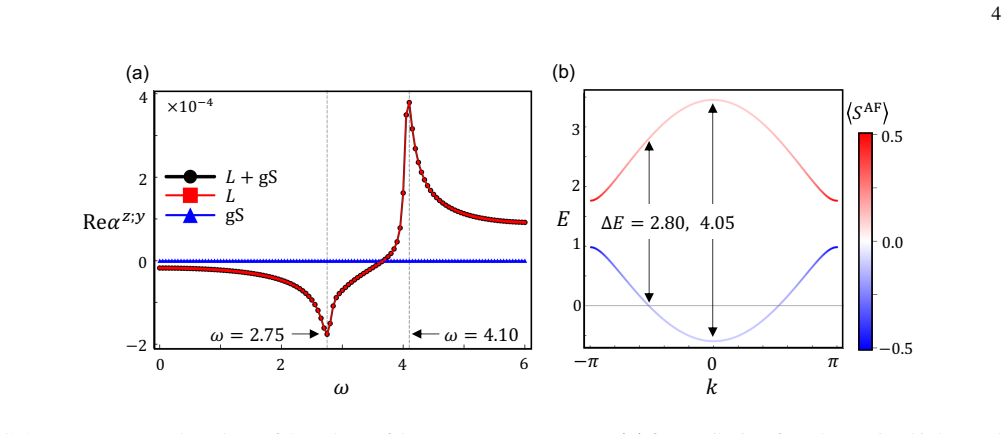
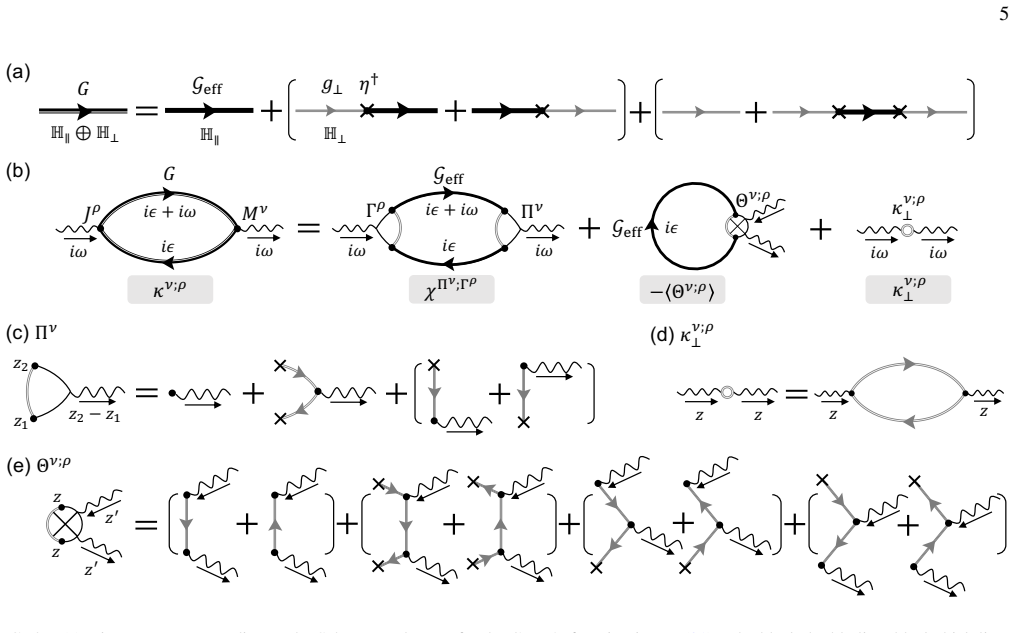
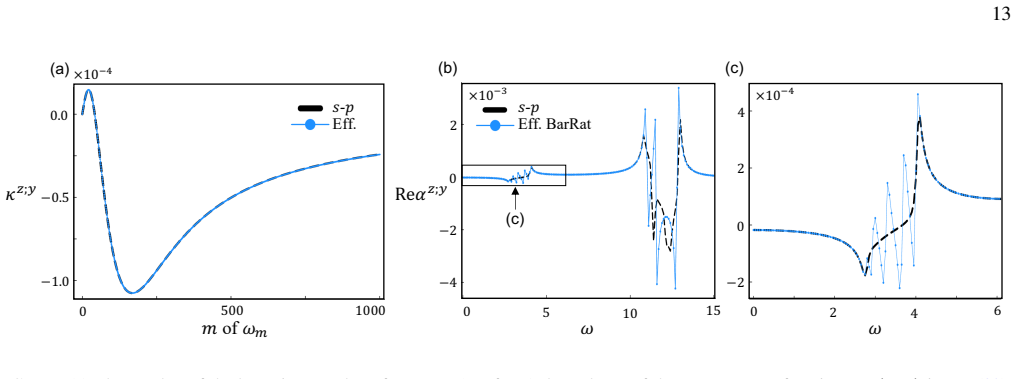
In the collinear antiferromagnetic zigzag chain, the magnetoelectric effect is governed by orbital degrees of freedom activated through s-p hybridization in the full multi-orbital tight-binding model, with the spin contribution vanishing due to spin conservation. Projecting onto the s-orbital subspace with the Schur complement produces an effective Hamiltonian for which the naive Kubo formula yields zero magnetoelectric response. Systematic inclusion of vertex corrections arising from orbital hybridization recovers the full result; a quasiparticle renormalization scheme yields a renormalized Kubo formula that preserves conservation laws and reproduces the multi-orbital calculation exactly.
What carries the argument
Vertex-corrected, renormalized Kubo formula applied after Schur-complement downfolding of the multi-orbital model to the s-orbital subspace.
If this is right
- Magnetoelectric responses in similar antiferromagnets cannot be read off directly from projected low-energy Hamiltonians.
- Orbital hybridization must be retained through vertex corrections even when working inside an effective single-orbital description.
- The renormalized Kubo formula provides a practical route to compute cross-correlated responses while respecting conservation laws.
- Spin contributions to the magnetoelectric effect are identically zero in this collinear zigzag geometry.
Where Pith is reading between the lines
- The same downfolding-plus-vertex-correction procedure could be used for other orbital-driven responses such as electric polarization or spin Hall effects in multi-orbital systems.
- Existing calculations that rely solely on minimal effective models for magnetoelectric materials may systematically underestimate the response strength.
- Extending the zigzag-chain analysis to two- or three-dimensional lattices would test whether the necessity of vertex corrections persists in higher dimensions.
- Material design could target specific s-p hybridization strengths to enhance magnetoelectric coupling without introducing additional spin-orbit terms.
Load-bearing premise
The chosen multi-orbital tight-binding model with explicit s-p hybridization faithfully captures the microscopic physics of the target materials without additional many-body effects.
What would settle it
Compute the magnetoelectric response in the full multi-orbital model with added Hubbard interactions or other many-body terms and check whether it still matches the vertex-corrected renormalized Kubo formula from the downfolded s-orbital model.
Figures




read the original abstract
Magnetoelectric (ME) effects in antiferromagnets provide a fertile platform for exploring symmetry-driven cross-correlated responses. However, their microscopic origin remains elusive and is often obscured in simplified low-energy descriptions. In this study, we revisit the microscopic mechanism of the ME effect in a collinear antiferromagnetic zigzag chain by employing a multi-orbital tight-binding model that explicitly includes both $s$- and $p$-orbital degrees of freedom. Using analytical and numerical calculations based on the Kubo formula, we demonstrate that the ME response is governed by orbital degrees of freedom activated through $s$--$p$ hybridization, while the spin contribution vanishes due to spin conservation. To elucidate the low-energy description, we derive an effective Hamiltonian projected onto the $s$-orbital subspace using the Schur complement. We show that a naive application of the Kubo formula within this effective model fails to capture the ME response. This issue is resolved by systematically incorporating vertex corrections in terms of orbital hybridization into the response functions. Furthermore, by introducing a quasiparticle renormalization scheme, we formulate a renormalized Kubo formula that preserves conservation laws and accurately reproduces the full multi-orbital results. Our analysis revisits the conventional low-energy perspective and reveals that the ME effect originates from virtual interorbital processes encoded in vertex corrections, rather than from the bare low-energy Hamiltonian. The effective framework developed here provides a unified microscopic understanding of orbital-driven ME responses and offers a systematic route to incorporate hybridization effects beyond simple low-energy models.
Editorial analysis
A structured set of objections, weighed in public.
Referee Report
Summary. The manuscript revisits the magnetoelectric (ME) response in collinear antiferromagnetic zigzag chains by constructing a multi-orbital tight-binding model that includes explicit s-p hybridization. It derives an effective Hamiltonian in the s-orbital subspace via the Schur complement, demonstrates that a naive Kubo-formula evaluation on this effective model yields zero ME response, and shows that the full multi-orbital calculation produces a finite orbital-driven ME effect. Vertex corrections arising from hybridization are introduced, together with a renormalized Kubo formula that preserves conservation laws and reproduces the full-model results, leading to the claim that the ME effect originates from virtual interorbital processes encoded in these corrections rather than from the bare low-energy Hamiltonian.
Significance. If the central claim holds, the work provides a concrete illustration of why naive projections of response functions can fail even when the effective Hamiltonian is correctly obtained, and supplies a systematic route (via vertex corrections and renormalization) to restore agreement with the microscopic model. The analytical consistency of the Schur-complement derivation with the numerical Kubo checks is a clear strength, as is the explicit separation of spin (vanishing) and orbital (finite) contributions. This framework could be useful for other low-dimensional antiferromagnets where orbital hybridization governs cross-correlated responses.
major comments (2)
- [Effective Hamiltonian and response-function sections] The section deriving the effective Hamiltonian via the Schur complement and the subsequent application of the Kubo formula should explicitly state how the projected current and polarization operators are obtained. If these operators are constructed by applying the identical Schur-complement procedure to the full response kernel, the vertex corrections should appear automatically; the manuscript must demonstrate this derivation rather than introducing the corrections to restore numerical agreement.
- [Numerical Kubo-formula results] The claim that the spin contribution to the ME response vanishes by spin conservation is central, yet the manuscript should provide an explicit decomposition (e.g., separate plots or tabulated values) of the ME coefficient into spin and orbital channels for both the full multi-orbital model and the effective model, confirming that the spin part is identically zero while the orbital part is recovered only after vertex corrections.
minor comments (2)
- Notation for the renormalized Kubo formula and the vertex-correction terms should be introduced with a clear table or equation block that distinguishes them from the bare operators.
- A brief statement on the range of parameters (hopping amplitudes, hybridization strength, filling) over which the renormalized formula remains accurate would help readers assess the robustness of the approach.
Simulated Author's Rebuttal
We thank the referee for the positive assessment and the recommendation for minor revision. The comments are constructive and help improve the clarity of our derivations and numerical results. We address each major comment below and will revise the manuscript accordingly.
read point-by-point responses
-
Referee: [Effective Hamiltonian and response-function sections] The section deriving the effective Hamiltonian via the Schur complement and the subsequent application of the Kubo formula should explicitly state how the projected current and polarization operators are obtained. If these operators are constructed by applying the identical Schur-complement procedure to the full response kernel, the vertex corrections should appear automatically; the manuscript must demonstrate this derivation rather than introducing the corrections to restore numerical agreement.
Authors: We agree that an explicit derivation of the projected operators strengthens the presentation. In the revised manuscript we will add a dedicated subsection deriving the current and polarization operators by applying the Schur complement directly to the full response kernel. This will show analytically that the vertex corrections emerge automatically from the projection, establishing equivalence with the corrections we introduced to match the microscopic results. The revised text will therefore present the corrections as a consequence of the proper operator projection rather than an independent restoration step. revision: yes
-
Referee: [Numerical Kubo-formula results] The claim that the spin contribution to the ME response vanishes by spin conservation is central, yet the manuscript should provide an explicit decomposition (e.g., separate plots or tabulated values) of the ME coefficient into spin and orbital channels for both the full multi-orbital model and the effective model, confirming that the spin part is identically zero while the orbital part is recovered only after vertex corrections.
Authors: We accept this suggestion and will enhance the numerical section with an explicit decomposition. The revised manuscript will include additional figures and a table showing the ME coefficient separated into spin and orbital channels for the full multi-orbital model, the bare effective model, and the effective model with vertex corrections. These will confirm that the spin channel remains identically zero in all cases (consistent with spin conservation) while the orbital channel is recovered only after the vertex corrections are included, matching the full-model value. revision: yes
Circularity Check
No significant circularity; derivation is self-contained via explicit projection and comparison
full rationale
The paper begins with a multi-orbital tight-binding model, applies the Schur complement to obtain an effective s-orbital Hamiltonian, demonstrates that the naive Kubo formula on this effective model yields zero ME response, then incorporates vertex corrections arising from s-p hybridization and a quasiparticle renormalization scheme to produce a renormalized Kubo formula that reproduces the full multi-orbital results. This chain is presented as a controlled low-energy limit with explicit benchmarks against the parent model; no equations reduce to their own inputs by construction, no parameters are fitted to match the target ME coefficient, and no load-bearing self-citations or ansatzes are invoked. The central claim follows directly from the comparison between naive and corrected response functions without circular reduction.
Axiom & Free-Parameter Ledger
axioms (2)
- standard math Kubo formula for linear response applies to the multi-orbital tight-binding Hamiltonian
- domain assumption Schur complement yields a valid effective Hamiltonian for the s-orbital subspace
Lean theorems connected to this paper
-
IndisputableMonolith/Cost/FunctionalEquation.leanwashburn_uniqueness_aczel unclear?
unclearRelation between the paper passage and the cited Recognition theorem.
We derive an effective Hamiltonian projected onto the s-orbital subspace using the Schur complement... vertex corrections in terms of orbital hybridization... renormalized Kubo formula
-
IndisputableMonolith/Foundation/AlphaCoordinateFixation.leanJ_uniquely_calibrated_via_higher_derivative unclear?
unclearRelation between the paper passage and the cited Recognition theorem.
naive application of the Kubo formula within this effective model fails to capture the ME response... resolved by systematically incorporating vertex corrections
What do these tags mean?
- matches
- The paper's claim is directly supported by a theorem in the formal canon.
- supports
- The theorem supports part of the paper's argument, but the paper may add assumptions or extra steps.
- extends
- The paper goes beyond the formal theorem; the theorem is a base layer rather than the whole result.
- uses
- The paper appears to rely on the theorem as machinery.
- contradicts
- The paper's claim conflicts with a theorem or certificate in the canon.
- unclear
- Pith found a possible connection, but the passage is too broad, indirect, or ambiguous to say the theorem truly supports the claim.
Reference graph
Works this paper leans on
-
[1]
Fiebig, Revival of the magnetoelectric effect, J
M. Fiebig, Revival of the magnetoelectric effect, J. Phys. D: Appl. Phys.38, R123 (2005)
work page 2005
-
[2]
N. A. Spaldin, M. Fiebig, and M. Mostovoy, The toroidal mo- ment in condensed-matter physics and its relation to the magne- toelectriceffect*, J. Phys.: Condens. Matter20, 434203 (2008)
work page 2008
-
[3]
Khomskii, Classifying multiferroics: Mechanisms and ef- fects, Physics2, 20 (2009)
D. Khomskii, Classifying multiferroics: Mechanisms and ef- fects, Physics2, 20 (2009)
work page 2009
- [4]
- [5]
- [6]
-
[7]
Y. Gao, D. Vanderbilt, and D. Xiao, Microscopic theory of spin toroidization in periodic crystals, Phys. Rev. B97, 134423 (2018)
work page 2018
-
[8]
A. Shitade, H. Watanabe, and Y. Yanase, Theory of orbital mag- netic quadrupole moment and magnetoelectric susceptibility, Phys. Rev. B98, 020407(R) (2018)
work page 2018
-
[9]
F. Th ¨ole and N. A. Spaldin, Magnetoelectric multipoles in met- als, Philos. Trans. R. Soc. A376, 20170450 (2018)
work page 2018
-
[10]
L. Ding, X. Xu, H. O. Jeschke, X. Bai, E. Feng, A. S. Ale- mayehu, J. Kim, F.-T. Huang, Q. Zhang, X. Ding, N. Harrison, V. Zapf, D. Khomskii, I. I. Mazin, S.-W. Cheong, and H. Cao, Field-tunable toroidal moment in a chiral-lattice magnet, Nat. Commun.12, 5339 (2021)
work page 2021
-
[11]
M. Yatsushiro, R. Oiwa, H. Kusunose, and S. Hayami, Analysis of model-parameter dependences on the second-order nonlin- ear conductivity inPT-symmetric collinear antiferromagnetic metals with magnetic toroidal moment on zigzag chains, Phys. Rev. B105, 155157 (2022)
work page 2022
-
[12]
A. Kirikoshi and S. Hayami, Finite-𝑞antiferrotoroidal and fer- ritoroidal order in a distorted kagome structure, Phys. Rev. B 111, L201112 (2025)
work page 2025
-
[13]
V. Dubovik and V. Tugushev, Toroid moments in electrodynam- ics and solid-state physics, Phys. Rep.187, 145 (1990)
work page 1990
-
[14]
Y. V. Kopaev, Toroidal ordering in crystals, Physics-Uspekhi52, 1111 (2009)
work page 2009
- [15]
-
[16]
S. Hayami and H. Kusunose, Unified description of electronic orderings and cross correlations by complete multipole repre- sentation, J. Phys. Soc. Jpn.93, 072001 (2024)
work page 2024
-
[17]
D.-F. Shao, S.-H. Zhang, G. Gurung, W. Yang, and E. Y. Tsym- bal, Nonlinear anomalous hall effect for n ´eel vector detection, Phys. Rev. Lett.124, 067203 (2020)
work page 2020
-
[18]
C. Wang, Y. Gao, and D. Xiao, Intrinsic nonlinear hall effect in antiferromagnetic tetragonal cumnas, Phys. Rev. Lett.127, 277201 (2021)
work page 2021
- [19]
-
[20]
A. Kirikoshi and S. Hayami, Microscopic mechanism for in- trinsic nonlinear anomalous hall conductivity in noncollinear antiferromagnetic metals, Phys. Rev. B107, 155109 (2023)
work page 2023
-
[21]
K. Sawada and N. Nagaosa, Optical magnetoelectric effect in multiferroic materials: Evidence for a lorentz force acting on a ray of light, Phys. Rev. Lett.95, 237402 (2005)
work page 2005
-
[22]
S. Miyahara and N. Furukawa, Nonreciprocal directional dichro- ism and toroidalmagnons in helical magnets, J. Phys. Soc. Jpn. 81, 023712 (2012)
work page 2012
- [23]
-
[24]
J. Mund, D. R. Yakovlev, A. N. Poddubny, R. M. Dubrovin, M. Bayer, and R. V. Pisarev, Toroidal nonreciprocity of optical second harmonic generation, Phys. Rev. B103, L180410 (2021)
work page 2021
- [25]
-
[26]
Y. Tokura and N. Nagaosa, Nonreciprocal responses from non- centrosymmetric quantum materials, Nat. Commun.9, 3740 15 (2018)
work page 2018
-
[27]
H. Isobe and N. Nagaosa, Toroidal scattering and nonreciprocal transport by magnetic impurities, J. Phys. Soc. Jpn.91, 115001 (2022)
work page 2022
-
[28]
T. Yamanaka, Y. Ihara, and S. Hayami, Nonlinear nonreciprocal electric conductivity driven by magnetic field gradients, J. Phys. Soc. Jpn.94, 083705 (2025)
work page 2025
-
[29]
K. Sudo, Y. Yanagi, M. Akaki, H. Tanida, and M. Kimata, Large spontaneous nonreciprocal charge transport in a zero- magnetization antiferromagnet, Phys. Rev. Lett.136, 016503 (2026)
work page 2026
-
[30]
Mostovoy, Ferroelectricity in spiral magnets, Phys
M. Mostovoy, Ferroelectricity in spiral magnets, Phys. Rev. Lett. 96, 067601 (2006)
work page 2006
-
[31]
S. Hayami and M. Yatsushiro, Nonlinear nonreciprocal transport in antiferromagnets free from spin-orbit coupling, Phys. Rev. B 106, 014420 (2022)
work page 2022
- [32]
-
[33]
Yanase, Magneto-electric effect in three-dimensional coupled zigzag chains, J
Y. Yanase, Magneto-electric effect in three-dimensional coupled zigzag chains, J. Phys. Soc. Jpn.83, 014703 (2014)
work page 2014
-
[34]
T. P. Cysne, F. S. M. Guimar ˜aes, L. M. Canonico, T. G. Rap- poport, and R. B. Muniz, Orbital magnetoelectric effect in zigzag nanoribbons of𝑝-band systems, Phys. Rev. B104, 165403 (2021)
work page 2021
-
[35]
J. C. Slater and G. F. Koster, Simplified lcao method for the periodic potential problem, Phys. Rev.94, 1498 (1954)
work page 1954
- [36]
-
[37]
H. Watanabe and Y. Yanase, Group-theoretical classification of multipole order: Emergent responses and candidate materials, Phys. Rev. B98, 245129 (2018)
work page 2018
-
[38]
M. Yatsushiro, H. Kusunose, and S. Hayami, Multipole classi- fication in 122 magnetic point groups for unified understanding of multiferroic responses and transport phenomena, Phys. Rev. B104, 054412 (2021)
work page 2021
-
[39]
A. M. Essin, J. E. Moore, and D. Vanderbilt, Magnetoelectric polarizability and axion electrodynamics in crystalline insula- tors, Phys. Rev. Lett.102, 146805 (2009)
work page 2009
-
[40]
S. Coh, D. Vanderbilt, A. Malashevich, and I. Souza, Chern- simons orbital magnetoelectric coupling in generic insulators, Phys. Rev. B83, 085108 (2011)
work page 2011
-
[41]
S. Gassner and E. J. Mele, Regularized lattice theory for spatially dispersive nonlinear optical conductivities, Phys. Rev. B108, 085403 (2023)
work page 2023
- [42]
-
[43]
L ¨owdin, Studies in perturbation theory
P.-O. L ¨owdin, Studies in perturbation theory. iv. solution of eigenvalue problem by projection operator formalism, J. Math. Phys.3, 969 (1962)
work page 1962
-
[44]
Feshbach, Unified theory of nuclear reactions, Rev
H. Feshbach, Unified theory of nuclear reactions, Rev. Mod. Phys.36, 1076 (1964)
work page 1964
-
[45]
J. Leinaas and T. Kuo, Convergence properties of the brillouin- wigner type of perturbation expansion, Ann, of Phys.111, 19 (1978)
work page 1978
-
[46]
N. Hatano and G. Ordonez, Time-reversal symmetric resolution of unity without background integrals in open quantum systems, J. Math. Phys.55, 122106 (2014)
work page 2014
-
[47]
A. Altland and B. D. Simons,Condensed Matter Field Theory, 2nd ed. (Cambridge University Press, 2010)
work page 2010
-
[48]
J. ¯Oik´e and R. Peters, Impact of electron correlations on the nonlinear edelstein effect, Phys. Rev. B110, 165111 (2024)
work page 2024
-
[49]
D. E. Parker, T. Morimoto, J. Orenstein, and J. E. Moore, Dia- grammatic approach to nonlinear optical response with applica- tion to weyl semimetals, Phys. Rev. B99, 045121 (2019)
work page 2019
-
[50]
J. M. Luttinger and J. C. Ward, Ground-state energy of a many- fermion system. ii, Phys. Rev.118, 1417 (1960)
work page 1960
-
[51]
G. H. Golub and C. F. Van Loan,Matrix Computations, 4th ed. (Johns Hopkins University Press, Philadelphia, PA, 2013)
work page 2013
-
[52]
J. C. Ward, An identity in quantum electrodynamics, Phys. Rev. 78, 182 (1950)
work page 1950
-
[53]
Takahashi, On the generalized ward identity, Il Nuovo Ci- mento6, 371 (1957)
Y. Takahashi, On the generalized ward identity, Il Nuovo Ci- mento6, 371 (1957)
work page 1957
-
[54]
Taylor, Ward identities and charge renormalization of the yang-mills field, Nucl
J. Taylor, Ward identities and charge renormalization of the yang-mills field, Nucl. Phys. B33, 436 (1971)
work page 1971
-
[55]
J. A. Hertz and D. M. Edwards, Electron-magnon interactions in itinerant ferromagnetism. i. formal theory, J. Phys. F3, 2174 (1973)
work page 1973
-
[56]
L. Huang and C. Yue, Barycentric rational function approxi- mation made simple: A fast analytic continuation method for matsubara green’s functions, Phys. Rev. B111, 125139 (2025)
work page 2025
-
[57]
R. Oiwa and H. Kusunose, Systematic analysis method for non- linear response tensors, J. Phys. Soc. Jpn.91, 014701 (2022)
work page 2022
-
[58]
A. I. Tursina, S. N. Nesterenko, E. V. Murashova, I. V. Cherny- shev, H. No ¨el, and Y. D. Seropegin, CeRu 2Al10 with the YbFe2Al10 structure type, Acta Crystallogr. Sect. E61, i12 (2005)
work page 2005
-
[59]
H. Kato, R. Kobayashi, T. Takesaka, T. Nishioka, M. Mat- sumura, K. Kaneko, and N. Metoki, Magnetic structure deter- mination of Ce𝑇2Al10 (𝑇=Ru and Os): Single crystal neutron diffraction studies, J. Phys. Soc. Jpn.80, 073701 (2011)
work page 2011
- [60]
-
[61]
D. T. Adroja, A. D. Hillier, Y. Muro, T. Takabatake, A. M. Strydom, A. Bhattacharyya, A. Daoud-Aladin, and J. W. Taylor, Muon-spin-relaxation and inelastic neutron scattering investiga- tions of the caged-type kondo semimetals: Ce𝑇 2Al10 (𝑇=Fe, Ru and Os), Phys. Scr.88, 068505 (2013)
work page 2013
-
[62]
G. Motoyama, M. Sezaki, J. Gouchi, K. Miyoshi, S. Nishigori, T. Mutou, K. Fujiwara, and Y. Uwatoko, Magnetic properties of new antiferromagnetic heavy-fermion compounds, Ce3TiBi5 and Ce3TiBi4, Phys. B: Condens. Matter536, 142 (2018)
work page 2018
-
[63]
M. Shinozaki, G. Motoyama, T. Mutou, S. Nishigori, A. Yam- aguchi, K. Fujiwara, K. Miyoshi, and A. Sumiyama, Study for current-induced magnetization in ferrotoroidal ordered state of Ce3TiBi5, JPS Conf. Proc.30, 011189 (2020)
work page 2020
-
[64]
M. Shinozaki, G. Motoyama, M. Tsubouchi, M. Sezaki, J. Gouchi, S. Nishigori, T. Mutou, A. Yamaguchi, K. Fujiwara, K. Miyoshi, and Y. Uwatoko, Magnetoelectric effect in the anti- ferromagnetic ordered state of Ce3TiBi5 with ce zig-zag chains, J. Phys. Soc. Jpn.89, 033703 (2020)
work page 2020
-
[65]
Magnetic properties of new antiferromagnetic compound of Ce3ZrBi5, JPS Conf. Proc.30, 011180 (2020)
work page 2020
-
[66]
S. Suzuki, K. Takubo, K. Kuga, W. Higemoto, T. U. Ito, T. Tomita, Y. Shimura, Y. Matsumoto, C. Bareille, H. Wadati, S. Shin, and S. Nakatsuji, High-temperature antiferromagnetism in Yb based heavy fermion systems proximate to a kondo insu- lator, Phys. Rev. Res.3, 023140 (2021)
work page 2021
- [67]
-
[68]
A. A. Mostofi, J. R. Yates, Y.-S. Lee, I. Souza, D. Vanderbilt, 16 and N. Marzari, Wannier90: A tool for obtaining maximally- localised Wannier functions, Comput. Phys. Commun.178, 685 (2008)
work page 2008
-
[69]
Ozaki, Closest Wannier functions to a given set of localized orbitals, Phys
T. Ozaki, Closest Wannier functions to a given set of localized orbitals, Phys. Rev. B110, 125115 (2024)
work page 2024
-
[70]
R. Oiwa, A. Inda, S. Hayami, T. Nomoto, R. Arita, and H. Kusunose, Symmetry-adapted closest Wannier modeling based on complete multipole basis set, Phys. Rev. B112, 035116 (2025)
work page 2025
discussion (0)
Sign in with ORCID, Apple, or X to comment. Anyone can read and Pith papers without signing in.