Recognition: 2 theorem links
· Lean TheoremFirst Interstellar Detection of Methyl Carbamate: A New Observational Anchor for Glycine Chemistry
Pith reviewed 2026-05-11 01:00 UTC · model grok-4.3
The pith
Methyl carbamate has been detected for the first time in interstellar space, serving as a new observational anchor for glycine chemistry.
A machine-rendered reading of the paper's core claim, the machinery that carries it, and where it could break.
Core claim
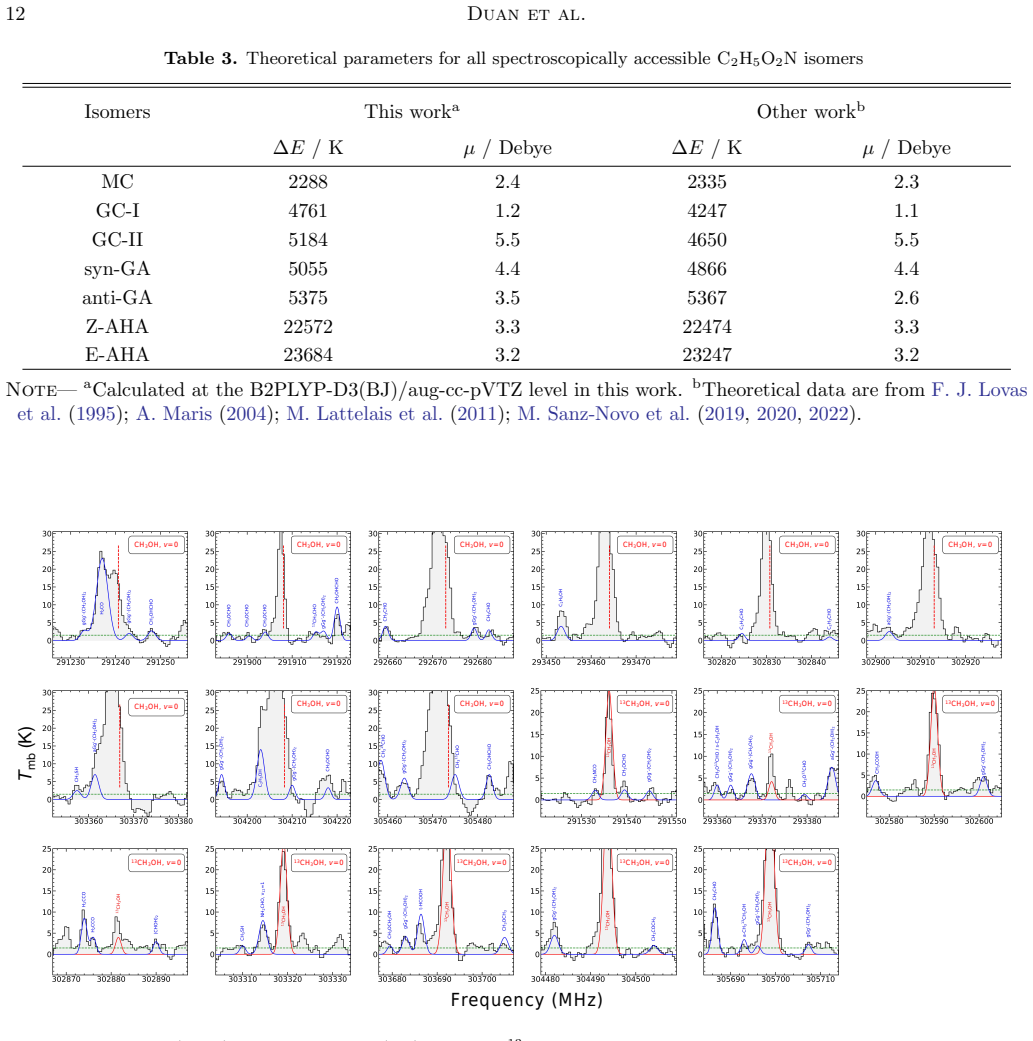
Ten unblended rotational transitions of methyl carbamate are identified toward G358.93-0.03 MM1, giving a column density of (4.21 ± 0.84) × 10^15 cm^{-2} and an excitation temperature of 204 ± 10 K. No other C2H5O2N isomers, including glycine, are detected. The resulting abundance ratios deviate from Minimum Energy Principle expectations, indicating that kinetic processes dominate over thermodynamic equilibrium. The observed abundance matches a grain-surface formation pathway via CH3O + NH2CO recombination and correlates with methanol and formamide abundances across environments.
What carries the argument
The grain-surface radical-radical recombination of CH3O and NH2CO that produces methyl carbamate, together with its observed abundance correlations with methanol and formamide.
If this is right
- The C2H5O2N isomer family in hot cores is controlled by kinetic chemistry rather than thermodynamic equilibrium.
- Methyl carbamate forms on grain surfaces through the same radical recombination that may lead to glycine.
- Upper limits on glycine and other isomers constrain the efficiency of their formation routes in the same source.
- Methyl carbamate can now be used as a reference molecule to test glycine formation models in additional star-forming regions.
Where Pith is reading between the lines
- Detections of methyl carbamate in other hot cores could map the spatial distribution of glycine-precursor chemistry across different star-forming environments.
- If kinetic control is common in this isomer family, similar deviations from equilibrium may appear in other complex organic molecule families observed in the same regions.
- Laboratory measurements of additional C2H5O2N isomers without existing spectra would allow tighter tests of the kinetic versus thermodynamic balance.
Load-bearing premise
The ten transitions are truly unblended, correctly assigned to methyl carbamate, and free of significant contamination from other species, with laboratory rest frequencies remaining accurate under interstellar conditions.
What would settle it
A higher-resolution spectrum or independent re-analysis that shows one or more of the ten lines is blended with another molecule or misassigned would remove the detection and its chemical implications.
Figures


read the original abstract
Glycine-the simplest amino acid-has remained undetected in the interstellar medium despite decades of sensitive searches, motivating alternative approaches to constrain its astrochemical origin. A promising strategy is to investigate the broader $\rm C_{2}H_{5}O_{2}N$ isomer family and identify detectable members that can serve as observational anchors for glycine-related chemistry. Herein, we report the first robust interstellar detection of methyl carbamate toward the hot molecular core G358.93-0.03 MM1 using ALMA 1 mm observations. Ten unblended rotational transitions are identified, yielding a column density of (4.21$\pm0.84)\times10^{15} \rm cm^{-2}$ and an excitation temperature of $204\pm10$ K. We also searched for other $\rm C_{2}H_{5}O_{2}N$ isomers with available rotational spectroscopic data, including glycine, but none were detected, allowing us to derive upper limits on their column densities. The resulting abundance pattern deviates significantly from the Minimum Energy Principle predictions, highlighting that the $\rm C_{2}H_{5}O_{2}N$ family is shaped primarily by kinetic chemical process rather than thermodynamic equilibrium. The observed methyl carbamate abundance is consistent with a grain-surface formation scenario involving radical-radical recombination ($\rm CH_{3}$O + $\rm NH_{2}$CO), further supported by its correlated abundances with its proposed precursors, methanol and formamide, across diverse astrophysical environments. This detection establishes methyl carbamate as a new observational anchor for glycine chemistry, providing critical constraints on the formation pathways of amino-acid-related molecules in star-forming regions.
Editorial analysis
A structured set of objections, weighed in public.
Referee Report
Summary. The paper claims the first robust interstellar detection of methyl carbamate in the hot molecular core G358.93-0.03 MM1 using ALMA 1 mm observations. Ten unblended rotational transitions are identified, from which a column density of (4.21 ± 0.84) × 10^{15} cm^{-2} and an excitation temperature of 204 ± 10 K are derived. Upper limits are set on other C2H5O2N isomers, including glycine, and the abundance pattern is used to argue that the chemistry is kinetically controlled rather than following the Minimum Energy Principle, supporting a grain-surface formation route involving CH3O and NH2CO radicals.
Significance. If the identification holds, this represents a significant advance by providing a new observational anchor for glycine-related chemistry in star-forming regions. The direct detection, non-detections of isomers, and correlation with precursors offer concrete constraints on astrochemical models. The manuscript benefits from being based on observational data rather than theoretical derivation.
major comments (1)
- [Abstract] The detection is based on ten unblended lines leading to the quoted column density and temperature. However, the manuscript does not include the list of transition frequencies, quantum numbers, or the full LTE model that demonstrates these lines are unblended and that all other known molecular carriers have been properly subtracted at those frequencies. Given the high line density in hot cores (>1 line per 10 MHz), this information is essential to substantiate the claim.
minor comments (1)
- The abstract contains LaTeX commands such as rm that should be rendered properly in the final manuscript.
Simulated Author's Rebuttal
We thank the referee for their constructive review and positive evaluation of the scientific significance of our detection. We have revised the manuscript to address the major comment by providing the requested spectroscopic details and modeling information.
read point-by-point responses
-
Referee: [Abstract] The detection is based on ten unblended lines leading to the quoted column density and temperature. However, the manuscript does not include the list of transition frequencies, quantum numbers, or the full LTE model that demonstrates these lines are unblended and that all other known molecular carriers have been properly subtracted at those frequencies. Given the high line density in hot cores (>1 line per 10 MHz), this information is essential to substantiate the claim.
Authors: We agree that explicit documentation of the ten unblended transitions and the supporting LTE model is necessary to substantiate the identification in a high line-density environment. In the revised manuscript we have added Table 2, which lists the rest frequencies, quantum numbers (J, K_a, K_c), upper-state energies, and integrated intensities for all ten transitions. We have also included a new figure (Figure 3) that overlays the observed ALMA spectrum with the best-fit LTE model for methyl carbamate (generated with CASSIS under the derived N = 4.21 × 10^{15} cm^{-2}, T_ex = 204 K, and ΔV = 3.5 km s^{-1}), together with the residual spectrum after subtraction of the methyl carbamate model and all other catalogued molecular carriers at those frequencies. The figure caption and methods section now explicitly state that no other known species contribute significantly to the observed line profiles, confirming that the features remain unblended. These additions directly address the concern while preserving the original column-density and temperature values. revision: yes
Circularity Check
No significant circularity; direct observational detection from ALMA data
full rationale
The paper's core claim is the identification of ten unblended rotational transitions of methyl carbamate in ALMA 1 mm spectra toward G358.93-0.03 MM1, followed by standard LTE fitting to derive column density (4.21±0.84)×10^15 cm^{-2} and T_ex=204±10 K. This is a direct data reduction and parameter estimation step using laboratory rest frequencies, with no equations or self-citations that reduce the reported values to inputs defined by the authors' prior work. Searches for other C2H5O2N isomers and upper limits are likewise observational. Interpretive sections on abundance patterns versus Minimum Energy Principle or grain-surface formation are post-hoc comparisons, not load-bearing derivations. The paper remains self-contained against external laboratory spectroscopy benchmarks.
Axiom & Free-Parameter Ledger
free parameters (2)
- column density =
(4.21±0.84)×10^{15} cm^{-2}
- excitation temperature =
204±10 K
axioms (2)
- domain assumption Laboratory-measured rest frequencies of methyl carbamate accurately match the interstellar environment.
- domain assumption The source can be described by a single excitation temperature and column density (LTE approximation).
Lean theorems connected to this paper
-
IndisputableMonolith/Cost/FunctionalEquation.leanwashburn_uniqueness_aczel unclear?
unclearRelation between the paper passage and the cited Recognition theorem.
Ten unblended rotational transitions are identified, yielding a column density of (4.21±0.84)×10^{15} cm^{-2} and an excitation temperature of 204±10 K... The resulting abundance pattern deviates significantly from the Minimum Energy Principle predictions
-
IndisputableMonolith/Foundation/BranchSelection.leanbranch_selection unclear?
unclearRelation between the paper passage and the cited Recognition theorem.
the C2H5O2N family is shaped primarily by kinetic chemical process rather than thermodynamic equilibrium... grain-surface formation scenario involving radical-radical recombination (CH3O + NH2CO)
What do these tags mean?
- matches
- The paper's claim is directly supported by a theorem in the formal canon.
- supports
- The theorem supports part of the paper's argument, but the paper may add assumptions or extra steps.
- extends
- The paper goes beyond the formal theorem; the theorem is a base layer rather than the whole result.
- uses
- The paper appears to rely on the theorem as machinery.
- contradicts
- The paper's claim conflicts with a theorem or certificate in the canon.
- unclear
- Pith found a possible connection, but the passage is too broad, indirect, or ambiguous to say the theorem truly supports the claim.
Reference graph
Works this paper leans on
-
[1]
2016, Science Advances, 2, e1600285, doi: 10.1126/sciadv.1600285
Altwegg, K., Balsiger, H., Bar-Nun, A., et al. 2016, Science Advances, 2, e1600285, doi: 10.1126/sciadv.1600285
-
[2]
2002, Journal of Molecular Spectroscopy, 215, 312, doi: https://doi.org/10.1006/jmsp.2002.8647
Bakri, B., Demaison, J., Kleiner, I., et al. 2002, Journal of Molecular Spectroscopy, 215, 312, doi: https://doi.org/10.1006/jmsp.2002.8647
-
[3]
Belloche, A., Garrod, R. T., M¨ uller, H. S. P., et al. 2019, A&A, 628, A10, doi: 10.1051/0004-6361/201935428
-
[4]
Belloche, A., Meshcheryakov, A. A., Garrod, R. T., et al. 2017, A&A, 601, A49, doi: 10.1051/0004-6361/201629724
-
[5]
Bonfand, M., Belloche, A., Garrod, R. T., et al. 2019, A&A, 628, A27, doi: 10.1051/0004-6361/201935523 Methyl Carbamate13
-
[6]
Brogan, C. L., Hunter, T. R., Towner, A. P. M., et al. 2019, ApJL, 881, L39, doi: 10.3847/2041-8213/ab2f8a
-
[7]
2012, in 39th COSPAR Scientific Assembly, Vol
Burton, A., Dworkin, J., Callahan, M., Glavin, D., & Elsila, J. 2012, in 39th COSPAR Scientific Assembly, Vol. 39, 264
2012
-
[8]
Chen, X., Sobolev, A. M., Ren, Z.-Y., et al. 2020, Nature Astronomy, 4, 1170, doi: 10.1038/s41550-020-1144-x
-
[9]
Chen, Z., Li, Z., & Tian, S. X. 2024, Chinese Journal of Chemical Physics, 37, 24, doi: 10.1063/1674-0068/cjcp2304037
-
[10]
1992, Nature, 355, 125, doi: 10.1038/355125a0
Chyba, C., & Sagan, C. 1992, Nature, 355, 125, doi: 10.1038/355125a0
-
[11]
Chyba, C. F., Thomas, P. J., Brookshaw, L., & Sagan, C. 1990, Science, 249, 366, doi: 10.1126/science.11538074
-
[12]
Colzi, L., Rivilla, V. M., Beltr´ an, M. T., et al. 2021, A&A, 653, A129, doi: 10.1051/0004-6361/202141573
-
[13]
2021,, 2.0.0 Zenodo, doi: 10.5281/zenodo.4905459
Comrie, A., Wang, K.-S., Hsu, S.-C., et al. 2021,, 2.0.0 Zenodo, doi: 10.5281/zenodo.4905459
-
[14]
Coutens, A., Jørgensen, J. K., van der Wiel, M. H. D., et al. 2016, A&A, 590, L6, doi: 10.1051/0004-6361/201628612
-
[15]
Cronin, J. R., & Pizzarello, S. 1983, Advances in Space Research, 3, 5, doi: 10.1016/0273-1177(83)90036-4
-
[16]
Cunningham, M. R., Jones, P. A., Godfrey, P. D., et al. 2007, MNRAS, 376, 1201, doi: 10.1111/j.1365-2966.2007.11504.x
-
[17]
Dean, A. M., & Westmoreland, P. R. 1987, International Journal of Chemical Kinetics, 19, 207, doi: https://doi.org/10.1002/kin.550190305
-
[18]
2004, in SF2A-2004: Semaine de l’Astrophysique Francaise, ed
Demyk, K., Wlodarczak, G., & Dartois, E. 2004, in SF2A-2004: Semaine de l’Astrophysique Francaise, ed. F. Combes, D. Barret, T. Contini, F. Meynadier, & L. Pagani, 493
2004
-
[19]
Tentative Detection of the Glycine Isomer Glycolamide in Hot Molecular Core
Duan, C., Xu, F., Gou, Q., et al. 2026, https://arxiv.org/abs/2603.23170
work page internal anchor Pith review Pith/arXiv arXiv 2026
-
[20]
J., Trucks, G
Frisch, M. J., Trucks, G. W., Schlegel, H. B., et al. 2016, Gaussian 16, Revision A.03, Gaussian, Inc., Wallingford,
2016
-
[21]
Corchado, J., Rivilla, V. M., & Mart´ ın-Pintado, J. 2021, ApJL, 912, L6, doi: 10.3847/2041-8213/abf650
-
[22]
Garrod, R. T. 2013, ApJ, 765, 60, doi: 10.1088/0004-637X/765/1/60
-
[23]
Garrod, R. T., Jin, M., Matis, K. A., et al. 2022, ApJS, 259, 1, doi: 10.3847/1538-4365/ac3131
-
[24]
Herbst, E., & van Dishoeck, E. F. 2009, ARA&A, 47, 427, doi: 10.1146/annurev-astro-082708-101654
-
[25]
Ilyushin, V., Alekseev, E., Demaison, J., & Kleiner, I. 2006, Journal of Molecular Spectroscopy, 240, 127, doi: https://doi.org/10.1016/j.jms.2006.09.008 Jim´ enez-Serra, I., Vasyunin, A. I., Caselli, P., et al. 2016, ApJL, 830, L6, doi: 10.3847/2041-8205/830/1/L6 Jim´ enez-Serra, I., Mart´ ın-Pintado, J., Rivilla, V. M., et al. 2020, Astrobiology, 20, 10...
-
[26]
Ram Pressure Stripping of Disc Galaxies: The Role of the Inclination Angle , shorttitle =
Jones, P. A., Cunningham, M. R., Godfrey, P. D., & Cragg, D. M. 2007, MNRAS, 374, 579, doi: 10.1111/j.1365-2966.2006.11175.x Jørgensen, J. K., Belloche, A., & Garrod, R. T. 2020, ARA&A, 58, 727, doi: 10.1146/annurev-astro-032620-021927
-
[27]
Kauffmann, J., Bertoldi, F., Bourke, T. L., Evans, N. J., I., & Lee, C. W. 2008, A&A, 487, 993, doi: 10.1051/0004-6361:200809481
-
[28]
B., Huang, H.-C., Tseng, W.-L., & Kisiel, Z
Kuan, Y.-J., Charnley, S. B., Huang, H.-C., Tseng, W.-L., & Kisiel, Z. 2003, ApJ, 593, 848, doi: 10.1086/375637
-
[29]
2009, ApJL, 696, L133, doi: 10.1088/0004-637X/696/2/L133
Lattelais, M., Pauzat, F., Ellinger, Y., & Ceccarelli, C. 2009, ApJL, 696, L133, doi: 10.1088/0004-637X/696/2/L133
-
[30]
2011, A&A, 532, A39, doi: 10.1051/0004-6361/201016039
Ceccarelli, C. 2011, A&A, 532, A39, doi: 10.1051/0004-6361/201016039
-
[31]
Lee, C.-W., Kim, J.-K., Moon, E.-S., Minh, Y. C., & Kang, H. 2009, ApJ, 697, 428, doi: 10.1088/0004-637X/697/1/428 L´ opez-Sepulcre, A., Sakai, N., Neri, R., et al. 2017, A&A, 606, A121, doi: 10.1051/0004-6361/201630334
-
[32]
J., Kawashima, Y., Grabow, J.-U., et al
Lovas, F. J., Kawashima, Y., Grabow, J.-U., et al. 1995, ApJL, 455, L201, doi: 10.1086/309844
-
[33]
2011, A&A, 526, A47, doi: 10.1051/0004-6361/201015487
Maret, S., Hily-Blant, P., Pety, J., Bardeau, S., & Reynier, E. 2011, A&A, 526, A47, doi: 10.1051/0004-6361/201015487
-
[34]
Maris, A. 2004, Phys. Chem. Chem. Phys., 6, 2611, doi: 10.1039/B401081G
-
[35]
1999, Acta Chemica Scandinavica, 53, 79
Marstokk, K., & Mollendal, H. 1999, Acta Chemica Scandinavica, 53, 79
1999
-
[36]
Mininni, C., Beltr´ an, M. T., Rivilla, V. M., et al. 2020, A&A, 644, A84, doi: 10.1051/0004-6361/202038966
-
[37]
Pickett, H. M., Poynter, R. L., Cohen, E. A., et al. 1998, JQSRT, 60, 883, doi: 10.1016/S0022-4073(98)00091-0
-
[38]
2023, Nature Communications, 14, 1482, doi: 10.1038/s41467-023-37107-6
Potiszil, C., Ota, T., Yamanaka, M., et al. 2023, Nature Communications, 14, 1482, doi: 10.1038/s41467-023-37107-6
-
[39]
Powell, M. J. D. 1964, The Computer Journal, 7, 155, doi: 10.1093/comjnl/7.2.155
-
[40]
M., Sanz-Novo, M., Jim´ enez-Serra, I., et al
Rivilla, V. M., Sanz-Novo, M., Jim´ enez-Serra, I., et al. 2023, ApJL, 953, L20, doi: 10.3847/2041-8213/ace977
-
[41]
2020, ApJ, 899, 65, doi: 10.3847/1538-4357/aba0a5
Sahu, D., Liu, S.-Y., Das, A., Garai, P., & Wakelam, V. 2020, ApJ, 899, 65, doi: 10.3847/1538-4357/aba0a5
-
[42]
Sanz-Novo, M., Alonso, J. L., Rivilla, V. M., et al. 2022, A&A, 666, A134, doi: 10.1051/0004-6361/202244330 14Duan et al
-
[43]
2019, ACS Earth and Space Chemistry, 3, 1170, doi: 10.1021/acsearthspacechem.9b00053
Sanz-Novo, M., Largo, A., Redondo, P., & Barrientos, C. 2019, ACS Earth and Space Chemistry, 3, 1170, doi: 10.1021/acsearthspacechem.9b00053
-
[44]
Sanz-Novo, M., Belloche, A., Alonso, J. L., et al. 2020, A&A, 639, A135, doi: 10.1051/0004-6361/202038149
-
[45]
Snyder, L. E., Lovas, F. J., Hollis, J. M., et al. 2005, ApJ, 619, 914, doi: 10.1086/426677
-
[46]
2004, Chemical Engineering & Technology, 27, 435, doi: https://doi.org/10.1002/ceat.200401911
Sun, J., Yang, B., & Lin, H. 2004, Chemical Engineering & Technology, 27, 435, doi: https://doi.org/10.1002/ceat.200401911
-
[47]
T., Henkel , C., Kobayashi , C., et al
Yan, Y. T., Henkel, C., Kobayashi, C., et al. 2023, A&A, 670, A98, doi: 10.1051/0004-6361/202244584
-
[48]
Zeng, S., Jim´ enez-Serra, I., Rivilla, V. M., et al. 2018, MNRAS, 478, 2962, doi: 10.1093/mnras/sty1174
-
[49]
M., Jim´ enez-Serra, I., et al
Zeng, S., Rivilla, V. M., Jim´ enez-Serra, I., et al. 2023, MNRAS, 523, 1448, doi: 10.1093/mnras/stad1478
discussion (0)
Sign in with ORCID, Apple, or X to comment. Anyone can read and Pith papers without signing in.