Recognition: 2 theorem links
· Lean TheoremFloquet second-order topological insulator in strained graphene
Pith reviewed 2026-05-11 02:29 UTC · model grok-4.3
The pith
Uniaxial strain and off-resonant circular light create a Floquet second-order topological insulator in graphene with protected corner modes.
A machine-rendered reading of the paper's core claim, the machinery that carries it, and where it could break.
Core claim
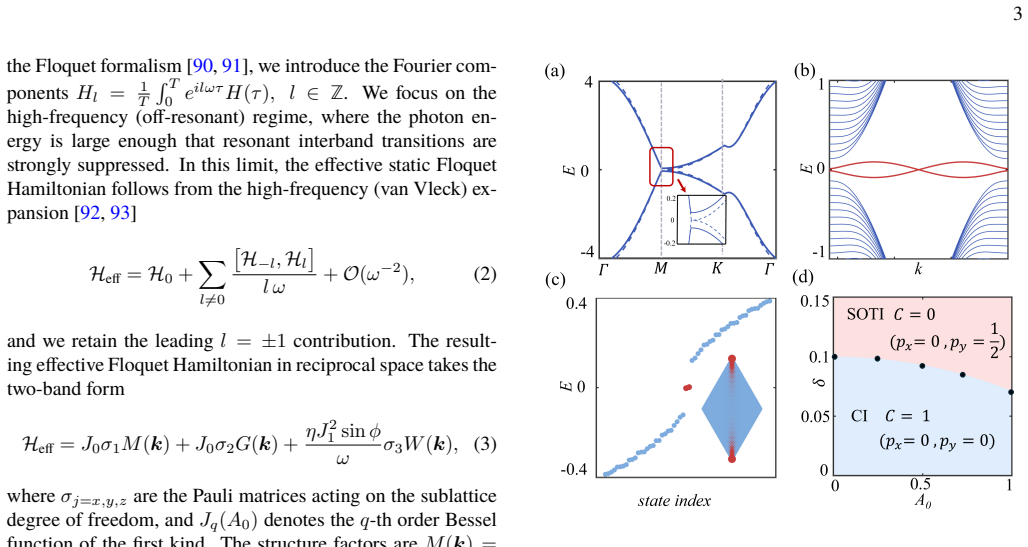
In a strained honeycomb tight-binding model with Peierls substitution for the vector potential, off-resonant circular drive at oblique incidence projects to an elliptically polarized field whose anisotropic mass term, when combined with uniaxial strain, opens a gap while preserving a quantized polarization invariant; this invariant guarantees in-gap corner modes in finite geometries even though the bulk Chern number is zero, thereby realizing a Floquet second-order topological insulator whose phase boundary is controlled by strain magnitude and incidence angle.
What carries the argument
The high-frequency effective Floquet Hamiltonian that incorporates uniaxial strain and the elliptically polarized component from oblique incidence, which produces an anisotropic Dirac mass and stabilizes a crystalline-symmetry-quantized polarization.
If this is right
- The phase can be entered and exited by continuously varying either the strain strength or the light incidence angle, producing a tunable phase diagram.
- The corner modes are protected by the polarization invariant and therefore survive smooth deformations that preserve the relevant crystalline symmetries.
- First-principles tight-binding calculations on realistic nanostructures reproduce the same topological evolution, indicating the effect should be observable in fabricated samples.
- The bulk remains topologically trivial by the Chern number yet hosts higher-order boundary states, separating this phase from conventional Floquet Chern insulators.
Where Pith is reading between the lines
- The same strain-plus-oblique-drive protocol could be applied to other Dirac materials such as transition-metal dichalcogenides to generate analogous corner modes.
- Time-resolved local probes could map the corner-state wavefunctions and their dependence on drive parameters in real devices.
- Because the drive is off-resonant, heating effects are expected to be weaker than in resonant Floquet schemes, potentially extending the lifetime of the corner states.
- Engineering the strain direction relative to the light polarization axis offers an extra control knob for switching between first-order and second-order topological regimes.
Load-bearing premise
The high-frequency expansion remains accurate for the chosen drive frequency and the strained tight-binding model with Peierls coupling fully captures the light-matter interaction without higher-order corrections.
What would settle it
In a finite strained graphene flake illuminated by off-resonant circularly polarized light at oblique incidence, the appearance of robust in-gap states localized at the corners while the edges stay fully gapped would confirm the predicted second-order phase.
Figures


read the original abstract
Graphene provides a canonical setting for Floquet band engineering, where circularly polarized light can dynamically open topological gaps at Dirac points and generate nonequilibrium Hall responses. Here we show that uniaxial strain and off-resonant circularly polarized light with tunable incidence angle enable a controllable route to Floquet higher-order topology in graphene. Using a strained honeycomb tight-binding model with Peierls coupling and a high-frequency expansion for the effective Floquet Hamiltonian, we find that strain drives the Dirac cones toward the Dirac-merging (semi-Dirac) critical regime, where the light-induced mass becomes strongly anisotropic. For oblique incidence, the projected drive is effectively elliptically polarized and, in combination with strain, stabilizes a phase with gapped edges but robust in-gap corner modes in finite geometries, realizing a Floquet second-order topological insulator. We characterize the phase diagram via the Chern number and a crystalline-symmetry-quantized polarization invariant. Finally, first-principles-informed tight-binding calculations corroborate the predicted topological evolution in strained graphene nanostructures. Our results identify driven strained graphene as a realistic and tunable platform for realizing and diagnosing Floquet higher-order topological phases.
Editorial analysis
A structured set of objections, weighed in public.
Referee Report
Summary. The manuscript claims that uniaxial strain combined with off-resonant circularly polarized light at tunable incidence angles provides a controllable route to a Floquet second-order topological insulator in graphene. A strained honeycomb tight-binding model with Peierls coupling is used together with a high-frequency expansion to obtain an effective Floquet Hamiltonian; strain tunes the Dirac cones toward a semi-Dirac regime where the light-induced mass is strongly anisotropic. For oblique incidence the projected drive is elliptically polarized, stabilizing a phase with gapped edges but robust corner modes in finite geometries. The phase is characterized by the Chern number and a crystalline-symmetry-quantized polarization, with supporting first-principles-informed tight-binding calculations.
Significance. If substantiated, the result supplies a realistic, experimentally tunable platform for Floquet higher-order topology by combining two accessible control knobs (strain and incidence angle) in a well-characterized material. The use of standard tight-binding plus Magnus expansion methods, together with first-principles checks, makes the proposal concrete and potentially testable in graphene nanostructures.
major comments (1)
- [section describing the high-frequency expansion and effective Hamiltonian] The high-frequency expansion for the effective Floquet Hamiltonian is applied in the strain-tuned regime approaching the semi-Dirac point, where one Dirac velocity vanishes and the local bandwidth shrinks. In this limit the expansion parameter (drive frequency versus renormalized hopping) is no longer uniformly large, so omitted higher-order Magnus terms or residual resonant processes could modify the anisotropy of the induced mass and thereby change the computed Chern number or polarization invariant. Explicit bounds on the expansion error or direct comparison with exact Floquet diagonalization for representative parameter values is required to confirm that the reported topological phase survives.
minor comments (2)
- [figures and captions] Figure captions and the phase-diagram presentation would benefit from explicit listing of the numerical values of strain strength and incidence angle used for each panel.
- [model section] Notation for the projected electric-field components under oblique incidence should be introduced once and used consistently in both the text and the supplementary material.
Simulated Author's Rebuttal
We thank the referee for the positive overall assessment and for the detailed major comment, which raises a substantive point about the applicability of our high-frequency expansion. We address this concern directly below and will incorporate additional validation into the revised manuscript.
read point-by-point responses
-
Referee: The high-frequency expansion for the effective Floquet Hamiltonian is applied in the strain-tuned regime approaching the semi-Dirac point, where one Dirac velocity vanishes and the local bandwidth shrinks. In this limit the expansion parameter (drive frequency versus renormalized hopping) is no longer uniformly large, so omitted higher-order Magnus terms or residual resonant processes could modify the anisotropy of the induced mass and thereby change the computed Chern number or polarization invariant. Explicit bounds on the expansion error or direct comparison with exact Floquet diagonalization for representative parameter values is required to confirm that the reported topological phase survives.
Authors: We agree that the high-frequency (Magnus) expansion requires careful scrutiny near the semi-Dirac point, where the renormalized bandwidth is reduced. In the revised manuscript we will add explicit estimates of the magnitude of the next-order terms in the expansion for the strain and drive parameters used in our phase diagrams. We will also include direct comparisons of the effective Hamiltonian with exact Floquet diagonalization (via numerical time-evolution over one period) for representative points, including those approaching the semi-Dirac regime. These checks will confirm that the anisotropy of the light-induced mass, the Chern number, and the crystalline-symmetry-quantized polarization remain unchanged within the reported phase, thereby validating the topological characterization. revision: yes
Circularity Check
No significant circularity; derivation uses standard Floquet and topological invariants
full rationale
The paper constructs the effective Hamiltonian via the standard high-frequency Magnus expansion applied to a strained tight-binding model with Peierls substitution, then diagnoses the phase using the conventional Chern number and crystalline-symmetry-quantized polarization. These steps rely on established techniques without reducing any central claim (e.g., the existence of corner modes) to a fitted parameter or self-referential definition. No load-bearing self-citation chains or ansatz smuggling appear in the derivation; the first-principles corroboration is external validation rather than internal closure. The skeptic concern about expansion validity near the semi-Dirac point is a question of approximation accuracy, not circularity of the logical chain.
Axiom & Free-Parameter Ledger
free parameters (2)
- uniaxial strain strength
- light incidence angle
axioms (2)
- domain assumption High-frequency expansion yields a reliable effective Floquet Hamiltonian for off-resonant driving
- domain assumption Tight-binding model with Peierls substitution captures light-matter coupling in strained graphene
Lean theorems connected to this paper
-
IndisputableMonolith/Cost/FunctionalEquation.leanwashburn_uniqueness_aczel unclear?
unclearRelation between the paper passage and the cited Recognition theorem.
Using a strained honeycomb tight-binding model with Peierls coupling and a high-frequency expansion for the effective Floquet Hamiltonian... Heff = H0 + Σ [H−l, Hl]/(lω) + O(ω−2)
-
IndisputableMonolith/Foundation/AlexanderDuality.leanalexander_duality_circle_linking unclear?
unclearRelation between the paper passage and the cited Recognition theorem.
We characterize the phase diagram via the Chern number and a crystalline-symmetry-quantized polarization invariant... pi = 1/S ∫ A_i(k) d²k mod 1
What do these tags mean?
- matches
- The paper's claim is directly supported by a theorem in the formal canon.
- supports
- The theorem supports part of the paper's argument, but the paper may add assumptions or extra steps.
- extends
- The paper goes beyond the formal theorem; the theorem is a base layer rather than the whole result.
- uses
- The paper appears to rely on the theorem as machinery.
- contradicts
- The paper's claim conflicts with a theorem or certificate in the canon.
- unclear
- Pith found a possible connection, but the passage is too broad, indirect, or ambiguous to say the theorem truly supports the claim.
Reference graph
Works this paper leans on
-
[1]
and quantum spin Hall (QSH) [4] effects. In these models, the transition to a topological phase is achieved by generat- ing a Dirac mass term (staggered flux or intrinsic spin–orbit coupling), highlighting how symmetry constrains permissi- ble masses and thereby dictates band topology and quantized boundary responses. A particularly powerful extension of ...
work page internal anchor Pith review Pith/arXiv arXiv 2026
-
[2]
O. Vafek and A. Vishwanath, Dirac fermions in solids: From high-Tc cuprates and graphene to topological insulators and Weyl semimetals, Annu. Rev. Condens. Matter Phys.5, 83 (2014)
work page 2014
-
[3]
A. H. Castro Neto, F. Guinea, N. M. R. Peres, K. S. Novoselov, and A. K. Geim, The electronic properties of graphene, Rev. Mod. Phys.81, 109 (2009)
work page 2009
-
[4]
F. D. M. Haldane, Model for a quantum Hall effect without Landau levels: Condensed-matter realization of the “parity anomaly”, Phys. Rev. Lett.61, 2015 (1988)
work page 2015
-
[5]
C. L. Kane and E. J. Mele, Quantum spin hall effect in graphene, Phys. Rev. Lett.95, 226801 (2005)
work page 2005
-
[6]
J. Cayssol, B. D ´ora, F. Simon, and R. Moessner, Floquet topo- logical insulators, Phys. Status Solidi RRL7, 101 (2013)
work page 2013
- [7]
- [8]
-
[9]
M. S. Rudner and N. H. Lindner, Band structure engineering and non-equilibrium dynamics in Floquet topological insula- tors, Nat. Rev. Phys.2, 229 (2020)
work page 2020
-
[10]
C. Bao, P. Tang, D. Sun, and S. Zhou, Light-induced emergent phenomena in 2D materials and topological materials, Nat. Rev. Phys.4, 33 (2022)
work page 2022
- [11]
-
[12]
J.-i. Inoue and A. Tanaka, Photoinduced transition between con- ventional and topological insulators in two-dimensional elec- tronic systems, Phys. Rev. Lett.105, 017401 (2010)
work page 2010
-
[13]
T. Kitagawa, E. Berg, M. Rudner, and E. Demler, Topological characterization of periodically driven quantum systems, Phys. Rev. B82, 235114 (2010)
work page 2010
-
[14]
Z. Gu, H. A. Fertig, D. P. Arovas, and A. Auerbach, Floquet spectrum and transport through an irradiated graphene ribbon, Phys. Rev. Lett.107, 216601 (2011)
work page 2011
-
[15]
T. Kitagawa, T. Oka, A. Brataas, L. Fu, and E. Demler, Transport properties of nonequilibrium systems under the application of light: Photoinduced quantum Hall insulators without Landau levels, Phys. Rev. B84, 235108 (2011)
work page 2011
-
[16]
P. Delplace, A. G ´omez-Le´on, and G. Platero, Merging of Dirac points and Floquet topological transitions in ac-driven graphene, Phys. Rev. B88, 245422 (2013)
work page 2013
-
[17]
L. E. F. Foa Torres, P. M. Perez-Piskunow, C. A. Balseiro, and G. Usaj, Multiterminal conductance of a Floquet topological in- sulator, Phys. Rev. Lett.113, 266801 (2014)
work page 2014
-
[18]
G. Usaj, P. M. Perez-Piskunow, L. E. F. Foa Torres, and C. A. Balseiro, Irradiated graphene as a tunable Floquet topological insulator, Phys. Rev. B90, 115423 (2014)
work page 2014
-
[19]
N. H. Lindner, G. Refael, and V. Galitski, Floquet topological insulator in semiconductor quantum wells, Nat. Phys.7, 490 (2011)
work page 2011
-
[20]
T. Kitagawa, M. S. Rudner, E. Berg, and E. Demler, Explor- ing topological phases with quantum walks, Phys. Rev. A82, 033429 (2010)
work page 2010
-
[21]
N. H. Lindner, D. L. Bergman, G. Refael, and V. Galitski, Topo- logical Floquet spectrum in three dimensions via a two-photon resonance, Phys. Rev. B87, 235131 (2013)
work page 2013
- [22]
-
[23]
M. S. Rudner, N. H. Lindner, E. Berg, and M. Levin, Anomalous edge states and the bulk-edge correspondence for periodically driven two-dimensional systems, Phys. Rev. X3, 031005 (2013)
work page 2013
-
[24]
Ezawa, Photoinduced topological phase transition and a sin- gle Dirac-cone state in silicene, Phys
M. Ezawa, Photoinduced topological phase transition and a sin- gle Dirac-cone state in silicene, Phys. Rev. Lett.110, 026603 (2013)
work page 2013
-
[25]
A. G ´omez-Le´on and G. Platero, Floquet-Bloch theory and topology in periodically driven lattices, Phys. Rev. Lett.110, 200403 (2013)
work page 2013
-
[26]
A. G. Grushin, A. G ´omez-Le´on, and T. Neupert, Floquet frac- tional Chern insulators, Phys. Rev. Lett.112, 156801 (2014)
work page 2014
-
[27]
R. Wang, B. Wang, R. Shen, L. Sheng, and D. Y. Xing, Floquet Weyl semimetal induced by off-resonant light, EPL105, 17004 (2014)
work page 2014
-
[28]
Narayan, Tunable point nodes from line-node semimetals via application of light, Phys
A. Narayan, Tunable point nodes from line-node semimetals via application of light, Phys. Rev. B94, 041409 (2016)
work page 2016
- [29]
-
[30]
K. Taguchi, D.-H. Xu, A. Yamakage, and K. T. Law, Photo- voltaic anomalous Hall effect in line-node semimetals, Phys. Rev. B94, 155206 (2016)
work page 2016
-
[31]
J. Gonz ´alez and R. A. Molina, Macroscopic degeneracy of zero- mode rotating surface states in 3D Dirac and Weyl semimetals under radiation, Phys. Rev. Lett.116, 156803 (2016)
work page 2016
-
[32]
A. Narayan, Floquet dynamics in two-dimensional semi-Dirac semimetals and three-dimensional Dirac semimetals, Phys. Rev. B91, 205445 (2015)
work page 2015
-
[33]
Saha, Photoinduced chern insulating states in semi-Dirac ma- terials, Phys
K. Saha, Photoinduced chern insulating states in semi-Dirac ma- terials, Phys. Rev. B94, 081103 (2016)
work page 2016
-
[34]
C.-K. Chan, Y.-T. Oh, J. H. Han, and P. A. Lee, Type-II Weyl cone transitions in driven semimetals, Phys. Rev. B94, 121106 (2016)
work page 2016
- [35]
-
[36]
J.-Y. Zou and B.-G. Liu, Floquet Weyl fermions in three- dimensional stacked graphene systems irradiated by circularly polarized light, Phys. Rev. B93, 205435 (2016)
work page 2016
-
[37]
H. H ¨ubener, M. A. Sentef, U. De Giovannini, A. F. Kemper, and A. Rubio, Creating stable Floquet–Weyl semimetals by laser- driving of 3D Dirac materials, Nat. Commun.8, 1 (2017)
work page 2017
-
[38]
R. Chen, B. Zhou, and D.-H. Xu, Floquet Weyl semimetals in light-irradiated type-II and hybrid line-node semimetals, Phys. Rev. B97, 155152 (2018)
work page 2018
- [39]
-
[40]
S. Firoz Islam and A. A. Zyuzin, Photoinduced interfacial chi- ral modes in threefold topological semimetal, Phys. Rev. B100, 165302 (2019)
work page 2019
-
[41]
T. Deng, B. Zheng, F. Zhan, J. Fan, X. Wu, and R. Wang, Pho- toinduced Floquet mixed-Weyl semimetallic phase in a carbon allotrope, Phys. Rev. B102, 201105 (2020)
work page 2020
-
[42]
A. K. Ghosh, T. Nag, and A. Saha, Systematic generation of the cascade of anomalous dynamical first- and higher-order modes in floquet topological insulators, Phys. Rev. B105, 115418 (2022)
work page 2022
- [43]
- [44]
-
[45]
X.-L. Du, R. Chen, R. Wang, and D.-H. Xu, Weyl nodes with higher-order topology in an optically driven nodal-line semimetal, Phys. Rev. B105, L081102 (2022)
work page 2022
-
[46]
Z.-M. Wang, R. Wang, J.-H. Sun, T.-Y. Chen, and D.-H. Xu, Floquet weyl semimetal phases in light-irradiated higher- order topological dirac semimetals, Phys. Rev. B107, L121407 (2023)
work page 2023
-
[47]
F. Zhan, R. Chen, Z. Ning, D.-S. Ma, Z. Wang, D.-H. Xu, and R. Wang, Perspective: Floquet engineering topological states from effective models towards realistic materials, Quan- tum Front.3, 21 (2024)
work page 2024
-
[48]
Z. Ning, D.-S. Ma, J. Zeng, D.-H. Xu, and R. Wang, Flexi- ble control of chiral superconductivity in optically driven nodal point superconductors with antiferromagnetism, Phys. Rev. Lett. 133, 246606 (2024)
work page 2024
-
[49]
T. V. Trevisan, P. V. Arribi, O. Heinonen, R.-J. Slager, and P. P. Orth, Bicircular light Floquet engineering of magnetic sym- metry and topology and its application to the Dirac semimetal Cd3As2, Phys. Rev. Lett.128, 066602 (2022)
work page 2022
-
[50]
R. W. Bomantara, L. Zhou, J. Pan, and J. Gong, Coupled-wire construction of static and Floquet second-order topological in- sulators, Phys. Rev. B99, 045441 (2019)
work page 2019
-
[51]
M. Rodriguez-Vega, A. Kumar, and B. Seradjeh, Higher-order Floquet topological phases with corner and bulk bound states, Phys. Rev. B100, 085138 (2019)
work page 2019
-
[52]
T. Nag, V. Juriˇci´c, and B. Roy, Out of equilibrium higher-order topological insulator: Floquet engineering and quench dynam- ics, Phys. Rev. Research1, 032045 (2019)
work page 2019
-
[53]
R. Seshadri, A. Dutta, and D. Sen, Generating a second-order topological insulator with multiple corner states by periodic driving, Phys. Rev. B100, 115403 (2019). 7
work page 2019
-
[54]
Y. Peng and G. Refael, Floquet second-order topological insu- lators from nonsymmorphic space-time symmetries, Phys. Rev. Lett.123, 016806 (2019)
work page 2019
-
[55]
H. Hu, B. Huang, E. Zhao, and W. V. Liu, Dynamical singular- ities of Floquet higher-order topological insulators, Phys. Rev. Lett.124, 057001 (2020)
work page 2020
-
[56]
A. K. Ghosh, G. C. Paul, and A. Saha, Higher order topological insulator via periodic driving, Phys. Rev. B101, 235403 (2020)
work page 2020
-
[57]
Y. Peng, Floquet higher-order topological insulators and super- conductors with space-time symmetries, Phys. Rev. Research2, 013124 (2020)
work page 2020
-
[58]
R. W. Bomantara, Time-induced second-order topological su- perconductors, Phys. Rev. Research2, 033495 (2020)
work page 2020
-
[59]
B. Huang and W. V. Liu, Floquet higher-order topological insu- lators with anomalous dynamical polarization, Phys. Rev. Lett. 124, 216601 (2020)
work page 2020
-
[60]
W. Zhu, Y. D. Chong, and J. Gong, Floquet higher-order topo- logical insulator in a periodically driven bipartite lattice, Phys. Rev. B103, L041402 (2021)
work page 2021
-
[61]
R.-X. Zhang and Z.-C. Yang, Tunable fragile topology in Flo- quet systems, Phys. Rev. B103, L121115 (2021)
work page 2021
-
[62]
T. Nag, V. Juri ˇci´c, and B. Roy, Hierarchy of higher-order Flo- quet topological phases in three dimensions, Phys. Rev. B103, 115308 (2021)
work page 2021
-
[63]
W. Zhu, Y. D. Chong, and J. Gong, Symmetry analysis of anomalous Floquet topological phases, Phys. Rev. B104, L020302 (2021)
work page 2021
-
[64]
W. Zhu, M. Umer, and J. Gong, Floquet higher-order Weyl and nexus semimetals, Phys. Rev. Research3, L032026 (2021)
work page 2021
-
[65]
W. B. Rui, S.-B. Zhang, M. M. Hirschmann, Z. Zheng, A. P. Schnyder, B. Trauzettel, and Z. D. Wang, Higher-order Weyl su- perconductors with anisotropic Weyl-point connectivity, Phys. Rev. B103, 184510 (2021)
work page 2021
-
[66]
B.-Q. Wang, H. Wu, and J.-H. An, Engineering exotic second- order topological semimetals by periodic driving, Phys. Rev. B 104, 205117 (2021)
work page 2021
- [67]
-
[68]
P. Liu, C. Cui, L. Li, R. Li, D.-H. Xu, and Z.-M. Yu, Floquet control of topological phases and hall effects inZ 2 nodal line semimetals, Phys. Rev. B111, 235105 (2025)
work page 2025
-
[69]
X. Wan, F. Zhan, X. Ding, Z. Qin, S. Huang, D.-H. Xu, and R. Wang, Floquet higher-order weyl semimetallic phase in three- dimensional graphdiyne, Phys. Rev. B113, L041109 (2026)
work page 2026
- [70]
-
[71]
J. W. McIver, B. Schulte, F.-U. Stein, T. Matsuyama, G. Jotzu, G. Meier, and A. Cavalleri, Light-induced anomalous Hall effect in graphene, Nat. Phys.16, 38 (2020)
work page 2020
-
[72]
D. Choi, M. Mogi, U. De Giovannini, D. Azoury, B. Lv, Y. Su, H. H¨ubener, A. Rubio, and N. Gedik, Observation of floquet– bloch states in monolayer graphene, Nat. Phys.21, 1100 (2025)
work page 2025
-
[73]
M. Merboldt, M. Sch¨uler, D. Schmitt, J. P. Bange, W. Bennecke, K. Gadge, K. Pierz, H. W. Schumacher, D. Momeni, D. Steil, S. R. Manmana, M. A. Sentef, M. Reutzel, and S. Mathias, Observation of floquet states in graphene, Nat. Phys.21, 1093 (2025)
work page 2025
-
[74]
F. Wang, X. Cai, X. Tang, J. Lu, W. Chen, T. Sheng, R. Feng, H. Zhong, H. Zhang, P. Yu, and S. Zhou, Observation of floquet- induced gap in graphene, Nature Materials 10.1038/s41563- 026-02549-y (2026)
- [75]
-
[76]
W. A. Benalcazar, B. A. Bernevig, and T. L. Hughes, Quantized electric multipole insulators, Science357, 61 (2017)
work page 2017
-
[77]
J. Langbehn, Y. Peng, L. Trifunovic, F. von Oppen, and P. W. Brouwer, Reflection-symmetric second-order topological insu- lators and superconductors, Phys. Rev. Lett.119, 246401 (2017)
work page 2017
-
[78]
Z. Song, Z. Fang, and C. Fang,(d−2)-dimensional edge states of rotation symmetry protected topological states, Phys. Rev. Lett.119, 246402 (2017)
work page 2017
-
[79]
F. Schindler, A. M. Cook, M. G. Vergniory, Z. Wang, S. S. P. Parkin, B. A. Bernevig, and T. Neupert, Higher-order topologi- cal insulators, Sci. Adv.4, eaat0346 (2018)
work page 2018
-
[80]
R. Chen, C.-Z. Chen, J.-H. Gao, B. Zhou, and D.-H. Xu, Higher- order topological insulators in quasicrystals, Phys. Rev. Lett. 124, 036803 (2020)
work page 2020
discussion (0)
Sign in with ORCID, Apple, or X to comment. Anyone can read and Pith papers without signing in.