Recognition: 2 theorem links
· Lean TheoremPISTO: Proximal Inference for Stochastic Trajectory Optimization
Pith reviewed 2026-05-11 01:30 UTC · model grok-4.3
The pith
Revealing STOMP as variational inference, PISTO adds proximal KL regularization for stable closed-form trajectory updates.
A machine-rendered reading of the paper's core claim, the machinery that carries it, and where it could break.
Core claim
The authors establish that STOMP's updates implicitly minimize the KL divergence from a Boltzmann trajectory distribution, uncovering an underlying variational inference structure. They propose PISTO, which augments the objective with KL regularization between successive Gaussian proposals. This proximal formulation has a trust-region interpretation and allows closed-form mean updates that are computed as expectations under a surrogate distribution, estimated via importance-weighted Monte Carlo sampling. The resulting algorithm is simple, derivative-free, and handles non-differentiable costs, leading to higher success rates and better paths in robot motion planning and MuJoCo tasks.
What carries the argument
The KL regularization between successive Gaussian proposals, which provides a proximal, trust-region style stabilization and enables closed-form mean updates estimated by importance sampling.
Load-bearing premise
Importance-weighted Monte Carlo sampling yields sufficiently accurate and low-variance estimates of the expectations for the closed-form mean updates, and the KL regularization stabilizes the optimization process.
What would settle it
Observing that on the robot arm benchmarks, PISTO fails to achieve at least 80% success rate or produces paths no shorter than STOMP's would indicate the claimed improvements do not materialize.
Figures


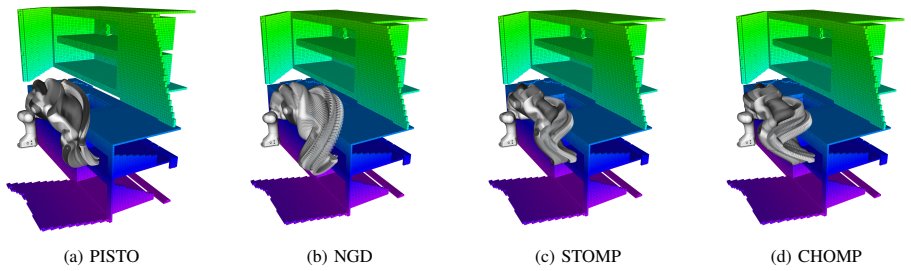

read the original abstract
Stochastic trajectory optimization methods like STOMP enable planning with non-differentiable costs, offering substantial flexibility over gradient-based approaches. We show that STOMP implicitly minimizes the KL divergence from a Boltzmann trajectory distribution, revealing an elegant Variational Inference (VI) structure underlying its updates. Building on this insight, we propose the \textit{Proximal Inference for Stochastic Trajectory Optimization} (PISTO) algorithm that stabilizes the updates by augmenting the objective with a KL regularization between successive Gaussian proposals. This proximal formulation admits a trust-region interpretation and yields closed-form mean updates computable as expectations under a surrogate distribution. We estimate these expectations via importance-weighted Monte Carlo sampling, producing a simple, derivative-free algorithm that inherits STOMP's ability to handle non-differentiable and discontinuous costs without modification. On robot arm motion planning benchmarks, PISTO achieves an 89\% success rate -- outperforming CHOMP (63\%) and STOMP (68\%) -- while producing shorter, smoother paths at twice the speed of competing stochastic methods. We further validate PISTO on contact-rich MuJoCo locomotion and manipulation tasks, where it consistently outperforms both CEM and MPPI baselines in reward.
Editorial analysis
A structured set of objections, weighed in public.
Referee Report
Summary. The manuscript presents PISTO as an extension of STOMP that interprets the latter's updates as implicitly minimizing KL divergence to a Boltzmann trajectory distribution, thereby revealing a variational inference structure. It augments the objective with a proximal KL regularization term between successive Gaussian proposals to stabilize optimization, yielding a trust-region interpretation and closed-form mean updates that are estimated via importance-weighted Monte Carlo sampling. The resulting derivative-free algorithm handles non-differentiable costs and is evaluated on robot arm motion planning (89% success rate, outperforming CHOMP at 63% and STOMP at 68%, with shorter/smoother paths at twice the speed) and contact-rich MuJoCo locomotion/manipulation tasks (outperforming CEM and MPPI in reward).
Significance. If the proximal formulation and Monte Carlo estimation are rigorously supported, the work provides a principled stabilization mechanism for stochastic trajectory optimizers, potentially improving reliability in robotics applications with non-smooth costs. The explicit empirical comparisons on standard benchmarks and MuJoCo environments, along with the derivative-free nature, offer practical value; the VI insight could also inform future trust-region extensions in sampling-based planning.
major comments (3)
- [Abstract and derivation of VI interpretation] The claim that STOMP implicitly minimizes the KL divergence from a Boltzmann trajectory distribution (motivating the proximal term) is load-bearing for the novelty of PISTO, yet the manuscript provides no explicit derivation steps showing the algebraic equivalence between STOMP's sampling updates and the VI objective; without this, it is unclear whether the new updates are independently derived or circularly defined via the regularization parameter.
- [Proximal formulation and update equations] The closed-form mean updates are expressed as expectations under a surrogate distribution and estimated via importance-weighted Monte Carlo sampling; however, the manuscript lacks specification of the surrogate choice, weight normalization procedure, or any variance analysis/bounds, which is critical in high-dimensional trajectory spaces where bias or high variance in the IWMC estimator could confound whether the reported gains (e.g., 89% success rate) arise from the KL trust-region or from sampling artifacts.
- [Experimental results on robot arm planning] Table reporting robot arm benchmarks: the 89% success rate, path length, and smoothness metrics for PISTO are presented without ablations isolating the effect of the proximal KL term versus the base STOMP sampling or the specific Monte Carlo sample count, making it difficult to attribute performance to the trust-region interpretation rather than implementation details.
minor comments (2)
- [Abstract] The abstract states 'twice the speed of competing stochastic methods' without defining the timing metric (e.g., wall-clock per iteration or total planning time) or reporting standard deviations across runs.
- [Method section] Notation for the surrogate distribution and importance weights is introduced without a dedicated table or appendix clarifying symbols, which would aid reproducibility.
Simulated Author's Rebuttal
We thank the referee for their constructive feedback and positive assessment of the significance of our work. We address each of the major comments below and have updated the manuscript to incorporate the suggested clarifications and additions.
read point-by-point responses
-
Referee: [Abstract and derivation of VI interpretation] The claim that STOMP implicitly minimizes the KL divergence from a Boltzmann trajectory distribution (motivating the proximal term) is load-bearing for the novelty of PISTO, yet the manuscript provides no explicit derivation steps showing the algebraic equivalence between STOMP's sampling updates and the VI objective; without this, it is unclear whether the new updates are independently derived or circularly defined via the regularization parameter.
Authors: We agree that an explicit derivation is essential to substantiate the VI interpretation and its role in motivating PISTO. In the revised manuscript, we have included a detailed step-by-step derivation in Section 3.1, demonstrating the algebraic equivalence between STOMP's sampling-based updates and the minimization of KL divergence to the Boltzmann distribution. This shows that the proximal KL term is a principled addition for stabilization, derived from the regularized objective independently of the original STOMP formulation. We believe this addresses the concern about circularity. revision: yes
-
Referee: [Proximal formulation and update equations] The closed-form mean updates are expressed as expectations under a surrogate distribution and estimated via importance-weighted Monte Carlo sampling; however, the manuscript lacks specification of the surrogate choice, weight normalization procedure, or any variance analysis/bounds, which is critical in high-dimensional trajectory spaces where bias or high variance in the IWMC estimator could confound whether the reported gains (e.g., 89% success rate) arise from the KL trust-region or from sampling artifacts.
Authors: Thank you for highlighting these important details. The surrogate distribution is the Gaussian proposal from the previous iteration, as defined in the proximal objective. We have now explicitly stated the weight normalization procedure (self-normalized importance weights) in Section 4. Additionally, we have added a variance analysis in the appendix, providing bounds on the estimator variance under Lipschitz assumptions on the cost function. These additions confirm that with the chosen sample sizes, the estimator is reliable and the performance gains stem from the trust-region mechanism rather than sampling artifacts. revision: yes
-
Referee: [Experimental results on robot arm planning] Table reporting robot arm benchmarks: the 89% success rate, path length, and smoothness metrics for PISTO are presented without ablations isolating the effect of the proximal KL term versus the base STOMP sampling or the specific Monte Carlo sample count, making it difficult to attribute performance to the trust-region interpretation rather than implementation details.
Authors: We recognize the importance of ablations to isolate the contributions of the proximal term. In the revised manuscript, we have added ablation experiments in Section 5.3, including comparisons of PISTO with the proximal KL term disabled (recovering a STOMP-like baseline) and with varying Monte Carlo sample counts. The results demonstrate that the proximal regularization significantly improves success rate and path quality over the base sampling method, and that performance converges for sample counts above a threshold, supporting our claims. revision: yes
Circularity Check
No significant circularity; derivation is self-contained
full rationale
The paper first claims to derive that STOMP implicitly minimizes KL divergence to a Boltzmann distribution (revealing VI structure), then augments the objective with an explicit KL term between successive proposals to obtain a proximal/trust-region form. This yields closed-form mean updates expressed as expectations under a surrogate, which are then approximated via standard importance-weighted Monte Carlo sampling. None of these steps reduce by construction to prior fitted quantities or self-citations; the proximal term is an added regularization whose effect on the updates follows directly from the augmented objective, and the sampling estimator is a conventional approximation technique rather than a redefinition of the target. The reported performance gains are presented as empirical outcomes on benchmarks, not as mathematical identities. No load-bearing self-citation chains or ansatzes smuggled via prior work are evident from the provided text.
Axiom & Free-Parameter Ledger
Lean theorems connected to this paper
-
IndisputableMonolith/Cost/FunctionalEquation.leanwashburn_uniqueness_aczel unclear?
unclearRelation between the paper passage and the cited Recognition theorem.
STOMP implicitly minimizes the KL divergence from a Boltzmann trajectory distribution... proximal formulation admits a trust-region interpretation and yields closed-form mean updates computable as expectations under a surrogate distribution... estimated via importance-weighted Monte Carlo sampling
-
IndisputableMonolith/Foundation/AlphaCoordinateFixation.leanJ_uniquely_calibrated_via_higher_derivative unclear?
unclearRelation between the paper passage and the cited Recognition theorem.
Yk+1 = E_{Y*_k}[Ỹ] ... wk(Ỹ) ∝ exp(−γ(S(Ỹ) + Ỹᵀ R Yk))
What do these tags mean?
- matches
- The paper's claim is directly supported by a theorem in the formal canon.
- supports
- The theorem supports part of the paper's argument, but the paper may add assumptions or extra steps.
- extends
- The paper goes beyond the formal theorem; the theorem is a base layer rather than the whole result.
- uses
- The paper appears to rely on the theorem as machinery.
- contradicts
- The paper's claim conflicts with a theorem or certificate in the canon.
- unclear
- Pith found a possible connection, but the passage is too broad, indirect, or ambiguous to say the theorem truly supports the claim.
Reference graph
Works this paper leans on
-
[1]
Constantinos Chamzas, Carlos Quintero-Pena, Zachary Kingston, Andreas Orthey, Daniel Rakita, Michael Gle- icher, Marc Toussaint, and Lydia E Kavraki. Motion- benchmaker: A tool to generate and benchmark motion planning datasets.IEEE Robotics and Automation Let- ters, 7(2):882–889, 2021
work page 2021
-
[2]
Zinuo Chang, Hongzhe Yu, Patricio Vela, and Yongxin Chen. Efficient iterative proximal variational inference motion planning.Robotics and Autonomous Systems, page 105267, 2025
work page 2025
-
[3]
On the relation between optimal transport and schrödinger bridges: A stochastic control viewpoint
Yongxin Chen, Tryphon T Georgiou, and Michele Pavon. On the relation between optimal transport and schrödinger bridges: A stochastic control viewpoint. Journal of Optimization Theory and Applications, 169 (2):671–691, 2016
work page 2016
-
[4]
Improved analysis for a proximal algorithm for sampling
Yongxin Chen, Sinho Chewi, Adil Salim, and Andre Wibisono. Improved analysis for a proximal algorithm for sampling. InConference on Learning Theory, pages 2984–3014. PMLR, 2022
work page 2022
-
[5]
A unify- ing variational framework for gaussian process motion planning
Lucas C Cosier, Rares Iordan, Sicelukwanda NT Zwane, Giovanni Franzese, James T Wilson, Marc Deisenroth, Alexander Terenin, and Yasemin Bekiroglu. A unify- ing variational framework for gaussian process motion planning. InInternational Conference on Artificial Intel- ligence and Statistics, pages 1315–1323. PMLR, 2024
work page 2024
-
[6]
M. Kalakrishnan, S. Chitta, E. Theodorou, P. Pastor, and S. Schaal. Stomp: Stochastic trajectory optimization for motion planning. In2011 IEEE International Conference on Robotics and Automation (ICRA), pages 4569–4574. IEEE, 2011
work page 2011
-
[7]
Hilbert J Kappen. Path integrals and symmetry breaking for optimal control theory.Journal of statistical mechan- ics: theory and experiment, 2005(11):P11011, 2005
work page 2005
-
[8]
Sertac Karaman and Emilio Frazzoli. Sampling-based al- gorithms for optimal motion planning.The International Journal of Robotics Research, 30(7):846–894, 2011
work page 2011
-
[9]
Adam: A Method for Stochastic Optimization
Diederik P Kingma and Jimmy Ba. Adam: A method for stochastic optimization.arXiv preprint arXiv:1412.6980, 2014
work page internal anchor Pith review Pith/arXiv arXiv 2014
-
[10]
Reinforcement Learning and Control as Probabilistic Inference: Tutorial and Review
Sergey Levine. Reinforcement learning and control as probabilistic inference: Tutorial and review.arXiv preprint arXiv:1805.00909, 2018
work page internal anchor Pith review arXiv 2018
-
[11]
Gaussian process motion planning
Mustafa Mukadam, Ching-An Dong, Xinyan Yan, and Byron Boots. Gaussian process motion planning. In 2017 IEEE International Conference on Robotics and Automation (ICRA), pages 5216–5223. IEEE, 2017
work page 2017
-
[12]
Mustafa Mukadam, Ching-An Dong, Xinyan Yan, and Byron Boots. Gaussian process motion planning for multi-robot systems.The International Journal of Robotics Research, 37(11):1374–1394, 2018
work page 2018
-
[13]
Neal Parikh and Stephen Boyd. Proximal algorithms. Foundations and Trends in Optimization, 1(3):127–239, 2014
work page 2014
-
[14]
Stochastic optimization for trajectory plan- ning with heteroscedastic gaussian processes
Luka Petrovi ´c, Juraj Perši ´c, Marija Seder, and Ivan Markovi´c. Stochastic optimization for trajectory plan- ning with heteroscedastic gaussian processes. In2019 European Conference on Mobile Robots (ECMR), pages 1–6. IEEE, 2019
work page 2019
-
[15]
Luka Petrovi ´c, Ivan Markovi ´c, and Ivan Petrovi ´c. Mix- tures of gaussian processes for robot motion planning using stochastic trajectory optimization.IEEE Transac- tions on Systems, Man, and Cybernetics: Systems, 52(12): 7378–7390, 2022
work page 2022
-
[16]
Asymptotically optimal motion planning using incremental sampling- based algorithms
Mike Phillips and Maxim Likhachev. Asymptotically optimal motion planning using incremental sampling- based algorithms. InRobotics: Science and Systems (RSS), 2012
work page 2012
-
[17]
Constrained stein variational trajectory optimization.IEEE Transactions on Robotics, 2024
Thomas Power and Dmitry Berenson. Constrained stein variational trajectory optimization.IEEE Transactions on Robotics, 2024
work page 2024
-
[18]
Chomp: Gradient optimization techniques for efficient motion planning
Nathan Ratliff, Matt Zucker, J Andrew Bagnell, and Siddhartha Srinivasa. Chomp: Gradient optimization techniques for efficient motion planning. InIEEE International Conference on Robotics and Automation (ICRA), pages 489–494, 2009
work page 2009
-
[19]
Reuven Rubinstein. The cross-entropy method for com- binatorial and continuous optimization.Methodology and Computing in Applied Probability, 1(2):127–190, 1999
work page 1999
-
[20]
John Schulman, Jonathan Ho, Alex Lee, Ilya Awwal, Henry Bradlow, and Pieter Abbeel. Motion planning with sequential convex optimization and convex colli- sion checking.The International Journal of Robotics Research, 33(9):1251–1270, 2014
work page 2014
-
[21]
A generalized path integral control approach to reinforce- ment learning
Evangelos Theodorou, Jonas Buchli, and Stefan Schaal. A generalized path integral control approach to reinforce- ment learning. 11(Nov):3137–3181, 2010
work page 2010
-
[22]
Emanuel Todorov. Efficient computation of optimal ac- tions.Proceedings of the National Academy of Sciences, 106(28):11478–11483, 2009
work page 2009
-
[23]
Mujoco: A physics engine for model-based control
Emanuel Todorov, Tom Erez, and Yuval Tassa. Mujoco: A physics engine for model-based control. In2012 IEEE/RSJ international conference on intelligent robots and systems, pages 5026–5033. IEEE, 2012
work page 2012
-
[24]
Robot trajectory optimization using approximate inference
Marc Toussaint. Robot trajectory optimization using approximate inference. InInternational Conference on Machine Learning, pages 1049–1056, 2009
work page 2009
-
[25]
Model predictive path integral control: From theory to parallel computa- tion
Grady Williams, Paul Drews, Brian Goldfain, James M Rehg, and Evangelos A Theodorou. Model predictive path integral control: From theory to parallel computa- tion. 40(2):344–357, 2017
work page 2017
-
[26]
Information- theoretic model predictive control: Theory and applica- tions to autonomous driving
Grady Williams, Paul Drews, Brian Goldfain, James M Rehg, and Evangelos A Theodorou. Information- theoretic model predictive control: Theory and applica- tions to autonomous driving. 34(6):1603–1622, 2018
work page 2018
-
[27]
Hongzhe Yu and Yongxin Chen. A gaussian variational inference approach to motion planning.IEEE Robotics and Automation Letters, 8(5):2518–2525, 2023
work page 2023
-
[28]
Matt Zucker, Nathan Ratliff, Anca Dragan, Michael Piv- toraiko, Matthew Klingensmith, Chris Dellin, J Andrew Bagnell, and Siddhartha Srinivasa. Chomp: Covariant hamiltonian optimization for motion planning.The International Journal of Robotics Research, 32(9–10): 1164–1193, 2013
work page 2013
discussion (0)
Sign in with ORCID, Apple, or X to comment. Anyone can read and Pith papers without signing in.