Recognition: 2 theorem links
· Lean TheoremSpatiotemporal dynamics of wind-speed volatility
Pith reviewed 2026-05-11 01:15 UTC · model grok-4.3
The pith
Properly modeling spatial dependence in the mean is essential for reliable wind-speed volatility inference and forecasting.
A machine-rendered reading of the paper's core claim, the machinery that carries it, and where it could break.
Core claim
A parsimonious spatiotemporal volatility framework based on GARCH-type dynamics, in which conditional variance depends on past local shocks and spatially aggregated information from neighbouring stations using distance-based and directionally informed weight matrices, shows that properly modelling spatial dependence in the mean is essential for well-behaved residuals and reliable inference, while forecast performance is strongly driven by the mean specification.
What carries the argument
The spatiotemporal volatility model combining spatial mean specification with GARCH dynamics using distance-based weight matrices for aggregating neighbor information.
If this is right
- Properly accounting for spatial dependence in the mean leads to well-behaved residuals and reliable inference.
- Flexible mean structures perform better when residual spatial dependence remains, while parsimonious distance-based models yield robust out-of-sample forecasts once spatial interactions are captured.
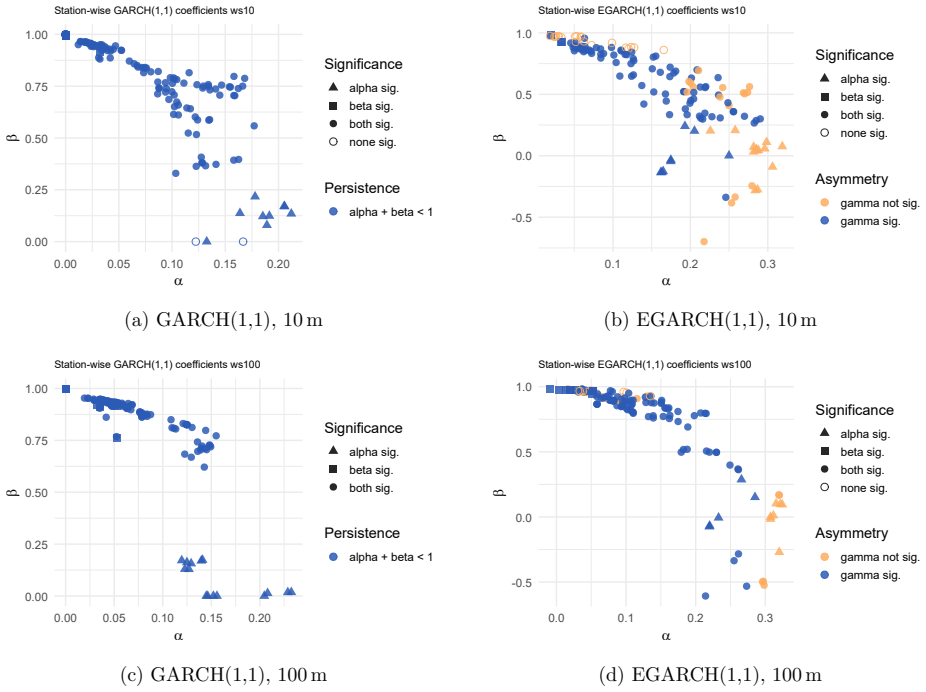
- Volatility persistence increases with height.
- A multivariate extension reveals cross-height dependence.
Where Pith is reading between the lines
- Similar spatiotemporal GARCH models could be tested on wind data from other regions to check generalizability of the spatial mean importance.
- Accounting for height-dependent persistence may help in designing better vertical wind profiles for atmospheric applications.
- The cross-height dependence suggests potential for joint modeling of multi-level data to improve overall volatility predictions.
Load-bearing premise
The chosen distance-based and directionally informed weight matrices adequately capture the true spatial interactions in wind-speed volatility across the monitoring network.
What would settle it
If residuals from a model without spatial mean modeling show no spatial autocorrelation and yield better or equal out-of-sample forecasts, the claim that spatial mean modeling is essential would be challenged.
Figures


read the original abstract
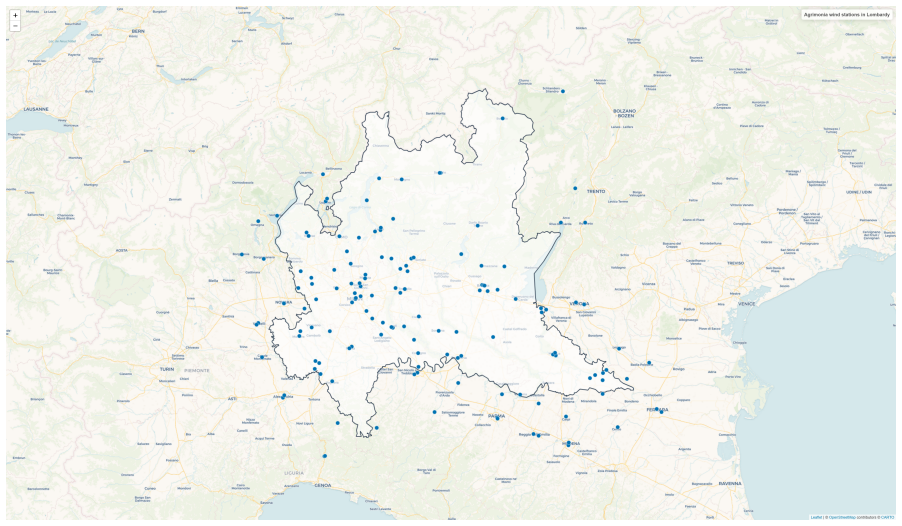
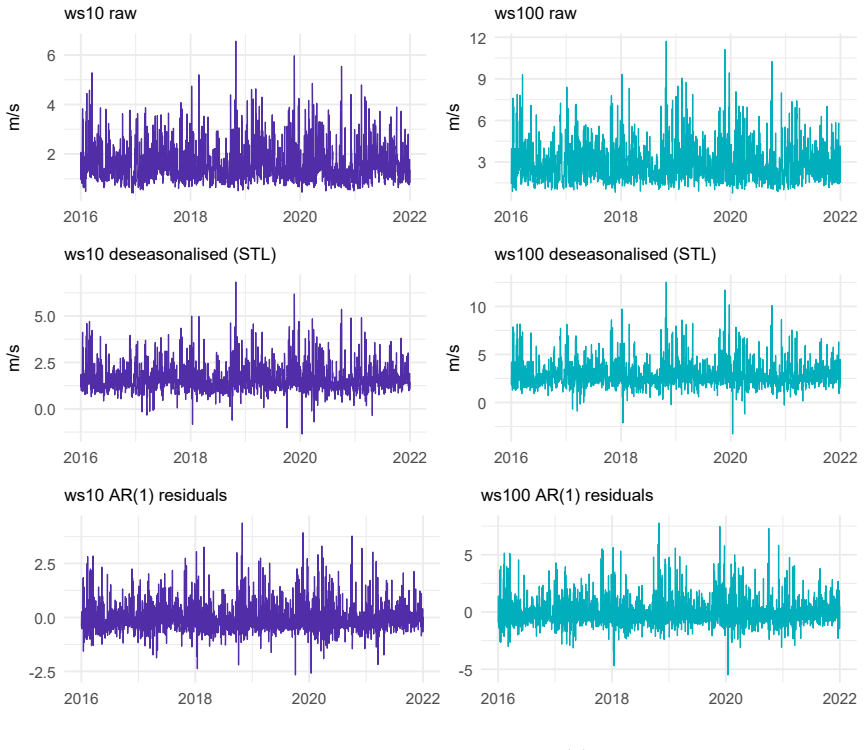
Wind-speed processes exhibit substantial temporal variability and spatial dependence, yet volatility dynamics across monitoring networks remain relatively unexplored. This study investigates the spatiotemporal behaviour of wind-speed volatility using daily observations from 141 stations in Northern Italy over 2016--2021, with measurements at 10 m and 100 m enabling the analysis of spatial and vertical dependence. We adopt a parsimonious spatiotemporal volatility framework based on GARCH-type dynamics, in which conditional variance depends on past local shocks and spatially aggregated information from neighbouring stations. The approach combines a spatial mean specification with structured volatility models using distance-based and directionally informed weight matrices. Results show that properly modelling spatial dependence in the mean is essential for well-behaved residuals and reliable inference. Forecast performance is strongly driven by the mean specification: flexible structures perform better when residual spatial dependence remains, while parsimonious distance-based models yield robust out-of-sample forecasts once spatial interactions are captured. Persistence increases with height, and a multivariate extension reveals cross-height dependence.
Editorial analysis
A structured set of objections, weighed in public.
Referee Report
Summary. The paper develops a spatiotemporal GARCH-type volatility model for daily wind-speed observations from 141 Northern Italy stations at 10 m and 100 m heights (2016–2021). It combines flexible or parsimonious spatial mean specifications with volatility dynamics driven by local shocks and spatially aggregated neighbor information via distance-based and directionally informed weight matrices. Central claims are that proper spatial modeling in the mean is required for well-behaved residuals and reliable inference, that forecast performance is driven by the mean specification, that volatility persistence increases with height, and that a multivariate extension reveals cross-height dependence.
Significance. If the empirical separation of mean and volatility effects holds, the work offers a practical framework for spatiotemporal volatility modeling with direct relevance to wind-energy forecasting and risk assessment. The use of real multi-height observational data and out-of-sample forecast comparisons is a positive empirical contribution, though the study relies on pre-specified weight matrices rather than parameter-free derivations or machine-checked proofs.
major comments (3)
- [Section 3] Section 3 (model specification): The central claim that modeling spatial dependence in the mean produces well-behaved residuals and reliable inference rests on the pre-specified distance-based and directionally informed weight matrices adequately representing the true spatial interactions. No sensitivity analysis or comparison against topography- or elevation-informed alternatives is reported; if these matrices omit key features, apparent gains from flexible mean models may reflect residual spatial misspecification rather than genuine mean-volatility separation.
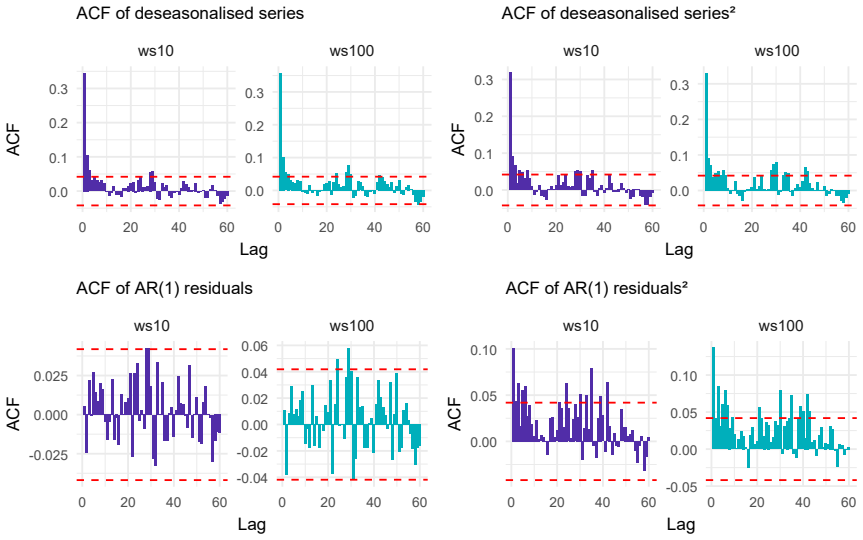
- [Section 4] Section 4 (estimation and diagnostics): The abstract and methods provide no explicit details on the fitting procedure for GARCH parameters, convergence criteria, or residual diagnostics (e.g., spatial autocorrelation tests on standardized residuals). Without these, the assertion of 'well-behaved residuals' after spatial mean modeling cannot be independently verified and undermines the reliability of the reported persistence and forecast results.
- [Section 5] Section 5 (forecast results): The statement that 'parsimonious distance-based models yield robust out-of-sample forecasts once spatial interactions are captured' requires quantitative comparison (e.g., specific RMSE or CRPS values across mean specifications in a table). The current qualitative summary does not allow assessment of effect sizes or whether the improvement is statistically significant after accounting for multiple testing.
minor comments (2)
- [Abstract] Abstract: The phrase 'structured volatility models' is undefined; a brief parenthetical reference to the specific GARCH lag structure or weight-matrix form would improve clarity.
- [Section 2] Notation: The distinction between local shocks and spatially aggregated shocks should be denoted consistently with subscripts or superscripts throughout the equations to avoid ambiguity when reading the multivariate extension.
Simulated Author's Rebuttal
We thank the referee for their constructive and detailed comments, which have helped us identify areas where the manuscript can be strengthened for clarity, reproducibility, and robustness. We address each major comment point by point below and indicate the revisions planned for the next version of the manuscript.
read point-by-point responses
-
Referee: [Section 3] Section 3 (model specification): The central claim that modeling spatial dependence in the mean produces well-behaved residuals and reliable inference rests on the pre-specified distance-based and directionally informed weight matrices adequately representing the true spatial interactions. No sensitivity analysis or comparison against topography- or elevation-informed alternatives is reported; if these matrices omit key features, apparent gains from flexible mean models may reflect residual spatial misspecification rather than genuine mean-volatility separation.
Authors: We acknowledge the importance of verifying the robustness of the chosen weight matrices. Our distance-based and directionally informed specifications follow standard approaches in the spatiotemporal literature for wind-speed data, where geographic distance and prevailing wind directions capture key dependencies in Northern Italy. To directly address the concern that apparent mean-volatility separation might stem from unmodeled topography effects, we will add a sensitivity analysis in the revised Section 3. This will compare results using the original matrices against alternatives that incorporate elevation differences and topographic features derived from the station metadata, thereby providing quantitative evidence on whether the core findings hold under alternative spatial representations. revision: yes
-
Referee: [Section 4] Section 4 (estimation and diagnostics): The abstract and methods provide no explicit details on the fitting procedure for GARCH parameters, convergence criteria, or residual diagnostics (e.g., spatial autocorrelation tests on standardized residuals). Without these, the assertion of 'well-behaved residuals' after spatial mean modeling cannot be independently verified and undermines the reliability of the reported persistence and forecast results.
Authors: We agree that greater transparency in the estimation and diagnostic procedures is essential for reproducibility. In the revised manuscript, we will expand Section 4 to include a dedicated subsection detailing the maximum-likelihood estimation of the GARCH parameters (using a quasi-Newton optimizer), convergence criteria (e.g., gradient norm tolerance of 1e-6 and maximum iterations), and a full suite of residual diagnostics. These will encompass Ljung-Box tests for serial correlation, Engle's ARCH test for remaining heteroskedasticity, and Moran's I statistic applied to the standardized residuals to formally confirm the absence of spatial autocorrelation after the spatial mean modeling step. revision: yes
-
Referee: [Section 5] Section 5 (forecast results): The statement that 'parsimonious distance-based models yield robust out-of-sample forecasts once spatial interactions are captured' requires quantitative comparison (e.g., specific RMSE or CRPS values across mean specifications in a table). The current qualitative summary does not allow assessment of effect sizes or whether the improvement is statistically significant after accounting for multiple testing.
Authors: We thank the referee for this suggestion to improve the quantitative presentation of the forecast results. In the revised Section 5, we will replace the qualitative summary with a new table that reports specific out-of-sample RMSE and CRPS values for each combination of mean specification and volatility model. We will also include Diebold-Mariano tests for pairwise forecast accuracy comparisons, with p-values adjusted via the Bonferroni correction to account for multiple testing. This will allow readers to evaluate both the magnitude of improvements and their statistical significance. revision: yes
Circularity Check
No circularity: empirical model fitted to external observational data
full rationale
The paper is a standard empirical spatiotemporal analysis that fits GARCH-type volatility models (with spatial mean specifications and pre-specified distance/directional weight matrices) to independent wind-speed observations from 141 Northern Italy stations. All reported results—residual diagnostics, forecast comparisons, persistence by height, and cross-height dependence—derive from out-of-sample performance against held-out data rather than from any equation or parameter that is defined in terms of the fitted outputs themselves. No self-citation chain, ansatz smuggling, or fitted-input-renamed-as-prediction is present; the weight-matrix choice is an explicit modeling assumption, not a self-referential definition.
Axiom & Free-Parameter Ledger
free parameters (1)
- GARCH parameters and spatial weight matrices
axioms (1)
- domain assumption Wind-speed volatility follows GARCH-type dynamics where conditional variance depends on past local shocks and spatially aggregated neighbor information
Lean theorems connected to this paper
-
IndisputableMonolith/Cost/FunctionalEquation.leanwashburn_uniqueness_aczel unclear?
unclearRelation between the paper passage and the cited Recognition theorem.
STARMAGARCH(1,1,1,1) with distance-band, k-NN and directional weight matrices; SDPD mean equation; persistence β increasing with height
-
IndisputableMonolith/Foundation/RealityFromDistinction.leanreality_from_one_distinction unclear?
unclearRelation between the paper passage and the cited Recognition theorem.
Moran’s I on residuals and squared residuals; forecasting RMSFE/MAFE on log-variance
What do these tags mean?
- matches
- The paper's claim is directly supported by a theorem in the formal canon.
- supports
- The theorem supports part of the paper's argument, but the paper may add assumptions or extra steps.
- extends
- The paper goes beyond the formal theorem; the theorem is a base layer rather than the whole result.
- uses
- The paper appears to rely on the theorem as machinery.
- contradicts
- The paper's claim conflicts with a theorem or certificate in the canon.
- unclear
- Pith found a possible connection, but the passage is too broad, indirect, or ambiguous to say the theorem truly supports the claim.
Reference graph
Works this paper leans on
-
[1]
Autoregressive conditional heteroscedasticity with estimates of the variance of United Kingdom inflation , author=. Econometrica , volume=
-
[2]
Environmental Modelling & Software , volume=
A bivariate GARCH model for Sydney Harbour wind components , author=. Environmental Modelling & Software , volume=
-
[3]
Journal of Econometrics , volume=
Generalized autoregressive conditional heteroskedasticity , author=. Journal of Econometrics , volume=
-
[4]
Conditional heteroskedasticity in asset returns: A new approach , author=. Econometrica , volume=
-
[5]
Wind power volatility forecasting using GARCH-type models , author=. Energy Economics , volume=
-
[6]
Asymmetric GARCH-type models for volatility characteristics analysis and wind power forecasting , author=. Applied Energy , volume=
-
[7]
On the relation between the expected value and the volatility of the nominal excess return on stocks , author=. Journal of Finance , volume=
-
[8]
Journal of Empirical Finance , volume=
A long memory property of stock market returns and a new model , author=. Journal of Empirical Finance , volume=
- [9]
-
[10]
GARCH Models: Structure, Statistical Inference and Financial Applications , author=. 2010 , publisher=
work page 2010
-
[11]
Energy Conversion and Management , volume=
Empirical investigation on using wind speed volatility to estimate the operation probability and power output of wind turbines , author=. Energy Conversion and Management , volume=. 2013 , publisher=
work page 2013
-
[12]
International journal of green energy , volume=
Short-term wind speed forecasting: Application of linear and non-linear time series models , author=. International journal of green energy , volume=. 2016 , publisher=
work page 2016
-
[13]
Liu, Heping and Erdem, Erdal and Shi, Jing , journal =. Comprehensive evaluation of. 2011 , publisher =
work page 2011
-
[14]
Forecasting volatility of wind power production , author=. Applied Energy , volume=. 2016 , publisher=
work page 2016
-
[15]
Chen, Hao and Zhang, Jianzhong and Tao, Yubo and Tan, Fenglei , journal=. Asymmetric. 2019 , publisher=
work page 2019
-
[16]
Journal of Time Series Analysis , volume=
Parametric and semiparametric models for volatility in meteorological time series , author=. Journal of Time Series Analysis , volume=
-
[17]
Journal of Time Series Analysis , author =
A distance measure for classifying. Journal of Time Series Analysis , author =. 1990 , publisher=. doi:10.1111/j.1467-9892.1990.tb00048.x , abstract =
-
[18]
Exponential Spatiotemporal GARCH Model with Asymmetric Volatility Spillovers , author=. 2025 , eprint=
work page 2025
-
[19]
ARMA-based approaches for forecasting the tuple of wind speed and direction , author=. Applied Energy , volume=
-
[20]
Journal of the Royal Statistical Society: Series C , volume=
Using conditional heteroskedasticity models for density forecasting of wind speed and direction , author=. Journal of the Royal Statistical Society: Series C , volume=
-
[21]
Hansen, Peter R. and Lunde, Asger , journal=. A forecast comparison of volatility models: Does anything beat a
-
[22]
Statistics for Spatial Data , author =
-
[23]
Journal of the American Statistical Association , volume =
Geostatistical Space–Time Models, Stationarity, Separability and Full Covariance Structures , author =. Journal of the American Statistical Association , volume =
-
[24]
Journal of Applied Energy , volume =
A hybrid wavelet transform and neural network approach for short-term wind speed forecasting , author =. Journal of Applied Energy , volume =. 2014 , note =
work page 2014
-
[25]
International Journal of Numerical Modelling: Electronic Networks, Devices and Fields , volume=
Wind speed forecasting based on wavelet transformation and recurrent neural network , author=. International Journal of Numerical Modelling: Electronic Networks, Devices and Fields , volume=. 2020 , publisher=
work page 2020
-
[26]
Journal of Econometrics , volume =
Long memory processes and fractional integration in econometrics , author =. Journal of Econometrics , volume =
-
[27]
Journal of Official Statistics , volume=
STL: A seasonal-trend decomposition procedure based on loess , author=. Journal of Official Statistics , volume=. 1990 , publisher=
work page 1990
-
[28]
IEEE Transactions on Energy Conversion , volume =
Short-term prediction of wind farm power: A data mining approach , author =. IEEE Transactions on Energy Conversion , volume =. 2010 , publisher =
work page 2010
-
[29]
Prediction of wind power ramp rates: A data-mining approach , author =. Applied Energy , volume =. 2009 , publisher =
work page 2009
-
[30]
Decision Making Under Uncertainty in Electricity Markets , author =
-
[31]
Statistical modeling of the space-time relation between wind and significant wave height , author=. Authorea Preprints , year=
-
[32]
European Journal of Operational Research , volume=
Forecasting wind speed with recurrent neural networks , author=. European Journal of Operational Research , volume=. 2012 , publisher=
work page 2012
-
[33]
Forecasting wind power--modeling periodic and non-linear effects under conditional heteroscedasticity , author=. Applied Energy , volume=. 2016 , publisher=
work page 2016
-
[34]
IEEE Transactions on Energy conversion , volume=
Wind power density forecasting using ensemble predictions and time series models , author=. IEEE Transactions on Energy conversion , volume=. 2009 , publisher=
work page 2009
-
[35]
Long-term wind power and global warming prediction using
Y. Long-term wind power and global warming prediction using. Journal of Industrial and Management Optimization , volume=. 2024 , publisher=
work page 2024
-
[36]
2010 IEEE 11th International Conference on Probabilistic Methods Applied to Power Systems , pages=
Advantages of ARMA-GARCH wind speed time series modeling , author=. 2010 IEEE 11th International Conference on Probabilistic Methods Applied to Power Systems , pages=. 2010 , organization=
work page 2010
-
[37]
Time series analysis of wind speed with time-varying turbulence , author=. Environmetrics , volume=. 2006 , publisher=
work page 2006
-
[38]
arXiv preprint arXiv:2603.02195 , year=
Comparative Analysis of Spatiotemporal Volatility Models: An Empirical Study on Financial Network Series , author=. arXiv preprint arXiv:2603.02195 , year=
-
[39]
Geographical Analysis , volume=
Estimation of Anisotropic, Time-Varying Spatial Spillovers of Fine Particulate Matter Due to Wind Direction , author=. Geographical Analysis , volume=. 2020 , publisher=
work page 2020
-
[40]
A multivariate spatial and spatiotemporal ARCH model , author=. Spatial Statistics , volume=. 2024 , publisher=
work page 2024
-
[41]
Journal of the Royal Statistical Society: Series B (Statistical Methodology) , volume=
Econometric analysis of realized volatility and its use in estimating stochastic volatility models , author=. Journal of the Royal Statistical Society: Series B (Statistical Methodology) , volume=. 2002 , publisher=
work page 2002
-
[42]
Asset price dynamics, volatility, and prediction , author=. 2011 , publisher=
work page 2011
-
[43]
arXiv preprint arXiv:2507.14389 , year=
Regional compositional trajectories and structural change: A spatiotemporal multivariate autoregressive framework , author=. arXiv preprint arXiv:2507.14389 , year=
-
[44]
Basic laws of turbulent mixing in the surface layer of the atmosphere , author=. Contrib. Geophys. Inst. Acad. Sci. USSR , volume=
-
[45]
An introduction to boundary layer meteorology , author=. 2012 , publisher=
work page 2012
- [46]
-
[47]
Agrimonia: a dataset on livestock, meteorology and air quality in the Lombardy region, Italy , author=. Scientific Data , volume=. 2023 , publisher=
work page 2023
-
[48]
Energy conversion and management , volume=
A new hybrid model optimized by an intelligent optimization algorithm for wind speed forecasting , author=. Energy conversion and management , volume=. 2014 , publisher=
work page 2014
-
[49]
Energy Science & Engineering , year=
Economic and Technical Assessment of Wind Potential Using SARIMAX Time Series Models: Wind Speed Forecasting and Analysis , author=. Energy Science & Engineering , year=
-
[50]
A two-stage deep learning-based hybrid model for daily wind speed forecasting , author=. Heliyon , volume=. 2025 , publisher=
work page 2025
-
[51]
ISOPE International Ocean and Polar Engineering Conference , pages=
Spatio-Temporal Modelling of Wind Speed Variations , author=. ISOPE International Ocean and Polar Engineering Conference , pages=. 2018 , organization=
work page 2018
-
[52]
Theoretical and Applied Climatology , volume=
Spatio-temporal modelling of wind speed variations and extremes in the Caribbean and the Gulf of Mexico , author=. Theoretical and Applied Climatology , volume=. 2019 , publisher=
work page 2019
-
[53]
Ailliot, Pierre and Bessac, Julie and Monbet, Val. Non-homogeneous hidden. Journal of Statistical Planning and Inference , volume=. 2015 , publisher=
work page 2015
-
[54]
Spatial econometrics: methods and models , author=. 1988 , publisher=
work page 1988
-
[55]
Journal of Time Series Analysis , volume=
A Stationary Spatio-Temporal GARCH Model , author=. Journal of Time Series Analysis , volume=. 2020 , publisher=
work page 2020
-
[56]
A dimension-reduced approach to space-time Kalman filtering , author=. Biometrika , volume=. 1999 , publisher=
work page 1999
- [57]
discussion (0)
Sign in with ORCID, Apple, or X to comment. Anyone can read and Pith papers without signing in.