Recognition: 2 theorem links
· Lean TheoremMovable Subarray-Aided Hybrid Beamforming for Near-Field Multiuser Communications
Pith reviewed 2026-05-11 01:59 UTC · model grok-4.3
The pith
Movable subarrays combined with hybrid beamforming exploit near-field distance and position degrees of freedom for precise multiuser beamfocusing.
A machine-rendered reading of the paper's core claim, the machinery that carries it, and where it could break.
Core claim
By coupling MSA movement with HBF, the proposed design simultaneously exploits NF distance-dependent and MSA position-dependent DoFs, enabling highly precise beamfocusing and superior interference mitigation. A hybrid planar-spherical wave model approximates channels efficiently, and an alternating optimization algorithm integrating fractional programming, ADMM, and projected gradient ascent yields the joint solution of subarray positions and beamforming coefficients.
What carries the argument
The movable subarray-aided hybrid beamforming architecture, which adjusts subarray locations to add position-dependent spatial flexibility to near-field propagation effects.
If this is right
- Higher achievable sum rates in near-field multiuser XL-MIMO systems.
- More effective separation of users through combined distance and position control.
- Reduced hardware complexity while retaining spatial adaptability compared with fully digital beamforming.
- Practical scalability to extremely large antenna arrays under hybrid constraints.
Where Pith is reading between the lines
- The same coupling principle could be tested in movable-antenna schemes outside hybrid beamforming to isolate the contribution of position control.
- Dynamic subarray repositioning during data transmission, rather than static optimization, might further increase the effective degrees of freedom.
- Hardware prototypes would reveal whether mechanical movement speed limits the gains in time-varying channels.
Load-bearing premise
The hybrid planar-spherical wave model supplies a sufficiently accurate channel approximation to support the claimed optimization and performance gains.
What would settle it
Real-world channel measurements in a near-field multiuser setup that show the reported sum-rate gains disappear when replacing the hybrid wave model with full spherical-wave channels would falsify the practical value of the design.
Figures
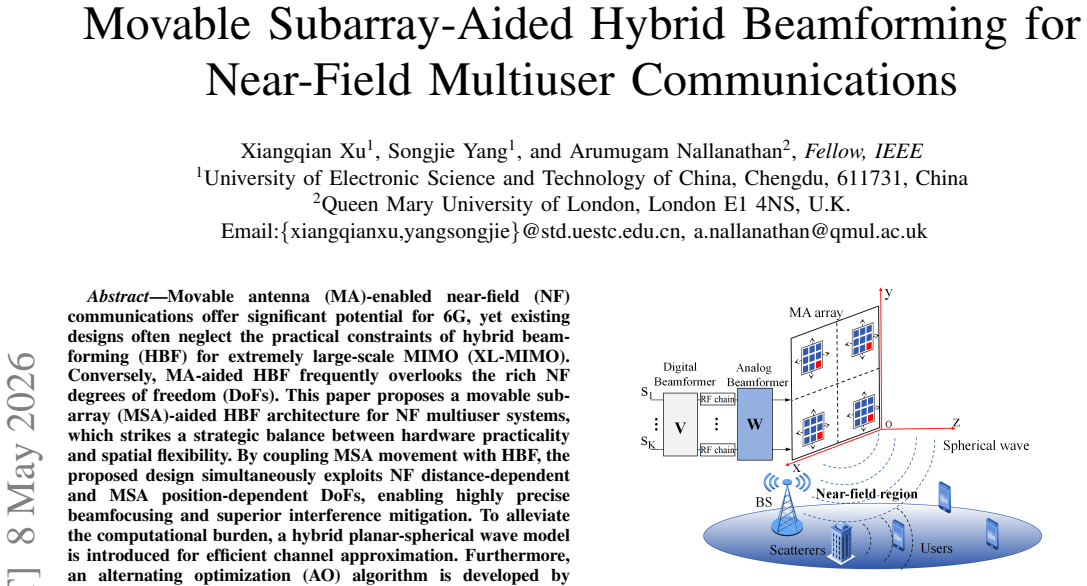


read the original abstract
Movable antenna (MA)-enabled near-field (NF) communications offer significant potential for 6G, yet existing designs often neglect the practical constraints of hybrid beamforming (HBF) for extremely large-scale MIMO (XL-MIMO). Conversely, MA-aided HBF frequently overlooks the rich NF degrees of freedom (DoFs). This paper proposes a movable subarray (MSA)-aided HBF architecture for NF multiuser systems, which strikes a strategic balance between hardware practicality and spatial flexibility. By coupling MSA movement with HBF, the proposed design simultaneously exploits NF distance-dependent and MSA position-dependent DoFs, enabling highly precise beamfocusing and superior interference mitigation. To alleviate the computational burden, a hybrid planar-spherical wave model is introduced for efficient channel approximation. Furthermore, an alternating optimization (AO) algorithm is developed by integrating fractional programming, the alternating direction method of multipliers (ADMM), and projected gradient ascent. Simulation results validate substantial sum-rate gains over fixedposition antenna (FPA) benchmarks.
Editorial analysis
A structured set of objections, weighed in public.
Referee Report
Summary. This paper proposes a movable subarray (MSA)-aided hybrid beamforming (HBF) architecture for near-field multiuser communications in XL-MIMO systems. By jointly optimizing subarray positions and beamforming vectors, the design aims to exploit both NF distance-dependent and MSA position-dependent degrees of freedom for precise beamfocusing and improved interference mitigation. A hybrid planar-spherical wave model is introduced to approximate the channel and reduce complexity, and an alternating optimization algorithm is developed that integrates fractional programming, ADMM, and projected gradient ascent. Simulation results are presented to show substantial sum-rate gains relative to fixed-position antenna benchmarks.
Significance. If the hybrid wave model is shown to be sufficiently accurate and the optimization reliably achieves the claimed gains, the work could provide a practical hardware-efficient approach for 6G NF systems that balances the flexibility of movable antennas with the cost of hybrid architectures, potentially advancing multiuser interference management through additional spatial DoFs.
major comments (1)
- The hybrid planar-spherical wave model (introduced explicitly for complexity reduction in the channel representation) is used exclusively for deriving the AO algorithm and all reported sum-rate results. No quantitative error analysis, bounds, or side-by-side comparisons against the full spherical-wave model are provided at the operating distances and array sizes, which directly affects whether the claimed exploitation of NF DoFs and superior interference mitigation are preserved in true near-field propagation.
minor comments (2)
- The abstract states that simulations 'validate substantial sum-rate gains' but omits key parameters such as the number of users, SNR operating points, array dimensions, or exact FPA baseline configurations, making it difficult to assess the magnitude and robustness of the improvements.
- Simulation figures would benefit from error bars or results over multiple channel realizations to confirm that the observed gains are statistically consistent rather than dependent on particular random seeds.
Simulated Author's Rebuttal
We thank the referee for the constructive feedback. We address the major comment below and will revise the manuscript accordingly to strengthen the validation of the hybrid wave model.
read point-by-point responses
-
Referee: The hybrid planar-spherical wave model (introduced explicitly for complexity reduction in the channel representation) is used exclusively for deriving the AO algorithm and all reported sum-rate results. No quantitative error analysis, bounds, or side-by-side comparisons against the full spherical-wave model are provided at the operating distances and array sizes, which directly affects whether the claimed exploitation of NF DoFs and superior interference mitigation are preserved in true near-field propagation.
Authors: We agree that the absence of a quantitative error analysis is a gap in the current manuscript. In the revision, we will add a new subsection (Section III-D) providing numerical comparisons of the hybrid model against the exact spherical-wave model. This will include the normalized approximation error for channel coefficients at the considered distances (10-50 m) and XL-MIMO array sizes, as well as the resulting difference in optimized sum rates and interference levels. We will also derive and present a simple bound on the phase error induced by the planar approximation within each subarray. These additions will confirm that the reported performance gains and exploitation of NF DoFs remain valid under the full model. revision: yes
Circularity Check
No circularity in derivation chain
full rationale
The paper introduces a hybrid planar-spherical wave model explicitly as a complexity-reducing approximation for the NF channel, then applies standard alternating optimization combining fractional programming, ADMM, and projected gradient ascent to the resulting problem. No load-bearing step reduces by construction to a fitted parameter, self-defined quantity, or self-citation chain; the optimization framework operates on the approximated model without renaming or smuggling prior results as new predictions. The derivation remains self-contained against external benchmarks and does not invoke uniqueness theorems from the authors' prior work.
Axiom & Free-Parameter Ledger
Lean theorems connected to this paper
-
IndisputableMonolith/Foundation/AlexanderDuality.leanalexander_duality_circle_linking unclearhybrid planar-spherical wave model... spherical-wave propagation between subarrays while assuming planar-wave propagation within each subarray
-
IndisputableMonolith/Cost/FunctionalEquation.leanwashburn_uniqueness_aczel unclearalternating optimization (AO) algorithm... fractional programming, ADMM, projected gradient ascent
Reference graph
Works this paper leans on
-
[1]
A tutorial on movable antennas for wireless networks,
L. Zhu, W. Ma, W. Mei, Y . Zeng, Q. Wu, B. Ning, Z. Xiao, X. Shao, J. Zhang, and R. Zhang, “A tutorial on movable antennas for wireless networks,”IEEE Communications Surveys & Tutorials, Feb. 2025
work page 2025
-
[2]
W. K. New, K.-K. Wong, H. Xu, C. Wang, F. R. Ghadi, J. Zhang, J. Rao, R. Murch, P. Ram ´ırez-Espinosa, D. Morales-Jimenezet al., “A tutorial on fluid antenna system for 6g networks: Encompassing communication theory, optimization methods and hardware designs,” IEEE Communications Surveys & Tutorials, vol. 27, no. 4, pp. 2325– 2377, Aug. 2024
work page 2024
-
[3]
Movable antenna-enhanced near-field flexible beamforming: Performance analysis and optimization,
S. Yang, X. Wei, N. Su, W. Mei, Z. Chen, and B. Ning, “Movable antenna-enhanced near-field flexible beamforming: Performance analysis and optimization,”IEEE Transactions on V ehicular Technology, pp. 1– 16, 2026
work page 2026
-
[4]
Near- field communications: A tutorial review,
Y . Liu, Z. Wang, J. Xu, C. Ouyang, X. Mu, and R. Schober, “Near- field communications: A tutorial review,”IEEE Open Journal of the Communications Society, vol. 4, pp. 1999–2049, Aug. 2023
work page 1999
-
[5]
Beamforming technologies for ultra-massive mimo in terahertz commu- nications,
B. Ning, Z. Tian, W. Mei, Z. Chen, C. Han, S. Li, J. Yuan, and R. Zhang, “Beamforming technologies for ultra-massive mimo in terahertz commu- nications,”IEEE Open Journal of the Communications Society, vol. 4, pp. 614–658, Feb. 2023
work page 2023
-
[6]
Movable antenna-assisted integrated sensing and communication systems,
C. Jiang, C. Zhang, C. Huang, J. Ge, D. Niyato, and C. Yuen, “Movable antenna-assisted integrated sensing and communication systems,”IEEE Transactions on Wireless Communications, Mar. 2025
work page 2025
-
[7]
Movable antenna enabled integrated sensing and communication,
W. Lyu, S. Yang, Y . Xiu, Z. Zhang, C. Assi, and C. Yuen, “Movable antenna enabled integrated sensing and communication,”IEEE Trans- actions on Wireless Communications, Jan. 2025
work page 2025
-
[8]
B. Ning, S. Yang, Y . Wu, P. Wang, W. Mei, C. Yuen, and E. Bjornson, “Movable antenna-enhanced wireless communications: General archi- tectures and implementation methods,”IEEE Wireless Communications, May. 2025
work page 2025
-
[9]
Movable antenna-aided hybrid beamforming for multi-user communications,
Y . Zhang, Y . Zhang, L. Zhu, S. Xiao, W. Tang, Y . C. Eldar, and R. Zhang, “Movable antenna-aided hybrid beamforming for multi-user communications,”IEEE Transactions on V ehicular Technology, Jan. 2025
work page 2025
-
[10]
Near-field multiuser communications aided by movable antennas,
J. Ding, L. Zhu, Z. Zhou, B. Jiao, and R. Zhang, “Near-field multiuser communications aided by movable antennas,”IEEE Wireless Communi- cations Letters, Nov. 2024
work page 2024
-
[11]
Movable antenna enabled near-field communications: Channel modeling and performance opti- mization,
L. Zhu, W. Ma, Z. Xiao, and R. Zhang, “Movable antenna enabled near-field communications: Channel modeling and performance opti- mization,”IEEE Transactions on Communications, no. 99, pp. 1–1, Mar. 2025
work page 2025
-
[12]
Movable antenna enabled near-field MU-MIMO communication,
X. Pi, L. Zhu, H. Mao, Z. Xiao, X.-G. Xia, and R. Zhang, “Movable antenna enabled near-field MU-MIMO communication,”IEEE Wireless Communications Letters, Jul. 2025
work page 2025
-
[13]
Two-level spatial multiplexing using hybrid beamforming for millimeter-wave backhaul,
X. Song, W. Rave, N. Babu, S. Majhi, and G. Fettweis, “Two-level spatial multiplexing using hybrid beamforming for millimeter-wave backhaul,”IEEE Transactions on Wireless Communications, vol. 17, no. 7, pp. 4830–4844, May. 2018
work page 2018
-
[14]
Fractional programming for communication systems—part I: Power control and beamforming,
K. Shen and W. Yu, “Fractional programming for communication systems—part I: Power control and beamforming,”IEEE Transactions on Signal Processing, vol. 66, no. 10, pp. 2616–2630, May. 2018
work page 2018
-
[15]
Joint precoding design for sub-connected hybrid beamforming system,
Y . Hu, H. Qian, K. Kang, X. Luo, and H. Zhu, “Joint precoding design for sub-connected hybrid beamforming system,”IEEE Transactions on Wireless Communications, vol. 23, no. 2, pp. 1199–1212, Jun. 2024. 6
work page 2024
discussion (0)
Sign in with ORCID, Apple, or X to comment. Anyone can read and Pith papers without signing in.