Recognition: no theorem link
Transporting treatment effects by calibrating large-scale observational outcomes
Pith reviewed 2026-05-11 01:15 UTC · model grok-4.3
The pith
By calibrating observational outcome measurements to a small experimental dataset via ordinary least squares, researchers obtain a consistent estimator for the transported average treatment effect with valid inference even without overlap.
A machine-rendered reading of the paper's core claim, the machinery that carries it, and where it could break.
Core claim
We construct the estimator by first using ordinary least squares to calibrate the observational treatment-control contrast to the experimental data and then averaging the fitted conditional average treatment effects over the observational sample. When the calibration regression is well specified, the estimator is consistent for the transported average treatment effect. Otherwise it converges to a projection estimand. As long as the observational dataset size grows sufficiently quickly relative to the experimental dataset size, the estimator achieves semiparametric efficiency for the projection estimand. Inference remains asymptotically valid without positivity between the two datasets.
What carries the argument
Ordinary least squares calibration of the observational treatment-control contrast to the experimental outcomes, followed by averaging the estimated conditional average treatment effects over the observational dataset.
If this is right
- The estimator is consistent for the transported average treatment effect when the calibration regression is correctly specified.
- It converges to a projection estimand when the calibration model is misspecified.
- Asymptotic inference remains valid without requiring positivity or overlap between the experimental and observational datasets.
- Semiparametric efficiency is attained when the observational sample grows sufficiently fast relative to the experimental sample.
Where Pith is reading between the lines
- Flexible nonparametric calibration models could replace ordinary least squares to accommodate more complex outcome biases while preserving the same transport logic.
- The projection estimand supplies a stable policy-relevant target in applications where perfect alignment between datasets is unrealistic.
- The approach naturally extends to settings with large-scale proxy measurements, such as remote sensing or administrative records, that must be aligned with limited ground-truth experiments.
Load-bearing premise
The ordinary least squares calibration regression must correctly specify the relationship between the observational and experimental outcomes for the estimator to remain consistent for the true transported average treatment effect rather than a projection.
What would settle it
A simulation in which the bias between observational and experimental outcomes is known to be nonlinear in the covariates used for calibration, checking whether the estimator's bias fails to vanish as sample sizes increase.
Figures


read the original abstract
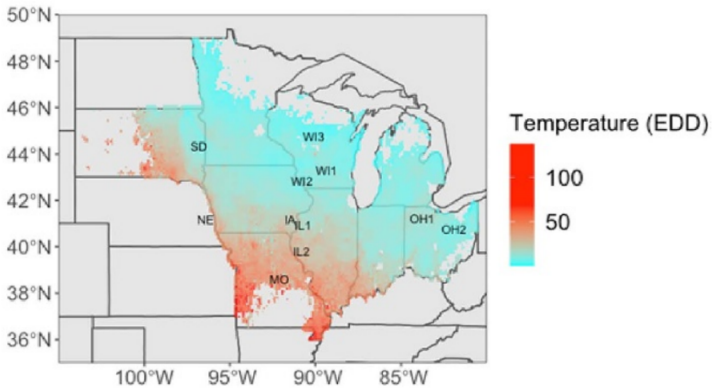
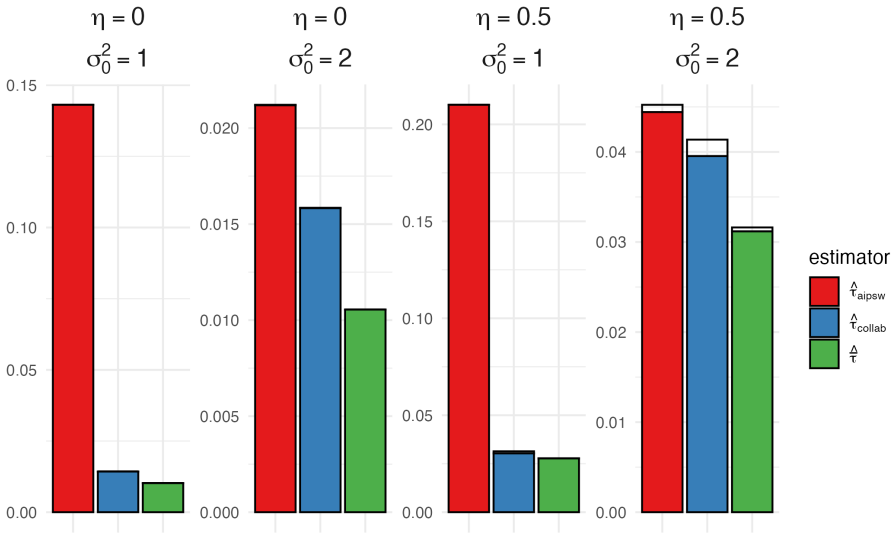
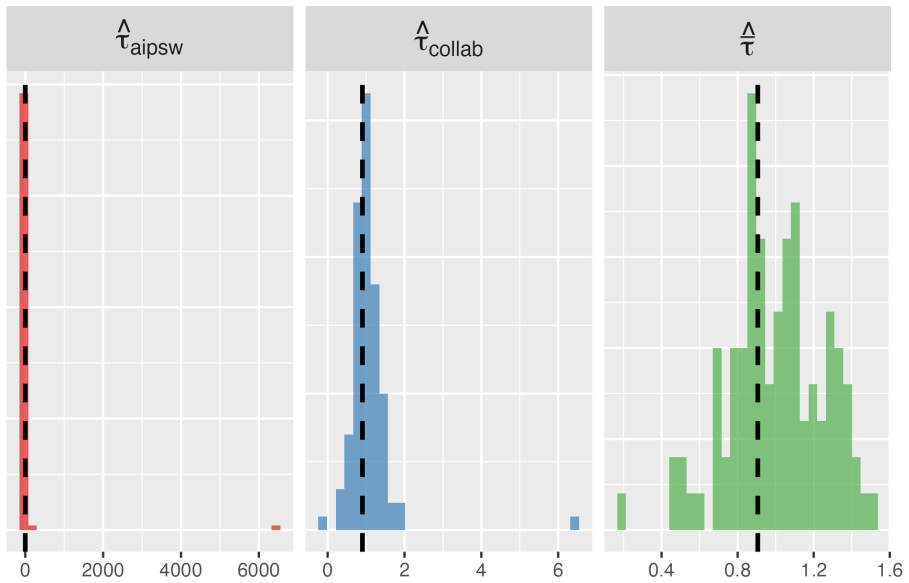
A high-quality experimental dataset is typically much smaller than a corresponding observational dataset. In this regime, we propose an estimation and inference method for a transported treatment effect when there are imperfect and possibly biased measurements of the outcome of interest in the observational dataset. First, we estimate the conditional average treatment effect (CATE) by using ordinary least squares to calibrate a treatment-control contrast in the observational outcome to the experimental data. Then, our estimator is the sample average of this estimated CATE over the observational dataset. Unlike existing methods, our inference remains asymptotically valid without positivity (overlap) between the two datasets. When the calibration regression is well specified, our estimator is consistent for the transported average treatment effect. Otherwise, it converges to a projection estimand. As long as the observational dataset size grows sufficiently quickly relative to the experimental dataset size, our estimator achieves a notion of semiparametric efficiency proposed in recent work on semi-supervised learning for the projection estimand. We illustrate the precision and stability of our methodology compared to existing proposals for transporting average treatment effects under various degrees of positivity violations using numerical simulations and a data example that incorporates field experiments and satellite images to estimate an aggregate effect of crop rotation on maize (corn) yields over a large area of the Midwestern United States.
Editorial analysis
A structured set of objections, weighed in public.
Referee Report
Summary. The manuscript proposes an estimator for the transported average treatment effect that first uses OLS regression to calibrate a treatment-control contrast from a large observational dataset (with possibly biased outcome measurements) to a smaller experimental dataset, then takes the sample average of the resulting estimated CATE over the observational units. The central claims are that the estimator is consistent for the true transported ATE when the calibration regression is correctly specified, converges to a well-defined projection estimand otherwise, yields asymptotically valid inference without requiring positivity/overlap between the datasets, and attains a semiparametric efficiency bound from the semi-supervised learning literature provided the observational sample size grows sufficiently fast relative to the experimental sample size. These results are illustrated via simulations under varying positivity violations and an empirical example fusing field experiments with satellite imagery to estimate aggregate crop-rotation effects on maize yields.
Significance. If the asymptotic claims hold, the work is significant because it provides a simple, positivity-free method for leveraging abundant but imperfect observational data to sharpen estimates of transported effects from limited experiments. The OLS calibration approach is computationally attractive and the efficiency guarantee under explicit rate conditions connects directly to recent semi-supervised learning theory, offering a practical route to more precise aggregate causal estimates in domains such as agriculture, policy evaluation, and epidemiology where full overlap is unrealistic.
minor comments (3)
- The growth-rate condition for efficiency (observational size growing sufficiently fast relative to experimental size) is stated in the abstract and introduction but would benefit from an explicit statement of the precise rate (e.g., n_obs / n_exp → ∞ or a specific polynomial rate) in the main theorem statement for clarity.
- In the simulation section, the reported coverage probabilities and MSE comparisons under strong positivity violations are useful, but adding a table or figure that directly contrasts the proposed estimator against a standard inverse-probability-weighted transport estimator would make the advantage under positivity violations more transparent.
- Notation for the calibration regression coefficients and the projection estimand could be introduced with a single consolidated display equation early in Section 2 to reduce cross-referencing.
Simulated Author's Rebuttal
We thank the referee for their positive assessment of the manuscript and for recommending minor revision. The referee's summary accurately captures the proposed calibration-based estimator, its consistency and efficiency properties under the stated conditions, and the empirical illustration. No specific major comments were raised in the report.
Circularity Check
Minor reference to semi-supervised learning work; derivation self-contained via standard OLS and averaging
specific steps
-
other
[Abstract]
"As long as the observational dataset size grows sufficiently quickly relative to the experimental dataset size, our estimator achieves a notion of semiparametric efficiency proposed in recent work on semi-supervised learning for the projection estimand."
The efficiency claim invokes an external reference (potentially self-citation) for the specific semiparametric efficiency notion, but this does not reduce the estimator definition, consistency result, or inference validity to the cited work; the rate condition and projection estimand are derived independently.
full rationale
The paper defines its estimator explicitly as OLS calibration of the observational treatment-control contrast followed by a sample average over the observational units. Consistency holds under well-specified calibration regression (a standard assumption), and the rate condition for efficiency is stated explicitly without reducing the main claims to fitted parameters or self-referential definitions. The sole reference to 'recent work on semi-supervised learning' for the efficiency notion is not load-bearing for the consistency or validity results, which stand on the paper's own equations and the explicit growth-rate assumption. No self-definitional loops, fitted-input predictions, or ansatz smuggling appear in the derivation chain.
Axiom & Free-Parameter Ledger
free parameters (1)
- calibration regression coefficients
axioms (2)
- domain assumption The calibration regression model is correctly specified
- domain assumption Observational dataset size grows sufficiently quickly relative to experimental dataset size
Reference graph
Works this paper leans on
-
[1]
Semi-supervised inference: General theory and estimation of means , author=. 2019 , journal=
work page 2019
-
[2]
High-dimensional semi-supervised learning: in search of optimal inference of the mean , author=. Biometrika , volume=. 2022 , publisher=
work page 2022
- [3]
-
[4]
Information and Inference: A Journal of the IMA , volume=
Double robust semi-supervised inference for the mean: selection bias under MAR labeling with decaying overlap , author=. Information and Inference: A Journal of the IMA , volume=. 2023 , publisher=
work page 2023
-
[5]
Solving the missing at random problem in semi-supervised learning: An inverse probability weighting method , author=. Stat , volume=. 2024 , publisher=
work page 2024
-
[6]
Prediction-powered inference , author=. Science , volume=. 2023 , publisher=
work page 2023
-
[7]
Angelopoulos, Anastasios N and Duchi, John C and Zrnic, Tijana , journal=
-
[8]
Proceedings of the National Academy of Sciences , volume=
Cross-prediction-powered inference , author=. Proceedings of the National Academy of Sciences , volume=. 2024 , publisher=
work page 2024
-
[9]
A Unified Framework for Semiparametrically Efficient Semi-Supervised Learning , author=. arXiv preprint arXiv:2502.17741 , year=
-
[10]
Handbook of Statistical Methods for Precision Medicine , pages=
Semiparametric doubly robust targeted double machine learning: a review , author=. Handbook of Statistical Methods for Precision Medicine , pages=. 2024 , publisher=
work page 2024
-
[11]
Annual Review of Statistics and its Application , volume=
A review of generalizability and transportability , author=. Annual Review of Statistics and its Application , volume=. 2023 , publisher=
work page 2023
-
[12]
Causal inference methods for combining randomized trials and observational studies: a review , author=. Statistical Science , volume=. 2024 , publisher=
work page 2024
-
[13]
Dealing with limited overlap in estimation of average treatment effects , author=. Biometrika , volume=. 2009 , publisher=
work page 2009
-
[14]
Doubly-robust and heteroscedasticity-aware sample trimming for causal inference , author=. Biometrika , pages=. 2024 , publisher=
work page 2024
-
[15]
American Journal of Epidemiology , volume=
Addressing extreme propensity scores via the overlap weights , author=. American Journal of Epidemiology , volume=. 2019 , publisher=
work page 2019
-
[16]
The American Statistician , year=
Assumption lean regression , author=. The American Statistician , year=
-
[17]
Journal of the Royal Statistical Society Series B: Statistical Methodology , volume=
Assumption-lean inference for generalised linear model parameters , author=. Journal of the Royal Statistical Society Series B: Statistical Methodology , volume=. 2022 , publisher=
work page 2022
-
[18]
Models as approximations I , author=. Statistical Science , volume=. 2019 , publisher=
work page 2019
-
[19]
Models as approximations II , author=. Statistical Science , volume=. 2019 , publisher=
work page 2019
-
[20]
Automatic debiased machine learning via
Chernozhukov, Victor and Newey, Whitney K and Quintas-Martinez, Victor and Syrgkanis, Vasilis , journal=. Automatic debiased machine learning via
-
[21]
International Conference on Machine Learning , pages=
Chernozhukov, Victor and Newey, Whitney and Quintas-Mart. International Conference on Machine Learning , pages=. 2022 , organization=
work page 2022
-
[22]
Lee, Kaitlyn J and Schuler, Alejandro , journal=
-
[23]
Journal of the American Statistical Association , volume=
Balancing covariates via propensity score weighting , author=. Journal of the American Statistical Association , volume=. 2018 , publisher=
work page 2018
-
[24]
arXiv preprint arXiv:2110.14831 , year=
The balancing act in causal inference , author=. arXiv preprint arXiv:2110.14831 , year=
-
[25]
Huang, Melody and Egami, Naoki and Hartman, Erin and Miratrix, Luke , journal=. Leveraging population outcomes to improve the generalization of experimental results: Application to the. 2023 , publisher=
work page 2023
-
[26]
arXiv preprint arXiv:2505.06452 , year=
Semiparametric semi-supervised learning for general targets under distribution shift and decaying overlap , author=. arXiv preprint arXiv:2505.06452 , year=
work page internal anchor Pith review arXiv
-
[27]
Statistics in Medicine , volume=
Extending inferences from a randomized trial to a new target population , author=. Statistics in Medicine , volume=. 2020 , publisher=
work page 2020
-
[28]
Journal of Econometrics , volume=
Overlap in observational studies with high-dimensional covariates , author=. Journal of Econometrics , volume=. 2021 , publisher=
work page 2021
-
[29]
Environmental Research Letters , volume=
Combining randomized field experiments with observational satellite data to assess the benefits of crop rotations on yields , author=. Environmental Research Letters , volume=. 2022 , publisher=
work page 2022
-
[30]
arXiv preprint arXiv:2305.19180 , year=
Prognostic adjustment with efficient estimators to unbiasedly leverage historical data in randomized trials , author=. arXiv preprint arXiv:2305.19180 , year=
-
[31]
Journal of Causal Inference , volume=
Precise unbiased estimation in randomized experiments using auxiliary observational data , author=. Journal of Causal Inference , volume=. 2023 , publisher=
work page 2023
-
[32]
The Annals of Applied Statistics , volume=
Overlap violations in external validity: Application to Ugandan cash transfer programs , author=. The Annals of Applied Statistics , volume=. 2025 , publisher=
work page 2025
-
[33]
Journal of the American Statistical Association , volume=
Estimation and inference of heterogeneous treatment effects using random forests , author=. Journal of the American Statistical Association , volume=. 2018 , publisher=
work page 2018
-
[34]
Improving efficiency in transporting average treatment effects , issn =
Rudolph, K E and Williams, N T and Stuart, E A and DÍAZ, I , month = apr, year =. Improving efficiency in transporting average treatment effects , issn =. doi:10.1093/biomet/asaf027 , journal =
-
[35]
Econometrica: Journal of the Econometric Society , pages=
The asymptotic variance of semiparametric estimators , author=. Econometrica: Journal of the Econometric Society , pages=. 1994 , publisher=
work page 1994
-
[36]
The Annals of Statistics , volume=
Augmented minimax linear estimation , author=. The Annals of Statistics , volume=. 2021 , publisher=
work page 2021
-
[37]
Journal of the American statistical Association , volume=
Estimation of regression coefficients when some regressors are not always observed , author=. Journal of the American statistical Association , volume=. 1994 , publisher=
work page 1994
-
[38]
Wiley Interdisciplinary Reviews: Computational Statistics , volume=
Methods for combining observational and experimental causal estimates: A review , author=. Wiley Interdisciplinary Reviews: Computational Statistics , volume=. 2025 , publisher=
work page 2025
-
[39]
Advances in neural information processing systems , volume=
Removing hidden confounding by experimental grounding , author=. Advances in neural information processing systems , volume=
-
[40]
Data fusion methods for the heterogeneity of treatment effect and confounding function , author=. Bernoulli , year=
-
[41]
arXiv preprint arXiv:2508.14858 , year=
Data Fusion for High-Resolution Estimation , author=. arXiv preprint arXiv:2508.14858 , year=
-
[42]
Journal of the American Statistical Association , pages=
Data fusion using weakly aligned sources , author=. Journal of the American Statistical Association , pages=. 2025 , publisher=
work page 2025
-
[43]
Journal of the American Statistical Association , pages=
On the comparative analysis of average treatment effects estimation via data combination , author=. Journal of the American Statistical Association , pages=. 2025 , publisher=
work page 2025
-
[44]
Global change biology , volume=
Recent cover crop adoption is associated with small maize and soybean yield losses in the United States , author=. Global change biology , volume=. 2023 , publisher=
work page 2023
-
[45]
The American Statistician , volume=
One-step weighting to generalize and transport treatment effect estimates to a target population , author=. The American Statistician , volume=. 2024 , publisher=
work page 2024
-
[46]
Statistics in medicine , volume=
A calibration approach to transportability and data-fusion with observational data , author=. Statistics in medicine , volume=. 2022 , publisher=
work page 2022
-
[47]
Electronic Journal of Statistics , volume=
Towards optimal doubly robust estimation of heterogeneous causal effects , author=. Electronic Journal of Statistics , volume=. 2023 , publisher=
work page 2023
-
[48]
2016 IEEE international conference on data science and advanced analytics (DSAA) , pages=
The highly adaptive lasso estimator , author=. 2016 IEEE international conference on data science and advanced analytics (DSAA) , pages=. 2016 , organization=
work page 2016
-
[49]
Journal of the American Statistical Association , volume=
Who are we missing?: a principled approach to characterizing the underrepresented population , author=. Journal of the American Statistical Association , volume=. 2025 , publisher=
work page 2025
-
[50]
Communications in Statistics-Theory and Methods , volume=
A note on semiparametric efficient generalization of causal effects from randomized trials to target populations , author=. Communications in Statistics-Theory and Methods , volume=. 2023 , publisher=
work page 2023
-
[51]
Journal of the Royal Statistical Society Series B: Statistical Methodology , volume=
On the role of surrogates in the efficient estimation of treatment effects with limited outcome data , author=. Journal of the Royal Statistical Society Series B: Statistical Methodology , volume=. 2025 , publisher=
work page 2025
-
[52]
Partially Retargeted Balancing Weights for Causal Effect Estimation Under Positivity Violations , author=. 2025 , eprint=
work page 2025
-
[53]
Rate doubly robust estimation for weighted average treatment effects , author=. 2025 , eprint=
work page 2025
-
[54]
Double/debiased machine learning for treatment and structural parameters , author=. 2018 , publisher=
work page 2018
-
[55]
arXiv preprint arXiv:2406.06941 , year=
Efficient estimation and data fusion under general semiparametric restrictions on outcome mean functions , author=. arXiv preprint arXiv:2406.06941 , year=
- [56]
-
[57]
On the role of the propensity score in efficient semiparametric estimation of average treatment effects , author=. Econometrica , pages=. 1998 , publisher=
work page 1998
-
[58]
Bickel, Peter J and Klaassen, Chris AJ and Ritov, Ya’acov and Wellner, Jon A , volume=. Efficient and. 1993 , publisher=
work page 1993
-
[59]
Generalized Additive Models: An Introduction with R , year =
S.N Wood , edition =. Generalized Additive Models: An Introduction with R , year =
- [60]
-
[61]
Journal of the Royal Statistical Society Series B: Statistical Methodology , volume=
Regression shrinkage and selection via the lasso , author=. Journal of the Royal Statistical Society Series B: Statistical Methodology , volume=. 1996 , publisher=
work page 1996
-
[62]
The Annals of Statistics , volume=
Multivariate adaptive regression splines , author=. The Annals of Statistics , volume=. 1991 , publisher=
work page 1991
-
[63]
Random forests , author=. Machine learning , volume=. 2001 , publisher=
work page 2001
-
[64]
Support-vector networks , author=. Machine Learning , volume=. 1995 , publisher=
work page 1995
-
[65]
The International Journal of Biostatistics , volume=
Prognostic adjustment with efficient estimators to unbiasedly leverage historical data in randomized trials , author=. The International Journal of Biostatistics , volume=. 2025 , publisher=
work page 2025
- [66]
-
[67]
Sustainable corn CAP research data (USDA-NIFA award no. 2011-68002-30190) , author=
work page 2011
-
[68]
Long-term evidence shows that crop-rotation diversification increases agricultural resilience to adverse growing conditions in North America , author=. One Earth , volume=. 2020 , publisher=
work page 2020
discussion (0)
Sign in with ORCID, Apple, or X to comment. Anyone can read and Pith papers without signing in.