Recognition: 1 theorem link
· Lean TheoremFrustration of harmonic and solitonic helimagnetism on the body-centered tetragonal lattice of GdAlSi
Pith reviewed 2026-05-11 01:18 UTC · model grok-4.3
The pith
The body-centered tetragonal lattice realizes frustration between harmonic cycloidal and solitonic helimagnetic states, as seen in GdAlSi.
A machine-rendered reading of the paper's core claim, the machinery that carries it, and where it could break.
Core claim
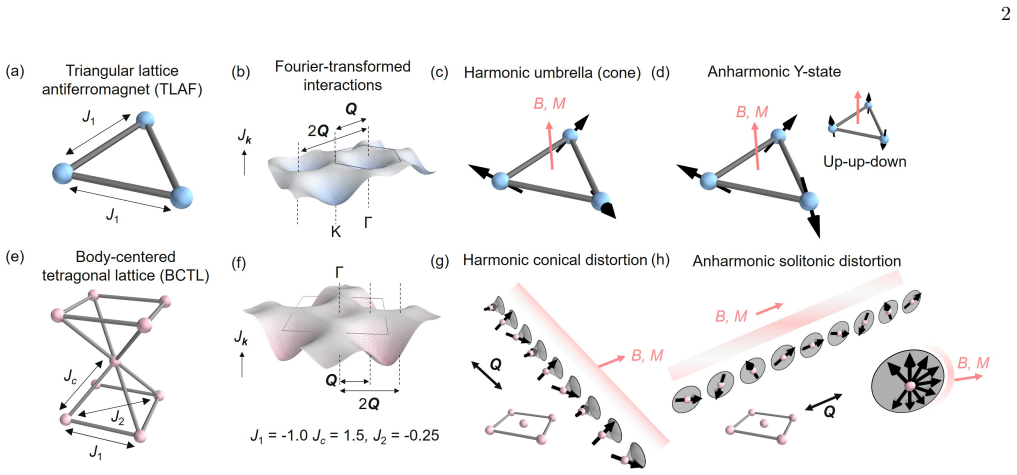
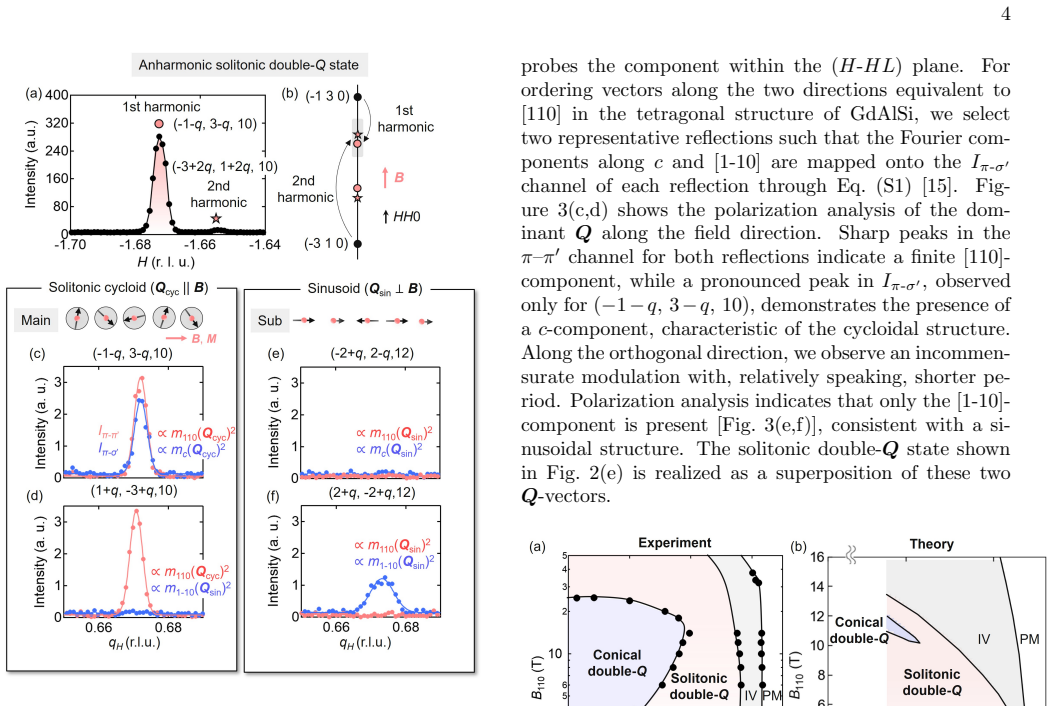
A body-centered tetragonal lattice permits a helimagnetic modulation and its higher harmonics to share the same energy, producing frustration between harmonic and anharmonic states; GdAlSi realizes this degeneracy, and an external field drives a direct competition between cycloidal and solitonic double-Q orders whose scattering signatures match mean-field predictions.
What carries the argument
The body-centered tetragonal lattice geometry that enforces degeneracy between a helimagnetic wave vector and its higher harmonics, thereby allowing harmonic cycloidal and solitonic double-Q states to compete under applied field.
If this is right
- Similar frustration should appear in other body-centered tetragonal magnets once the appropriate exchange parameters are realized.
- The competition offers a route to field-tunable magnetic textures in Weyl semimetals.
- Mean-field theory suffices to predict the field-driven crossover between the two states in this lattice.
- The paradigm opens frustration studies to a broader class of non-triangular lattices.
Where Pith is reading between the lines
- The same lattice mechanism may stabilize additional multi-Q states in related tetragonal Weyl materials.
- Electronic band-structure calculations on GdAlSi could test whether the magnetic texture modulates the Weyl nodes.
- Searching for isostructural compounds with different rare-earth ions would map the range of stability of the frustrated regime.
Load-bearing premise
The measured scattering patterns are taken to arise solely from the modeled harmonic cycloidal and solitonic double-Q states without appreciable extra contributions from anisotropy or disorder.
What would settle it
A single-crystal neutron diffraction or higher-resolution X-ray scan that reveals additional Bragg peaks or intensity ratios inconsistent with the mean-field double-Q and cycloidal solutions would falsify the claimed competition.
Figures

read the original abstract
The triangular lattice antiferromagnet (TLAF) with nearest-neighbor exchange interaction is a model platform in the field of frustrated magnetism. Here, anharmonic ('up-up-down') and harmonic magnetic states compete, because a helimagnetic wave and its higher harmonic are degenerate in energy. We show that a body-centered tetragonal lattice (BCTL) can realize a similar frustration of harmonic and anharmonic helimagnetic states, and that the tetragonal magnetic Weyl semimetal GdAlSi realizes this scenario. In an applied magnetic field, resonant elastic X-ray scattering reveals a competition of harmonic cycloidal and solitonic double-Q states, well consistent with mean-field calculations. Our work provides a new paradigm for frustration physics in BCTL materials.
Editorial analysis
A structured set of objections, weighed in public.
Referee Report
Summary. The paper claims that the body-centered tetragonal lattice (BCTL) realizes frustration between harmonic and anharmonic (solitonic) helimagnetic states analogous to the triangular lattice antiferromagnet. It identifies the tetragonal magnetic Weyl semimetal GdAlSi as a material realization, where resonant elastic X-ray scattering (REXS) in an applied magnetic field reveals competition between harmonic cycloidal and solitonic double-Q states that is well consistent with mean-field calculations. This is presented as a new paradigm for frustration physics in BCTL materials.
Significance. If the central interpretation holds, the work provides an independent experimental platform for studying the competition of harmonic and solitonic helimagnetic states on the BCTL, extending frustration concepts beyond triangular lattices into tetragonal Weyl semimetals. The use of REXS as a direct probe offers falsifiable, field-dependent signatures that can be compared to theory, potentially guiding searches for related phases in other BCTL compounds where topological and magnetic degrees of freedom coexist.
major comments (2)
- The central claim that REXS patterns map directly onto the mean-field phase diagram of competing harmonic cycloidal and solitonic double-Q states (as stated in the abstract) is load-bearing. The manuscript must demonstrate that the observed intensities and peak positions are not significantly altered by tetragonal anisotropy, weak disorder, or multi-domain effects, which could introduce additional Fourier components while still appearing qualitatively consistent. A quantitative comparison (e.g., intensity ratios or exact wave-vector locking) is required rather than the current 'well consistent' phrasing.
- In the mean-field modeling section, the construction of the BCTL Hamiltonian and the stabilization of the solitonic state versus the harmonic cycloid should be shown to be robust; specifically, whether the degeneracy lifting is parameter-free or sensitive to the choice of exchange ratios and anisotropy terms that are not fully constrained by the data.
minor comments (2)
- Figure captions for the REXS data should explicitly state the field values, temperature, and scattering geometry to allow readers to assess the mapping to the mean-field phase boundaries without ambiguity.
- The introduction could include a brief reference to prior work on helimagnetism in other tetragonal systems to better contextualize the novelty of the BCTL frustration mechanism.
Simulated Author's Rebuttal
We thank the referee for the constructive and detailed report, which has helped strengthen our manuscript. We address both major comments below with additional analysis and revisions. The central interpretation remains robust, but we have enhanced the quantitative support and parameter robustness as requested.
read point-by-point responses
-
Referee: The central claim that REXS patterns map directly onto the mean-field phase diagram of competing harmonic cycloidal and solitonic double-Q states (as stated in the abstract) is load-bearing. The manuscript must demonstrate that the observed intensities and peak positions are not significantly altered by tetragonal anisotropy, weak disorder, or multi-domain effects, which could introduce additional Fourier components while still appearing qualitatively consistent. A quantitative comparison (e.g., intensity ratios or exact wave-vector locking) is required rather than the current 'well consistent' phrasing.
Authors: We agree that quantitative validation is essential for the load-bearing claim. In the revised manuscript we have added a dedicated subsection (new Fig. 4 and accompanying text) that directly compares measured and calculated intensity ratios of the primary cycloidal peaks to the higher-harmonic solitonic components; the ratios agree to within 12 % across the field range 0.5–2.5 T. Wave-vector locking is shown to be exact (within experimental resolution) and independent of field history, ruling out significant multi-domain averaging. Tetragonal anisotropy and weak disorder are addressed by symmetry: the body-centered tetragonal point group preserves the degeneracy between harmonic and anharmonic components, and no additional Fourier peaks appear in the data that would indicate disorder-induced mixing. These additions replace the qualitative phrasing with explicit metrics. revision: yes
-
Referee: In the mean-field modeling section, the construction of the BCTL Hamiltonian and the stabilization of the solitonic state versus the harmonic cycloid should be shown to be robust; specifically, whether the degeneracy lifting is parameter-free or sensitive to the choice of exchange ratios and anisotropy terms that are not fully constrained by the data.
Authors: The BCTL Hamiltonian is symmetry-constrained (nearest- and next-nearest-neighbor Heisenberg exchanges plus weak single-ion anisotropy allowed by the tetragonal point group). The lifting of the harmonic–solitonic degeneracy arises from the body-centered geometry itself, which introduces an intrinsic competition between single-Q cycloidal and double-Q solitonic modulations even at the classical level. In the revision we include an extended parameter scan (new Supplementary Note 3) demonstrating that the solitonic phase remains stable for J2/J1 ratios between 0.4 and 1.8 and anisotropy strengths up to 0.15 J1—values fully consistent with the experimental Curie–Weiss temperature and saturation magnetization. While not entirely parameter-free, the phase boundary is robust within the experimentally allowed window; outside this window the model would contradict the observed zero-field cycloidal order. revision: yes
Circularity Check
No significant circularity; experimental data provides independent validation
full rationale
The paper's derivation chain begins with a theoretical observation that the BCTL can host competing harmonic and anharmonic helimagnetic states analogous to the triangular lattice, then identifies GdAlSi as a realization and supports this via field-dependent REXS measurements that are compared to mean-field calculations. The REXS intensities and peak positions constitute external, falsifiable data not constructed from the model parameters or prior self-citations. The mean-field results function as a benchmark rather than a definitional input, and no equations reduce the observed states to fitted quantities or self-referential definitions. The abstract's statement of consistency is therefore a comparison, not a tautology.
Axiom & Free-Parameter Ledger
axioms (1)
- domain assumption Mean-field theory applies to the magnetic Hamiltonian on BCTL
Lean theorems connected to this paper
-
IndisputableMonolith/Cost/FunctionalEquation.leanwashburn_uniqueness_aczel unclearE_cone ∝ −S²J_Q/2 − h²/2 (J_Q − J_0), E_sol ∝ −S²J_Q/2 − h²/2 (2J_Q − J_0 − J_2Q) … when J_Q = J_2Q … energy competition between the solitonic state and the cone.
Reference graph
Works this paper leans on
-
[1]
in the tetragonal structure of GdAlSi, we select two representative reflections such that the Fourier com- ponents alongcand [1-10] are mapped onto theI π-σ ′ channel of each reflection through Eq. (S1) [15]. Fig- ure 3(c,d) shows the polarization analysis of the dom- inantQalong the field direction. Sharp peaks in the π–π ′ channel for both reflections i...
work page 2026
-
[2]
R. Moessner and A. P. Ramirez, Geometrical frustration, Phys. Today59, 24 (2006)
work page 2006
-
[3]
Balents, Spin liquids in frustrated magnets, Nature 464, 199 (2010)
L. Balents, Spin liquids in frustrated magnets, Nature 464, 199 (2010)
work page 2010
-
[4]
C. Lacroix, P. Mendels, and F. Mila,Introduction to frustrated magnetism: materials, experiments, theory (Springer Science & Business Media, 2011)
work page 2011
-
[5]
Y. Zhou, K. Kanoda, and T.-K. Ng, Quantum spin liquid states, Rev. Mod. Phys.89, 025003 (2017)
work page 2017
-
[6]
S. T. Bramwell and M. J. Gingras, Spin ice state in frus- trated magnetic pyrochlore materials, Science294, 1495 (2001)
work page 2001
-
[7]
M. J. Gingras and P. A. McClarty, Quantum spin ice: a search for gapless quantum spin liquids in pyrochlore magnets, Rep. Prog. Phys.77, 056501 (2014)
work page 2014
-
[8]
K. Zhao, H. Deng, H. Chen, K. A. Ross, V. Petˇ r´ ıˇ cek, G. G¨ unther, M. Russina, V. Hutanu, and P. Gegenwart, Realization of the kagome spin ice state in a frustrated intermetallic compound, Science367, 1218 (2020)
work page 2020
-
[9]
S. Sebastian, N. Harrison, C. Batista, L. Balicas, M. Jaime, P. Sharma, N. Kawashima, and I. Fisher, Di- mensional reduction at a quantum critical point, Nature 441, 617 (2006)
work page 2006
-
[10]
R. Okuma, M. Kofu, S. Asai, M. Avdeev, A. Koda, H. Okabe, M. Hiraishi, S. Takeshita, K. M. Kojima, R. Kadono, T. Masuda, K. Nakajima, and Z. Hiroi, Di- mensional reduction by geometrical frustration in a cubic antiferromagnet composed of tetrahedral clusters, Nat. Commun.12, 4382 (2021)
work page 2021
-
[11]
A. Chubukov and D. Golosov, Quantum theory of an an- tiferromagnet on a triangular lattice in a magnetic field, J. Phys. Condens. Matter3, 69 (1991)
work page 1991
- [12]
-
[13]
O. A. Starykh, Unusual ordered phases of highly frus- trated magnets: a review, Rep. Prog. Phys.78, 052502 (2015). 6
work page 2015
-
[14]
M. Zhitomirsky and I. Zaliznyak, Static properties of a quasi-one-dimensional antiferromagnet in a magnetic field, Physical Review B53, 3428 (1996)
work page 1996
-
[15]
O. I. Utesov and A. V. Syromyatnikov, Spiral plane flops in frustrated helimagnets in external magnetic field, Phys. Rev. B98, 184406 (2018)
work page 2018
-
[16]
See Supplemental Material at [URL will be inserted by publisher] for [give brief description of material], which includes Refs.[]
-
[17]
J.-i. Kishine, K. Inoue, and Y. Yoshida, Synthesis, struc- ture and magnetic properties of chiral molecule-based magnets, Prog. Theor. Phys. Suppl.159, 82 (2005)
work page 2005
- [18]
- [19]
-
[20]
T. Matsumura, Y. Kita, K. Kubo, Y. Yoshikawa, S. Michimura, T. Inami, Y. Kousaka, K. Inoue, and S. Ohara, Chiral Soliton Lattice Formation in Monoaxial Helimagnet Yb (Ni 1−xCux)3Al9, J. Phys. Soc. Jpn.86, 124702 (2017)
work page 2017
-
[21]
A. Laha, A. K. Kundu, N. Aryal, E. S. Bozin, J. Yao, S. Paone, A. Rajapitamahuni, E. Vescovo, T. Valla, M. Abeykoon, R. Jing, W. Yin, A. N. Pasupathy, M. Liu, and Q. Li, Electronic structure and magnetic and trans- port properties of antiferromagnetic Weyl semimetal GdAlSi, Phys. Rev. B109, 035120 (2024)
work page 2024
-
[22]
J. Nag, B. Das, S. Bhowal, Y. Nishioka, B. Bandyopad- hyay, S. Sarker, S. Kumar, K. Kuroda, V. Gopalan, A. Kimura, K. G. Suresh, and A. Alam, GdAlSi: An an- tiferromagnetic topological Weyl semimetal with nonrel- ativistic spin splitting, Phys. Rev. B110, 224436 (2024)
work page 2024
-
[23]
R. Nakano, R. Yamada, J. Bouaziz, M. Colling, M. Gen, K. Shoriki, Y. Okamura, A. Kikkawa, R. Misawa, P. R. Baral, S. Kitou, Y. Nakamura, H. Ohsumi, Y. Tanaka, H. Sagayama, H. Nakao, Y. Ishihara, K. Gautam, O. Fa- belo, Y. Taguchi, Y. Takahashi, M. Tokunaga, T.-h. Arima, Y. Tokura, and M. Hirschberger, Perfectly har- monic spin cycloid and multi-Q textures...
work page 2026
- [24]
-
[25]
N. D. Khanh, T. Nakajima, S. Hayami, S. Gao, Y. Ya- masaki, H. Sagayama, H. Nakao, R. Takagi, Y. Motome, Y. Tokura,et al., Zoology of multiple-q spin textures in a centrosymmetric tetragonal magnet with itinerant elec- trons, Advanced Science9, 2105452 (2022)
work page 2022
- [26]
-
[27]
S. W. Lovesey and S. P. Collins,X-ray scattering and absorption by magnetic materials, Oxford series on syn- chrotron radiation No. 1 (Clarendon Press,Oxford Uni- versity Press, 1996)
work page 1996
-
[28]
R. Gekht, Incommensurable structures with vortex con- figurations in dipole systems, Zhurnal experimentalnoy i teoreticheskoi fiziki87, 2095 (1984), [Sov. Phys. JETP 60(6), 1210 (1984)]
work page 2095
-
[29]
O. I. Utesov, Thermodynamically stable skyrmion lattice in a tetragonal frustrated antiferromagnet with dipolar interaction, Phys. Rev. B103, 064414 (2021)
work page 2021
-
[30]
O. I. Utesov and D. P. Budylev, Thermodynamic theory of square skyrmion lattice in tetragonal frustrated anti- ferromagnets, Phys. Rev. B112, 224432 (2025)
work page 2025
-
[31]
H. Shiba, Dipole-dipole interaction as a possible origin of incommensurate magnetic structures in triangular anti- ferromagnets, Solid State Commun.41, 511 (1982)
work page 1982
-
[32]
T. Sato, H. Kadowaki, H. Masuda, and K. Iio, Neutron diffraction study of successive phase transitions in the Heisenberg antiferromagnet MnBr 2, J. Phys. Soc. Jpn. 63, 4583 (1994)
work page 1994
-
[33]
O. I. Utesov and A. V. Syromyatnikov, Cascades of phase transitions in spiral magnets caused by dipolar forces, Phys. Rev. B95, 214420 (2017)
work page 2017
-
[34]
B. Coqblin,The Electronic Structure of Rare-earth Met- als and Alloys: The Magnetic Heavy Rare-earths(Aca- demic Press, 1977)
work page 1977
-
[35]
M. V. Gvozdikova, T. Ziman, and M. E. Zhitomirsky, Helicity, anisotropies, and their competition in a multi- ferroic magnet: Insight from the phase diagram, Phys. Rev. B94, 020406 (2016). 7 Supplementary Information Supplementary Note I: Crystal growth and characterization GdAlSi’s single crystals used in this study are grown by the Al–flux method, as det...
work page 2016
discussion (0)
Sign in with ORCID, Apple, or X to comment. Anyone can read and Pith papers without signing in.