Recognition: 2 theorem links
· Lean TheoremPRISM: Refracting the Entangled User Behavior Space for E-Commerce Search
Pith reviewed 2026-05-11 01:14 UTC · model grok-4.3
The pith
Explicitly modeling the interaction between user preference and item relevance improves robustness of e-commerce search models.
A machine-rendered reading of the paper's core claim, the machinery that carries it, and where it could break.
Core claim
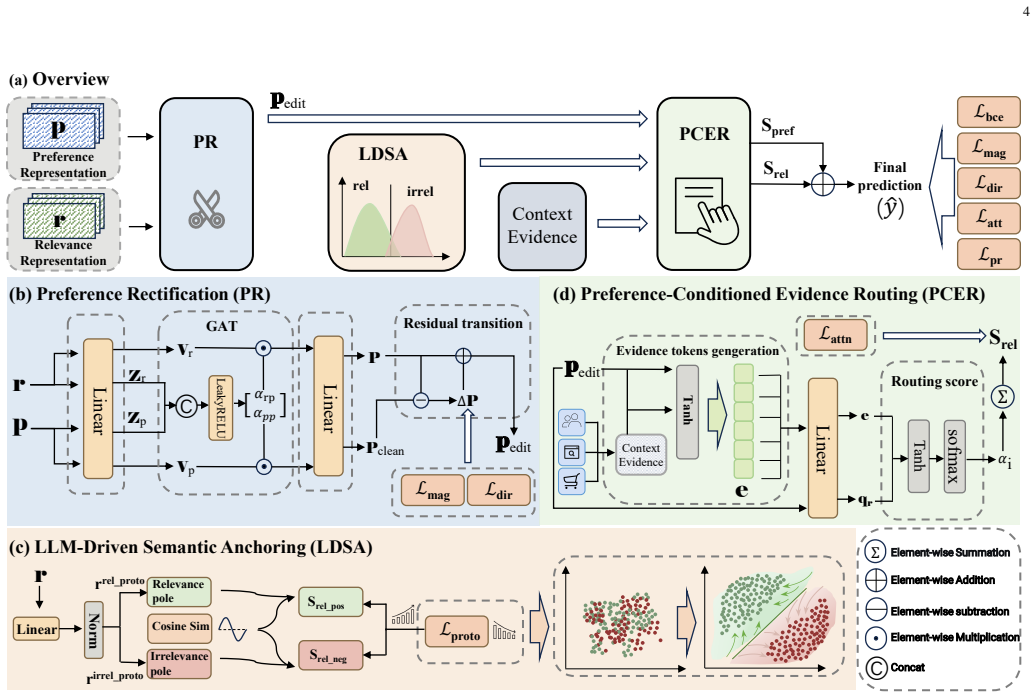
PRISM is a Preference-Relevance Interaction Semantic Modeling framework that explicitly models the interaction between user preference and item relevance for e-commerce search behavior prediction. It introduces a preference rectification module to iteratively refine user preference under relevance-aware constraints, an LLM-driven semantic anchoring mechanism that uses positive and negative prototypes to calibrate relevance representations, and a preference-conditioned evidence routing module that adaptively aggregates multi-source behavioral signals.
What carries the argument
The PRISM framework's three modules that treat preference and relevance as interacting: preference rectification under relevance constraints, LLM prototype-based semantic anchoring, and preference-conditioned evidence routing.
If this is right
- Reduces confounding effects from exposure mechanisms and feedback loops in behavior signals.
- Improves semantic consistency of relevance representations through prototype calibration.
- Produces context-aware relevance estimates by routing evidence according to current preferences.
- Yields consistent gains over strong baselines on public e-commerce search benchmarks.
Where Pith is reading between the lines
- The same interaction approach could apply to recommendation systems outside search where behavior signals also drift.
- Upstream disentanglement might simplify the design of downstream ranking models by reducing the need for separate debiasing steps.
- Deeper LLM integration for anchoring could support more dynamic handling of semantic shifts in live traffic.
Load-bearing premise
The proposed modules can disentangle confounded behavioral signals without introducing new biases or requiring heavy post-hoc tuning.
What would settle it
Ablation experiments on the two public e-commerce benchmarks that remove the interaction modules and show no gain or a drop in ranking metrics, or user studies that still detect semantic misalignment in the outputs.
Figures


read the original abstract
E-commerce search systems rely on modeling user behavior to estimate item relevance and user preference, which are typically assumed to be stable and independently learnable signals. However, in practice, user interactions are jointly shaped by exposure mechanisms, feedback loops, and semantic matching, leading to entangled and dynamically drifting behavioral signals. As a result, both preference estimation and relevance modeling suffer from confounding effects and semantic misalignment, which limits the robustness of downstream ranking models. To address this issue, we propose PRISM, a Preference-Relevance Interaction Semantic Modeling framework for e-commerce search behavior prediction. PRISM explicitly models the interaction between user preference and item relevance rather than treating them as independent components. Specifically, it introduces a preference rectification module to iteratively refine user preference under relevance-aware constraints, improving robustness against behavioral confounding. To ensure semantic consistency, we further incorporate a large language model (LLM)-driven semantic anchoring mechanism that leverages positive and negative prototypes to calibrate relevance representations. Finally, a preference-conditioned evidence routing module adaptively aggregates multi-source behavioral signals, enabling context-aware and preference-aligned relevance estimation. Extensive experiments on two public e-commerce benchmarks demonstrate that PRISM consistently outperforms strong baselines, validating the effectiveness of explicitly modeling preference-relevance interaction for robust and semantically grounded search behavior modeling.
Editorial analysis
A structured set of objections, weighed in public.
Referee Report
Summary. The manuscript proposes PRISM, a Preference-Relevance Interaction Semantic Modeling framework for e-commerce search behavior prediction. It claims that user interactions are jointly shaped by exposure mechanisms, feedback loops, and semantic matching, entangling preference and relevance signals and causing confounding and misalignment in ranking models. PRISM explicitly models their interaction via three components: a preference rectification module that iteratively refines user preference under relevance-aware constraints, an LLM-driven semantic anchoring mechanism using positive and negative prototypes to calibrate relevance representations, and a preference-conditioned evidence routing module that adaptively aggregates multi-source behavioral signals. Experiments on two public e-commerce benchmarks are reported to show consistent outperformance over strong baselines.
Significance. If the modules prove effective at disentangling confounded signals without new biases, the work could advance robust modeling of dynamic user behavior in e-commerce search by moving beyond independent treatment of preference and relevance. The LLM-based prototype anchoring represents a timely integration of generative models for semantic consistency. However, the absence of any equations, algorithmic specifications, ablation results, or numerical performance deltas in the manuscript prevents assessment of whether the claimed robustness gains are realized or merely asserted.
major comments (2)
- Abstract and §3 (method overview): the central claim that explicit preference-relevance interaction modeling improves robustness against behavioral confounding rests on the three proposed modules, yet no equations, pseudocode, or loss formulations are supplied for the rectification step, prototype calibration, or routing mechanism; without these, the claim cannot be verified or reproduced.
- §4 (experiments): the statement that PRISM 'consistently outperforms strong baselines' on two public benchmarks is presented without any tables, metrics (e.g., NDCG, AUC), ablation results, or statistical significance tests; this omission makes it impossible to evaluate the magnitude or reliability of the reported gains.
minor comments (2)
- The abstract and introduction use the term 'refracting' in the title and motivation without defining its technical meaning in the context of behavior space; a brief clarification would improve accessibility.
- No discussion of computational overhead or inference latency introduced by the LLM component is provided, which is relevant for e-commerce deployment.
Simulated Author's Rebuttal
We thank the referee for their thorough review and valuable comments on our manuscript. We acknowledge the need for greater detail in the methodological and experimental sections to substantiate our claims. We will revise the paper accordingly to address these points.
read point-by-point responses
-
Referee: Abstract and §3 (method overview): the central claim that explicit preference-relevance interaction modeling improves robustness against behavioral confounding rests on the three proposed modules, yet no equations, pseudocode, or loss formulations are supplied for the rectification step, prototype calibration, or routing mechanism; without these, the claim cannot be verified or reproduced.
Authors: We agree that the manuscript currently lacks the specific equations, pseudocode, and loss formulations for the preference rectification module, the semantic anchoring with prototypes, and the evidence routing mechanism. This is a significant omission that hinders verification. In the revised version, we will provide the complete mathematical specifications, including the iterative update rules for preference rectification under relevance constraints, the contrastive losses for prototype calibration using the LLM, and the pseudocode for the preference-conditioned routing. These additions will enable readers to understand and reproduce the proposed approach. revision: yes
-
Referee: §4 (experiments): the statement that PRISM 'consistently outperforms strong baselines' on two public benchmarks is presented without any tables, metrics (e.g., NDCG, AUC), ablation results, or statistical significance tests; this omission makes it impossible to evaluate the magnitude or reliability of the reported gains.
Authors: The referee is correct in noting the absence of detailed experimental results, including tables, specific metrics, ablations, and significance tests in the submitted manuscript. We will incorporate all necessary experimental details in the revision, including performance comparison tables with metrics like NDCG@K and AUC, quantitative improvements over baselines, module ablation studies, and p-value based statistical significance tests to rigorously demonstrate the gains. revision: yes
Circularity Check
No significant circularity in claimed derivation
full rationale
The paper describes a high-level architectural framework (preference rectification module, LLM-driven semantic anchoring with prototypes, and preference-conditioned evidence routing) without presenting any mathematical derivations, equations, or first-principles results that could reduce to their own inputs. Claims about disentangling entangled signals follow directly from the problem motivation and are validated via experiments on external public benchmarks, with no self-citations or fitted quantities invoked as load-bearing predictions. The approach remains self-contained against independent evaluation.
Axiom & Free-Parameter Ledger
Lean theorems connected to this paper
-
IndisputableMonolith/Cost/FunctionalEquation.lean (Jcost uniqueness, Aczél classification)washburn_uniqueness_aczel unclear?
unclearRelation between the paper passage and the cited Recognition theorem.
preference rectification module to iteratively refine user preference under relevance-aware constraints... LLM-driven semantic anchoring... preference-conditioned evidence routing
-
IndisputableMonolith/Foundation/AlphaCoordinateFixation.lean (higher-derivative calibration of CostAlphaLog)J_uniquely_calibrated_via_higher_derivative unclear?
unclearRelation between the paper passage and the cited Recognition theorem.
Lmag = ||Δp||², Ldir = 1-cos(p_edit, p), prototype margin loss with cos(r_proto, r_pos/neg)
What do these tags mean?
- matches
- The paper's claim is directly supported by a theorem in the formal canon.
- supports
- The theorem supports part of the paper's argument, but the paper may add assumptions or extra steps.
- extends
- The paper goes beyond the formal theorem; the theorem is a base layer rather than the whole result.
- uses
- The paper appears to rely on the theorem as machinery.
- contradicts
- The paper's claim conflicts with a theorem or certificate in the canon.
- unclear
- Pith found a possible connection, but the passage is too broad, indirect, or ambiguous to say the theorem truly supports the claim.
Reference graph
Works this paper leans on
-
[1]
Challenges and research opportunities in ecommerce search and recommendations,
M. Tsagkias, T. H. King, S. Kallumadi, V . Murdock, and M. de Rijke, “Challenges and research opportunities in ecommerce search and recommendations,”SIGIR Forum, vol. 54, no. 1, Jun. 2020. [Online]. Available: https://doi.org/10.1145/3451964.3451966 10 TABLE VII EFFECTIVENESS OFPREFERENCERECTIFICATION UNDER THEDSSM/QEM + MLPSETTING ONKUAISAR. RM Method AU...
-
[2]
Kuaisar: A unified search and recommendation dataset,
Z. Sun, Z. Si, X. Zang, D. Leng, Y . Niu, Y . Song, X. Zhang, and J. Xu, “Kuaisar: A unified search and recommendation dataset,” in Proceedings of the 32nd ACM International Conference on Information and Knowledge Management, ser. CIKM ’23. New York, NY , USA: Association for Computing Machinery, Oct. 2023, pp. 5407–5411. [Online]. Available: https://doi....
-
[4]
Available: https://arxiv.org/abs/2405.05606
[Online]. Available: https://arxiv.org/abs/2405.05606
-
[5]
From semantic retrieval to pairwise ranking: Applying deep learning in e-commerce search,
R. Li, Y . Jiang, W. Yang, G. Tang, S. Wang, C. Ma, W. He, X. Xiong, Y . Xiao, and Y . E. Zhao, “From semantic retrieval to pairwise ranking: Applying deep learning in e-commerce search,” inProceedings of the 42nd International ACM SIGIR Conference on Research and Development in Information Retrieval, ser. SIGIR ’19. New York, NY , USA: Association for Co...
-
[6]
Behavior modeling space reconstruction for e-commerce search,
Y . Wang, C. Zhang, X. Zhao, Q. Liu, M. Wang, X. Wei, Z. Liu, X. Shi, X. Yang, L. Zhong, and W. Lin, “Behavior modeling space reconstruction for e-commerce search,” inProceedings of the ACM Web Conference 2025, ser. WWW ’25. New York, NY , USA: Association for Computing Machinery, Apr. 2025, pp. 1683–1692. [Online]. Available: https://doi.org/10.1145/3696...
-
[7]
Jdsearch: A personalized product search dataset with real queries and full interactions,
J. Liu, Z. Dou, G. Tang, and S. Xu, “Jdsearch: A personalized product search dataset with real queries and full interactions,” inProceedings of the 46th International ACM SIGIR Conference on Research and Development in Information Retrieval, ser. SIGIR ’23. New York, NY , USA: Association for Computing Machinery, Jul. 2023, pp. 2945–2952. [Online]. Availa...
-
[8]
A setwise approach for effective and highly efficient zero-shot ranking with large language models
T. Shi, Z. Si, J. Xu, X. Zhang, X. Zang, K. Zheng, D. Leng, Y . Niu, and Y . Song, “Unisar: Modeling user transition behaviors between search and recommendation,” inProceedings of the 47th International ACM SIGIR Conference on Research and Development in Information Retrieval, ser. SIGIR ’24. New York, NY , USA: Association for Computing Machinery, Jul. 2...
-
[9]
A zero attention model for personalized product search,
Q. Ai, D. N. Hill, S. V . N. Vishwanathan, and W. B. Croft, “A zero attention model for personalized product search,” inProceedings of the 28th ACM International Conference on Information and Knowledge Management, 2019, pp. 379–388
work page 2019
-
[10]
Learning a fine-grained review-based transformer model for personalized product search,
K. Bi, Q. Ai, and W. B. Croft, “Learning a fine-grained review-based transformer model for personalized product search,” inProceedings of the 44th International ACM SIGIR Conference on Research and Development in Information Retrieval, 2021, pp. 123–132
work page 2021
-
[11]
R. Chen, S. Cao, A. He, S. Han, and J. Chen, “Prectr: A synergistic framework for integrating personalized search relevance matching and ctr prediction,”arXiv preprint arXiv:2503.18395, 2025
-
[12]
Print: Personalized relevance incentive network for ctr prediction in sponsored search,
Z. Hong, H. Wang, C. Qian, W. Chen, T. He, Y . Zou, Q. Liu, and X. Wang, “Print: Personalized relevance incentive network for ctr prediction in sponsored search,” inCompanion Proceedings of the ACM on Web Conference 2024, 2024, pp. 190–195
work page 2024
-
[13]
A survey on causal inference for recommendation,
H. Luo, F. Zhuang, R. Xie, H. Zhu, D. Wang, Z. An, and Y . Xu, “A survey on causal inference for recommendation,”The Innovation, vol. 5, no. 2, p. 100590, 2024. [Online]. Available: https://doi.org/10.1016/j.xinn.2024.100590
-
[14]
Recrec: Reasoning the causes of implicit feedback for debiased recommendation,
S. Lin, S. Zhou, J. Chen, Y . Feng, Q. Shi, C. Chen, Y . Li, and C. Wang, “Recrec: Reasoning the causes of implicit feedback for debiased recommendation,”ACM Transactions on Information Systems, vol. 42, no. 6, pp. 158:1–158:26, 2024
work page 2024
-
[15]
Investigating the robustness of counterfactual learning to rank models: A reproducibility study,
Z. Niu, J. Mao, Q. Ai, and J. Wen, “Investigating the robustness of counterfactual learning to rank models: A reproducibility study,” arXiv preprint arXiv:2404.03707, 2024. [Online]. Available: https: //arxiv.org/abs/2404.03707
-
[16]
E. Coppolillo, S. Mungari, E. Ritacco, F. Fabbri, M. Minici, F. Bonchi, and G. Manco, “Algorithmic drift: A simulation framework to study the effects of recommender systems on user preferences,”Information Processing & Management, vol. 62, no. 4, p. 104125, 2025
work page 2025
-
[17]
Causal learning for trustworthy recommender systems: A survey,
J. Li, S. Wang, Q. Zhang, L. Cao, F. Chen, X. Zhang, D. Jannach, and C. C. Aggarwal, “Causal learning for trustworthy recommender systems: A survey,”CoRR, vol. abs/2402.08241, 2024. [Online]. Available: https://arxiv.org/abs/2402.08241
-
[18]
Decon- founding user preference in recommendation systems through implicit and explicit feedback,
Y . Liang, E. Yang, G. Guo, W. Cai, L. Jiang, and X. Wang, “Decon- founding user preference in recommendation systems through implicit and explicit feedback,”ACM Transactions on Knowledge Discovery from Data, vol. 18, no. 8, pp. 198:1–198:18, 2024
work page 2024
-
[19]
Knowledge distillation based contextual relevance matching for e-commerce product search,
Z. Liu, C. Wang, H. Feng, L. Wu, and L. Yang, “Knowledge distillation based contextual relevance matching for e-commerce product search,” inProceedings of the 2022 Conference on Empirical Methods in Natural Language Processing: Industry Track. Abu Dhabi, UAE: 11 Association for Computational Linguistics, Dec. 2022, pp. 63–76. [Online]. Available: https://...
work page 2022
-
[20]
Multimodal recommender systems: A survey,
Q. Liu, J. Hu, Y . Xiao, X. Zhao, J. Gao, W. Wang, Q. Li, and J. Tang, “Multimodal recommender systems: A survey,”ACM Comput. Surv., vol. 57, no. 2, pp. 1–17, 2025, art. no. 26
work page 2025
-
[21]
Learning a product relevance model from click-through data in e-commerce,
S. Yao, J. Tan, X. Chen, K. Yang, R. Xiao, H. Deng, and X. Wan, “Learning a product relevance model from click-through data in e-commerce,” inProceedings of the Web Conference 2021, ser. WWW ’21. New York, NY , USA: Association for Computing Machinery, 2021, pp. 2890–2899. [Online]. Available: https://doi.org/10.1145/3442381.3450129
-
[22]
End-to-end neural ad- hoc ranking with kernel pooling
Q. Ai, Y . Zhang, K. Bi, X. Chen, and W. B. Croft, “Learning a hierarchical embedding model for personalized product search,” inProceedings of the 40th International ACM SIGIR Conference on Research and Development in Information Retrieval, ser. SIGIR ’17. New York, NY , USA: Association for Computing Machinery, Aug. 2017, pp. 645–654. [Online]. Available...
-
[23]
Attentive long short-term preference modeling for personalized product search,
Y . Guo, Z. Cheng, L. Nie, Y . Wang, J. Ma, and M. S. Kankanhalli, “Attentive long short-term preference modeling for personalized product search,”ACM Transactions on Information Systems, vol. 37, no. 2, Jan
-
[24]
Available: https://doi.org/10.1145/3295822
[Online]. Available: https://doi.org/10.1145/3295822
-
[25]
A transformer-based embedding model for personalized product search,
K. Bi, Q. Ai, and W. B. Croft, “A transformer-based embedding model for personalized product search,” inProceedings of the 43rd International ACM SIGIR Conference on Research and Development in Information Retrieval, ser. SIGIR ’20. New York, NY , USA: Association for Computing Machinery, Jul. 2020, pp. 1521–1524. [Online]. Available: https://doi.org/10.1...
-
[26]
Deep interest network for click-through rate prediction
G. Zhou, X. Zhu, C. Song, Y . Fan, H. Zhu, X. Ma, Y . Yan, J. Jin, H. Li, and K. Gai, “Deep interest network for click-through rate prediction,” inProceedings of the 24th ACM SIGKDD International Conference on Knowledge Discovery & Data Mining, ser. KDD ’18. New York, NY , USA: Association for Computing Machinery, Jul. 2018, pp. 1059–1068. [Online]. Avail...
-
[27]
Deep interest evolution network for click-through rate prediction,
G. Zhou, N. Mou, Y . Fan, Q. Pi, W. Bian, C. Zhou, X. Zhu, and K. Gai, “Deep interest evolution network for click-through rate prediction,” Proc. AAAI Conf. Artif. Intell., vol. 33, no. 1, pp. 5941–5948, 2019
work page 2019
-
[28]
Behavior sequence transformer for e-commerce recommendation in alibaba
Q. Chen, H. Zhao, W. Li, P. Huang, and W. Ou, “Behavior sequence transformer for e-commerce recommendation in alibaba,” in Proceedings of the 1st International Workshop on Deep Learning Practice for High-Dimensional Sparse Data. New York, NY , USA: Association for Computing Machinery, Aug. 2019, pp. 1–4. [Online]. Available: https://doi.org/10.1145/332693...
-
[29]
Deepfm: A factorization- machine based neural network for ctr prediction,
H. Guo, R. Tang, Y . Ye, Z. Li, and X. He, “Deepfm: A factorization- machine based neural network for ctr prediction,” inProceedings of the Twenty-Sixth International Joint Conference on Artificial Intelligence, ser. IJCAI ’17. International Joint Conferences on Artificial Intelligence Organization, 2017, pp. 1725–1731
work page 2017
-
[30]
Deep & cross network for ad click predictions,
R. Wang, B. Fu, G. Fu, and M. Wang, “Deep & cross network for ad click predictions,” inProceedings of the ADKDD’17. New York, NY , USA: Association for Computing Machinery, 2017, pp. 1–7
work page 2017
-
[31]
D. Carmel, E. Haramaty, A. Lazerson, L. Lewin-Eytan, and Y . Maarek, “Why do people buy seemingly irrelevant items in voice product search?: On the relation between product relevance and customer satisfaction in ecommerce,” inProceedings of the 13th International Conference on Web Search and Data Mining, ser. WSDM ’20. New York, NY , USA: Association for ...
-
[32]
Unbiased learning- to-rank with biased feedback,
T. Joachims, A. Swaminathan, and T. Schnabel, “Unbiased learning- to-rank with biased feedback,” inProceedings of the Tenth ACM International Conference on Web Search and Data Mining, ser. WSDM ’17. New York, NY , USA: Association for Computing Machinery, Feb. 2017, pp. 781–789. [Online]. Available: https: //doi.org/10.1145/3018661.3018699
-
[33]
Recent advances in the foundations and applications of unbiased learning to rank,
S. Gupta, P. Hager, J. Huang, A. Vardasbi, and H. Oosterhuis, “Recent advances in the foundations and applications of unbiased learning to rank,” inProceedings of the 46th International ACM SIGIR Conference on Research and Development in Information Retrieval, ser. SIGIR ’23, 2023. [Online]. Available: https://arxiv.org/abs/2305.02914
-
[34]
Causal inference for recommender systems,
Y . Wang, D. Liang, L. Charlin, and D. M. Blei, “Causal inference for recommender systems,” inProceedings of the 14th ACM Conference on Recommender Systems, 2020, pp. 426–431
work page 2020
-
[35]
Understanding echo chambers in e-commerce recommender systems,
Y . Ge, S. Zhao, H. Zhou, C. Pei, F. Sun, W. Ou, and Y . Zhang, “Understanding echo chambers in e-commerce recommender systems,” inProceedings of the 43rd International ACM SIGIR Conference on Research and Development in Information Retrieval, ser. SIGIR ’20. New York, NY , USA: Association for Computing Machinery, Jul. 2020, pp. 2261–2270. [Online]. Avai...
-
[36]
Learning supplementary nlp features for ctr prediction in sponsored search,
D. Wang, S. Yan, Y . Xia, K. Salamatian, W. Deng, and Q. Zhang, “Learning supplementary nlp features for ctr prediction in sponsored search,” inProceedings of the 28th ACM SIGKDD Conference on Knowledge Discovery & Data Mining, ser. KDD ’22. New York, NY , USA: Association for Computing Machinery, Aug. 2022, pp. 4010–
work page 2022
-
[37]
Available: https://doi.org/10.1145/3534678.3539064
[Online]. Available: https://doi.org/10.1145/3534678.3539064
-
[38]
Clickprompt: Ctr models are strong prompt generators for adapting language models to ctr prediction,
J. Lin, B. Chen, H. Wang, Y . Xi, Y . Qu, X. Dai, K. Zhang, R. Tang, Y . Yu, and W. Zhang, “Clickprompt: Ctr models are strong prompt generators for adapting language models to ctr prediction,” inProceedings of the ACM Web Conference 2024, ser. WWW ’24. New York, NY , USA: Association for Computing Machinery, May 2024, pp. 3319–3330. [Online]. Available: ...
-
[39]
Cluster-based partial dense retrieval fused with sparse text retrieval,
B. Geng, Z. Huan, X. Zhang, Y . He, L. Zhang, F. Yuan, J. Zhou, and L. Mo, “Breaking the length barrier: Llm-enhanced ctr prediction in long textual user behaviors,” inProceedings of the 47th International ACM SIGIR Conference on Research and Development in Information Retrieval, ser. SIGIR ’24. New York, NY , USA: Association for Computing Machinery, Jul...
-
[40]
Towards open-world recommendation with knowledge augmentation from large language models,
Y . Xi, W. Liu, J. Lin, X. Cai, H. Zhu, J. Zhu, B. Chen, R. Tang, W. Zhang, and Y . Yu, “Towards open-world recommendation with knowledge augmentation from large language models,” inProceedings of the 18th ACM Conference on Recommender Systems, ser. RecSys ’24. New York, NY , USA: Association for Computing Machinery, Oct. 2024, pp. 12–22. [Online]. Availa...
-
[41]
Large language model enhanced recommender systems: Taxonomy, trend, application and future,
Q. Liu, X. Zhao, Y . Wang, Y . Wang, Z. Zhang, Y . Sun, X. Li, M. Wang, P. Jia, C. Chen, W. Huang, and F. Tian, “Large language model enhanced recommender systems: Taxonomy, trend, application and future,”CoRR, vol. abs/2412.13432, 2024. [Online]. Available: https://arxiv.org/abs/2412.13432
-
[42]
C- pack: Packed resources for general chinese embeddings,
S. Xiao, Z. Liu, P. Zhang, N. Muennighoff, D. Lian, and J.-Y . Nie, “C- pack: Packed resources for general chinese embeddings,” inProceedings of the 47th International ACM SIGIR Conference on Research and Development in Information Retrieval, 2024, pp. 641–649
work page 2024
-
[43]
Adam: A Method for Stochastic Optimization
D. P. Kingma and J. Ba, “Adam: A method for stochastic optimization,” inProceedings of the International Conference on Learning Representations, 2015. [Online]. Available: https://arxiv.org/ abs/1412.6980
work page internal anchor Pith review Pith/arXiv arXiv 2015
-
[44]
Learning deep structured semantic models for web search using clickthrough data,
P. Huang, X. He, J. Gao, L. Deng, A. Acero, and L. Heck, “Learning deep structured semantic models for web search using clickthrough data,” inProceedings of the 22nd ACM International Conference on Information & Knowledge Management, 2013, pp. 2333–2338
work page 2013
-
[45]
Deep learning over multi- field categorical data: A case study on user response prediction,
W. Zhang, T. Du, and J. Wang, “Deep learning over multi- field categorical data: A case study on user response prediction,” inAdvances in Information Retrieval: 38th European Conference on IR Research, ECIR 2016, Padua, Italy, March 20–23, 2016, Proceedings, Part I, ser. Lecture Notes in Computer Science, vol. 9626. Springer, Cham, 2016, pp. 45–57. [Onlin...
-
[46]
Utilizing non-click samples via semi-supervised learning for conversion rate prediction,
J. Huang, L. Zhang, J. Wang, S. Jiang, D. Huang, C. Ding, and L. Xu, “Utilizing non-click samples via semi-supervised learning for conversion rate prediction,” inProceedings of the 18th ACM Conference on Recommender Systems, ser. RecSys ’24. New York, NY , USA: Association for Computing Machinery, 2024, pp. 350–359. [Online]. Available: https://doi.org/10...
-
[47]
Metam: Goal-oriented data discovery,
F. Zhu, M. Zhong, X. Yang, L. Li, L. Yu, T. Zhang, J. Zhou, C. Chen, F. Wu, G. Liu, and Y . Wang, “Dcmt: A direct entire-space causal multi-task framework for post-click conversion estimation,” in2023 IEEE 39th International Conference on Data Engineering (ICDE). Piscataway, NJ, USA: IEEE, 2023, pp. 3113–3125. [Online]. Available: https://doi.org/10.1109/...
discussion (0)
Sign in with ORCID, Apple, or X to comment. Anyone can read and Pith papers without signing in.