Recognition: no theorem link
Non-intrusive spectral submanifold model reduction for geometrically nonlinear rotating structures with Coriolis and centrifugal forces
Pith reviewed 2026-05-11 01:45 UTC · model grok-4.3
The pith
Non-intrusive spectral submanifold reduction accurately models nonlinear vibrations in rotating structures with Coriolis and centrifugal forces.
A machine-rendered reading of the paper's core claim, the machinery that carries it, and where it could break.
Core claim
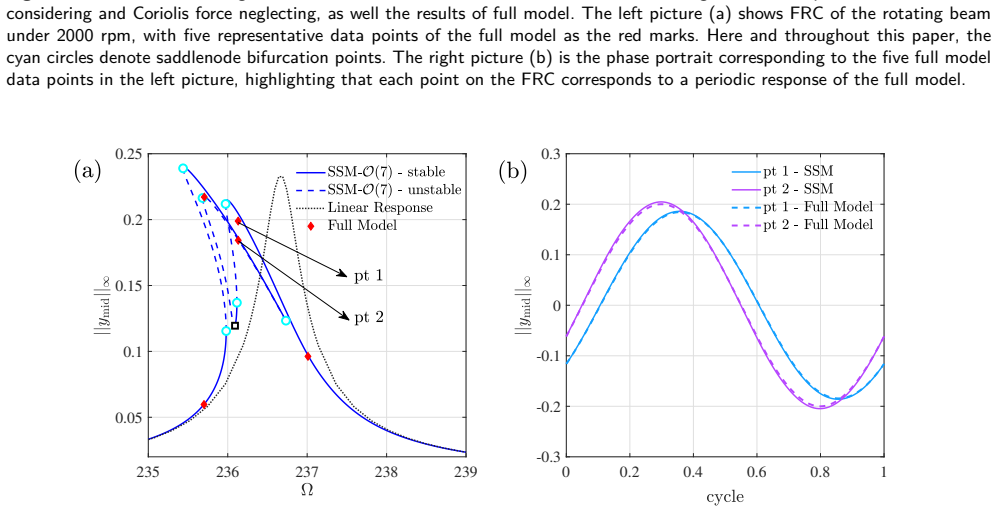
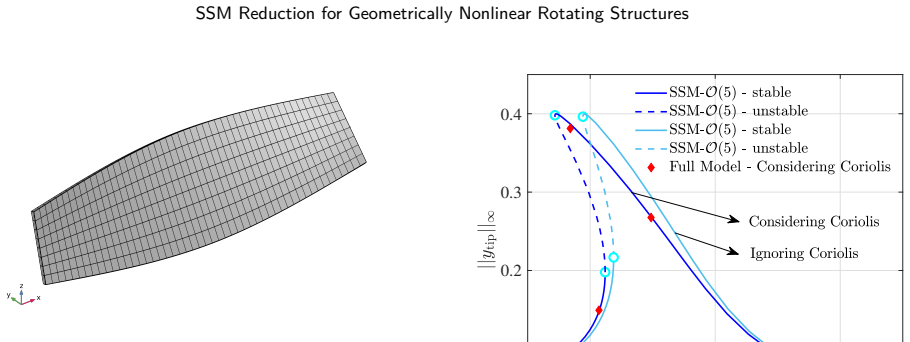
The authors claim that spectral submanifolds can be constructed non-intrusively around the nontrivial static equilibrium induced by centrifugal forces to yield low-dimensional models that accurately reproduce the nonlinear dynamics, including backbone and forced response curves, for rotating structures subject to geometric nonlinearity, Coriolis effects, and centrifugal stiffening, as verified through comparisons with full finite element simulations in COMSOL.
What carries the argument
Non-intrusive spectral submanifold (SSM) construction anchored at the centrifugal static equilibrium, which reduces the high-dimensional finite element model while retaining the essential coupled nonlinear dynamics.
If this is right
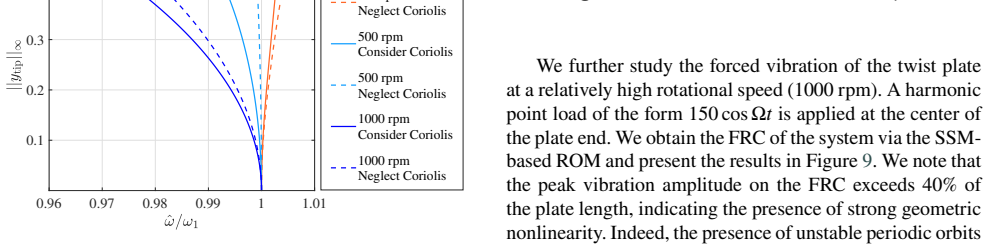
- SSM-based ROMs allow efficient extraction of backbone curves for rotating beams and twisted plates.
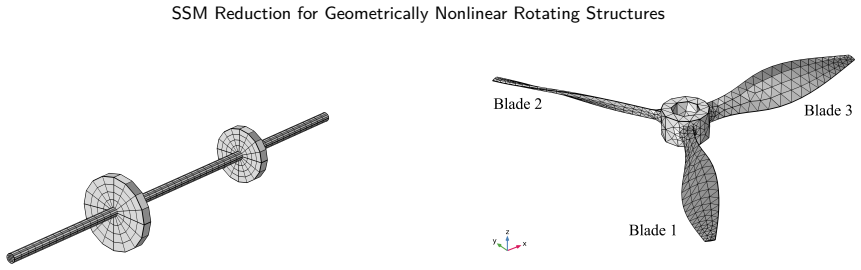
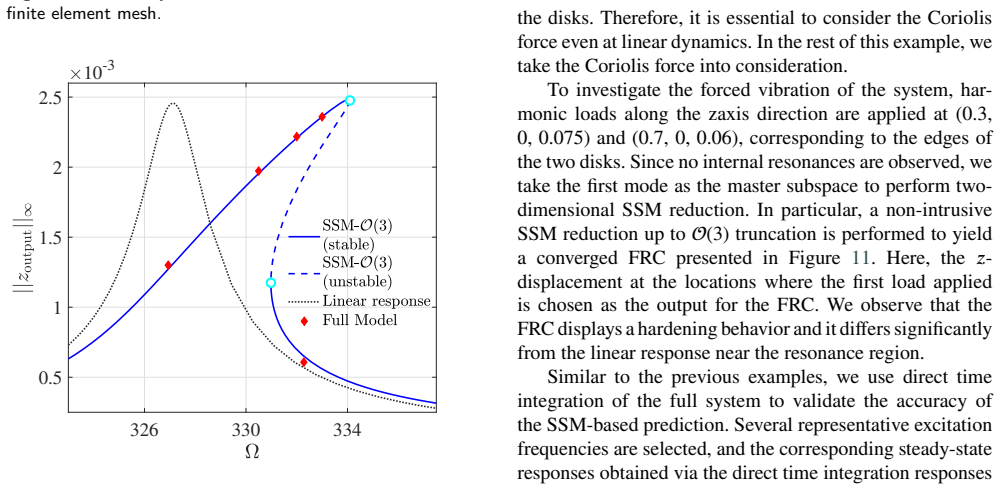
- Accurate forced response predictions are possible for rotors with multiple disks.
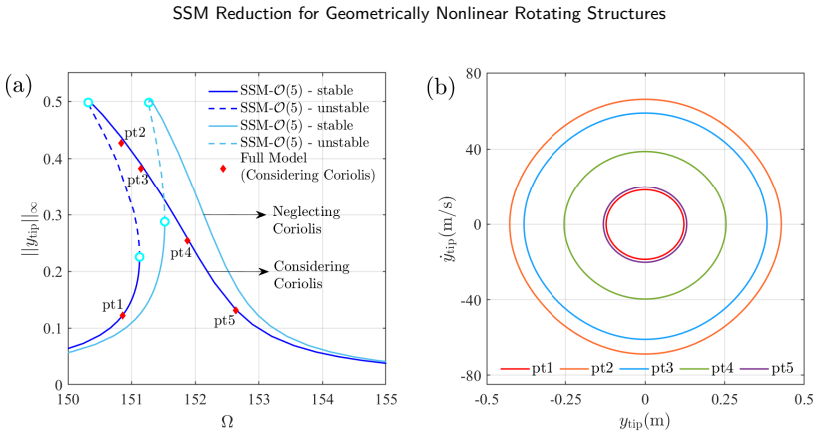
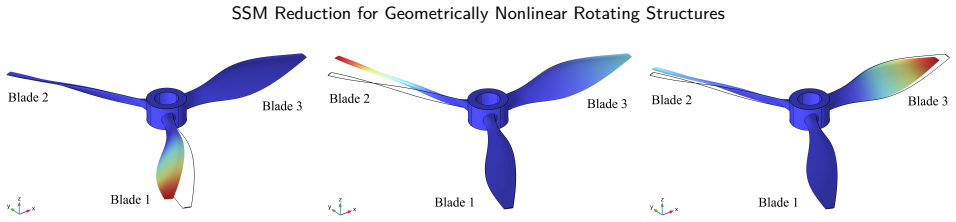
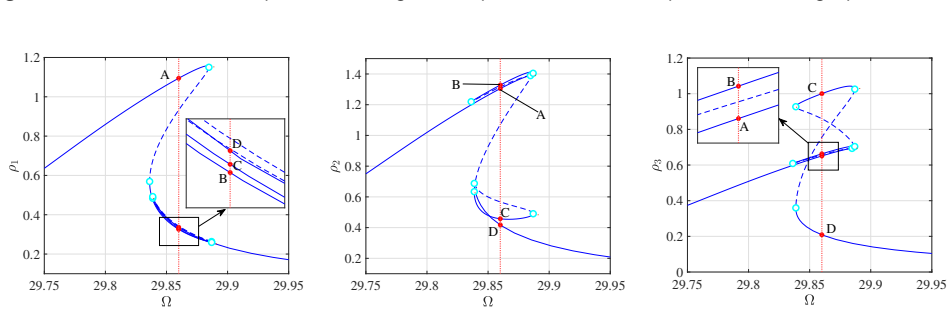
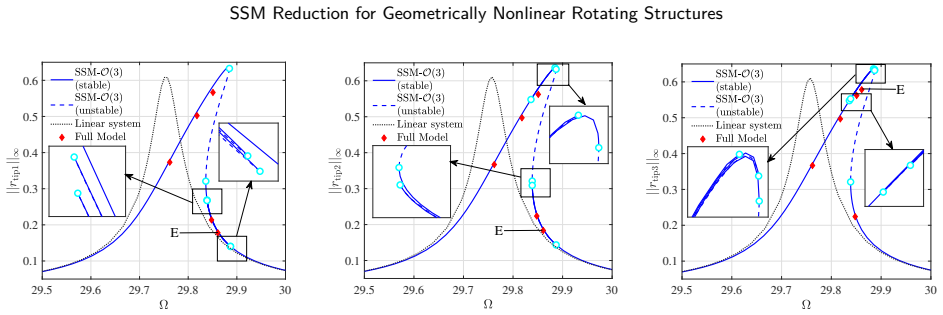
- Internal resonances in fans with three blades can be analyzed efficiently.
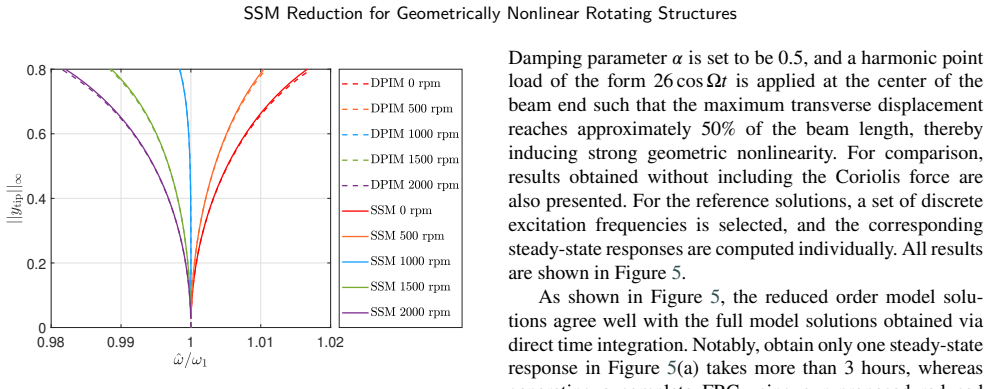
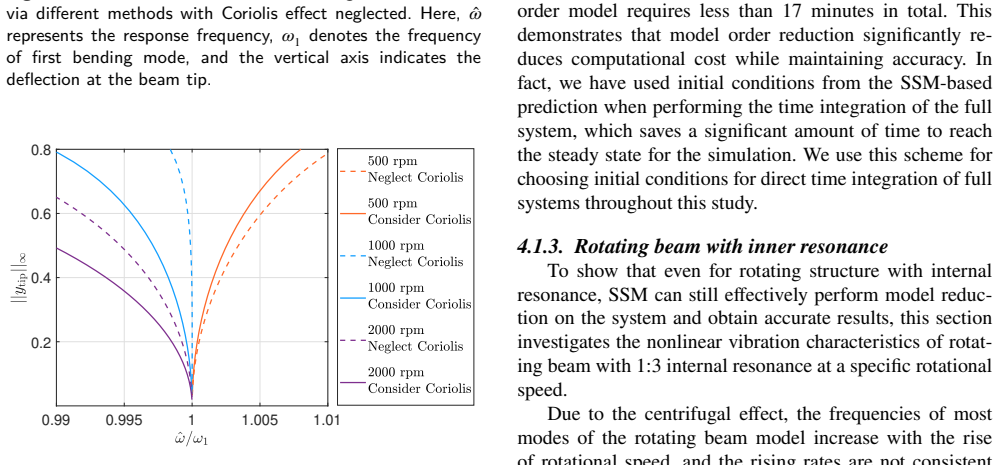
- The method highlights the important role of Coriolis forces in the nonlinear vibration behavior.
Where Pith is reading between the lines
- Similar non-intrusive SSM techniques might apply to other engineering systems with rotating components, such as wind turbines or jet engines, for design optimization.
- Extensions could involve incorporating additional effects like aerodynamic loading or material damping to broaden applicability.
- Comparisons with experimental data from rotating test setups would further validate the models for practical use.
Load-bearing premise
The non-intrusive SSM anchored at the centrifugal equilibrium fully captures all relevant coupled nonlinear effects from the underlying finite element model.
What would settle it
A significant mismatch between the SSM reduced-order model predictions and full finite element results for the forced response curve of the internally resonant fan would falsify the central claim.
Figures
read the original abstract
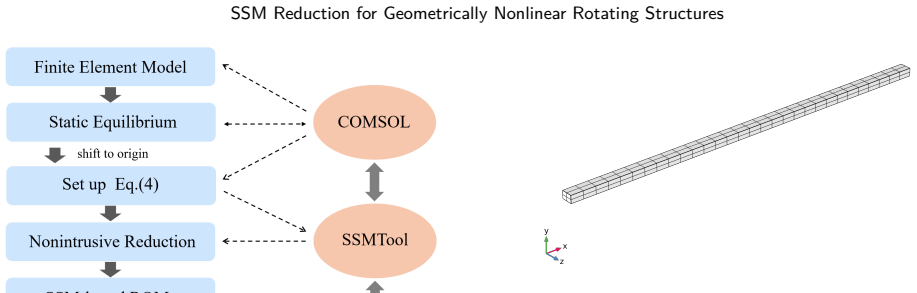
Rotating structures are widely observed in engineering applications such as turbomachinary and wind turbine. These rotating structures, particularly for blades made by lightweight materials, can undergo large deformation in operations and display complex nonlinear dynamics under the coupling interaction of geometric nonlinearity, Coriolis effect and centrifugal force. Finite element (FE) methods provide a powerful and accurate modeling approach for capturing the complex nonlinear dynamics for realistic rotating structures, yet its high-dimensionality causes significant challenge to efficient prediction for the nonlinear vibration. Here, we present a non-intrusive spectral submanifold (SSM) model reduction for these FE models of rotating structures. We use COMSOL to establish FE models and simulate these FE models to verify the accuracy of SSM-based reduction. We first compute nontrivial static equilibrium induced by the centrifugal force and then construct non-intrusively SSM based reduced-order model (ROM) anchored at the equilibrium. These SSM-based ROMs enable efficient and accurate extraction of backbone and forced response curves. We use a suite of examples with increasing complexity to demonstrate the effectiveness of the SSM reduction, including a rotating beam, a twisted plate, a rotor with two disks, and an internally resonant fan with three blades. The obtained results also highlight the significant effects of Coriolis force on the nonlinear vibration of rotating structures.
Editorial analysis
A structured set of objections, weighed in public.
Referee Report
Summary. The manuscript proposes a non-intrusive spectral submanifold (SSM) model reduction for high-dimensional finite-element models of geometrically nonlinear rotating structures that incorporate geometric nonlinearity together with Coriolis and centrifugal forces. The method first locates the nontrivial centrifugal static equilibrium and then constructs an SSM-based reduced-order model anchored at that equilibrium using trajectory data generated by COMSOL; the resulting ROMs are used to compute backbone curves and forced-response curves. The approach is demonstrated on four examples of increasing complexity (rotating beam, twisted plate, two-disk rotor, and internally resonant three-blade fan), with the claim that Coriolis effects are shown to be significant.
Significance. If the non-intrusive construction is shown to recover the correct reduced dynamics including velocity-dependent gyroscopic terms, the work would supply a practical tool for nonlinear vibration analysis of industrial rotating machinery without requiring intrusive access to the underlying FE code. This would be a useful extension of existing SSM theory to systems with skew-symmetric linear operators.
major comments (2)
- [Methods section on non-intrusive SSM construction] The central claim that the data-driven SSM ROM satisfies the invariance equation for the full nonlinear vector field (including the skew-symmetric Coriolis contribution) rests on the non-intrusive fitting procedure. The manuscript does not specify how the homological equations are solved or how the linear operator is assembled when only output trajectories are available; trajectory sampling alone cannot guarantee recovery of velocity-dependent coupling terms.
- [Results, three-blade fan subsection] In the three-blade fan example (internally resonant case), modal interactions make the quadratic and cubic coefficients especially sensitive to any mismatch in the reduced vector field. No quantitative error metrics (e.g., relative L2 deviation between full-order and reduced backbone curves, or residual of the invariance equation) are supplied, so the accuracy claim cannot be evaluated.
minor comments (2)
- [Abstract] The abstract states that 'COMSOL simulations verify accuracy' but supplies neither error tables nor comparison baselines; adding these would strengthen the verification statements.
- [Introduction and Methods] Notation for the centrifugal equilibrium and the anchored SSM should be introduced with a single consistent symbol set rather than being redefined across sections.
Simulated Author's Rebuttal
We thank the referee for their constructive comments, which help clarify the presentation of the non-intrusive SSM construction and the validation of the reduced-order models. We address each major comment below and indicate the corresponding revisions.
read point-by-point responses
-
Referee: [Methods section on non-intrusive SSM construction] The central claim that the data-driven SSM ROM satisfies the invariance equation for the full nonlinear vector field (including the skew-symmetric Coriolis contribution) rests on the non-intrusive fitting procedure. The manuscript does not specify how the homological equations are solved or how the linear operator is assembled when only output trajectories are available; trajectory sampling alone cannot guarantee recovery of velocity-dependent coupling terms.
Authors: We agree that additional detail is required on the non-intrusive procedure. In the revised manuscript we will expand the Methods section to specify that the linear operator (including its skew-symmetric Coriolis component) is recovered by regressing the full state-space vector field on the COMSOL-generated trajectories, which supply both displacement and velocity time series; the resulting reduced vector field is then inserted into the standard homological equations for the SSM coefficients. This data-driven approximation is constructed in the tangent space at the centrifugal equilibrium so that the invariance equation holds for the fitted dynamics. We will also note the practical limitation that exact recovery is guaranteed only up to the accuracy of the trajectory data and the chosen polynomial degree. revision: yes
-
Referee: [Results, three-blade fan subsection] In the three-blade fan example (internally resonant case), modal interactions make the quadratic and cubic coefficients especially sensitive to any mismatch in the reduced vector field. No quantitative error metrics (e.g., relative L2 deviation between full-order and reduced backbone curves, or residual of the invariance equation) are supplied, so the accuracy claim cannot be evaluated.
Authors: We accept that quantitative error measures are necessary, especially under internal resonance. The revised manuscript will add, in the three-blade fan subsection, the relative L2 deviation between the full-order and reduced backbone curves together with the residual norm of the invariance equation evaluated along the computed SSM. These metrics will be reported for both the backbone and forced-response results. revision: yes
Circularity Check
No significant circularity; derivation is self-contained via data-driven SSM construction and external verification
full rationale
The paper constructs non-intrusive SSM ROMs from COMSOL trajectory data around the centrifugal equilibrium and verifies accuracy against full FE simulations on multiple examples. No step reduces by construction to its inputs: the invariance equation is solved or approximated from sampled orbits without self-defining the manifold coefficients, and no load-bearing self-citation or ansatz smuggling is present in the provided text. The central claim (efficient extraction of backbone/forced response curves) rests on independent numerical comparison rather than tautological fitting or imported uniqueness theorems.
Axiom & Free-Parameter Ledger
axioms (1)
- domain assumption Spectral submanifold reduction theory for nonlinear dynamical systems
Reference graph
Works this paper leans on
-
[1]
Rotating machinery vibration: from analysis to troubleshooting
Adams, M.L., 2009. Rotating machinery vibration: from analysis to troubleshooting. CRC Press
work page 2009
-
[2]
Ahsan, Z., Dankowicz, H., Li, M., Sieber, J., 2022. Methods of con- tinuation and their implementation in the COCO software platform with application to delay differential equations. Nonlinear Dynamics 107, 3181–3243
work page 2022
-
[3]
Geometrically nonlinear transient analyses of rotating structures through high-fidelity models
Azzara, R., Filippi, M., Carrera, E., 2024. Geometrically nonlinear transient analyses of rotating structures through high-fidelity models. Composite Structures 343, 118265
work page 2024
-
[4]
Beli, D., Mencik, J.M., Silva, P.B., Arruda, J.R.F., 2018. A projection- based model reduction strategy for the wave and vibration analysis of rotating periodic structures. Computational Mechanics 62, 15111528
work page 2018
-
[5]
Vibration control of a pre-twisted rotating beam with nonlinear bi-stable attachments
Bera, K.K., Aravind, G., Banerjee, A., 2023. Vibration control of a pre-twisted rotating beam with nonlinear bi-stable attachments. Structures 57, 105050
work page 2023
-
[6]
Bhartiya, Y., Sinha, A., 2011. Reduced order model of a multistage bladed rotor with geometric mistuning via modal analyses of finite element sectors. Journal of Turbomachinery 134
work page 2011
-
[7]
Investigations on projection-based reduced-order model development for rotating detonation engine
Camacho, R., Huang, C., 2025. Investigations on projection-based reduced-order model development for rotating detonation engine. AIAA Journal 63, 854869
work page 2025
-
[8]
Turbomachinery equipment, vibration prob- lems, diagnosis
CASSOLATO, B., 1997. Turbomachinery equipment, vibration prob- lems, diagnosis. Encyclopedia of Chemical Processing and Design , 320
work page 1997
-
[9]
Chai, Y., Wang, Y., Li, H., Zhang, J., Zheng, J., 2026. Response of wind turbine loads to multi-scale turbulent structures: a study based on turbulence signals observed in the field. Acta Mechanica Sinica 42, 324721
work page 2026
-
[10]
Nonlinear resonance of rotating solar-sail membrane under solar thermal and pressure excitations
Chen, J., Shi, A., Dowell, E.H., Pei, Y., 2026. Nonlinear resonance of rotating solar-sail membrane under solar thermal and pressure excitations. Acta Mechanica Sinica 42, 524784
work page 2026
-
[11]
COMSOL LiveLink for MATLAB User’s Guide
COMSOL AB, 2018. COMSOL LiveLink for MATLAB User’s Guide. COMSOL 5.4
work page 2018
-
[12]
Cui, Y., Wang, Y., 2026. Dynamic modelling and nonlinear vibration of bearing-supported shaft-disk-shaft rotors with bolted flange joints and spigot fits. Applied Mathematical Modelling , 116902
work page 2026
-
[13]
Fully geometrical nonlinear model of shaft-disk rotors in thermal environment
Cui, Y.S., Wang, Y.Q., 2025. Fully geometrical nonlinear model of shaft-disk rotors in thermal environment. ZAMM-Journal of Applied Mathematics and Mechanics/Zeitschrift für Angewandte Mathematik und Mechanik 105, e70139. Gao H.J. et al.: Preprint submitted to Elsevier Page 11 of 13 SSM Reduction for Geometrically Nonlinear Rotating Structures
work page 2025
-
[14]
Dankowicz, H., Schilder, F., 2013. Recipes for Continuation. vol- ume 1. SIAM
work page 2013
-
[15]
A review on vibrations in various turbomachines such as fans, compressors, turbines and pumps
Doshi, S., Katoch, A., Suresh, A., Razak, F.A., Datta, S., Madhavan, S., Zanhar, C., Gundabattini, E., 2021. A review on vibrations in various turbomachines such as fans, compressors, turbines and pumps. Journal of Vibration Engineering & Technologies 9, 1557– 1575
work page 2021
-
[16]
Ekene, I.A., Sam, O., Emeka, A.S., Amaechi, O.A., Princewill, O.C.,
-
[17]
International Journal of Research and Innovation in Applied Science IX, 291306
Theoretical and simulation finite element modal analysis of rotating cantilever beam. International Journal of Research and Innovation in Applied Science IX, 291306
-
[18]
Genta, G., 2005. Dynamics of rotating systems. Springer Science & Business Media
work page 2005
-
[19]
Ghasabi, S.A., Arbabtafti, M., Shahgholi, M., 2018. Forced os- cillations and stability analysis of a nonlinear micro-rotating shaft incorporating a non-classical theory. Acta Mechanica Sinica 34, 970982
work page 2018
-
[20]
The influence of rotation on vibration of a thick cylindrical shell
Guo, D., Chu, F., Zheng, Z., 2001. The influence of rotation on vibration of a thick cylindrical shell. Journal of Sound and Vibration 242, 487–505
work page 2001
-
[21]
Haller, G., 2025. Modeling Nonlinear Dynamics from Equations and Data with Applications to Solids, Fluids, and Controls. SIAM
work page 2025
-
[22]
Nonlinear normal modes and spectral submanifolds: existence, uniqueness and use in model reduction
Haller, G., Ponsioen, S., 2016. Nonlinear normal modes and spectral submanifolds: existence, uniqueness and use in model reduction. Nonlinear Dynamics 86, 1493–1534
work page 2016
-
[23]
Holzinger, S., Zwölfer, A., Trainotti, F., Gerstmayr, J., 2025. The float- ing frame of reference formulation for rotordynamics applications: limitations and practical solutions. Multibody System Dynamics
work page 2025
-
[24]
Huang, C., Duraisamy, K., 2023. Predictive reduced order modeling of chaotic multi-scale problems using adaptively sampled projections. Journal of Computational Physics 491, 112356
work page 2023
-
[25]
Jain, S., Haller, G., 2022. How to compute invariant manifolds and their reduced dynamics in high-dimensional finite element models. Nonlinear Dynamics 107, 1417–1450
work page 2022
-
[26]
SSMTool 2.6: Computation of invariant manifolds in high-dimensional mechanics problems
Jain, S., Li, M., Thurnher, T., Haller, G., 2025. SSMTool 2.6: Computation of invariant manifolds in high-dimensional mechanics problems
work page 2025
-
[27]
Improved nonlinear analysis of a propeller blade based on hyper-reduction
Kim, Y., Kang, S.H., Cho, H., Shin, S., 2022. Improved nonlinear analysis of a propeller blade based on hyper-reduction. AIAA Journal 60, 19091922
work page 2022
-
[28]
Nonlinear structural mechanics: theory, dynamical phenomena and modeling
Lacarbonara, W., 2013. Nonlinear structural mechanics: theory, dynamical phenomena and modeling. Springer Science & Business Media
work page 2013
-
[29]
Nonlinear finite element modeling of a high speed rotating timoshenko beam structure
Lai, S.H., 1994. Nonlinear finite element modeling of a high speed rotating timoshenko beam structure. International Journal of Mechan- ical Sciences 36, 849–861
work page 1994
-
[30]
Li, M., Haller, G., 2022. Nonlinear analysis of forced mechanical systems with internal resonance using spectral submanifolds, part ii: Bifurcation and quasi-periodic response. Nonlinear Dynamics 110, 10451080
work page 2022
-
[31]
Li, M., Jain, S., Haller, G., 2022. Nonlinear analysis of forced mechan- ical systemswith internal resonance using spectral submanifolds, part i: Periodic response and forced response curve. Nonlinear Dynamics 110, 10051043
work page 2022
-
[32]
Model reduction for constrained mechanical systems via spectral submanifolds
Li, M., Jain, S., Haller, G., 2023a. Model reduction for constrained mechanical systems via spectral submanifolds. Nonlinear Dynamics 111, 8881–8911
-
[33]
Data-free non-intrusive model reduction for nonlinear finite element models via spectral submanifolds
Li, M., Thurnher, T., Xu, Z., Jain, S., 2025. Data-free non-intrusive model reduction for nonlinear finite element models via spectral submanifolds. Computer Methods in Applied Mechanics and Engi- neering 434, 117590
work page 2025
-
[34]
Li, M., Yan, H., Wang, L., 2023b. Nonlinear model reduction for a cantilevered pipe conveying fluid: a system with asymmetric damping and stiffness matrices. Mechanical Systems and Signal Processing 188, 109993
-
[35]
Li, Z.M., Liu, T., Kang, H., Tian, J., Jing, J., Wang, D., 2023c. Theoretical and experimental investigations on steady-state responses of rotor-blade systems with varying rotating speeds based on a new nonlinear dynamic model. Mechanical Systems and Signal Processing 184, 109692
-
[36]
Lin- ear, nonlinear dynamics, and sensitivity analysis of a vibratory ring gyroscope
Liang, D.D., Yang, X.D., Zhang, W., Ren, Y., Yang, T., 2018. Lin- ear, nonlinear dynamics, and sensitivity analysis of a vibratory ring gyroscope. Theoretical and Applied Mechanics Letters 8, 393–403
work page 2018
-
[37]
Dynamic modeling and modal truncation approach for a high-speed rotating elastic beam
Liu, J.Y., Hong, J.Z., 2002. Dynamic modeling and modal truncation approach for a high-speed rotating elastic beam. Archive of Applied Mechanics (Ingenieur Archiv) 72, 554563
work page 2002
-
[38]
Dynamic response analysis of a double-disc rotor system with rolling bearings based on POD method
Lu, K., Guo, D., Cheng, H., Zhang, W., Zhang, H., Fu, C., 2024. Dynamic response analysis of a double-disc rotor system with rolling bearings based on POD method. International Journal of Non-Linear Mechanics 158, 104569
work page 2024
-
[39]
Łuczko, J., 2002. A geometrically non-linear model of rotating shafts with internal resonance and self-excited vibration. Journal of Sound and Vibration 255, 433–456
work page 2002
-
[40]
The role of geometric nonlinearity in structural vibration: A stiffening/softening theory
Luo, R., Sun, W., 2025. The role of geometric nonlinearity in structural vibration: A stiffening/softening theory. Communications in Nonlinear Science and Numerical Simulation 150, 109014
work page 2025
-
[41]
Reduced-order mod- eling approach for blisks with large mass, stiffness, and geometric mistuning
Madden, A., Epureanu, B.I., Filippi, S., 2012. Reduced-order mod- eling approach for blisks with large mass, stiffness, and geometric mistuning. AIAA Journal 50, 366374
work page 2012
-
[42]
Martin, A., Opreni, A., Vizzaccaro, A., Debeurre, M., Salles, L., Frangi, A., Thomas, O., Touzé, C., 2023. Reduced-order modeling of geometrically nonlinear rotating structures using the direct parametri- sation of invariant manifolds. Journal of Theoretical, Computational and Applied Mechanics
work page 2023
-
[43]
Modal reduction of a nonlinear rotating beam through nonlinear normal modes
Pesheck, E., Pierre, C., Shaw, S.W., 2002. Modal reduction of a nonlinear rotating beam through nonlinear normal modes. J. Vib. Acoust. 124, 229–236
work page 2002
-
[44]
Ponsioen, S., Jain, S., Haller, G., 2020. Model reduction to spectral submanifolds and forced-response calculation in high-dimensional mechanical systems. Journal of Sound and Vibration 488, 115640
work page 2020
-
[45]
Automated com- putation of autonomous spectral submanifolds for nonlinear modal analysis
Ponsioen, S., Pedergnana, T., Haller, G., 2018. Automated com- putation of autonomous spectral submanifolds for nonlinear modal analysis. Journal of sound and Vibration 420, 269–295
work page 2018
-
[46]
Structural dynamics of turbo-machines
Rangwala, A.S., 2009. Structural dynamics of turbo-machines. New Age International
work page 2009
-
[47]
Rao, J.S., 1991. Turbomachine blade vibration. New Age Interna- tional
work page 1991
-
[48]
Fast analysis of rotating machine using simplified model-order reduction based on POD
Sakamoto, H., Okamoto, K., Igarashi, H., 2020. Fast analysis of rotating machine using simplified model-order reduction based on POD. IEEE Transactions on Magnetics 56, 14
work page 2020
-
[49]
Santarpia, E., Testa, C., Demasi, L., Greco, L., Bernardini, G., 2021. A hierarchical generalized formulation for the large-displacement dynamic analysis of rotating plates. Computational Mechanics 68, 1325–1347
work page 2021
-
[50]
Non-linear normal modes and invariant manifolds
Shaw, S., Pierre, C., 1991. Non-linear normal modes and invariant manifolds. Journal of sound and Vibration 150, 170–173
work page 1991
-
[51]
Normal modes for non-linear vibratory systems
Shaw, S.W., Pierre, C., 1993. Normal modes for non-linear vibratory systems. Journal of sound and vibration 164, 85–124
work page 1993
-
[52]
Natural frequencies of a pre-twisted blade in a centrifugal force field
Sinha, S.K., Turner, K.E., 2011. Natural frequencies of a pre-twisted blade in a centrifugal force field. Journal of Sound and Vibration 330, 2655–2681
work page 2011
-
[53]
Thomas, O., Sénéchal, A., Deü, J.F., 2016. Hardening/softening be- havior and reduced order modeling of nonlinear vibrations of rotating cantilever beams. Nonlinear Dynamics 86, 12931318
work page 2016
-
[54]
Touzé, C., Vizzaccaro, A., Thomas, O., 2021. Model order reduction methods for geometrically nonlinear structures: a review of nonlinear techniques. Nonlinear Dynamics 105, 1141–1190
work page 2021
-
[55]
On nonlinear vibrations of a rotating beam
Turhan, O., Bulut, G., 2009. On nonlinear vibrations of a rotating beam. Journal of Sound and Vibration 322, 314335
work page 2009
-
[56]
Vibra- tion analysis & condition monitoring for rotating machines: a review
Vishwakarma, M., Purohit, R., Harshlata, V ., Rajput, P., 2017. Vibra- tion analysis & condition monitoring for rotating machines: a review. Materials Today: Proceedings 4, 2659–2664
work page 2017
-
[57]
Wang, F., Luo, A.C., 2012. Analytical vibrations of a rotating blade with geometric nonlinearity, in: 2012 IEEE 4th International Conference on Nonlinear Science and Complexity (NSC), IEEE. p. 183188. Gao H.J. et al.: Preprint submitted to Elsevier Page 12 of 13 SSM Reduction for Geometrically Nonlinear Rotating Structures
work page 2012
-
[58]
Wei, D., Li, H., Chen, Y., Zhao, X., Dong, J., Fan, Z., 2022. A novel model reduction technique for mistuned blisks based on proper orthogonal decomposition in frequency domain. Aerospace Science and Technology 121, 107320
work page 2022
-
[59]
Wei, J., He, Y., Wang, Y., Dai, H., Wang, L., Li, M., 2026. Model reduction for complex pipes conveying fluid using spectral sub- manifolds: from circular, S-shaped pipes to pipelines with multiple branches. Acta Mechanica Sinica
work page 2026
-
[60]
Vibration modes of centrifugally stiffened beams
Wright, A.D., Smith, C.E., Thresher, R.W., Wang, J.L.C., 1982. Vibration modes of centrifugally stiffened beams. Journal of Applied Mechanics 49, 197202
work page 1982
-
[61]
Forced vibration response of disk- drum structures jointed by bolted flange under base excitation
Xing, W., Wang, Y., 2025. Forced vibration response of disk- drum structures jointed by bolted flange under base excitation. Acta Mechanica Sinica 41, 524459
work page 2025
-
[62]
Nonlinear vibrations of blade with varying rotating speed
Yao, M.H., Chen, Y.P., Zhang, W., 2011. Nonlinear vibrations of blade with varying rotating speed. Nonlinear Dynamics 68, 487504
work page 2011
-
[63]
A geometric softening phenomenon of a rotating cantilever beam
Zhao, G., Du, J., Wu, Z., 2017. A geometric softening phenomenon of a rotating cantilever beam. Archive of Applied Mechanics 87, 10491059
work page 2017
-
[64]
Rotordynamics local frame formulations for three-dimensional continuum finite el- ements
Zwölfer, A., Rasmussen, J.Ø.H., Santos, I., 2025. Rotordynamics local frame formulations for three-dimensional continuum finite el- ements. Journal of Computational and Nonlinear Dynamics 20. Gao H.J. et al.: Preprint submitted to Elsevier Page 13 of 13
work page 2025
discussion (0)
Sign in with ORCID, Apple, or X to comment. Anyone can read and Pith papers without signing in.