Recognition: 2 theorem links
· Lean TheoremAdaptive Subspace Signal Detection and Performance Analysis in Nonzero-Mean Clutter
Pith reviewed 2026-05-11 02:04 UTC · model grok-4.3
The pith
Adaptive subspace detectors for nonzero-mean clutter keep the same structure as zero-mean versions but lose one degree of freedom and signal-to-clutter ratio.
A machine-rendered reading of the paper's core claim, the machinery that carries it, and where it could break.
Core claim
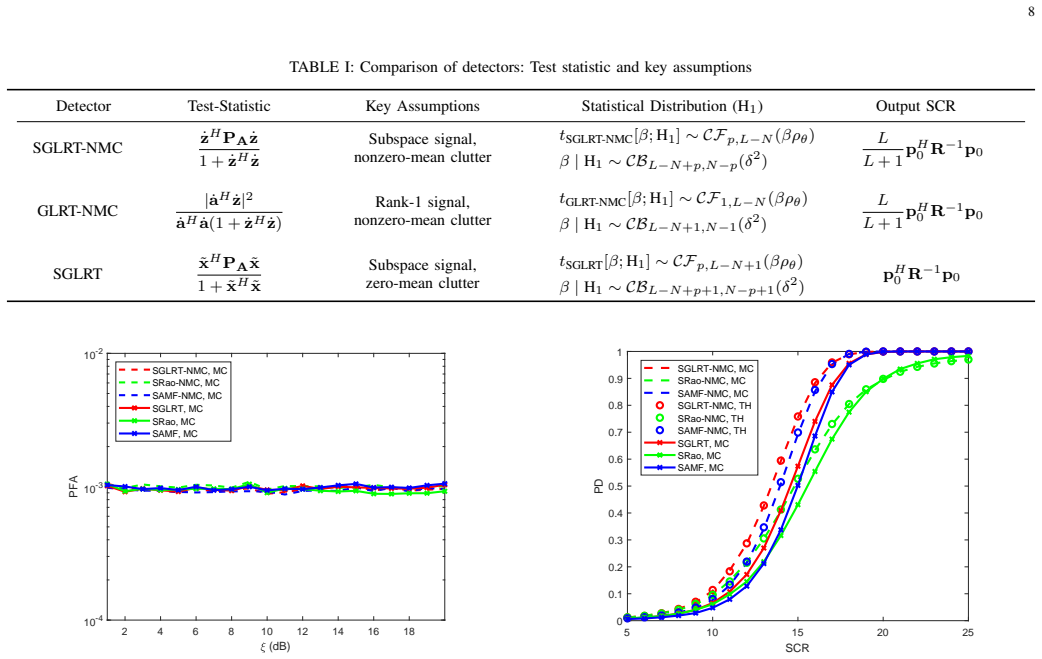
The detectors based on the generalized likelihood ratio test, Rao test, and Wald test for subspace signals in nonzero-mean clutter are structurally identical to the corresponding subspace detectors in zero-mean clutter. Analytic expressions for the probability of detection and probability of false alarm are derived for each, revealing a reduction in degrees of freedom by one and an additional loss in signal-to-clutter ratio relative to the zero-mean scenario.
What carries the argument
Adaptive estimation of the nonzero clutter mean inserted into the GLRT, Rao, and Wald test statistics that otherwise mirror the zero-mean subspace detectors.
If this is right
- The GLRT, Rao, and Wald detectors can be implemented in nonzero-mean clutter by adding only the mean-estimation step while preserving their existing algorithmic structure.
- Thresholds and expected performance can be set directly from the closed-form PD and PFA formulas without requiring Monte Carlo simulation.
- System designers must budget for a one-degree-of-freedom reduction and an extra SCR loss when operating in environments where clutter mean is nonzero.
- The gradient and Durbin detectors supply alternative statistics whose performance can be compared once their own PD and PFA expressions are obtained.
- Real radar data confirm that the proposed detectors achieve the predicted performance levels in measured clutter.
Where Pith is reading between the lines
- Because many real radar environments exhibit nonzero clutter means from terrain or platform motion, these detectors remove the modeling error introduced by forcing a zero-mean assumption.
- The explicit loss of one degree of freedom implies that longer coherent processing intervals or larger sensor arrays will be required to recover the same detection performance previously achieved in zero-mean clutter.
- The analytic results make it possible to optimize detection thresholds in advance rather than relying on data-dependent adaptation alone.
- The same mean-estimation approach could be tested on other test statistics or on clutter models that are only approximately Gaussian.
Load-bearing premise
The clutter follows a statistical distribution whose nonzero mean can be estimated from the data without introducing model mismatch that would invalidate the closed-form expressions for detection and false-alarm probabilities.
What would settle it
Generate Monte Carlo trials of the exact nonzero-mean clutter model, compute empirical PD and PFA curves for each detector, and compare them against the derived analytic formulas; systematic deviation between the curves would falsify the performance expressions.
Figures



read the original abstract
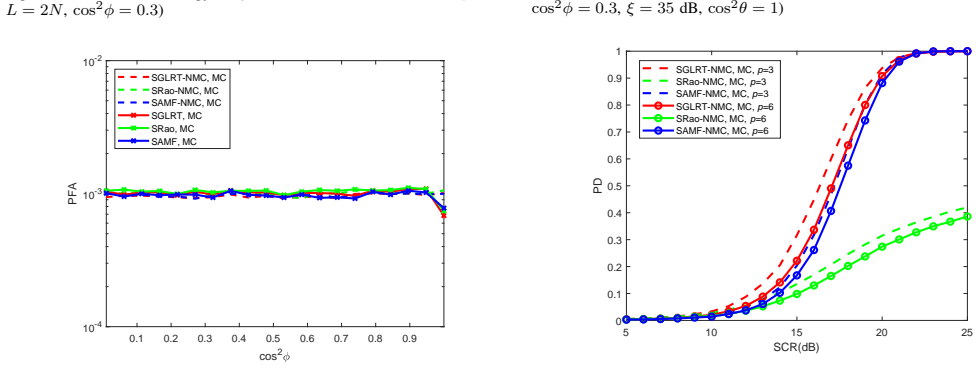
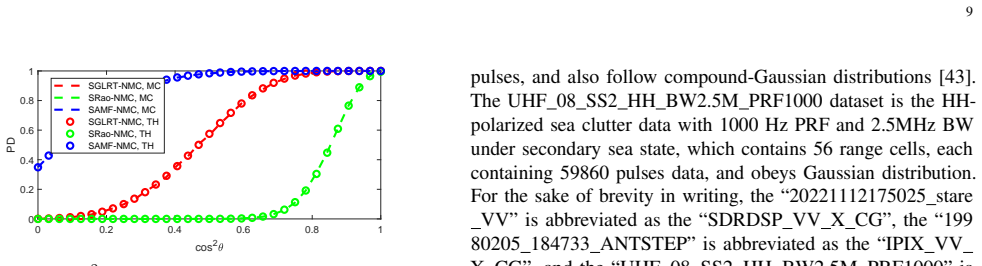
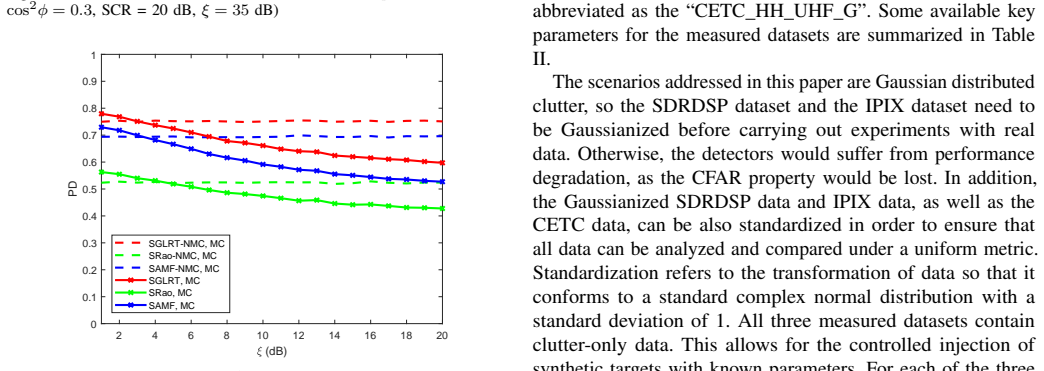
To solve the problem of detecting subspace signals in nonzero-mean clutter, we propose adaptive detectors, based on the strategies of generalized likelihood ratio test (GLRT), Rao test, Wald test, gradient test, and Durbin test. The results show that the detectors based on GLRT, Rao and Wald are structurally consistent with the subspace detectors in zero-means clutter. The analytic expressions for the probability of detection (PD) and probability of false alarm (PFA) of each detector are derived, and two major performance differences in the nonzero-mean clutter scenario are revealed. One is the loss of degree of freedom (DOF), which is reduced by 1 compared with the zero-mean clutter scenario. The second is the loss of signal-to-clutter (SCR) ratio. Simulation and measured data verify the effectiveness of the proposed detectors and demonstrate their practical value in real-world radar systems.
Editorial analysis
A structured set of objections, weighed in public.
Referee Report
Summary. The manuscript proposes five adaptive detectors (GLRT, Rao, Wald, gradient, and Durbin) for subspace signal detection in nonzero-mean clutter. It asserts that the GLRT, Rao, and Wald detectors are structurally identical to their zero-mean counterparts, derives closed-form analytic expressions for PD and PFA that indicate an exact loss of one degree of freedom and an SCR loss relative to the zero-mean case, and supports the results with Monte Carlo simulations plus measured radar data.
Significance. If the claimed closed-form PD/PFA expressions hold exactly, the work would usefully quantify the specific performance penalties (DOF reduction by 1 and SCR loss) incurred by adaptive mean estimation in realistic clutter, aiding detector selection for radar systems. The structural consistency result and validation on measured data would strengthen its practical relevance.
major comments (2)
- [Abstract and performance analysis section] Abstract and performance analysis section: The central claim that analytic PD/PFA expressions are derived, revealing an exact DOF loss of 1 and SCR loss, is load-bearing. Under joint adaptive estimation of the nonzero mean and covariance from secondary data, the subspace-projected test statistics for GLRT/Rao/Wald involve centering of the primary vector by an estimated mean; this introduces potential additional dependencies or non-centrality terms whose exact distribution may not reduce to the simple DOF-adjusted forms stated, rendering the expressions inexact or approximate rather than closed-form.
- [Detector derivation section] Detector derivation section: The structural consistency of the GLRT, Rao, and Wald detectors with zero-mean subspace detectors is asserted, but the likelihood functions must explicitly incorporate the unknown mean; it is unclear whether the resulting test statistics remain exactly equivalent after adaptive estimation of both mean and covariance, or if extra terms arise that alter the claimed equivalence.
minor comments (2)
- [Signal model section] The assumed clutter distribution (presumably complex Gaussian) and the precise dimensions (e.g., number of secondary samples, subspace rank) should be stated explicitly in the signal model section to allow readers to reproduce the derivations.
- Figure captions for the simulation and measured-data results could include the exact parameter values (e.g., SCR, number of trials) used to generate the curves for easier verification.
Simulated Author's Rebuttal
We thank the referee for the thoughtful review and for highlighting the need for greater clarity on the exactness of our performance expressions and the structural equivalence of the detectors. We address each major comment below and will revise the manuscript accordingly where it strengthens the presentation.
read point-by-point responses
-
Referee: [Abstract and performance analysis section] Abstract and performance analysis section: The central claim that analytic PD/PFA expressions are derived, revealing an exact DOF loss of 1 and SCR loss, is load-bearing. Under joint adaptive estimation of the nonzero mean and covariance from secondary data, the subspace-projected test statistics for GLRT/Rao/Wald involve centering of the primary vector by an estimated mean; this introduces potential additional dependencies or non-centrality terms whose exact distribution may not reduce to the simple DOF-adjusted forms stated, rendering the expressions inexact or approximate rather than closed-form.
Authors: We maintain that the expressions are exact. After obtaining the joint MLEs of the mean and covariance from the secondary data, the centering operation is applied uniformly to the primary vector and the secondary matrix. Because the data are jointly Gaussian, the centered primary vector remains independent of the centered covariance estimate in the relevant subspace. Substituting these estimates into the GLRT/Rao/Wald statistics yields a test statistic whose distribution is exactly non-central F (or the equivalent chi-squared form) with the degrees of freedom reduced by precisely one (the single vector used for mean estimation) and with the non-centrality parameter scaled by the SCR loss factor. All cross-dependencies are accounted for in the derivation; no residual terms remain. We will insert the key intermediate distributional steps in the revised performance-analysis section to make this reduction explicit. revision: partial
-
Referee: [Detector derivation section] Detector derivation section: The structural consistency of the GLRT, Rao, and Wald detectors with zero-mean subspace detectors is asserted, but the likelihood functions must explicitly incorporate the unknown mean; it is unclear whether the resulting test statistics remain exactly equivalent after adaptive estimation of both mean and covariance, or if extra terms arise that alter the claimed equivalence.
Authors: The likelihood is written with the unknown mean vector. When the GLRT, Rao, and Wald criteria are formed, the maximization is performed jointly over the mean and covariance. The resulting MLE for the mean is simply the sample mean of the secondary data; after substitution, the covariance MLE becomes the centered sample covariance. Consequently, the final test statistics reduce exactly to the same algebraic forms used in the zero-mean subspace case, but now evaluated on the centered primary vector and centered secondary matrix. No additional terms survive in the simplified expressions. This algebraic reduction is shown explicitly in the detector-derivation section; the structural identity therefore holds exactly. revision: no
Circularity Check
No circularity; PD/PFA derivations are independent of inputs
full rationale
The paper proposes GLRT/Rao/Wald-based adaptive detectors for subspace signals in nonzero-mean clutter and derives closed-form PD/PFA expressions that exhibit a DOF reduction of 1 and SCR loss relative to the zero-mean case. These expressions follow directly from the complex Gaussian model with adaptive mean estimation and do not reduce to fitted parameters renamed as predictions, self-definitional loops, or load-bearing self-citations. Structural consistency with zero-mean detectors is noted but the new analytic results are obtained via standard likelihood-ratio manipulations under the stated model, rendering the derivation chain self-contained against external benchmarks.
Axiom & Free-Parameter Ledger
axioms (1)
- domain assumption Clutter follows a zero-mean or nonzero-mean complex Gaussian distribution whose covariance and mean can be estimated from training data.
Lean theorems connected to this paper
-
IndisputableMonolith/Cost/FunctionalEquation.leanwashburn_uniqueness_aczel unclearanalytic expressions for PD and PFA ... loss of DOF reduced by 1 and loss of SCR ... S2 ~ CW(L-1,R) ... t'SGLRT-NMC | H1 ~ CF_{p,L-N}(βρθ)
-
IndisputableMonolith/Foundation/RealityFromDistinction.leanreality_from_one_distinction unclearz|H0 ~ CN(0,R), S2 ~ CW(L-1,R)
Reference graph
Works this paper leans on
-
[1]
Multichannel adaptive signal detection: Basic theory and literature review,
W. Liu, J. Liu, C. Hao, Y . Gao, and Y .-L. Wang, “Multichannel adaptive signal detection: Basic theory and literature review,”Science China: Information Sciences, vol. 65, no. 2, p. 121301, 2022
work page 2022
-
[2]
An adaptive detection algorithm,
E. J. Kelly, “An adaptive detection algorithm,”IEEE Transactions on Aerospace and Electronic Systems, vol. 22, no. 1, pp. 115–127, 1986
work page 1986
-
[3]
A. De Maio and S. G. Greco,Modern Radar Detection Theory. SciTech Publishing, 2016
work page 2016
-
[4]
J. Liu, D. Orlando, C. Hao, and W. Liu,Adaptive Detection of Multichannel Signals Exploiting Persymmetry. CRC Press, 2022
work page 2022
-
[5]
C. Hao, D. Orlando, J. Liu, and C. Yin,Advances in Adaptive Radar Detection and Range Estimation. Springer, 2022
work page 2022
-
[6]
Z. Wang, W. Liu, and H. Chen,Adaptive Detection for Multichannel Signals in Non-Ideal Environments. CRC Press, 2024
work page 2024
-
[7]
A new CFAR detection test for radar,
W.-S. Chen and I. S. Reed, “A new CFAR detection test for radar,” Digital Signal Processing, vol. 1, no. 4, pp. 198–214, 1991
work page 1991
-
[8]
Rao test for adaptive detection in Gaussian interference with unknown covariance matrix,
A. De Maio, “Rao test for adaptive detection in Gaussian interference with unknown covariance matrix,”IEEE Transactions on Signal Processing, vol. 55, no. 7, pp. 3577–3584, 2007
work page 2007
-
[9]
The CFAR adaptive subspace detector is a scale-invariant GLRT,
S. Kraut and L. L. Scharf, “The CFAR adaptive subspace detector is a scale-invariant GLRT,”IEEE Transactions on Signal Processing, vol. 47, no. 9, pp. 2538–2541, 1999
work page 1999
-
[10]
Moving target detection using FDA-MIMO radar with planar array,
L. Miao, S. Zhang, L. Huang, J. Ding, and W.-Q. Wang, “Moving target detection using FDA-MIMO radar with planar array,”IEEE Geoscience and Remote Sensing Letters, vol. 21, pp. 1–5, 2024
work page 2024
-
[11]
Adaptive detection of distributed target for fda-mimo radar in compound-gaussian clutter,
P. Li, B. Huang, W. Jia, and W.-Q. Wang, “Adaptive detection of distributed target for fda-mimo radar in compound-gaussian clutter,” IEEE Transactions on Aerospace and Electronic Systems, pp. 1–12, 2025
work page 2025
-
[12]
L. Lan, J. Zhu, M. Rosamilia, J. Xu, and G. Liao, “Simultaneous target detection and parameters estimation with fda-mimo radar exploiting centro-hermitian array manifold,”IEEE Signal Processing Letters, vol. 32, pp. 2204–2208, 2025
work page 2025
-
[13]
Joint detection and delay-Doppler estimation algorithms for MIMO radars,
T. Wang, C. Yin, D. Xu, C. Hao, D. Orlando, and G. Ricci, “Joint detection and delay-Doppler estimation algorithms for MIMO radars,” IEEE Transactions on Signal Processing, vol. 72, pp. 809–823, 2024
work page 2024
-
[14]
Hybrid signal fusion for target detection in distributed pa-mimo radar systems on moving platforms,
D. Zhou, M. Yang, H. Lian, M. S. Greco, and F. Gini, “Hybrid signal fusion for target detection in distributed pa-mimo radar systems on moving platforms,”IEEE Transactions on Aerospace and Electronic Systems, pp. 1–16, 2025
work page 2025
-
[15]
Matched subspace CFAR detection of hovering helicopters,
F. Gini and A. Farina, “Matched subspace CFAR detection of hovering helicopters,”IEEE Transactions on Aerospace and Electronic Systems, vol. 35, no. 4, pp. 1293–1305, 1999
work page 1999
-
[16]
L. Liu, Q. Guo, Y . Tian, M. Kaliuzhnyi, and V . Tuz, “Adaptive polarimetric persymmetric detection for distributed subspace targets in lognormal texture clutter,”Digital Signal Processing, vol. 156, p. 104872, 2025
work page 2025
-
[17]
Performance of the GLRT for adaptive vector subspace detection,
R. S. Raghavan, N. Pulsone, and D. J. McLaughlin, “Performance of the GLRT for adaptive vector subspace detection,”IEEE Transactions on Aerospace and Electronic Systems, vol. 32, no. 4, pp. 1473–1487, 1996
work page 1996
-
[18]
J. Liu, Z.-J. Zhang, and Y . Yang, “Optimal waveform design for generalized likelihood ratio and adaptive matched filter detectors using a diversely polarized antenna,”Signal Processing, vol. 92, no. 4, pp. 1126–1131, 2012
work page 2012
-
[19]
Adaptive double subspace signal detection in Gaussian background–part I: Homogeneous environments,
W. Liu, W. Xie, J. Liu, and Y . Wang, “Adaptive double subspace signal detection in Gaussian background–part I: Homogeneous environments,” IEEE Transactions on Signal Processing, vol. 62, no. 9, pp. 2345–2357, 2014
work page 2014
-
[20]
S. Kraut and L. L. Scharf, “Adaptive subspace detectors,”IEEE Transactions on Signal Processing, vol. 49, no. 1, pp. 1–16, 2001
work page 2001
-
[21]
Non zero mean adaptive cosine estimator and application to hyperspectral imaging,
F. Vincent and O. Besson, “Non zero mean adaptive cosine estimator and application to hyperspectral imaging,”IEEE Signal Processing Letters, vol. 27, pp. 1989–1993, 2020
work page 1989
-
[22]
Outlier censoring via block sparse learning,
E. Bassak and S. M. Karbasi, “Outlier censoring via block sparse learning,” IEEE Transactions on Signal Processing, vol. 71, pp. 1307–1318, 2023
work page 2023
-
[23]
Censoring outliers in radar data: An approximate ML approach and its analysis,
S. Han, A. De Maio, V . Carotenuto, L. Pallotta, and X. Huang, “Censoring outliers in radar data: An approximate ML approach and its analysis,” IEEE Transactions on Aerospace and Electronic Systems, vol. 55, no. 2, pp. 534–546, 2019
work page 2019
-
[24]
Robust anmf detection in noncentered impulsive background,
J. Frontera-Pons, J.-P. Ovarlez, and F. Pascal, “Robust anmf detection in noncentered impulsive background,”IEEE Signal Processing Letters, vol. 24, no. 12, pp. 1891–1895, 2017
work page 2017
-
[25]
Adaptive nonzero-mean Gaussian detection,
J. Frontera-Pons, F. Pascal, and J.-P. Ovarlez, “Adaptive nonzero-mean Gaussian detection,”IEEE Transactions on Geoscience and Remote Sensing, vol. 55, no. 2, pp. 1117–1124, 2017
work page 2017
-
[26]
Sub-pixel detection in hyperspectral imaging with elliptically contoured t-distributed background,
O. Besson and F. Vincent, “Sub-pixel detection in hyperspectral imaging with elliptically contoured t-distributed background,”Signal Processing, vol. 175, p. 107662, 2020
work page 2020
-
[27]
O. Besson, F. Vincent, and S. Matteoli, “Adaptive target detection in hyperspectral imaging from two sets of training samples with different means,”Signal Processing, vol. 181, p. 107909, 2021
work page 2021
-
[28]
Analysis of adaptive detectors robustness to mismatches on noise mean value,
O. Besson and F. Vincent, “Analysis of adaptive detectors robustness to mismatches on noise mean value,”IEEE Transactions on Signal Processing, vol. 70, pp. 268–279, 2022
work page 2022
-
[29]
Adaptive radar target detection in nonzero-mean compound gaussian sea clutter with random texture,
H. Wu, Z. Wang, H. Guo, and Z. He, “Adaptive radar target detection in nonzero-mean compound gaussian sea clutter with random texture,” Signal Processing, vol. 227, p. 109720, 2025
work page 2025
-
[30]
Rao and Wald tests in nonzero- mean non–Gaussian sea clutter,
H. Wu, H. Guo, Z. Wang, and Z. He, “Rao and Wald tests in nonzero- mean non–Gaussian sea clutter,”Remote Sensing, vol. 17, no. 10, 2025
work page 2025
-
[31]
Wald- and Rao-based detection for maritime radar targets in sea clutter with Lognormal texture,
J. Xue, M. Ma, J. Liu, M. Pan, S. Xu, and J. Fang, “Wald- and Rao-based detection for maritime radar targets in sea clutter with Lognormal texture,” IEEE Transactions on Geoscience and Remote Sensing, vol. 60, pp. 1–9, 2022
work page 2022
-
[32]
Rao, Wald and gradient tests for adaptive detection of Swerling I targets,
O. Besson, “Rao, Wald and gradient tests for adaptive detection of Swerling I targets,”IEEE Transactions on Signal Processing, 2023
work page 2023
-
[33]
Adaptive detection of second-order subspace signals using rao and durbin tests,
——, “Adaptive detection of second-order subspace signals using rao and durbin tests,”IEEE Signal Processing Letters, vol. 32, pp. 2134–2138, 2025
work page 2025
-
[34]
Rao, durbin and gradient tests for adaptive detection of rician targets,
——, “Rao, durbin and gradient tests for adaptive detection of rician targets,”Signal Processing, vol. 233, p. 109941, 2025
work page 2025
-
[35]
Multichannel signal detection in interference and noise when signal mismatch happens,
W. Liu, J. Liu, Y . Gao, G. Wang, and Y .-L. Wang, “Multichannel signal detection in interference and noise when signal mismatch happens,” Signal Processing, vol. 166, p. 107268, 2020
work page 2020
-
[36]
Robust moving target detection for FDA-MIMO radar with steering vector mismatches,
B. Huang, W.-Q. Wang, W. Liu, S. Zhang, and Y . Jia, “Robust moving target detection for FDA-MIMO radar with steering vector mismatches,” Digital Signal Processing, vol. 145, p. 104299, 2024
work page 2024
-
[37]
Complex parameter Rao, Wald, gradient, and Durbin tests for multichannel signal detection,
M. Sun, W. Liu, J. Liu, and C. Hao, “Complex parameter Rao, Wald, gradient, and Durbin tests for multichannel signal detection,”IEEE Transactions on Signal Processing, vol. 70, pp. 117–131, 2022
work page 2022
-
[38]
Performance prediction of subspace- based adaptive detectors with signal mismatch,
W. Liu, J. Liu, C. Zhang, and H. Li, “Performance prediction of subspace- based adaptive detectors with signal mismatch,”Signal Processing, vol. 123, pp. 122–126, 2016
work page 2016
-
[39]
Adaptive detection and parameter estimation for multidimensional signal models,
E. J. Kelly and K. M. Forsythe, “Adaptive detection and parameter estimation for multidimensional signal models,” Lincoln Laboratory, Lexington, Technical Report, 1989
work page 1989
-
[40]
R. J. Muirhead,Aspects of Multivariate Statistical Theory, 2nd ed. Hoboken: Wiley, 2005
work page 2005
-
[41]
J. Guan, N. Liu, G. Wang, H. Ding, Y . Dong, Y . Huang, K. Tian, and M. Zhang, “Sea-detecting radar experiment and target feature data acquisition for multi-source observation data set of marine targets,” Journal of Radars, vol. 12, no. 2, p. 456–469, 2023
work page 2023
-
[42]
A tunable detector for distributed target detection in the situation of signal mismatch,
P. Tang, Y .-L. Wang, W. Liu, Q. Du, and W. Chen, “A tunable detector for distributed target detection in the situation of signal mismatch,”IEEE Signal Processing Letters, vol. 27, no. 1, pp. 151–155, 2020
work page 2020
-
[43]
Performance analysis of two adaptive radar detectors against non-Gaussian real sea clutter data,
F. Gini, M. S. Greco, M. Diani, and L. Verrazzani, “Performance analysis of two adaptive radar detectors against non-Gaussian real sea clutter data,”IEEE Transactions on Aerospace and Electronic Systems, vol. 36, pp. 1429–1439, 2000
work page 2000
-
[44]
Haykin,Adaptive Filter Theory, 5th ed
S. Haykin,Adaptive Filter Theory, 5th ed. Upper Saddle River, NJ: Pearson Education, 2014
work page 2014
-
[45]
M. H. Hayes,Statistical Digital Signal Processing and Modeling. New York: John Wiley & Sons, 1996
work page 1996
-
[46]
K. B. Petersen and M. S. Pedersen,The Matrix Cookbook, November
- [47]
discussion (0)
Sign in with ORCID, Apple, or X to comment. Anyone can read and Pith papers without signing in.