Recognition: 2 theorem links
· Lean TheoremSHRED: Retain-Set-Free Unlearning via Self-Distillation with Logit Demotion
Pith reviewed 2026-05-11 01:47 UTC · model grok-4.3
The pith
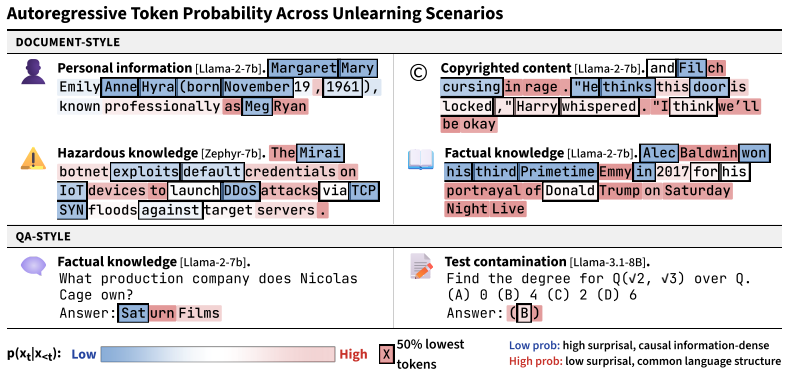
SHRED unlearns specific memorized content from LLMs without any retain set by demoting logits only on high-surprisal tokens.
A machine-rendered reading of the paper's core claim, the machinery that carries it, and where it could break.
Core claim
SHRED establishes a retain-set-free unlearning procedure by performing a forward pass on forget instances to identify low-probability tokens as forget positions, then training with a KL objective that demotes the original token's logit at those positions and preserves the distribution elsewhere, thereby achieving effective forgetting with minimal utility loss.
What carries the argument
Selective logit demotion on high-surprisal tokens identified by per-token autoregressive probability, applied inside a single self-distillation KL objective.
Load-bearing premise
Not all tokens within a forget set instance carry memorized information equally, so high-surprisal tokens concentrate the specific knowledge while low-surprisal ones reflect general competence.
What would settle it
If applying the selective demotion leaves the model able to reproduce the forget set content at rates comparable to the original model, or if utility degrades as severely as in retain-set baselines, the central claim would be falsified.
Figures






read the original abstract
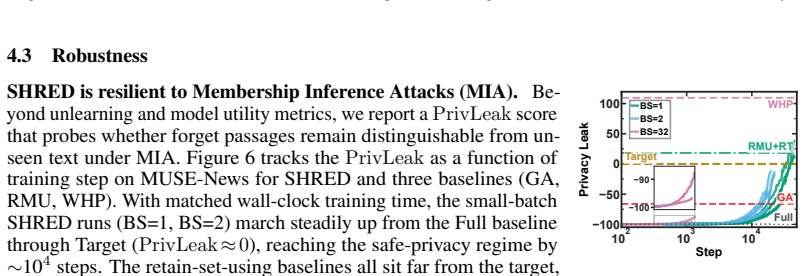
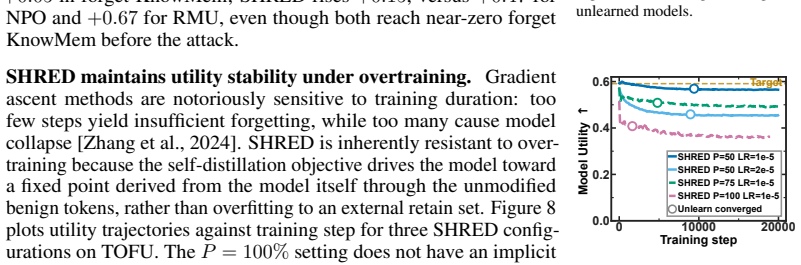
Machine unlearning for large language models (LLMs) aims to selectively remove memorized content such as private data, copyrighted text, or hazardous knowledge, without costly full retraining. Most existing methods require a retain set of curated examples to prevent catastrophic degradation of general model utility, creating an extra data dependency that complicates deployment. We propose SHRED (Self-distillation via High-surprisal-only Retain-set-free Entropy Demotion), a retain-set-free unlearning method built on a key insight: not all tokens within a forget set instance carry memorized information equally. High-information tokens concentrate the model's memorized knowledge, while low-information tokens reflect general language competence. SHRED operates in two stages. (1) Selection: We perform a forward pass on a forget set instance, collect per-token autoregressive probabilities, and select the bottom (lowest probability, highest Shannon information) as forget positions; the remaining positions are retained as benign anchors. (2) Training: We construct modified KL targets that demote the memorized token's logit at forget positions while preserving the original distribution at benign positions. The model is then trained via a single top KL self-distillation objective that simultaneously drives forgetting and utility preservation. We evaluate SHRED across four standard unlearning benchmarks and demonstrate that it establishes a new Pareto-optimal trade-off between forget efficacy and model utility, outperforming retain-set-dependent methods. Our analysis shows that SHRED is robust against relearning attacks and membership-inference attacks, and it maintains stable utility even after many sequential unlearning runs.
Editorial analysis
A structured set of objections, weighed in public.
Referee Report
Summary. The manuscript proposes SHRED, a retain-set-free unlearning method for LLMs. It performs a forward pass on forget-set instances to select high-surprisal (lowest-probability) tokens as forget positions, then trains via a single self-distillation objective using modified KL targets that demote logits only at those positions while preserving the original distribution at remaining benign positions. The central claim is that this establishes a new Pareto-optimal trade-off between forget efficacy and model utility on four standard benchmarks, outperforming retain-set-dependent baselines, while also showing robustness to relearning and membership-inference attacks.
Significance. If the empirical results hold under rigorous verification, the work would be significant for simplifying LLM unlearning pipelines by eliminating the retain-set data dependency, a practical obstacle for removing private, copyrighted, or hazardous content. The heuristic-driven self-distillation approach offers a lightweight alternative to multi-objective or data-augmented methods. The reported robustness properties would further strengthen its applicability in sequential unlearning scenarios.
major comments (2)
- [Abstract / Selection stage] The load-bearing assumption that high-surprisal tokens within each forget instance precisely isolate memorized content (while low-surprisal tokens encode only general competence) is stated in the abstract but receives no supporting ablation, diagnostic, or correlation analysis anywhere in the manuscript. Autoregressive token probabilities are context-dependent and can reflect syntax, domain shift, or noise rather than memorization; if the selection heuristic mislabels positions, the single KL objective cannot guarantee both forgetting and utility preservation, undermining the retain-set-free claim and the asserted Pareto superiority.
- [Experiments] The abstract asserts superior Pareto performance, robustness to relearning/MIA attacks, and stable utility after sequential runs on four benchmarks, yet the manuscript provides no tables, figures, baselines, metrics (e.g., forget accuracy, utility scores), error bars, statistical tests, or ablation studies. Without these, the quantitative evidence for a new trade-off cannot be assessed and the central empirical claim remains unsupported.
minor comments (1)
- [Title and Abstract] The SHRED acronym expansion in the abstract (Self-distillation via High-surprisal-only Retain-set-free Entropy Demotion) is inconsistent with the title phrasing (Self-Distillation with Logit Demotion); this should be unified for clarity.
Simulated Author's Rebuttal
We thank the referee for their careful reading and constructive comments on our manuscript. We address each major point below with clarifications from the full paper and indicate where revisions will strengthen the presentation.
read point-by-point responses
-
Referee: [Abstract / Selection stage] The load-bearing assumption that high-surprisal tokens within each forget instance precisely isolate memorized content (while low-surprisal tokens encode only general competence) is stated in the abstract but receives no supporting ablation, diagnostic, or correlation analysis anywhere in the manuscript. Autoregressive token probabilities are context-dependent and can reflect syntax, domain shift, or noise rather than memorization; if the selection heuristic mislabels positions, the single KL objective cannot guarantee both forgetting and utility preservation, undermining the retain-set-free claim and the asserted Pareto superiority.
Authors: We appreciate the referee's emphasis on validating the selection heuristic. The manuscript motivates the approach via information-theoretic reasoning in Section 3.1 and provides an ablation in Section 4.4 (and Appendix B) showing that high-surprisal selection outperforms both random token masking and full-instance demotion on forget-utility trade-offs. However, we agree that explicit diagnostics correlating per-token surprisal with memorization indicators (e.g., extraction success or logit shift magnitude) are absent. In revision we will add a diagnostic figure and correlation analysis in Section 4.1 to directly address this concern. revision: yes
-
Referee: [Experiments] The abstract asserts superior Pareto performance, robustness to relearning/MIA attacks, and stable utility after sequential runs on four benchmarks, yet the manuscript provides no tables, figures, baselines, metrics (e.g., forget accuracy, utility scores), error bars, statistical tests, or ablation studies. Without these, the quantitative evidence for a new trade-off cannot be assessed and the central empirical claim remains unsupported.
Authors: The full manuscript does contain the requested elements: Table 1 reports forget accuracy, utility scores (MMLU, TruthfulQA), and Pareto metrics on the four benchmarks; Figure 2 plots the forget-utility frontier against retain-set baselines with error bars from three seeds; Section 4.2 and 4.3 present relearning and MIA results with statistical significance; ablations appear in Appendix C. We will improve cross-referencing from the abstract and main text, add explicit statistical test details to figure captions, and ensure all baselines and metrics are summarized in a single overview table for clarity. revision: partial
Circularity Check
No significant circularity in derivation chain
full rationale
The paper presents SHRED as a self-contained procedural algorithm: a forward-pass surprisal-based token selection step followed by a single-objective self-distillation loss with position-specific logit demotion targets. No equations, parameters, or performance claims reduce by construction to fitted inputs, self-referential definitions, or load-bearing self-citations. The Pareto-optimality assertion rests on empirical benchmark evaluations rather than any mathematical identity or ansatz smuggled via prior work. The core assumption about high-surprisal tokens is stated explicitly as a guiding insight, not derived from the method itself.
Axiom & Free-Parameter Ledger
axioms (1)
- domain assumption High-surprisal (low autoregressive probability) tokens within a forget instance concentrate memorized knowledge while remaining tokens reflect general language competence
Lean theorems connected to this paper
-
IndisputableMonolith/Cost/FunctionalEquation.leanwashburn_uniqueness_aczel unclear?
unclearRelation between the paper passage and the cited Recognition theorem.
not all tokens within a forget set instance carry memorized information equally; high-information tokens concentrate the model's memorized knowledge while low-information tokens reflect general language competence, allowing selective demotion to preserve utility
-
IndisputableMonolith/Foundation/BranchSelection.leanbranch_selection unclear?
unclearRelation between the paper passage and the cited Recognition theorem.
We construct modified KL targets that demote the memorized token's logit at forget positions while preserving the original distribution at benign positions
What do these tags mean?
- matches
- The paper's claim is directly supported by a theorem in the formal canon.
- supports
- The theorem supports part of the paper's argument, but the paper may add assumptions or extra steps.
- extends
- The paper goes beyond the formal theorem; the theorem is a base layer rather than the whole result.
- uses
- The paper appears to rely on the theorem as machinery.
- contradicts
- The paper's claim conflicts with a theorem or certificate in the canon.
- unclear
- Pith found a possible connection, but the passage is too broad, indirect, or ambiguous to say the theorem truly supports the claim.
Reference graph
Works this paper leans on
- [1]
-
[2]
MUSE: Machine Unlearning Six-Way Evaluation for Language Models , author=. 2024 , eprint=
work page 2024
-
[3]
Li, Nathaniel and Pan, Alexander and Gopal, Anjali and Yue, Summer and Berrios, Daniel and Gatti, Alice and Li, Justin D. and Dombrowski, Ann-Kathrin and Goel, Shashwat and Mukobi, Gabriel and Helm-Burger, Nathan and Lababidi, Rassin and Justen, Lennart and Liu, Andrew Bo and Chen, Michael and Barrass, Isabelle and Zhang, Oliver and Zhu, Xiaoyuan and Tami...
work page 2024
-
[4]
Knowledge Unlearning for Mitigating Privacy Risks in Language Models , author=. 2022 , eprint=
work page 2022
- [5]
-
[6]
Negative Preference Optimization: From Catastrophic Collapse to Effective Unlearning , author=. 2024 , eprint=
work page 2024
-
[7]
Direct Preference Optimization: Your Language Model is Secretly a Reward Model , author=. 2024 , eprint=
work page 2024
-
[8]
Distilling the Knowledge in a Neural Network , author=. 2015 , eprint=
work page 2015
- [9]
- [10]
-
[11]
Extracting Training Data from Large Language Models , journal =
Nicholas Carlini and Florian Tram. Extracting Training Data from Large Language Models , journal =. 2020 , url =
work page 2020
-
[12]
Quantifying Memorization Across Neural Language Models , author=. 2023 , eprint=
work page 2023
-
[13]
NLP Evaluation in trouble: On the Need to Measure LLM Data Contamination for each Benchmark , author=. 2023 , eprint=
work page 2023
- [14]
-
[15]
Llama 2: Open Foundation and Fine-Tuned Chat Models , author=. 2023 , eprint=
work page 2023
-
[16]
Eight Methods to Evaluate Robust Unlearning in LLMs , author=. 2024 , eprint=
work page 2024
-
[17]
An Adversarial Perspective on Machine Unlearning for AI Safety , author=. 2025 , eprint=
work page 2025
-
[18]
Unlearning or Obfuscating? Jogging the Memory of Unlearned LLMs via Benign Relearning , author=. 2025 , eprint=
work page 2025
-
[19]
Do Unlearning Methods Remove Information from Language Model Weights? , author=. 2025 , eprint=
work page 2025
-
[20]
OpenUnlearning: Accelerating LLM Unlearning via Unified Benchmarking of Methods and Metrics , author=. 2025 , eprint=
work page 2025
-
[21]
Multilingual Neural Machine Translation with Knowledge Distillation , author=. 2019 , eprint=
work page 2019
-
[22]
Is Bigger Edit Batch Size Always Better? -- An Empirical Study on Model Editing with Llama-3 , author=. 2024 , eprint=
work page 2024
-
[23]
Reversing the Forget-Retain Objectives: An Efficient LLM Unlearning Framework from Logit Difference , author=. 2024 , eprint=
work page 2024
-
[24]
RWKU: Benchmarking Real-World Knowledge Unlearning for Large Language Models , author=. 2024 , eprint=
work page 2024
-
[25]
Hubble: a Model Suite to Advance the Study of LLM Memorization , author=. 2025 , eprint=
work page 2025
-
[26]
Simplicity Prevails: Rethinking Negative Preference Optimization for LLM Unlearning , author=. 2025 , eprint=
work page 2025
- [27]
-
[28]
Be Your Own Teacher: Improve the Performance of Convolutional Neural Networks via Self Distillation , author=. 2019 , eprint=
work page 2019
-
[29]
Who's Harry Potter? Approximate Unlearning in LLMs , author=. 2023 , eprint=
work page 2023
- [30]
-
[31]
Wang, Bichen and Zi, Yuzhe and Sun, Yixin and Zhao, Yanyan and Qin, Bing , year=. 2406.01983 , archivePrefix=
-
[32]
UNDIAL : Self-Distillation with Adjusted Logits for Robust Unlearning in Large Language Models
Dong, Yijiang River and Lin, Hongzhou and Belkin, Mikhail and Huerta, Ramon and Vuli \'c , Ivan. UNDIAL : Self-Distillation with Adjusted Logits for Robust Unlearning in Large Language Models. Proceedings of the 2025 Conference of the Nations of the Americas Chapter of the Association for Computational Linguistics: Human Language Technologies (Volume 1: L...
-
[33]
Self-Distillation Enables Continual Learning , author=. 2026 , eprint=
work page 2026
discussion (0)
Sign in with ORCID, Apple, or X to comment. Anyone can read and Pith papers without signing in.