Recognition: 1 theorem link
· Lean TheoremGradient Catastrophe for Solutions to the Conservation Laws with Source Term
Pith reviewed 2026-05-11 01:47 UTC · model grok-4.3
The pith
Solutions to conservation laws with source terms form singularities in finite time under weaker initial data conditions than prior work, with small compact support accelerating blow-up.
A machine-rendered reading of the paper's core claim, the machinery that carries it, and where it could break.
Core claim
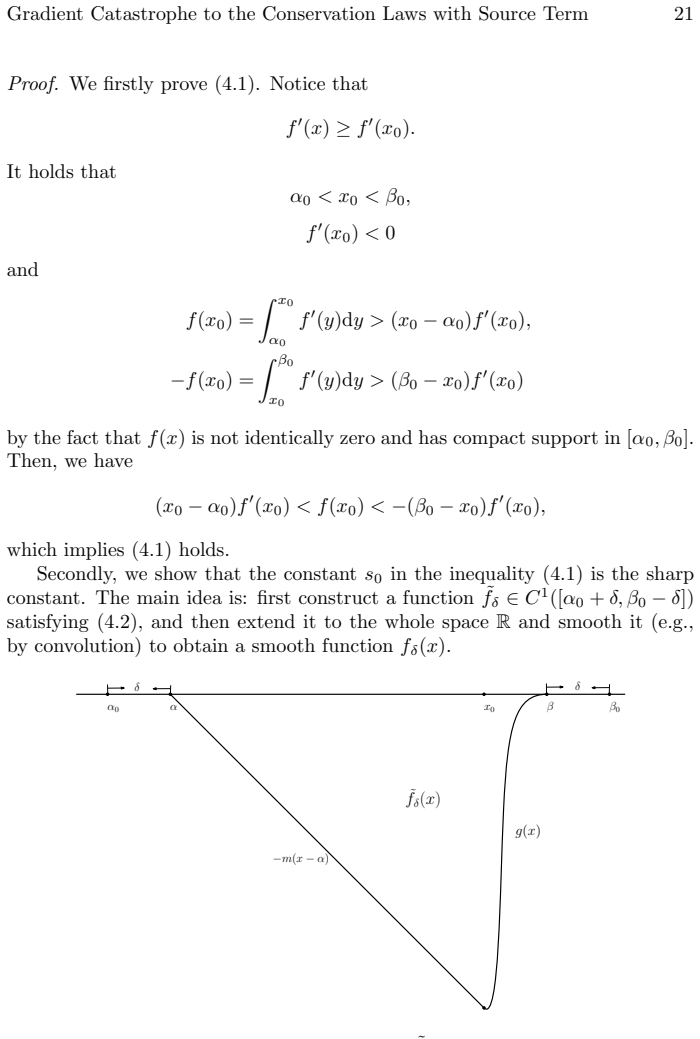
We prove finite-time blow-up under initial data conditions weaker than those in Barlin. Moreover, we show that a sufficiently small compact support length of the initial data promotes blow-up. Hence, global existence can only be achieved when the initial data have a large compact support length.
What carries the argument
John-type blow-up criteria applied along characteristics to the conservation law with source term, relaxed to weaker initial data assumptions.
If this is right
- The class of initial data that produce finite-time singularities is strictly larger than the one identified by Barlin.
- Initial data whose compact support is below a critical length must blow up in finite time.
- Global smooth existence is possible only for initial data whose compact support exceeds some positive threshold length.
- The support length acts as a tunable parameter that separates local blow-up from potential global regularity.
Where Pith is reading between the lines
- In applied models, compactly supported initial perturbations are expected to generate shocks on shorter time scales than spread-out data.
- Numerical schemes for these equations must resolve singularities earlier when the initial data are compactly supported.
- The support-length effect may carry over to related hyperbolic systems or to multidimensional settings, though the paper restricts attention to the one-dimensional scalar case.
Load-bearing premise
The specific flux and source term allow the existing blow-up criteria to apply even when the initial data satisfy less restrictive size or derivative bounds.
What would settle it
A concrete global smooth solution for initial data with small compact support that meet the paper's weaker conditions would disprove the claim that such support promotes blow-up.
Figures
read the original abstract
This paper studies singularity formation for conservation laws with a source term. Motivated by John (1974) and Barlin (2023), we prove finite-time blow-up under initial data conditions weaker than those in Barlin. Moreover, we show that a sufficiently small compact support length of the initial data promotes blow-up. Hence, global existence can only be achieved when the initial data have a large compact support length.
Editorial analysis
A structured set of objections, weighed in public.
Referee Report
Summary. The manuscript claims to prove finite-time gradient catastrophe for solutions to a conservation law with source term, under initial-data hypotheses weaker than those of Barlin (2023). It further asserts that a sufficiently small length of the compact support of the initial data forces blow-up in finite time and therefore concludes that global existence is possible only when the initial data possess a sufficiently large compact support.
Significance. If the central arguments are correct, the work would extend the blow-up theory for quasilinear hyperbolic systems with lower-order source terms by relaxing the initial-data restrictions and isolating the role of support size. Such a refinement could be useful in applications where source terms appear (e.g., reactive flows or traffic models) and would complement the criteria of John (1974) and Barlin (2023).
major comments (2)
- The abstract (and presumably the introduction) does not display the explicit form of the flux or the source term. Without this, it is impossible to verify that the characteristic or energy estimates underlying the John (1974) and Barlin (2023) blow-up criteria remain valid once the initial-data restrictions are weakened and the support-length dependence is introduced.
- The 'hence' statement that global existence can only be achieved for large compact support is not logically entailed by the claim that small support promotes blow-up; the manuscript must supply a separate argument showing that, for the given source term, sufficiently large support actually permits global smooth solutions (or at least does not force blow-up by other mechanisms).
minor comments (1)
- All citations (John 1974, Barlin 2023) should be given in full bibliographic form in the reference list.
Simulated Author's Rebuttal
We thank the referee for the careful reading and constructive comments. We address the major points below and indicate the revisions we will make to strengthen the manuscript.
read point-by-point responses
-
Referee: The abstract (and presumably the introduction) does not display the explicit form of the flux or the source term. Without this, it is impossible to verify that the characteristic or energy estimates underlying the John (1974) and Barlin (2023) blow-up criteria remain valid once the initial-data restrictions are weakened and the support-length dependence is introduced.
Authors: We agree that the explicit forms are needed for immediate verification. The full manuscript defines the flux f(u) and source g(u) in Section 2, but we will add these expressions directly into the abstract and the opening paragraph of the introduction in the revised version so that readers can check the applicability of the estimates without searching further. revision: yes
-
Referee: The 'hence' statement that global existence can only be achieved for large compact support is not logically entailed by the claim that small support promotes blow-up; the manuscript must supply a separate argument showing that, for the given source term, sufficiently large support actually permits global smooth solutions (or at least does not force blow-up by other mechanisms).
Authors: We acknowledge the logical gap. Our theorem establishes finite-time blow-up when the support length is sufficiently small, but the manuscript does not contain a separate existence proof or non-blow-up argument for large support. We will therefore revise the concluding sentence to state only that small support forces blow-up and that global existence, if it occurs, requires sufficiently large support; we will add a remark noting that a full global-existence result for large support lies outside the present scope and is left for future work. revision: partial
Circularity Check
No circularity detected; direct proof of blow-up under relaxed initial-data hypotheses
full rationale
The manuscript presents an independent mathematical argument establishing finite-time gradient catastrophe for the conservation law with source term, using adaptations of characteristic or energy methods from the cited external references John (1974) and Barlin (2023). The central claims rest on explicit PDE analysis and initial-data restrictions that are strictly weaker than those in the prior work, without any reduction of the new estimates to a fitted parameter, self-definition, or load-bearing self-citation chain. The additional statement that small compact support promotes blow-up follows directly from the derived blow-up criterion rather than being presupposed. No equations or steps in the derivation are shown to be equivalent to their inputs by construction.
Axiom & Free-Parameter Ledger
axioms (1)
- domain assumption The equation is a hyperbolic conservation law with a source term to which John-type blow-up criteria apply
Reference graph
Works this paper leans on
-
[1]
J. B¨ arlin, Formation of singularities in solutions to nonlinear hyperbolic systems with general sources,Nonlinear Anal. Real World Appl.,73(2023), 103901
work page 2023
-
[2]
J. B¨ arlin, Blow-up of solutions to relaxed compressible Navier-Stokes equations in divergence form, 2022, arXiv:2202.05634
-
[3]
J. Chen and S.-J. Yang, Blow-up of solutions to a scalar conservation law with nonlocal source arising in radiative gas,Appl. Anal.,103(10), 2024, 1751–1756
work page 2024
-
[4]
L. H¨ ormander, The lifespan of classical solutions of nonlinear hyperbolic equa- tions,Lecture Notes in Math., Springer, Berlin, 1987
work page 1987
-
[5]
Y.-X. Hu, R. Racke and N. Wang, Formation of singularities for one-dimensional relaxed compressible Navier-Stokes equations,J. Differ. Equ.,327(2022), 145– 165
work page 2022
- [6]
-
[7]
John, Formation of singularities in one-dimensional nonlinear wave propaga- tion,Commun
F. John, Formation of singularities in one-dimensional nonlinear wave propaga- tion,Commun. Pure Appl. Math.,27(3), 1974, 377–405
work page 1974
-
[8]
P.D. Lax, Development of singularities of solutions of nonlinear hyperbolic partial differential equations,J. Math. Phys.,5, 1964, 611–613
work page 1964
-
[9]
P.D. Lax, Hyperbolic Systems of Conservation Laws and the Mathematical The- ory of Shock Waves, in: Conference Board of the Mathematical Sciences Regional Conference Series in Applied Mathematics, (no. 11) Society for Industrial and Applied Mathematics, Philadelphia, Pa, 1973
work page 1973
-
[10]
T. Li, H. Liu, Critical thresholds in hyperbolic relaxation systems,J. Differ. Equ., 247(1), 2009, 33–48
work page 2009
-
[11]
T.-P. Liu, Development of singularities in the nonlinear waves for quasilinear hyperbolic partial differential equations,J. Differ. Equ.33(1), 1979, 92–111
work page 1979
-
[12]
J. Rauch, Hyperbolic Partial Differential Equations and Geometric Optics, in: Graduate Studies in Mathematics, vol. 133, American Mathematical Society, Providence, RI, 2012
work page 2012
-
[13]
Gradient Catastrophe for Solutions to the Hyperbolic Navier-Stokes Equations
Q.-S. Zhao, Gradient catastrophe for solutions to the hyperbolic Navier-Stokes equations, 2026, arXiv:2604.13837
work page internal anchor Pith review Pith/arXiv arXiv 2026
discussion (0)
Sign in with ORCID, Apple, or X to comment. Anyone can read and Pith papers without signing in.