Recognition: 2 theorem links
· Lean TheoremCausal mechanisms of drop breakup in turbulent flows
Pith reviewed 2026-05-11 01:48 UTC · model grok-4.3
The pith
Decomposing turbulent flow around drops into outer and inner fields reveals that intermittency causes memoryless breakup statistics.
A machine-rendered reading of the paper's core claim, the machinery that carries it, and where it could break.
Core claim
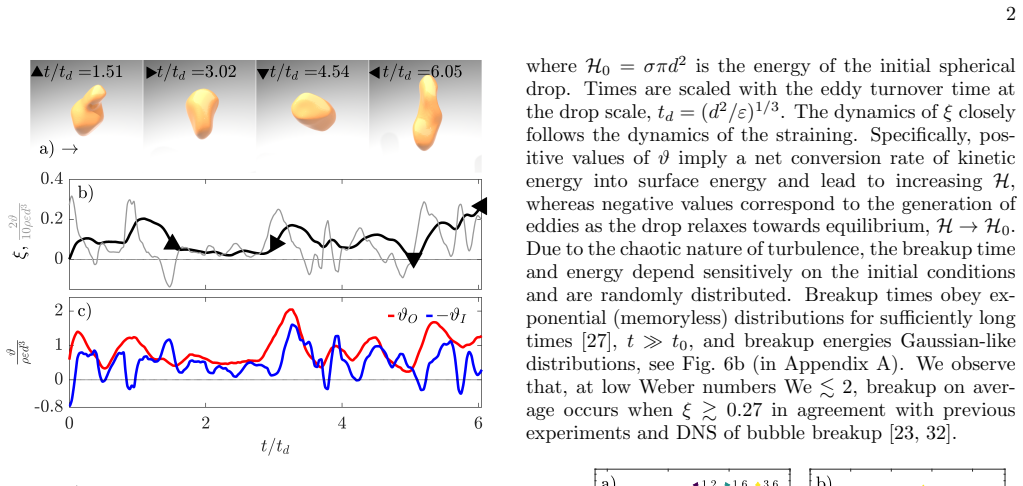
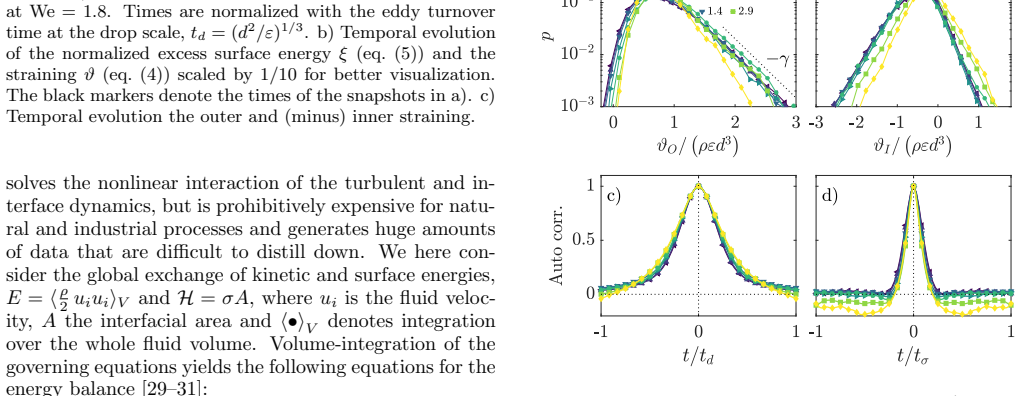
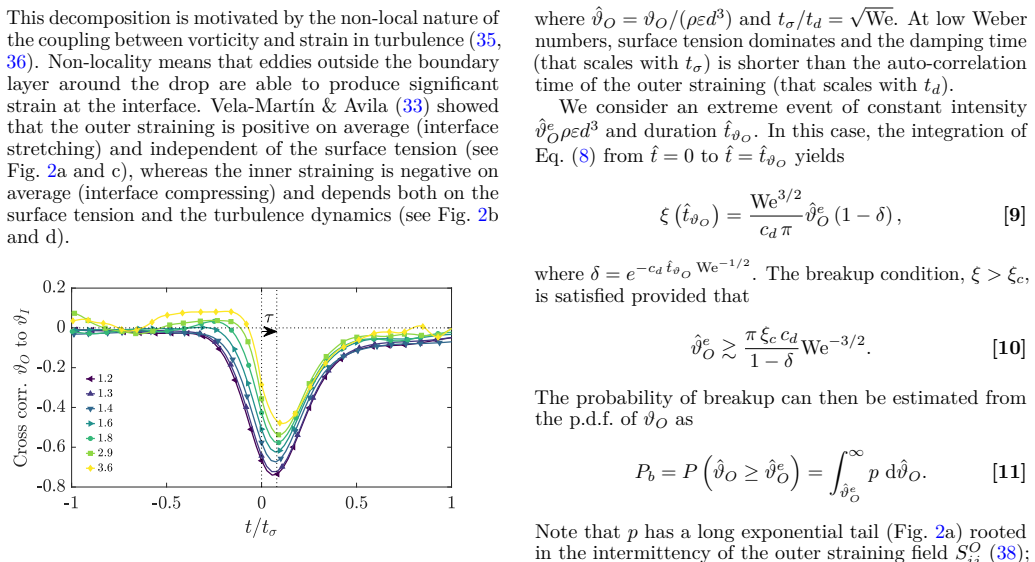
By decomposing the turbulent flow into outer and inner fields, where the outer field is independent of the drop dynamics and drives deformation, whereas the inner field responds to the deformation by dissipating the interfacial energy through the genesis of turbulent eddies, we derive a simple analytical model that reproduces the breakup statistics obtained from ensembles of direct numerical simulations of drops and bubbles. Our results reveal a causal link between the intermittency of turbulent flows and the memoryless breakup statistics.
What carries the argument
Decomposition of the flow into outer and inner fields, with the outer field driving deformation independently and the inner field dissipating energy through eddy genesis.
If this is right
- Breakup statistics of drops and bubbles can be predicted from an analytical expression without resolving the full nonlinear interface evolution.
- The memoryless character of breakup is a direct consequence of the intermittent straining events in turbulence.
- The same model applies equally to drops and to bubbles.
- The derived statistics match those measured in large ensembles of direct numerical simulations.
Where Pith is reading between the lines
- If the outer field truly remains unaffected, then deliberately altering turbulence intermittency (for example by adding polymers or changing geometry) should change breakup rates in a predictable way.
- The outer-inner separation may be useful for other interfacial problems in turbulence, such as coalescence or mass transfer.
- The approach suggests that breakup rates could be expressed in terms of single-point turbulence statistics rather than full flow histories.
Load-bearing premise
The outer flow field remains independent of the drop's deformation and breakup dynamics.
What would settle it
A direct numerical simulation in which the outer flow statistics change measurably once a deforming drop is introduced, or an experiment showing that the analytical model fails to predict breakup rates when turbulence intermittency is varied while other parameters are held fixed.
Figures


read the original abstract
The fragmentation of drops and bubbles in turbulence determines the rate of many processes in engineering and environmental fluid flows. The nonlinear coupling between interfacial and hydrodynamic stresses poses a fundamental difficulty to model reduction, which we here address by decomposing the flow into outer and inner fields. We show that the outer field is independent of the drop dynamics and drives deformation, whereas the inner field responds to the deformation by dissipating the interfacial energy through the genesis of turbulent eddies. Drawing from these observations, we derive a simple analytical model that reproduces the breakup statistics obtained from ensembles of direct numerical simulations of drops and bubbles. Our results reveal a causal link between the intermittency of turbulent flows and the memoryless breakup statistics.
Editorial analysis
A structured set of objections, weighed in public.
Referee Report
Summary. The manuscript claims that by decomposing the flow into outer and inner fields around drops and bubbles in turbulence, the outer field is independent of drop dynamics and drives deformation while the inner field dissipates interfacial energy through genesis of turbulent eddies. Drawing from these observations, a simple analytical model is derived that reproduces breakup statistics from ensembles of direct numerical simulations, revealing a causal link between turbulence intermittency and memoryless breakup statistics.
Significance. If the outer-inner decomposition holds rigorously and the analytical model is derived without fitting to the validation DNS data, this would represent a significant contribution by providing a mechanistic, causal explanation for exponential breakup waiting times in turbulent flows. The connection to intermittency and the use of DNS ensembles for validation are notable strengths that could advance reduced-order modeling of fragmentation processes.
major comments (2)
- [Abstract] Abstract: The central claim that the outer field is independent of the drop dynamics (allowing it to drive deformation independently) is load-bearing for the analytical model and the causal link to memoryless statistics, but the abstract provides no explicit test or demonstration (e.g., comparison of outer velocity gradients with and without the interface) to rule out bidirectional feedback from large deformations or breakup events via momentum/pressure coupling.
- [Abstract] Abstract and derivation: The model is stated to reproduce DNS breakup statistics, yet no details are given on whether the analytical expressions contain fitted parameters (or post-hoc choices) drawn from the same DNS ensembles used for validation; this leaves the reproduction vulnerable to circularity and undermines the claim of a parameter-free causal derivation from the outer-inner observations.
minor comments (1)
- [Abstract] The abstract could be expanded to include a brief mention of the specific form of the analytical model (e.g., the waiting-time distribution derived) and any quantitative error metrics against DNS to aid immediate assessment.
Simulated Author's Rebuttal
We thank the referee for their constructive comments, which highlight important aspects of clarity in our presentation. We address each major comment below and will incorporate revisions to strengthen the manuscript.
read point-by-point responses
-
Referee: [Abstract] Abstract: The central claim that the outer field is independent of the drop dynamics (allowing it to drive deformation independently) is load-bearing for the analytical model and the causal link to memoryless statistics, but the abstract provides no explicit test or demonstration (e.g., comparison of outer velocity gradients with and without the interface) to rule out bidirectional feedback from large deformations or breakup events via momentum/pressure coupling.
Authors: We agree that the abstract would benefit from greater explicitness on this foundational point. The manuscript body demonstrates the independence through quantitative comparisons of outer velocity gradients, strain rates, and flow structures extracted from DNS with and without the interface; these show that outer-field statistics are statistically indistinguishable, indicating negligible back-coupling from the drop. We will revise the abstract to include a brief reference to this evidence (e.g., 'We demonstrate this independence by comparing outer velocity fields in the presence and absence of the interface'). This change improves transparency without altering the reported results. revision: yes
-
Referee: [Abstract] Abstract and derivation: The model is stated to reproduce DNS breakup statistics, yet no details are given on whether the analytical expressions contain fitted parameters (or post-hoc choices) drawn from the same DNS ensembles used for validation; this leaves the reproduction vulnerable to circularity and undermines the claim of a parameter-free causal derivation from the outer-inner observations.
Authors: We share the referee's concern about avoiding any appearance of circularity. The analytical model is obtained directly from the outer-inner decomposition observations, with all functional forms (breakup rate, waiting-time distribution) derived analytically and containing no adjustable parameters or post-hoc tuning to the validation DNS. The reported agreement with DNS statistics is a pure validation step performed on independent simulation ensembles. We will add a dedicated paragraph (or short subsection) in the revised manuscript that explicitly walks through the derivation steps and states that no fitting to the validation data was performed. This addition will make the parameter-free character unambiguous. revision: yes
Circularity Check
No circularity: analytical model derived from field decomposition without reduction to fitted inputs or self-citations
full rationale
The paper's central derivation begins from the decomposition of the flow into outer and inner fields, with the outer field stated as independent and driving deformation while the inner dissipates energy. From these observations the authors derive the analytical breakup model. No equations or sections in the provided text reduce the model parameters or the memoryless statistics directly to a fit on the same DNS breakup times being reproduced; the reproduction is presented as a consequence of the causal link to intermittency rather than a statistical fit. The derivation chain remains self-contained against the external DNS benchmark and does not rely on load-bearing self-citations or ansatzes smuggled from prior work.
Axiom & Free-Parameter Ledger
axioms (2)
- domain assumption The outer field is independent of the drop dynamics and drives deformation.
- domain assumption The inner field dissipates interfacial energy through the genesis of turbulent eddies.
Lean theorems connected to this paper
-
IndisputableMonolith/Cost/FunctionalEquation.leanwashburn_uniqueness_aczel unclear?
unclearRelation between the paper passage and the cited Recognition theorem.
We show that the outer field is independent of the drop dynamics and drives deformation, whereas the inner field responds to the deformation by dissipating the interfacial energy through the genesis of turbulent eddies... Pb ∝ e^{-χ We^{-3/2}}
-
IndisputableMonolith/Foundation/AbsoluteFloorClosure.leanreality_from_one_distinction unclear?
unclearRelation between the paper passage and the cited Recognition theorem.
The breakup rate... κ∝Pb... ˆκ=ˆκ∞ e^{-χ We^{-3/2}}
What do these tags mean?
- matches
- The paper's claim is directly supported by a theorem in the formal canon.
- supports
- The theorem supports part of the paper's argument, but the paper may add assumptions or extra steps.
- extends
- The paper goes beyond the formal theorem; the theorem is a base layer rather than the whole result.
- uses
- The paper appears to rely on the theorem as machinery.
- contradicts
- The paper's claim conflicts with a theorem or certificate in the canon.
- unclear
- Pith found a possible connection, but the passage is too broad, indirect, or ambiguous to say the theorem truly supports the claim.
Reference graph
Works this paper leans on
-
[1]
Causal mechanisms of drop breakup in turbulent flows
performed thousands of direct numerical simulations (DNS) of a single-drop in homogeneous, isotropic tur- bulence. Their computed scaling of the breakup rate with We is consistent with a phenomenological model proposed by Coulaloglou and Tavlarides [12]. However, the applicability of their results beyond drop emulsions of nearly matched density and viscos...
work page internal anchor Pith review Pith/arXiv arXiv 2026
-
[2]
showed that the outer straining is positive on aver- age (interface stretching) and independent of the surface tension (see Fig. 2a and c), whereas the inner straining is negative on average (interface compressing) and depends both on the surface tension and the turbulence dynamics (see Fig. 2b and d). FIG. 3. Cross correlation between outer and inner str...
-
[3]
and rare decay events in turbulent pipe flow [44]. In summary, our analysis reveals a causal link between the inherent intermittency of the turbulent field and breakup. Key to this discovery, is the independence of the outer statistics on the drop dynamics and its causality to the inner motions. This establishes the foundations of our simple model, with t...
-
[4]
and high Reynolds number turbulence. In all these situations, the forcing experienced by the particle should be equally governed primarily by the statistics of the outer (independent) field. Thus, to extend the model, one would only need to replace the tail of the p.d.f. of Fig. 2a by the appropriate one (e.g., through a change of the slope parameterγ). F...
-
[5]
G. Falkovich, A. Fouxon, and M. Stepanov, Acceleration of rain initiation by cloud turbulence, Nature419, 151 (2002)
work page 2002
-
[6]
W. W. Grabowski and L.-P. Wang, Growth of cloud droplets in a turbulent environment, Annual review of fluid mechanics45, 293 (2013)
work page 2013
-
[7]
G. B. Deane and M. D. Stokes, Scale dependence of bub- ble creation mechanisms in breaking waves, Nature418, 839 (2002)
work page 2002
-
[8]
L. Deike, Mass transfer at the ocean–atmosphere inter- face: the role of wave breaking, droplets, and bubbles, Annual Review of Fluid Mechanics54, 191 (2022)
work page 2022
-
[9]
A. J. Mathijssen, M. Lisicki, V. N. Prakash, and E. J. Mossige, Culinary fluid mechanics and other currents in food science, Reviews of Modern Physics95, 025004 (2023)
work page 2023
-
[10]
A. H˚ akansson, Emulsion formation by homogenization: Current understanding and future perspectives, Annual review of food science and technology10, 239 (2019)
work page 2019
-
[11]
H. Watanabe, Y. Suzuki, T. Harada, Y. Matsushita, H. Aoki, and T. Miura, An experimental investigation of the breakup characteristics of secondary atomization of emulsified fuel droplet, Energy35, 806 (2010)
work page 2010
- [12]
-
[13]
R. Ni, Deformation and breakup of bubbles and drops in turbulence, Annual Review of Fluid Mechanics56, 319 (2024)
work page 2024
-
[14]
Kolmogorov, On the disintegration of drops in a tur- bulent flow, inDokl
A. Kolmogorov, On the disintegration of drops in a tur- bulent flow, inDokl. Akad. Nauk SSSR, Vol. 66 (sn, 1949) p. 30
work page 1949
-
[15]
J. O. Hinze, Fundamentals of the hydrodynamic mecha- nism of splitting in dispersion processes, AIChE journal 1, 289 (1955)
work page 1955
-
[16]
C. Coulaloglou and L. L. Tavlarides, Description of in- teraction processes in agitated liquid-liquid dispersions, Chemical Engineering Science32, 1289 (1977)
work page 1977
-
[17]
G. Narsimhan, J. Gupta, and D. Ramkrishna, A model for transitional breakage probability of droplets in agi- 6 tated lean liquid-liquid dispersions, Chemical Engineer- ing Science34, 257 (1979)
work page 1979
- [18]
-
[19]
J. C. Lasheras, C. Eastwood, C. Martınez-Baz´ an, and J. L. Monta˜ nes, A review of statistical models for the break-up of an immiscible fluid immersed into a fully de- veloped turbulent flow, International Journal of Multi- phase Flow28, 247 (2002)
work page 2002
-
[20]
Y. Liao and D. Lucas, A literature review of theoretical models for drop and bubble breakup in turbulent disper- sions, Chemical Engineering Science64, 3389 (2009)
work page 2009
-
[21]
B. Lalanne, O. Masbernat, and F. Risso, A model for drop and bubble breakup frequency based on turbulence spectra, AIChE Journal65, 347 (2019)
work page 2019
-
[22]
Y. Qi, S. Tan, N. Corbitt, C. Urbanik, A. K. Salibindla, and R. Ni, Fragmentation in turbulence by small eddies, Nature communications13, 469 (2022)
work page 2022
-
[23]
A. Rivi` ere, L. Duchemin, C. Josserand, and S. Perrard, Bubble breakup reduced to a one-dimensional nonlinear oscillator, Physical Review Fluids8, 094004 (2023)
work page 2023
-
[24]
S. Zhong and R. Ni, On the breakup frequency of bub- bles and droplets in turbulence: a compilation and evalu- ation of experimental data, International Journal of Mul- tiphase Flow176, 104842 (2024)
work page 2024
-
[25]
F. Risso and J. Fabre, Oscillations and breakup of a bub- ble immersed in a turbulent field, Journal of Fluid Me- chanics372, 323 (1998)
work page 1998
-
[26]
C. D. Eastwood, L. Armi, and J. Lasheras, The breakup of immiscible fluids in turbulent flows, Journal of Fluid Mechanics502, 309 (2004)
work page 2004
-
[27]
R. Andersson and B. Andersson, On the breakup of fluid particles in turbulent flows, AIChE Journal52, 2020 (2006)
work page 2020
-
[28]
J. Solsvik and H. A. Jakobsen, Single drop breakup ex- periments in stirred liquid–liquid tank, Chemical Engi- neering Science131, 219 (2015)
work page 2015
-
[29]
L. Beckedorff, G. C. Caridi, and A. Soldati, Jet-stirred homogeneous isotropic turbulent water tank for bubble and droplet fragmentation, Review of Scientific Instru- ments96(2025)
work page 2025
-
[30]
A. H˚ akansson, On the validity of different methods to es- timate breakup frequency from single drop experiments, Chemical Engineering Science227, 115908 (2020)
work page 2020
-
[31]
A. Vela-Mart´ ın and M. Avila, Memoryless drop breakup in turbulence, Science Advances8, eabp9561 (2022)
work page 2022
-
[32]
F. Magaletti, F. Picano, M. Chinappi, L. Marino, and C. M. Casciola, The sharp-interface limit of the cahn– hilliard/navier–stokes model for binary fluids, Journal of Fluid Mechanics714, 95 (2013)
work page 2013
-
[33]
A. Vela-Mart´ ın and M. Avila, Deformation of drops by outer eddies in turbulence, Journal of Fluid Mechanics 929, A38 (2021)
work page 2021
-
[34]
M. S. Dodd and A. Ferrante, On the interaction of taylor length scale size droplets and isotropic turbulence, Jour- nal of Fluid Mechanics806, 356 (2016)
work page 2016
- [35]
-
[36]
V. Vashisth and R. Andersson, Dynamics of bubble breakup under turbulent flow conditions, Chemical En- gineering Journal511, 162019 (2025)
work page 2025
-
[37]
K. Ohkitani and S. Kishiba, Nonlocal nature of vortex stretching in an inviscid fluid, Physics of Fluids7, 411 (1995)
work page 1995
-
[38]
P. E. Hamlington, J. Schumacher, and W. J. Dahm, Lo- cal and nonlocal strain rate fields and vorticity alignment in turbulent flows, Physical Review E—Statistical, Non- linear, and Soft Matter Physics77, 026303 (2008)
work page 2008
-
[39]
H. Lamb,Hydrodynamics, 6th ed. (Cambridge University Press, Cambridge, 1932)
work page 1932
-
[40]
J. Jim´ enez, A. A. Wray, P. G. Saffman, and R. S. Rogallo, The structure of intense vorticity in isotropic turbulence, Journal of Fluid Mechanics255, 65 (1993)
work page 1993
-
[41]
S. Perrard, A. Rivi` ere, W. Mostert, and L. Deike, Bub- ble deformation by a turbulent flow, Journal of Fluid Mechanics920, A15 (2021)
work page 2021
-
[42]
J. F. Lawless,Statistical models and methods for lifetime data(John Wiley & Sons, 2011)
work page 2011
-
[43]
C. Mart´ ınez-Baz´ an, J. L. Monta˜ nes, and J. C. Lasheras, On the breakup of an air bubble injected into a fully de- veloped turbulent flow. part 1. breakup frequency, Jour- nal of Fluid Mechanics401, 157 (1999)
work page 1999
-
[44]
C. Mart´ ınez-Baz´ an, J. Rodr´ ıguez-Rodr´ ıguez, G. Deane, J. L. Monta˜ nes, and J. C. Lasheras, Considerations on bubble fragmentation models, Journal of fluid mechanics 661, 159 (2010)
work page 2010
-
[45]
A. H˚ akansson, M. Crialesi-Esposito, L. Nilsson, and L. Brandt, A criterion for when an emulsion drop un- dergoing turbulent deformation has reached a critically deformed state, Colloids and Surfaces A: Physicochemi- cal and Engineering Aspects648, 129213 (2022)
work page 2022
- [46]
-
[47]
A. Vela-Mart´ ın and M. Avila, Large-scale patterns set the predictability limit of extreme events in kolmogorov flow, Journal of Fluid Mechanics986, A2 (2024)
work page 2024
-
[48]
D. M. Montesdeoca, A. Vela-Mart´ ın, and M. Avila, Probabilistic thresholds of turbulence decay in transi- tional shear flows, Journal of Fluid Mechanics1022, A48 (2025)
work page 2025
- [49]
-
[50]
P. K. Farsoiya, Z. Liu, A. Daiss, R. O. Fox, and L. Deike, Role of viscosity in turbulent drop break-up, Journal of Fluid Mechanics972, A11 (2023)
work page 2023
-
[51]
A. Rivi` ere and S. Perrard, Bubble breakup probability in turbulent flows, Comptes Rendus. M´ ecanique353, 1351 (2025). END MATTER Appendix A: The threshold of energy at breakup The DNS statistics of the interface energy at breakup (Fig. 6b) show a substantial spread in the values ofξ c at which drops fragment and a systematic shift towards largerξ c as ...
work page 2025
discussion (0)
Sign in with ORCID, Apple, or X to comment. Anyone can read and Pith papers without signing in.