Recognition: no theorem link
Dynamical evolution of Milky Way globular clusters on the cosmological timescale II. Terzan 2, 4, and 5 mass loss and collision tracking
Pith reviewed 2026-05-11 02:42 UTC · model grok-4.3
The pith
Mutual encounters among Terzan clusters raise mass loss and deform shapes compared to isolated evolution.
A machine-rendered reading of the paper's core claim, the machinery that carries it, and where it could break.
Core claim
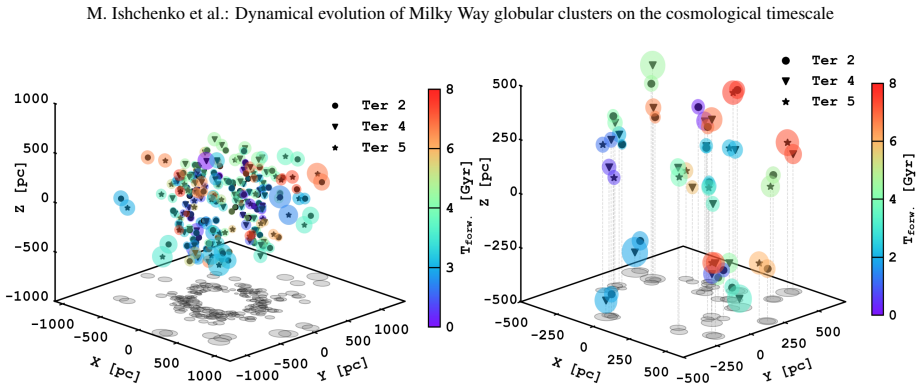
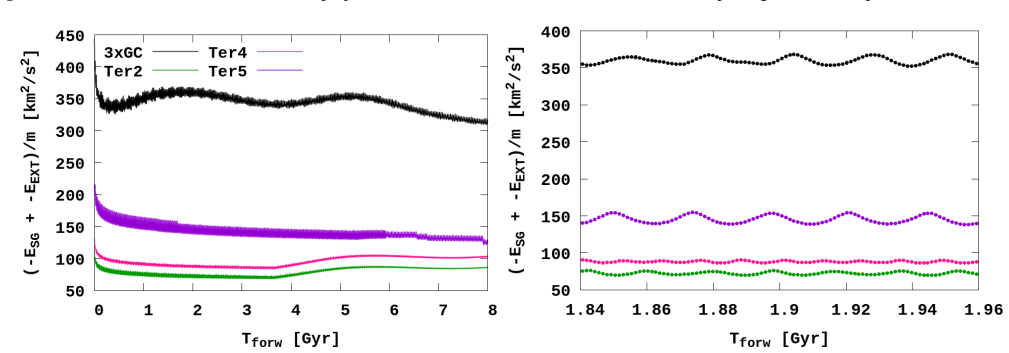
The simulations show that mutual gravitational interactions among the three clusters drive higher mass-loss rates than isolated runs, especially for the low-mass Terzan 2 and Terzan 4 systems. Close encounters occur, including one pair approaching within 10 pc at roughly 320 km/s. The combined system produces clear triaxial deformations that turn nearly spherical clusters into prolate shapes, while isolated clusters remain almost perfectly spherical. These differences confirm that collective interactions matter for mass loss, orbital behavior, and shape evolution in the dense galactic center.
What carries the argument
Direct comparison of high-resolution N-body simulations of isolated clusters versus the full three-cluster system, tracking mass loss, tidal radii, potential energy, orbital paths, and shape evolution inside a realistic Milky Way potential.
If this is right
- Mass loss for low-mass clusters increases when neighboring clusters are included in the model.
- Close passages within 10 pc can occur at high relative speeds and affect cluster structure.
- Clusters develop prolate shapes only when mutual interactions are active.
- Survivability estimates for galactic-center clusters require multi-cluster rather than single-cluster modeling.
- Dynamical evolution within a few kiloparsecs cannot be understood from isolated calculations alone.
Where Pith is reading between the lines
- The same interaction-driven mass loss and shape changes may operate in other dense groups of clusters throughout the galaxy.
- Observed ellipticities or mass deficits in central clusters could serve as indirect records of past encounters.
- Adding more clusters within a 5 kpc radius to future simulations could alter predicted dissolution times for the remaining systems.
- This modeling approach could be tested by comparing simulated orbital distributions against current positions of other Terzan-like objects.
Load-bearing premise
The chosen starting positions, velocities, masses, and the form of the Milky Way gravitational potential correctly represent real conditions for the clusters over the entire 8 Gyr interval.
What would settle it
A measurement showing that Terzan 2, 4, or 5 has lost substantially less mass or remained more spherical than the combined simulation predicts would indicate the interactions are not as influential as modeled.
Figures



read the original abstract
We investigate the long-term dynamical evolution of Ter2, Ter4, and Ter5, focusing on their mutual interactions, mass-loss behaviour, and survivability in the dense Galactic centre environment. We performed a suite of high-resolution direct N-body simulations over 8 Gyr, modelling three individual clusters that we also modelled as combined systems. We compared reference runs of isolated clusters with simulations of the full three-cluster system to quantify possible differences in mass loss, potential energy, and orbital behaviour. Our simulations reveal multiple close encounters between the Terzan clusters. The most significant encounters occur between Ter2-Ter4 and Ter4-Ter5, with their tidal radii exceeding the minimum separation. A notable case is the pair Ter2-Ter4, which approaches within 10 pc at a relative velocity of ~320 km/s. We found that the mass-loss rate is higher for the low-mass Ter2 and Ter4 systems in the combined three-cluster simulations than in our similar isolated runs, highlighting the importance of mutual cluster interactions. The common run clearly demonstrates that mutual gravitational interactions between clusters drive significant triaxial deformations, especially for Ter2 and Ter5, which evolve from nearly spherical to distinctly prolate shapes. In contrast, the isolated runs show clusters that remained almost perfectly spherical, confirming that the observed shape changes are correlated with the mutual interactions. The survivability and dynamical evolution of Galactic centre globular clusters cannot be fully understood without accounting for collective interactions among all systems within a few kiloparsecs. Our results emphasise the necessity of complex multi-cluster modelling in realistic Galactic potentials to capture the long-term fate of surviving and dissolved clusters
Editorial analysis
A structured set of objections, weighed in public.
Referee Report
Summary. The paper reports direct N-body simulations of Terzan 2, 4, and 5 over 8 Gyr, comparing isolated-cluster runs to a combined three-cluster run in a Galactic potential. It finds higher mass-loss rates for the lower-mass clusters and triaxial (prolate) deformations in the combined run, driven by close encounters (notably Ter2-Ter4 at ~10 pc and ~320 km/s), and concludes that collective interactions among clusters within a few kpc are required to understand the dynamical evolution and survivability of Galactic-centre globular clusters.
Significance. If the reported differences are robust, the work provides a concrete demonstration that mutual gravitational encounters can accelerate mass loss and induce shape changes in dense environments, strengthening the case for multi-cluster modelling in Galactic-bulge studies. The direct N-body approach is a strength, as it permits explicit tracking of individual encounters and tidal-radius comparisons without softening approximations or orbit-averaged methods.
major comments (4)
- [Abstract] Abstract and simulation description: no particle number, softening length, or convergence tests with respect to N or softening are reported. Over 8 Gyr, even modest resolution changes can alter close-encounter outcomes and mass-loss rates; without these tests the attribution of differences to physical interactions rather than numerical artifacts remains unverified.
- [Abstract] Abstract: the galactic potential is not specified (analytic form, bulge/bar components, or parameter values), and no sensitivity runs varying the potential are described. Encounter statistics (e.g., the 10 pc Ter2-Ter4 passage) depend sensitively on the inner potential; this is load-bearing for the central claim that collective effects are generic to the Galactic-centre environment.
- [Abstract] Abstract and results: quantitative mass-loss rates, fractional differences, and any error estimates or statistical significance between isolated and combined runs are not provided. The statement that mass loss “is higher” for Ter2 and Ter4 is therefore difficult to evaluate in magnitude or robustness.
- [Abstract] Abstract: initial conditions (masses, half-mass radii, velocities, and orbital parameters for each cluster) are not tabulated or justified with references to observations or uncertainties. Small changes in these parameters can shift encounter timings and strengths over 8 Gyr.
minor comments (2)
- [Abstract] The abstract would benefit from a brief statement of the adopted galactic potential model and the total particle number used in the N-body runs.
- Figure captions (if present) should explicitly label which curves correspond to isolated versus combined runs and indicate the time at which the reported close encounters occur.
Simulated Author's Rebuttal
We thank the referee for the detailed and constructive report. We address each major comment point by point below, indicating where revisions will be made to improve clarity and completeness without altering the core findings.
read point-by-point responses
-
Referee: [Abstract] Abstract and simulation description: no particle number, softening length, or convergence tests with respect to N or softening are reported. Over 8 Gyr, even modest resolution changes can alter close-encounter outcomes and mass-loss rates; without these tests the attribution of differences to physical interactions rather than numerical artifacts remains unverified.
Authors: The particle number and softening length are given in the methods section but were omitted from the abstract. We will revise the abstract to include these values. We did not perform systematic convergence tests varying N and softening across the full 8 Gyr due to computational cost. We will add a methods paragraph justifying the adopted resolution (noting that minimum encounter distances exceed the softening length by orders of magnitude) and explicitly acknowledging the lack of full convergence tests as a limitation. revision: partial
-
Referee: [Abstract] Abstract: the galactic potential is not specified (analytic form, bulge/bar components, or parameter values), and no sensitivity runs varying the potential are described. Encounter statistics (e.g., the 10 pc Ter2-Ter4 passage) depend sensitively on the inner potential; this is load-bearing for the central claim that collective effects are generic to the Galactic-centre environment.
Authors: We agree the abstract should name the potential. The simulations employ a standard analytic Galactic potential with bulge, disk and halo components whose parameters are stated in the methods. We did not run sensitivity experiments with alternate potentials. We will update the abstract to specify the potential and add a brief note that while exact encounter timings are potential-dependent, the occurrence of close passages among clusters within a few kpc is a generic feature of the dense inner Galaxy. revision: partial
-
Referee: [Abstract] Abstract and results: quantitative mass-loss rates, fractional differences, and any error estimates or statistical significance between isolated and combined runs are not provided. The statement that mass loss “is higher” for Ter2 and Ter4 is therefore difficult to evaluate in magnitude or robustness.
Authors: We will expand the abstract and results section to report the actual mass-loss fractions for each cluster in both the isolated and combined runs, together with the relative differences. Because the integrations are deterministic direct N-body calculations, we do not attach statistical error bars or significance tests; the exact percentages will be stated so readers can judge the size of the effect. revision: yes
-
Referee: [Abstract] Abstract: initial conditions (masses, half-mass radii, velocities, and orbital parameters for each cluster) are not tabulated or justified with references to observations or uncertainties. Small changes in these parameters can shift encounter timings and strengths over 8 Gyr.
Authors: We will add a table in the methods section listing the adopted masses, half-mass radii, velocities and orbital elements for Terzan 2, 4 and 5, each accompanied by the observational references used to set them. A short paragraph will discuss the observational uncertainties and their possible influence on encounter statistics. revision: yes
- Full convergence tests varying particle number and softening length over the entire 8 Gyr integration were not performed; such tests cannot be supplied without new, computationally expensive simulations.
Circularity Check
No significant circularity: direct N-body outputs with no reductive derivations
full rationale
The paper consists of high-resolution direct N-body simulations comparing isolated Terzan clusters against a combined three-cluster system over 8 Gyr. All reported differences in mass-loss rates, orbital encounters, and shape evolution (e.g., triaxial deformations) are explicit numerical outputs from the runs, not quantities derived from equations that reduce to the inputs by construction. No fitted parameters are relabeled as predictions, no self-definitional loops appear, and the central claim about collective interactions follows directly from the observed simulation contrasts rather than from any load-bearing self-citation chain or ansatz smuggled via prior work. The study is self-contained against external benchmarks in the sense that its conclusions rest on the computational results themselves.
Axiom & Free-Parameter Ledger
axioms (2)
- standard math Newtonian gravity governs stellar motions inside the clusters and between clusters
- domain assumption The adopted Milky Way potential and initial cluster positions/velocities are accurate over cosmological time
Reference graph
Works this paper leans on
-
[1]
How our proto-nuclear star cluster formed and grew due to early globular cluster disruption: I. Case of low masses. , keywords =. doi:10.1051/0004-6361/202556182 , archivePrefix =. 2601.01867 , primaryClass =
-
[2]
Multiple Stellar Populations in Globular Clusters. , keywords =. doi:10.1146/annurev-astro-081817-051839 , archivePrefix =. 1712.01286 , primaryClass =
-
[3]
What is a globular cluster? An observational perspective. , keywords =. doi:10.1007/s00159-019-0119-3 , archivePrefix =. 1911.02835 , primaryClass =
-
[4]
Simulations of the Hyades. , keywords =. doi:10.1051/0004-6361/201118021 , archivePrefix =. 1110.1274 , primaryClass =
-
[5]
, year = 1943, month = jan, volume =
The Statistics of the Gravitational Field Arising from a Random Distribution of Stars II. , year = 1943, month = jan, volume =. doi:10.1086/144487 , adsurl =
-
[6]
Monthly Notices of the Royal Astronomical Society , author =
Dynamical friction of massive objects in galactic centres. , keywords =. doi:10.1111/j.1365-2966.2010.17711.x , archivePrefix =. 1009.2455 , primaryClass =
-
[7]
Galactic Dynamics: Second Edition
-
[8]
The Statistics of the Gravitational Field Arising from a Random Distribution of Stars. I. The Speed of Fluctuations. , year = 1942, month = may, volume =. doi:10.1086/144420 , adsurl =
-
[9]
Dynamical Friction. I. General Considerations: the Coefficient of Dynamical Friction. , year = 1943, month = mar, volume =. doi:10.1086/144517 , adsurl =
-
[10]
Dynamical Friction. II. The Rate of Escape of Stars from Clusters and the Evidence for the Operation of Dynamical Friction. , year = 1943, month = mar, volume =. doi:10.1086/144518 , adsurl =
-
[11]
Dynamical model of Praesepe and its tidal tails. , keywords =. doi:10.1051/0004-6361/202451650 , archivePrefix =. 2509.24584 , primaryClass =
-
[12]
The structure of star clusters. I. an empirical density law. , year = 1962, month = oct, volume =. doi:10.1086/108756 , adsurl =
-
[13]
The manifest link between Terzan 5 and the Galactic bulge. , keywords =. doi:10.1051/0004-6361/202452110 , archivePrefix =. 2503.17258 , primaryClass =
-
[14]
2016, ARA&A, 54, 529, doi: 10.1146/annurev-astro-081915-023441 Bogd´ an,´A., Forman, W
The Galaxy in Context: Structural, Kinematic, and Integrated Properties. , keywords =. doi:10.1146/annurev-astro-081915-023441 , archivePrefix =. 1602.07702 , primaryClass =
-
[15]
The Size Scale of Star Clusters. , keywords =. doi:10.1088/0004-637X/756/2/167 , archivePrefix =. 1208.0340 , primaryClass =
-
[16]
Astronomy Letters , keywords =
Study of the Influence of an Evolving Galactic Potential on the Orbital Properties of 152 Globular Clusters with Data from the Gaia EDR3 Catalogue. Astronomy Letters , keywords =. doi:10.1134/S106377372107001X , archivePrefix =. 2109.10570 , primaryClass =
-
[17]
Exploring the Sgr-Milky Way-disk Interaction Using High-resolution N-body Simulations. , keywords =. doi:10.3847/1538-4357/ac5021 , archivePrefix =. 2107.08055 , primaryClass =
-
[18]
The Ages of 55 Globular Clusters as Determined Using an Improved V\^HB\_TO Method along with Color-Magnitude Diagram Constraints, and Their Implications for Broader Issues. , keywords =. doi:10.1088/0004-637X/775/2/134 , archivePrefix =. 1308.2257 , primaryClass =
-
[19]
Inferring the age of the universe with globular clusters. , keywords =. doi:10.1088/1475-7516/2020/12/002 , archivePrefix =. 2007.06594 , primaryClass =
-
[20]
The ACS Survey of Galactic Globular Clusters. VII. Relative Ages. , keywords =. doi:10.1088/0004-637X/694/2/1498 , archivePrefix =. 0812.4541 , primaryClass =
-
[21]
A Catalog of Globular Cluster Systems: What Determines the Size of a Galaxy's Globular Cluster Population?. , keywords =. doi:10.1088/0004-637X/772/2/82 , archivePrefix =. 1306.2247 , primaryClass =
-
[22]
On a Hermite Integrator with Ahmad-Cohen Scheme for Gravitational Many-Body Problems. , keywords =
-
[23]
, year = 1997, month = dec, volume = 490, pages =
A Universal Density Profile from Hierarchical Clustering. , keywords =. doi:10.1086/304888 , archivePrefix =. astro-ph/9611107 , primaryClass =
-
[24]
On N-body simulations of globular cluster streams. , keywords =. doi:10.1093/mnras/stab886 , archivePrefix =. 2101.12201 , primaryClass =
-
[25]
Structural Parameters of Thin and Thick Disks in Edge-on Disk Galaxies. , keywords =. doi:10.1086/497970 , archivePrefix =. astro-ph/0508460 , primaryClass =
-
[26]
The Astrophysical Journal Supplement Series , author =
galpy: A python Library for Galactic Dynamics. , keywords =. doi:10.1088/0067-0049/216/2/29 , archivePrefix =. 1412.3451 , primaryClass =
-
[27]
Made-to-measure modelling of observed galaxy dynamics. , keywords =. doi:10.1093/mnras/stx2402 , archivePrefix =. 1704.03884 , primaryClass =
-
[28]
Six New Galactic Orbits of Globular Clusters in a Milky Way-Like Galaxy. , keywords =. doi:10.1086/524982 , archivePrefix =. 0710.5526 , primaryClass =
-
[29]
Space Velocities of Southern Globular Clusters. VI. Nine Clusters in the Inner Milky Way. , keywords =. doi:10.1088/0004-6256/140/5/1282 , archivePrefix =. 1008.4545 , primaryClass =
-
[30]
Mergers, tidal interactions, and mass exchange in a population of disc globular clusters. , keywords =. doi:10.1051/0004-6361/201833534 , archivePrefix =. 1809.04350 , primaryClass =
-
[31]
Gravitational interactions between globular and open clusters: an introduction. , keywords =. doi:10.1007/s10509-013-1635-7 , archivePrefix =. 1309.3138 , primaryClass =
-
[32]
No globular cluster progenitors in Milky Way satellite galaxies. , keywords =. doi:10.1093/mnras/stac2578 , archivePrefix =. 2106.09419 , primaryClass =
-
[33]
The ellipticities of Galactic and Large Magellanic Cloud globular clusters. , keywords =. doi:10.1093/mnras/286.3.L39 , archivePrefix =. astro-ph/9702024 , primaryClass =
-
[34]
Understanding the dynamical state of globular clusters: core-collapsed versus non-core-collapsed. , keywords =. doi:10.1093/mnras/sts464 , archivePrefix =. 1207.3063 , primaryClass =
-
[35]
The multiple stellar populations of globular clusters in Early-type galaxies. SF2A-2018: Proceedings of the Annual meeting of the French Society of Astronomy and Astrophysics , year = 2018, editor =
work page 2018
-
[36]
The internal rotation of globular clusters revealed by Gaia DR2. , keywords =. doi:10.1093/mnras/sty2365 , archivePrefix =. 1806.02580 , primaryClass =
-
[37]
Central Rotations of Milky Way Globular Clusters. , keywords =. doi:10.1088/2041-8205/787/2/L26 , archivePrefix =. 1405.1722 , primaryClass =
-
[38]
Discovery of rotation axis alignments in Milky Way globular clusters. , keywords =. doi:10.1051/0004-6361/202038494 , archivePrefix =. 2006.06708 , primaryClass =
-
[39]
The effects of dwarf galaxies on the orbital evolution of galactic globular clusters. , keywords =. doi:10.1093/mnras/staa2773 , archivePrefix =. 2007.13752 , primaryClass =
-
[40]
Up to 700k GPU cores, Kepler, and the Exascale future for simulations of star clusters around black holes. Third International Conference on High Performance Computing, HPC-UA 2013 , year = 2013, archivePrefix = "arXiv", eprint =
work page 2013
-
[41]
Reddening distance modulus and age of the globular cluster NGC 6121 (M4) from the properties of RR Lyrae variables. , keywords =
-
[42]
Star Clusters: From the Milky Way to the Early Universe , year = 2020, editor =
Hunting for Globular Clusters in the early universe. Star Clusters: From the Milky Way to the Early Universe , year = 2020, editor =. doi:10.1017/S1743921319006914 , adsurl =
-
[43]
Advances in Astronomy and Space Physics , keywords =
Kinematic characteristics of the Milky Way globular clusters based on Gaia DR2 data. Advances in Astronomy and Space Physics , keywords =. doi:10.17721/2227-1481.18-24 , archivePrefix =. 2201.07221 , primaryClass =
-
[44]
Milky Way globular clusters on cosmological timescales. I. Evolution of the orbital parameters in time-varying potentials. , keywords =. doi:10.1051/0004-6361/202245117 , archivePrefix =. 2304.03547 , primaryClass =
-
[45]
Milky Way globular clusters on cosmological timescales. II. Interaction with the Galactic centre. , keywords =. doi:10.1051/0004-6361/202245753 , archivePrefix =. 2304.02311 , primaryClass =
-
[46]
Milky Way globular clusters on cosmological timescales. III. Interaction rates. , keywords =. doi:10.1051/0004-6361/202346553 , archivePrefix =. 2308.12699 , primaryClass =
-
[47]
The first three minutes: a modern view of the origin of the universe
-
[48]
Kinematics and Physics of Celestial Bodies , year = 2023, month = jan, volume = 39, pages =
Statistical analysis of the probability of globular clusters interactions with each other and with the Galactic Centre according to Gaia DR2 data on the cosmological time scale. Kinematics and Physics of Celestial Bodies , year = 2023, month = jan, volume = 39, pages =
work page 2023
-
[49]
Inspection of 19 globular cluster candidates in the Galactic bulge with the VVV survey. , keywords =. doi:10.1051/0004-6361/202141819 , archivePrefix =. 2111.08317 , primaryClass =
-
[50]
The Orbits of 48 Globular Clusters in a Milky Way-like Barred Galaxy. , keywords =. doi:10.1086/508676 , archivePrefix =. astro-ph/0609357 , primaryClass =
-
[51]
Mean proper motions, space orbits, and velocity dispersion profiles of Galactic globular clusters derived from Gaia DR2 data. , keywords =. doi:10.1093/mnras/sty2997 , archivePrefix =. 1811.01507 , primaryClass =
-
[52]
High performance massively parallel direct N-body simulations on large GPU clusters. International conference on High Performance Computing, HPC-UA 2011 , year = "2011", month = "Oct", pages =
work page 2011
-
[53]
Kinematics of globular clusters and dwarf galaxies around the Milky Way
Gaia Data Release 2. Kinematics of globular clusters and dwarf galaxies around the Milky Way. , keywords =. doi:10.1051/0004-6361/201832698 , archivePrefix =. 1804.09381 , primaryClass =
-
[54]
Destruction of the Galactic Globular Cluster System. , keywords =. doi:10.1086/303441 , archivePrefix =. astro-ph/9603042 , primaryClass =
-
[55]
A geometric distance measurement to the Galactic center black hole with 0.3\. , keywords =. doi:10.1051/0004-6361/201935656 , archivePrefix =. 1904.05721 , primaryClass =
-
[56]
Performance analysis of direct N-body algorithms on special-purpose supercomputers. , keywords =. doi:10.1016/j.newast.2006.11.003 , archivePrefix =. astro-ph/0608125 , primaryClass =
-
[57]
Reports of National Academy of Sciences of the Republic of Kazakhstan , keywords =
Milky Way Globular Clusters: close encounter rates with each other and with the Central Supermassive Black Hole. Reports of National Academy of Sciences of the Republic of Kazakhstan , keywords =. doi:10.32014/2021.2518-1483.116 , archivePrefix =. 2201.06891 , primaryClass =
-
[58]
Calculating Galactic Space Velocities and Their Uncertainties, with an Application to the Ursa Major Group. , keywords =. doi:10.1086/114370 , adsurl =
-
[59]
Direct N-body simulation of the Galactic centre. , keywords =. doi:10.1093/mnras/stz208 , archivePrefix =. 1805.02153 , primaryClass =
-
[60]
New Horizons in Galactic Center Astronomy and Beyond , year = 2021, editor =
Origin of the X-ray Excess in the Galactic Centre. New Horizons in Galactic Center Astronomy and Beyond , year = 2021, editor =
work page 2021
-
[61]
Coevolution (Or Not) of Supermassive Black Holes and Host Galaxies: Supplemental Material. arXiv e-prints , keywords =
-
[62]
Measuring Distance and Properties of the Milky Way's Central Supermassive Black Hole with Stellar Orbits. , keywords =. doi:10.1086/592738 , archivePrefix =. 0808.2870 , primaryClass =
-
[63]
, archivePrefix = "arXiv", eprint =
An Update on Monitoring Stellar Orbits in the Galactic Center. , keywords =. doi:10.3847/1538-4357/aa5c41 , archivePrefix =. 1611.09144 , primaryClass =
-
[64]
Star-disc interaction in galactic nuclei: orbits and rates of accreted stars. , keywords =. doi:10.1093/mnras/stw908 , archivePrefix =. 1604.05309 , primaryClass =
-
[65]
The Galactic Center massive black hole and nuclear star cluster. Reviews of Modern Physics , keywords =. doi:10.1103/RevModPhys.82.3121 , archivePrefix =. 1006.0064 , primaryClass =
-
[66]
Star-disc interaction in galactic nuclei: formation of a central stellar disc. , keywords =. doi:10.1093/mnras/sty459 , archivePrefix =. 1802.03027 , primaryClass =
-
[67]
Vertical waves in the solar neighbourhood in Gaia DR2. , keywords =. doi:10.1093/mnras/sty2813 , archivePrefix =. 1809.03507 , primaryClass =
-
[68]
The Proper Motion of Sagittarius A*. II. The Mass of Sagittarius A*. , keywords =. doi:10.1086/424960 , archivePrefix =. astro-ph/0408107 , primaryClass =
-
[69]
Dynamical Inference in the Milky Way
-
[70]
Summary of the contents and survey properties (Corrigendum)
Gaia Early Data Release 3. Summary of the contents and survey properties (Corrigendum). , keywords =. doi:10.1051/0004-6361/202039657e , adsurl =
-
[71]
Monthly Notices of the Royal Astronomical Society , author =
Accurate distances to Galactic globular clusters through a combination of Gaia EDR3, HST, and literature data. , keywords =. doi:10.1093/mnras/stab1474 , archivePrefix =. 2105.09526 , primaryClass =
-
[72]
Enhanced Accretion Rates of Stars on Supermassive Black Holes by Star-Disk Interactions in Galactic Nuclei. , keywords =. doi:10.1088/0004-637X/758/1/51 , archivePrefix =. 1208.4954 , primaryClass =
-
[73]
Global survey of star clusters in the Milky Way. II. The catalogue of basic parameters. , keywords =. doi:10.1051/0004-6361/201322302 , archivePrefix =. 1308.5822 , primaryClass =
-
[74]
Kraken reveals itself - the merger history of the Milky Way reconstructed with the E-MOSAICS simulations. , keywords =. doi:10.1093/mnras/staa2452 , archivePrefix =. 2003.01119 , primaryClass =
-
[75]
Le c ons sur l’integration et la recherche des fonctions primitives
-
[76]
Interaction of Recoiling Supermassive Black Holes with Stars in Galactic Nuclei. , keywords =. doi:10.1088/0004-637X/748/1/65 , archivePrefix =. 1201.3407 , primaryClass =
-
[77]
Supermassive black holes coalescence mediated by massive perturbers: implications for gravitational waves emission and nuclear cluster formation. , keywords =. doi:10.1093/mnras/sty3458 , archivePrefix =. 1712.05810 , primaryClass =
-
[78]
2018, MNRAS, 480, 5113, doi: 10.1093/mnras/sty2206
First results from the IllustrisTNG simulations: radio haloes and magnetic fields. , keywords =. doi:10.1093/mnras/sty2206 , archivePrefix =. 1707.03396 , primaryClass =
-
[79]
Cosmological Insights into the Early Accretion of r-process-enhanced Stars. I. A Comprehensive Chemodynamical Analysis of LAMOST J1109+0754. , keywords =. doi:10.3847/1538-4357/abbc13 , archivePrefix =. 2009.12142 , primaryClass =
-
[80]
Mass-loss from massive globular clusters in tidal fields. , keywords =. doi:10.1093/mnras/stab649 , archivePrefix =. 2006.01960 , primaryClass =
discussion (0)
Sign in with ORCID, Apple, or X to comment. Anyone can read and Pith papers without signing in.