Recognition: 2 theorem links
· Lean TheoremNoncollinear antiferromagnetic structure and physical properties of CrRhAs with distorted kagome lattice
Pith reviewed 2026-05-11 03:03 UTC · model grok-4.3
The pith
CrRhAs has a noncollinear antiferromagnetic order on its distorted kagome lattice with propagation vector (1/3, 1/3, 1/2) unlike theoretical predictions.
A machine-rendered reading of the paper's core claim, the machinery that carries it, and where it could break.
Core claim
CrRhAs is an antiferromagnet below 149 K whose magnetic structure, determined by powder neutron diffraction, is noncollinear with propagation vector k = (1/3, 1/3, 1/2) and features ferromagnetic second-nearest-neighbor interactions in the kagome plane, differing from density functional theory predictions; its transport properties suggest multiband conduction and strong spin fluctuations in this strongly correlated system.
What carries the argument
The noncollinear antiferromagnetic structure with propagation vector k = (1/3, 1/3, 1/2) on the distorted Cr kagome lattice, as revealed by neutron diffraction.
Load-bearing premise
The interpretation of the transport anomalies as arising from multiband effects and strong spin fluctuations, as opposed to sample impurities or other extrinsic factors.
What would settle it
A single-crystal neutron diffraction experiment that either confirms the propagation vector k = (1/3, 1/3, 1/2) and the noncollinear spin arrangement or reveals a different magnetic structure.
Figures


read the original abstract
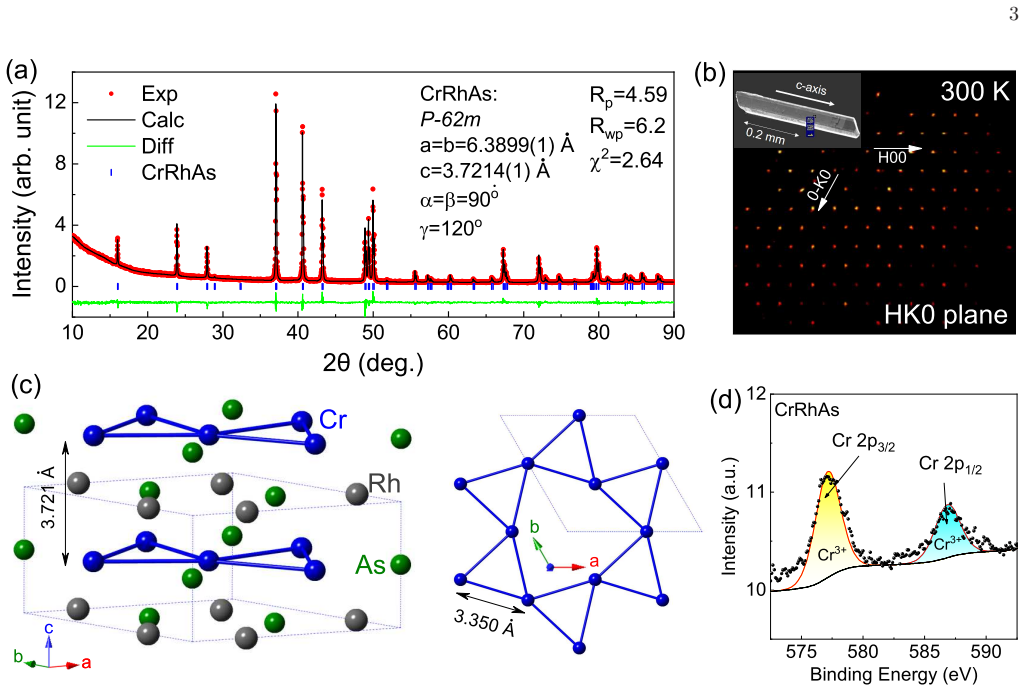
CrRhAs was theoretically proposed to be a kagome metal with unusual magnetic ground states; however, little is known about its magnetic structure and physical properties experimentally. Here, we present an experimental investigation of CrRhAs with ZrNiAl-type structure and a distorted Cr kagome lattice. CrRhAs is an antiferromagnet with TN = 149 K. Powder neutron diffraction analysis reveals a noncollinear antiferromagnetic structure with propagation vector k = (1/3, 1/3, 1/2), which features a ferromagnetic second nearest neighbor coupling in the kagome plane that is different from the prediction in previous density functional theory calculations. Furthermore, CrRhAs exhibits anomalous electrical transport properties which are possibly related to multiband effects and strong spin fluctuations. For the temperature-dependent longitudinal resistivity \r{ho}xx, it is semiconductinglike above TN and becomes metallic below TN . The Hall coefficients exhibit two sign changes near 70 and 300 K. Combined with the results of heat capacity measurements, a large Kadowaki-Woods ratio {\alpha} = 33.9 {\mu}{\Omega} cm mol2 K2/J2 is obtained. The above results suggest CrRhAs is a strongly correlated kagome metal with multiband and noncollinear magnetic structure features.
Editorial analysis
A structured set of objections, weighed in public.
Referee Report
Summary. The manuscript experimentally characterizes CrRhAs, which adopts the ZrNiAl-type structure featuring a distorted Cr kagome lattice. It reports an antiferromagnetic transition at TN = 149 K. Powder neutron diffraction determines a noncollinear antiferromagnetic structure with propagation vector k = (1/3, 1/3, 1/2) that exhibits ferromagnetic second-nearest-neighbor coupling within the kagome plane, differing from prior DFT predictions. Transport measurements reveal a semiconducting-to-metallic crossover in longitudinal resistivity below TN, two sign changes in the Hall coefficient (near 70 K and 300 K), and a large Kadowaki-Woods ratio of 33.9 μΩ cm mol² K²/J², which the authors attribute to multiband effects and strong spin fluctuations in a correlated kagome metal.
Significance. If the magnetic structure is robustly determined, the work is significant for providing the first experimental benchmark of the magnetic ground state in CrRhAs, directly challenging existing DFT calculations on kagome antiferromagnets and supplying concrete input for refined theoretical models. The complementary transport and thermodynamic data add context on correlated behavior in this distorted kagome system. Standard techniques (neutron diffraction, resistivity, Hall effect, heat capacity) are employed appropriately, with the experimental focus on falsifiable structural claims representing a strength.
major comments (1)
- [Powder neutron diffraction analysis] Powder neutron diffraction analysis: The refined noncollinear structure with k = (1/3, 1/3, 1/2) must report the Cr magnetic moment magnitudes and directions together with their uncertainties, plus the magnetic R-factor or χ² for the fit, to substantiate the claimed ferromagnetic second nearest neighbor coupling and to allow evaluation of model uniqueness.
minor comments (3)
- [Abstract] Abstract: Quantitative details such as magnetic moment sizes, error bars on TN, or fit quality metrics are absent, which reduces the standalone informativeness of the summary.
- [Transport properties] Transport discussion: The semiconducting-to-metallic crossover and Hall sign changes would benefit from explicit temperature/field ranges and raw data presentation to clarify the multiband interpretation.
- [Figures and notation] Notation and presentation: The resistivity symbol appears as a LaTeX artifact (e.g., “r{ho}xx”); ensure consistent, readable notation throughout and include error bars on all plotted data points.
Simulated Author's Rebuttal
We thank the referee for the positive evaluation of our manuscript and the constructive comment on the neutron diffraction analysis. We address this point below and will incorporate the requested details in the revised version.
read point-by-point responses
-
Referee: Powder neutron diffraction analysis: The refined noncollinear structure with k = (1/3, 1/3, 1/2) must report the Cr magnetic moment magnitudes and directions together with their uncertainties, plus the magnetic R-factor or χ² for the fit, to substantiate the claimed ferromagnetic second nearest neighbor coupling and to allow evaluation of model uniqueness.
Authors: We agree that these quantitative details are necessary for a complete and transparent presentation of the magnetic structure refinement. In the revised manuscript, we will include the refined Cr magnetic moment magnitudes and directions (with uncertainties) obtained from the powder neutron diffraction data, along with the magnetic R-factor (or χ² value) for the fit. These additions will allow readers to evaluate the quality of the refinement and the robustness of the claimed ferromagnetic second-nearest-neighbor coupling within the kagome plane. revision: yes
Circularity Check
No significant circularity; purely experimental determination
full rationale
The paper reports experimental measurements of magnetic structure via powder neutron diffraction and transport properties. The noncollinear antiferromagnetic order with k = (1/3, 1/3, 1/2) is obtained by direct indexing and Rietveld refinement of diffraction peaks on the ZrNiAl-type lattice; no theoretical derivation or ansatz is introduced that reduces to fitted inputs or prior self-citations. The noted difference from earlier DFT calculations is an external comparison, not an internal loop. Transport observations (resistivity crossover, Hall sign changes, Kadowaki-Woods ratio) are presented as measured data with cautious interpretation and do not rely on any self-definitional or load-bearing self-citation chain. The study is self-contained against external benchmarks with no reduction of claims to their own inputs.
Axiom & Free-Parameter Ledger
axioms (2)
- domain assumption Magnetic structures can be reliably refined from powder neutron diffraction data using standard symmetry analysis and propagation vector determination.
- domain assumption A large Kadowaki-Woods ratio signals strong electron correlations in metallic systems.
Lean theorems connected to this paper
-
IndisputableMonolith/Foundation/RealityFromDistinction.leanreality_from_one_distinction unclear?
unclearRelation between the paper passage and the cited Recognition theorem.
Powder neutron diffraction analysis reveals a noncollinear antiferromagnetic structure with propagation vector k = (1/3, 1/3, 1/2), which features a ferromagnetic second nearest neighbor coupling in the kagome plane that is different from the prediction in previous density functional theory calculations.
-
IndisputableMonolith/Cost/FunctionalEquation.leanwashburn_uniqueness_aczel unclear?
unclearRelation between the paper passage and the cited Recognition theorem.
a large Kadowaki-Woods ratio α = 33.9 µΩ cm mol² K²/J² is obtained
What do these tags mean?
- matches
- The paper's claim is directly supported by a theorem in the formal canon.
- supports
- The theorem supports part of the paper's argument, but the paper may add assumptions or extra steps.
- extends
- The paper goes beyond the formal theorem; the theorem is a base layer rather than the whole result.
- uses
- The paper appears to rely on the theorem as machinery.
- contradicts
- The paper's claim conflicts with a theorem or certificate in the canon.
- unclear
- Pith found a possible connection, but the passage is too broad, indirect, or ambiguous to say the theorem truly supports the claim.
Reference graph
Works this paper leans on
-
[1]
The dominant ∼ T2 dependence indicates either electron-electron or electron-magnon in- teractions
0358(2) µ Ω cm/K 2 . The dominant ∼ T2 dependence indicates either electron-electron or electron-magnon in- teractions. Fig. 4(b) presents the magnetoresistance (MR) data and MR is defined as [ ρ(B) - ρ(B = 0)]/ ρ(B = 0). Over- all, MR is quite weak at all temperatures and its max- imum value is lower than 0.4% at 14 T and 2 K. The main feature is that MR ...
-
[2]
2117 mJ mol − 1 K− 2 and γ = 32.8mJ mol − 1 K− 2 for sample 2)
5 mJ mol − 1 K− 2 for sample 1, β = 0 . 2117 mJ mol − 1 K− 2 and γ = 32.8mJ mol − 1 K− 2 for sample 2). The Debye temperature is estimated to be 136.7 K for sample 1 and 145.2 K for sample 2. The obtained electronic specific heat coefficient γ up to 32.8 mJ mol − 1 K− 2 is a very large value comparing with conventional metal. Both γ and the coefficient A in th...
-
[3]
J.-X. Yin, B. Lian, and M. Z. Hasan, Topological kagome magnets and superconductors, Nature 612, 647 (2022)
work page 2022
-
[4]
S. D. Wilson and B. R. Ortiz, A V 3Sb5 kagome supercon- ductors, Nature Reviews Materials 9, 420 (2024)
work page 2024
-
[5]
H. Li, T. T. Zhang, T. Yilmaz, Y. Y. Pai, C. E. Marvin- ney, A. Said, Q. W. Yin, C. S. Gong, Z. J. Tu, E. Vescovo, C. S. Nelson, R. G. Moore, S. Murakami, H. C. Lei, H. N. Lee, B. J. Lawrie, and H. Miao, Observation of uncon- ventional charge density wave without acoustic phonon anomaly in kagome superconductors A V 3Sb5(A = Rb, Cs), Phys. Rev. X 11, 0310...
work page 2021
-
[6]
Y.-X. Jiang, J.-X. Yin, M. M. Denner, N. Shumiya, B. R. Ortiz, G. Xu, Z. Guguchia, J. He, M. S. Hossain, X. Liu, J. Ruff, L. Kautzsch, S. S. Zhang, G. Chang, I. Belopol- ski, Q. Zhang, T. A. Cochran, D. Multer, M. Litskevich, Z.-J. Cheng, X. P. Yang, Z. Wang, R. Thomale, T. Ne- upert, S. D. Wilson, and M. Z. Hasan, Unconventional chiral charge order in kag...
work page 2021
-
[7]
H. W. S. Arachchige, W. R. Meier, M. Marshall, T. Matsuoka, R. Xue, M. A. McGuire, R. P. Hermann, H. Cao, and D. Mandrus, Charge den- sity wave in kagome lattice intermetallic ScV 6Sn6, Phys. Rev. Lett. 129, 216402 (2022)
work page 2022
-
[8]
X. Teng, L. Chen, F. Ye, E. Rosenberg, Z. Liu, J.-X. Yin, Y.-X. Jiang, J. S. Oh, M. Z. Hasan, K. J. Neubauer, B. Gao, Y. Xie, M. Hashimoto, D. Lu, C. Jozwiak, A. Bostwick, E. Rotenberg, R. J. Birgeneau, J.-H. Chu, M. Yi, and P. Dai, Discovery of charge density wave in a kagome lattice antiferromagnet, Nature 609, 490 (2022)
work page 2022
-
[9]
J.-X. Yin, W. Ma, T. A. Cochran, X. Xu, S. S. Zhang, H.-J. Tien, N. Shumiya, G. Cheng, K. Jiang, B. Lian, Z. Song, G. Chang, I. Belopolski, D. Mul- ter, M. Litskevich, Z.-J. Cheng, X. P. Yang, B. Swi- dler, H. Zhou, H. Lin, T. Neupert, Z. Wang, N. Yao, T.-R. Chang, S. Jia, and M. Zahid Hasan, Quantum- limit chern topological magnetism in TbMn 6Sn6, Nature...
work page 2020
-
[10]
F. Pollmann, P. Fulde, and K. Shtengel, Ki- netic ferromagnetism on a kagome lattice, Phys. Rev. Lett. 100, 136404 (2008)
work page 2008
- [11]
-
[12]
S. Nakatsuji, N. Kiyohara, and T. Higo, Large anomalous Hall effect in a non-collinear antiferromagnet at room temperature, Nature 527, 212 (2015)
work page 2015
-
[13]
Q. Wang, K. J. Neubauer, C. Duan, Q. Yin, S. Fu- jitsu, H. Hosono, F. Ye, R. Zhang, S. Chi, K. Krycka, H. Lei, and P. Dai, Field-induced topological hall ef- fect and double-fan spin structure with a c-axis compo- nent in the metallic kagome antiferromagnetic compound YMn6Sn6, Phys. Rev. B 103, 014416 (2021)
work page 2021
-
[14]
Q. Du, Z. Hu, M.-G. Han, F. Camino, Y. Zhu, and C. Petrovic, Topological hall ef- fect anisotropy in kagome bilayer metal Fe 3Sn2, Phys. Rev. Lett. 129, 236601 (2022)
work page 2022
-
[15]
Y. Tao, L. Daemen, Y. Cheng, J. C. Neue- feind, and D. Louca, Investigating the magnetoelas- tic properties in fesn and Fe 3Sn2 flat band metals, Phys. Rev. B 107, 174407 (2023)
work page 2023
-
[16]
K. Kuroda, T. Tomita, M.-T. Suzuki, C. Bareille, A. A. Nugroho, P. Goswami, M. Ochi, M. Ikhlas, M. Nakayama, S. Akebi, R. Noguchi, R. Ishii, N. In- ami, K. Ono, H. Kumigashira, A. Varykhalov, T. Muro, T. Koretsune, R. Arita, S. Shin, T. Kondo, and S. Nakat- suji, Evidence for magnetic Weyl fermions in a correlated metal, Nature Materials 16, 1090 (2017)
work page 2017
-
[17]
L. Zhou, F. Yang, S. Zhang, and T. Zhang, Chemical Rules for Stacked Kagome and Honeycomb Topological Semimetals, Advanced Materials 36, 2309803 (2024)
work page 2024
-
[18]
E. Morosan, S. Bud’ko, P. Canfield, M. Torikachvili, and A. Lacerda, Thermodynamic and transport properties of RAgGe (R=Tb–Lu) single crystals, Journal of Magnetism and Magnetic Materials 277, 298 (2004)
work page 2004
-
[19]
K. Zhao, H. Deng, H. Chen, K. A. Ross, V. Va- clav Petˇ r ´ ıˇ cek, G¨ unther, M. Russina, V. Hutanu, and P. Gegenwart, Realization of the kagome spin ice state in a frustrated intermetallic compound, Science 367, 1218 (2020)
work page 2020
-
[20]
K. Zhao, Y. Tokiwa, H. Chen, and P. Gegenwart, Discrete degeneracies distinguished by the anoma- lous Hall effect in a metallic kagome ice compound, Nature Physics 20, 442 (2024)
work page 2024
- [21]
- [22]
-
[23]
J.-K. Bao, D. E. Bugaris, H. Zheng, D. Y. Chung, and M. G. Kanatzidis, A Noncentrosymmetric Polymorph of LuRuGe, Inorganic Chemistry 60, 7827 (2021)
work page 2021
-
[24]
E. Morosan, S. L. Bud’ko, and P. C. Canfield, Angular-dependent planar metamagnetism in the hexagonal compounds TbPtIn and TmAgGe, Phys. Rev. B 71, 014445 (2005) . 9
work page 2005
- [25]
- [26]
-
[27]
W. Wu, W. J. Guo, P. Zheng, Z. Li, G. Li, and J. L. Luo, Field-induced metamagnetism tran- sition with anisotropic magnetoresistance in he- lical magnetic order on MnRuP single crystals, Phys. Rev. Res. 5, 043133 (2023)
work page 2023
- [28]
-
[29]
Y. N. Huang, H. O. Jeschke, and I. I. Mazin, CrRhAs: a member of a large family of metallic kagome antiferro- magnets, npj Quantum Materials 8, 32 (2023)
work page 2023
-
[30]
S. Ohta, T. Kanomata, and T. Kaneko, Mag- netic properties of CrRhAs and CrRuAs, Journal of Magnetism and Magnetic Materials 90–91, 171 (1990)
work page 1990
-
[31]
P. Cheng, H. Zhang, W. Bao, A. Schneidewind, P. Link, A. Gr¨ unwald, R. Georgii, L. Hao, and Y. Liu, Design of the cold neutron triple-axis spec- trometer at the China Advanced Research Reactor, Nuclear Instruments and Methods in Physics Research Sectio n A: Accelerators, Spectrometers, Detectors and Associate d Equipment 821
-
[32]
T. Kanomata, T. Kawashima, H. Utsugi, T. Goto, H. Hasegawa, and T. Kaneko, Mag- netic properties of the intermetallic compounds M M′(M=Cr, Mn, M ′=Ru, Rh, Pd, and X=P, As), Journal of Applied Physics 69, 4639 (1991)
work page 1991
- [33]
-
[34]
M. I. Aroyo, J. M. Perez-Mato, C. Capillas, E. Kroumova, S. Ivantchev, G. Madariaga, A. Kirov, and H. Wondratschek, Bilbao crystallographic server: I. databases and crystallographic computing programs, Zeitschrift f¨ ur Kristallographie-Crystalline Materials 221, 15 (2006)
work page 2006
-
[35]
E. Yi, D. F. Zheng, F. Pan, H. Zhang, B. Wang, B. Chen, D. Wu, H. Liang, Z. X. Mei, H. Wu, S. A. Yang, P. Cheng, M. Wang, and B. Shen, Topological hall ef- fect driven by short-range magnetic order in EuZn 2As2, Phys. Rev. B 107, 035142 (2023)
work page 2023
- [36]
-
[37]
B. Shi, Y. Geng, H. Wang, J. Yang, C. Shang, M. Wang, S. Mi, J. Huang, F. Pan, X. Gui, J. Wang, J. Liu, D. Xu, H. Zhang, J. Qin, H. Wang, L. Hao, M. Tian, Z. Cheng, G. Zheng, and P. Cheng, FePd 2Te2: An anisotropic two- dimensional ferromagnet with one-dimensional fe chains, Journal of the American Chemical Society 146, 21546 (2024)
work page 2024
-
[38]
A. B. Pippard, Magnetoresistance in Metals (Cambridge Uni versity Press, Cambridge, 1989)
work page 1989
-
[39]
J. M. Ziman, Electrons and Phonons the Theory of Trans- port Phenomena in Solids (Oxford University Press, Ox- ford, 1960)
work page 1960
-
[40]
Q. Yin, Z. Tu, C. Gong, Y. Fu, S. Yan, and H. Lei, Superconductivity and Normal-State Prop- erties of Kagome Metal RbV 3Sb5 Single Crystals, Chinese Physics Letters 38, 037403 (2021)
work page 2021
-
[41]
E. Mun, H. Ko, G. J. Miller, G. D. Samolyuk, S. L. Bud’ko, and P. C. Canfield, Magnetic field effects on transport properties of PtSn 4, Phys. Rev. B 85, 035135 (2012)
work page 2012
-
[42]
B. Lau, Anomalous Electronic Transport in the Hexag- onal Ternary Arsenides FeCrAs, CrNiAs, and CrPdAs , Ph.D. thesis
-
[43]
A. C. Jacko, J. O. Fjærestad, and B. J. Powell, A uni- fied explanation of the Kadowaki–Woods ratio in strongly correlated metals, Nature Physics 5, 422 (2009)
work page 2009
-
[44]
Z. Wang, M. Huang, J. Zhao, C. Chen, H. Huang, X. Wang, P. Liu, J. Wang, J. Xiang, C. Feng, Z. Zhang, X. Cui, Y. Lu, S. A. Yang, and B. Xiang, Fermi liq- uid behavior and colossal magnetoresistance in layered MoOCl2, Phys. Rev. Mater. 4, 041001 (2020)
work page 2020
-
[45]
F. L. Ruta, Y. Shao, S. Acharya, A. Mu, N. H. Jo, S. H. Ryu, D. Balatsky, Y. Su, D. Pashov, B. S. Y. Kim, M. I. Katsnelson, J. G. Analytis, E. Rotenberg, A. J. Millis, M. van Schilfgaarde, and D. N. Basov, Good plasmons in a bad metal, Science 387, 786 (2025)
work page 2025
-
[46]
O. Trovarelli, C. Geibel, R. Cardoso, S. Mederle, R. Borth, B. Buschinger, F. M. Grosche, Y. Grin, G. Sparn, and F. Steglich, Low-temperature properties of the Yb-based heavy-fermion antiferromagnets YbPtIn, YbRhSn, and YbNiGa, Phys. Rev. B 61, 9467 (2000)
work page 2000
-
[47]
S. L. Bud’ko, E. Morosan, and P. C. Canfield, Magnetic field induced non-fermi-liquid behavior in YbAgGe single crystals, Phys. Rev. B 69, 014415 (2004)
work page 2004
-
[48]
A. C. V, A. Ptok, P. Sobieszczyk, G. Vaitheeswaran, and V. Kanchana, Correlation stabilized ferro- magnetic MnRuAs with distorted kagome lattice, Physical Review B 111, 035125 (2025)
work page 2025
discussion (0)
Sign in with ORCID, Apple, or X to comment. Anyone can read and Pith papers without signing in.