Recognition: no theorem link
Distributionally Robust Data-Driven Predictive Control for Stochastic LTI Systems
Pith reviewed 2026-05-11 02:08 UTC · model grok-4.3
The pith
A distributionally robust framework uses one offline trajectory to guarantee bounds on expected cost and output constraints for unknown stochastic disturbances in linear systems.
A machine-rendered reading of the paper's core claim, the machinery that carries it, and where it could break.
Core claim
We propose a distributionally robust data-driven predictive control framework for stochastic linear time-invariant systems with unknown dynamics and disturbance distributions. We use an offline trajectory to fit the subspace predictive control (SPC) predictor via least squares and construct an empirical distribution of the prediction residuals as a proxy for the unknown disturbance distribution. We then center a Wasserstein ambiguity set around this estimate and minimize the worst-case expected cost while enforcing probabilistic output constraint satisfaction over all distributions in the set. The resulting problem admits a tractable reformulation with an equivalent direct data-driven form,
What carries the argument
Wasserstein ambiguity set centered at the empirical distribution of prediction residuals from least-squares fitting of the subspace predictive control predictor on offline data, enabling the tractable direct data-driven reformulation of the robust optimization.
If this is right
- The optimization can be solved in a direct data-driven manner without identifying the underlying system matrices.
- The chosen Wasserstein radius ensures high-probability bounds on the true expected cost and satisfaction of output constraints for the actual disturbance distribution.
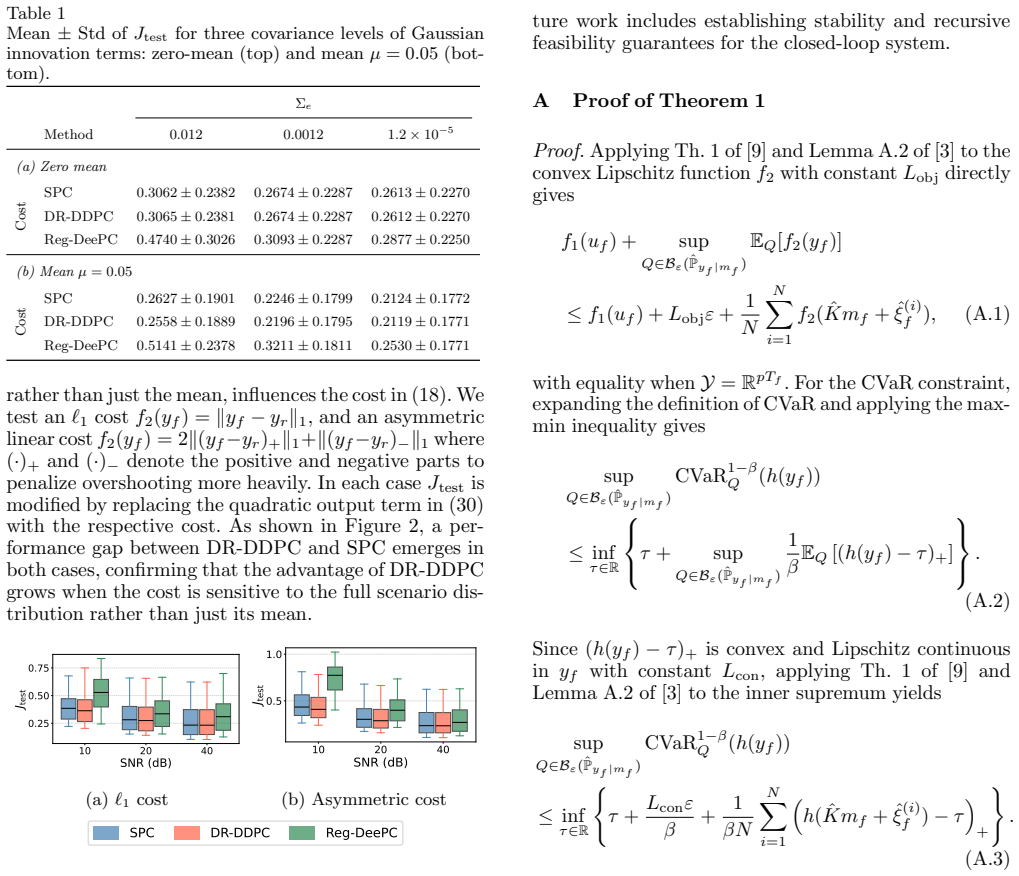
- The framework applies under different cost functions and various disturbance conditions as shown by numerical simulations.
- Probabilistic constraints on system outputs are satisfied robustly over the entire ambiguity set.
Where Pith is reading between the lines
- The direct data-driven form may reduce the need for separate identification steps in related predictive control schemes.
- Similar residual-based ambiguity sets could support robustness analysis in other data-driven methods that produce prediction errors.
- The radius selection rule offers a concrete way to adjust conservatism as more offline data becomes available.
Load-bearing premise
The empirical distribution of prediction residuals from a single offline trajectory is a sufficiently representative proxy for the unknown disturbance distribution so that the finite-sample concentration inequalities yield a valid Wasserstein radius.
What would settle it
A closed-loop experiment under a known disturbance distribution whose Wasserstein distance to the empirical residual distribution exceeds the selected radius, in which the realized expected cost exceeds the optimized objective or output constraints are violated, would disprove the high-probability guarantee.
Figures

read the original abstract
We propose a distributionally robust data-driven predictive control framework for stochastic linear time-invariant systems with unknown dynamics and disturbance distributions. We use an offline trajectory to fit the subspace predictive control (SPC) predictor via least squares and construct an empirical distribution of the prediction residuals as a proxy for the unknown disturbance distribution. We then center a Wasserstein ambiguity set around this estimate and minimize the worst-case expected cost while enforcing probabilistic output constraint satisfaction over all distributions in the set. The resulting problem admits a tractable reformulation with an equivalent direct data-driven form, eliminating the need for explicit predictor identification. Using finite-sample concentration results, we provide a data-driven Wasserstein radius such that, with high probability, the true expected cost is bounded above by the tractable objective and output constraints are satisfied with respect to the true disturbance distribution. Numerical simulations validate the framework against existing methods under various disturbance conditions and cost functions.
Editorial analysis
A structured set of objections, weighed in public.
Referee Report
Summary. The paper proposes a distributionally robust data-driven predictive control framework for stochastic LTI systems with unknown dynamics and disturbance distributions. It fits the subspace predictive control (SPC) predictor via least squares on an offline trajectory, constructs an empirical distribution of prediction residuals as a proxy for the unknown disturbance distribution, and centers a Wasserstein ambiguity set around this estimate. The control problem minimizes the worst-case expected cost while enforcing probabilistic output constraint satisfaction over the ambiguity set. The resulting problem admits a tractable reformulation with an equivalent direct data-driven form. Finite-sample concentration results are invoked to select a data-driven Wasserstein radius guaranteeing that, with high probability, the true expected cost is bounded by the tractable objective and output constraints hold w.r.t. the true disturbance distribution.
Significance. If the finite-sample guarantees hold after accounting for dependence in the residuals, the work would provide a practical bridge between data-driven predictive control and distributionally robust optimization, with the direct data-driven reformulation and explicit finite-sample bounds as clear strengths that support implementation without full system identification.
major comments (2)
- [Section deriving the data-driven Wasserstein radius and finite-sample guarantees] The central finite-sample guarantee (the data-driven Wasserstein radius selection and associated high-probability bounds on expected cost and output constraints) applies standard concentration inequalities to the empirical distribution of prediction residuals obtained after least-squares fitting of the SPC predictor on a single offline trajectory. These inequalities typically require i.i.d. draws independent of the center and exactly from the target distribution, but the residuals here are post-estimation quantities from the same data, inducing dependence and possible bias not addressed by a modified bound or citation in the manuscript. This directly undermines the high-probability claims.
- [Section on tractable reformulation and direct data-driven form] The equivalence of the tractable reformulation to the original distributionally robust problem (including translation of the Wasserstein worst-case expectation and output constraints into direct data-driven form) requires explicit verification that the least-squares fitting step and multi-step prediction structure of the LTI system do not introduce additional conservatism or invalidate the reformulation steps.
minor comments (2)
- [Abstract and Introduction] The abstract and introduction could more explicitly state the assumptions on the disturbance process (e.g., stationarity, independence from inputs) to clarify applicability of the concentration results.
- [Numerical simulations] In the numerical simulations, include sensitivity plots or tables showing performance variation with the chosen Wasserstein radius to illustrate robustness of the data-driven selection.
Simulated Author's Rebuttal
We thank the referee for the insightful comments on our manuscript. The points raised regarding the finite-sample guarantees and the tractable reformulation are important, and we address them point by point below. We plan to incorporate revisions to strengthen the presentation and address the concerns.
read point-by-point responses
-
Referee: [Section deriving the data-driven Wasserstein radius and finite-sample guarantees] The central finite-sample guarantee (the data-driven Wasserstein radius selection and associated high-probability bounds on expected cost and output constraints) applies standard concentration inequalities to the empirical distribution of prediction residuals obtained after least-squares fitting of the SPC predictor on a single offline trajectory. These inequalities typically require i.i.d. draws independent of the center and exactly from the target distribution, but the residuals here are post-estimation quantities from the same data, inducing dependence and possible bias not addressed by a modified bound or citation in the manuscript. This directly undermines the high-probability claims.
Authors: We agree that the prediction residuals are dependent due to the least-squares fitting on the same data. This is a valid observation. To address it, we will revise the manuscript to include a discussion on this dependence and provide a modified finite-sample bound that accounts for the estimation error in the SPC predictor. Specifically, we can use results from time-series analysis or add a term bounding the difference between the empirical residual distribution and the true one, ensuring the high-probability claims hold with an adjusted radius. We will cite relevant literature on concentration for dependent samples. revision: yes
-
Referee: [Section on tractable reformulation and direct data-driven form] The equivalence of the tractable reformulation to the original distributionally robust problem (including translation of the Wasserstein worst-case expectation and output constraints into direct data-driven form) requires explicit verification that the least-squares fitting step and multi-step prediction structure of the LTI system do not introduce additional conservatism or invalidate the reformulation steps.
Authors: The tractable reformulation is derived by substituting the data-driven predictor and expressing the worst-case expectation directly in terms of the data matrices, preserving equivalence. However, to make this explicit, we will add a detailed step-by-step verification in the supplementary material or an appendix, showing that the least-squares fitting does not introduce extra conservatism beyond the distributional robustness, and that the multi-step predictions are handled correctly via the subspace structure without invalidating the reformulation. This will confirm the direct data-driven form is equivalent. revision: yes
Circularity Check
No significant circularity; derivation uses external concentration inequalities and algebraic reformulation
full rationale
The paper fits an SPC predictor via least squares on an offline trajectory and builds an empirical residual distribution, then centers a Wasserstein ball whose radius is set via cited finite-sample concentration results (external to the optimization). The tractable reformulation is presented as an algebraic equivalence that eliminates explicit model identification, not as a re-derivation of the fitted quantities themselves. No step reduces the claimed guarantee or objective to a fitted parameter by construction, and no self-citation chain is load-bearing for the central result. The derivation remains self-contained against the stated external inequalities and data-driven equivalence.
Axiom & Free-Parameter Ledger
axioms (2)
- domain assumption The system is linear time-invariant and the disturbance is stationary.
- standard math Finite-sample concentration inequalities for Wasserstein distance apply to the empirical residual distribution.
Reference graph
Works this paper leans on
-
[1]
M¨ uller, and Frank Allg¨ ower
Julian Berberich, Johannes K¨ ohler, Matthias A. M¨ uller, and Frank Allg¨ ower. Data-driven model predictive control with stability and robustness guarantees.IEEE Transactions on Automatic Control, 66(4):1702–1717, 2021
work page 2021
-
[2]
Valentina Breschi, Alessandro Chiuso, and Simone Formentin. Data-driven predictive control in a stochastic setting: a unified framework.Automatica, 152:110961, 2023
work page 2023
-
[3]
Jeremy Coulson, John Lygeros, and Florian D¨ orfler. Distributionally robust chance constrained data-enabled predictive control.IEEE Transactions on Automatic Control, 67(7):3289–3304, 2022
work page 2022
-
[4]
Data- enabled predictive control: In the shallows of the deepc
Jeremy Coulson, John Lygeros, and Florian D¨ orfler. Data- enabled predictive control: In the shallows of the deepc. In 2019 18th European Control Conference (ECC), pages 307– 312, 2019
work page 2019
-
[5]
Florian D¨ orfler, Jeremy Coulson, and Ivan Markovsky. Bridging direct and indirect data-driven control formulations via regularizations and relaxations.IEEE Transactions on Automatic Control, 68(2):883–897, 2023
work page 2023
-
[6]
Peyman Mohajerin Esfahani and Daniel Kuhn. Data-driven distributionally robust optimization using the wasserstein metric: performance guarantees and tractable reformulations. Mathematical Programming, 171:115 – 166, 2015
work page 2015
-
[7]
Spc: Subspace predictive control.IF AC Proceedings Volumes, 32(2):4004–4009, 1999
Wouter Favoreel, Bart De Moor, and Michel Gevers. Spc: Subspace predictive control.IF AC Proceedings Volumes, 32(2):4004–4009, 1999. 14th IFAC World Congress 1999, Beijing, Chia, 5-9 July
work page 1999
-
[8]
On the rate of convergence in wasserstein distance of the empirical measure
Nicolas Fournier and Arnaud Guillin. On the rate of convergence in wasserstein distance of the empirical measure. Probability Theory and Related Fields, 162:707 – 738, 2013
work page 2013
- [9]
-
[10]
Central limit theorem for m- dependent random variables under sub-linear expectations
Wangyun Gu and Lixu Zhang. Central limit theorem for m- dependent random variables under sub-linear expectations. 2023
work page 2023
- [11]
-
[12]
Data- driven distributionally robust mpc for systems with uncertain dynamics
Francesco Micheli, Tyler Summers, and John Lygeros. Data- driven distributionally robust mpc for systems with uncertain dynamics. In2022 IEEE 61st Conference on Decision and Control (CDC), pages 4788–4793, 2022
work page 2022
-
[13]
Arkadi Nemirovski and Alexander Shapiro. Convex approximations of chance constrained programs.SIAM Journal on Optimization, 17(4):969–996, 2007
work page 2007
-
[14]
Guanru Pan, Ruchuan Ou, and Timm Faulwasser. On a stochastic fundamental lemma and its use for data-driven optimal control.IEEE Transactions on Automatic Control, 68(10):5922–5937, 2023
work page 2023
-
[15]
Malika Sader, Yibo Wang, Dexian Huang, Chao Shang, and Biao Huang. Causality-informed data-driven predictive control.IEEE Transactions on Control Systems Technology, 33(5):1921–1928, 2025
work page 1921
-
[16]
Johannes Teutsch, Sebastian Kerz, Dirk Wollherr, and Marion Leibold. Sampling-based stochastic data-driven predictive control under data uncertainty.IEEE Transactions on Automatic Control, 71(3):1924–1931, 2026
work page 1924
-
[17]
A note on persistency of excitation
Jan C Willems, Paolo Rapisarda, Ivan Markovsky, and Bart LM De Moor. A note on persistency of excitation. Systems & Control Letters, 54(4):325–329, 2005. 8
work page 2005
discussion (0)
Sign in with ORCID, Apple, or X to comment. Anyone can read and Pith papers without signing in.