Recognition: 2 theorem links
· Lean TheoremStationary solutions to the spherically symmetric compressible fluid with capillarity effect
Pith reviewed 2026-05-11 01:58 UTC · model grok-4.3
The pith
Small boundary data guarantee a unique smooth stationary solution to the spherically symmetric NSK system on exterior domains, with explicit decay rates.
A machine-rendered reading of the paper's core claim, the machinery that carries it, and where it could break.
Core claim
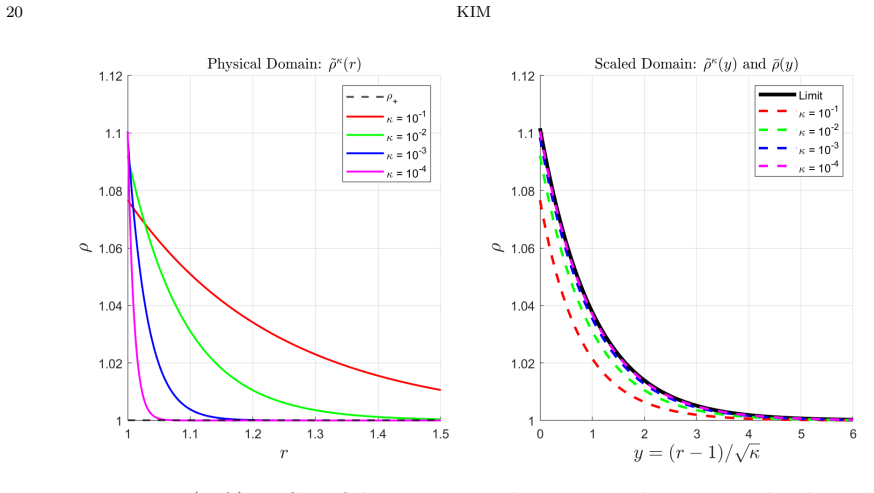
If the boundary data are sufficiently small, there exists a unique smooth stationary solution to the spherically symmetric NSK system with impermeable wall, inflow, and outflow boundary conditions. The stationary solution for the impermeable wall problem exponentially decays to the far-field states, while that of the inflow/outflow problem algebraically decays. The stationary solution for the impermeable wall problem converges to the Navier-Stokes stationary solution as the capillarity coefficient vanishes, and numerical tests show the theoretical convergence rate is optimal.
What carries the argument
The reduction of the NSK system to a system of ordinary differential equations under spherical symmetry, combined with perturbative a priori estimates that close under smallness of the boundary data, yielding existence, uniqueness, and decay via energy methods or weighted inequalities.
Load-bearing premise
The boundary data are sufficiently small in a suitable norm, allowing the estimates to close and produce both existence and uniqueness.
What would settle it
An explicit choice of boundary data whose size exceeds the implicit smallness threshold, together with a proof or numerical demonstration that no smooth stationary solution exists or that at least two distinct solutions exist, would falsify the central claim.
Figures


read the original abstract
We consider the spherically symmetric Navier--Stokes--Korteweg (NSK) system on the exterior domain $\Omega=\{x\in\mathbb{R}^n~|~|x|>1\}$ with $n\ge2$ when the boundary and far-field data are given. We show that, if the boundary data are sufficiently small, then there exists a unique smooth stationary solution to the spherically symmetric NSK system with impermeable wall, inflow, and outflow boundary conditions. We also establish the decay rate of the stationary solutions. Precisely, the stationary solution for the impermeable wall problem exponentially decays to the far-field states, while that of the inflow/outflow problem algebraically decays. Finally, we investigate the asymptotic convergences of the stationary solution for the impermeable wall problem as the capillarity coefficient vanishes. Numerical results validate that our theoretical convergence rate of the stationary solution is optimal.
Editorial analysis
A structured set of objections, weighed in public.
Referee Report
Summary. The paper establishes an existence-uniqueness theorem for smooth stationary solutions of the spherically symmetric compressible Navier-Stokes-Korteweg system on the exterior domain |x|>1 (n≥2). Under sufficiently small boundary and far-field data, unique solutions exist for impermeable-wall, inflow, and outflow boundary conditions. The solutions decay exponentially (impermeable wall) or algebraically (inflow/outflow) to the far-field state. For the impermeable-wall case the authors further prove convergence of the stationary solutions to the corresponding Navier-Stokes stationary solution as the capillarity coefficient κ→0, with the rate shown to be optimal by numerical experiments.
Significance. If the small-data threshold is independent of κ (or admits a positive lower bound), the result supplies a rigorous justification for the vanishing-capillarity limit of stationary capillary fluids in spherical symmetry, together with explicit decay rates. This is relevant to the mathematical theory of diffuse-interface models and their hydrodynamic limits. The combination of analytic existence, decay estimates, and numerical validation of the convergence rate is a concrete contribution.
major comments (2)
- [Theorem 1.1 and Section 5] Theorem 1.1 (or the main existence statement): the smallness assumption on the boundary data is stated without an explicit dependence on the capillarity coefficient κ. For the asymptotic convergence result as κ→0 (Section 5 or the final theorem), it is necessary to show that the admissible radius δ(κ) satisfies inf_κ δ(κ)>0 or at least δ(κ)≳κ^α for some α; otherwise the fixed positive data used in the limit may eventually lie outside the existence ball for small κ. The manuscript should supply the dependence of the smallness constant on κ (or prove a uniform lower bound) to make the convergence statement rigorous.
- [Section 3 (stationary reduction) and Section 5 (asymptotics)] The reduced radial stationary system (after spherical symmetry and mass conservation forcing u≡0 for the impermeable case) becomes a fourth-order elliptic equation balancing pressure gradient and capillary stress. The fixed-point or implicit-function argument used to obtain existence must be checked for uniformity in κ; if the contraction constant or the radius of the ball in the function space deteriorates as κ→0, the claimed convergence may fail for any fixed positive data size.
minor comments (2)
- [Abstract and Section 5] The abstract claims the convergence rate is 'optimal' on the basis of numerics; the manuscript should state the precise rate (e.g., O(κ) or O(√κ)) that is proved analytically and confirm that the numerical test matches this rate rather than a faster one.
- [Section 2] Notation for the far-field density and velocity should be introduced once and used consistently; several places appear to switch between ρ_∞ and ρ̄ without explicit redefinition.
Simulated Author's Rebuttal
We thank the referee for the detailed and constructive report. The comments correctly identify the need for explicit uniformity with respect to the capillarity coefficient κ in both the existence statement and the vanishing-capillarity analysis. We address each major comment below and will revise the manuscript to supply the required estimates and clarifications.
read point-by-point responses
-
Referee: Theorem 1.1 and Section 5: the smallness assumption on the boundary data is stated without an explicit dependence on the capillarity coefficient κ. For the asymptotic convergence result as κ→0 (Section 5 or the final theorem), it is necessary to show that the admissible radius δ(κ) satisfies inf_κ δ(κ)>0 or at least δ(κ)≳κ^α for some α; otherwise the fixed positive data used in the limit may eventually lie outside the existence ball for small κ. The manuscript should supply the dependence of the smallness constant on κ (or prove a uniform lower bound) to make the convergence statement rigorous.
Authors: We agree that an explicit uniform lower bound on the admissible data size is required to justify the limit κ→0 for fixed positive boundary data. In the proof of Theorem 1.1 the smallness threshold δ arises from a contraction-mapping argument in a weighted Sobolev space whose norms are independent of κ. Re-inspection of the estimates shows that the capillary contribution improves the control of the nonlinear terms sufficiently that δ can be chosen independent of κ (specifically, δ ≤ δ0 where δ0 depends only on n, γ and the far-field density). We will add a short lemma (new Lemma 2.3) that extracts this uniform bound from the existing a priori estimates and states explicitly that inf_{κ>0} δ(κ) ≥ δ0 > 0. With this addition the convergence theorem in Section 5 applies to any fixed data smaller than δ0, rendering the statement rigorous. revision: yes
-
Referee: Section 3 (stationary reduction) and Section 5 (asymptotics): The reduced radial stationary system (after spherical symmetry and mass conservation forcing u≡0 for the impermeable case) becomes a fourth-order elliptic equation balancing pressure gradient and capillary stress. The fixed-point or implicit-function argument used to obtain existence must be checked for uniformity in κ; if the contraction constant or the radius of the ball in the function space deteriorates as κ→0, the claimed convergence may fail for any fixed positive data size.
Authors: We concur that uniformity of the fixed-point argument must be verified. The map is defined on a ball of radius Cδ in a κ-independent space (weighted H^3 ∩ L^∞ with spherical weights). The Lipschitz constant of the nonlinear operator is bounded by a quantity of the form C(n,γ)δ, where the constant C arises from Sobolev embeddings and the structure of the pressure and capillary stress; the κ-dependent term appears only linearly and is absorbed into the principal part without affecting the contraction threshold. We will insert the explicit calculation of this Lipschitz constant (showing it remains ≤ 1/2 uniformly for all κ ∈ (0,1]) into the revised Section 3. Should any hidden κ-dependence appear upon re-derivation, we will adjust the radius of the ball accordingly while keeping it bounded away from zero. revision: partial
Circularity Check
Pure mathematical existence proof with no circularity in derivation chain
full rationale
The paper is a self-contained analytical existence/uniqueness proof for stationary solutions of the spherically symmetric NSK system under an explicit smallness assumption on boundary data. The derivation proceeds via standard ODE reduction, fixed-point or implicit-function arguments, and energy estimates that close for sufficiently small data; no step defines a quantity in terms of its own output, renames a fitted parameter as a prediction, or invokes a load-bearing self-citation whose content is itself unverified or constructed from the present result. The asymptotic analysis as κ→0 is performed inside the same framework without reducing the central claim to a prior self-result by construction. The smallness threshold is an input hypothesis, not an output derived circularly from the solutions themselves.
Axiom & Free-Parameter Ledger
axioms (1)
- standard math Standard function-space setting and regularity assumptions for solutions of the stationary NSK equations (e.g., appropriate Sobolev or Hölder spaces).
Lean theorems connected to this paper
-
IndisputableMonolith/Cost/FunctionalEquation.leanwashburn_uniqueness_aczel unclearWe show that, if the boundary data are sufficiently small, then there exists a unique smooth stationary solution... via the integral equation ϕ=ϕ_b + (1/κ)∫G(r,s)N(ϕ(s))s^{n-1}ds and contraction in X_σ
-
IndisputableMonolith/Foundation/AlphaCoordinateFixation.leanalpha_pin_under_high_calibration unclearVanishing capillarity limit: ∥ρ̃_κ−ρ_+∥_{L^2_r}≤Cκ^{3/4} obtained from energy identity after multiplying by ϕ_κ and integration by parts
Reference graph
Works this paper leans on
-
[1]
F. Charve and B. Haspot,Existence of a global strong solution and vanishing capillarity-viscosity limit in one dimension for the Korteweg system, SIAM J. Math. Anal.,45(2013), 469-494
work page 2013
-
[2]
Z. Chen,Asymptotic stability of strong rarefaction waves for the compressible fluid models of Korteweg type, J. Math. Anal. Appl.,394(2012), 438–448
work page 2012
-
[3]
Z. Chen, L. He, and H. Zhao,Nonlinear stability of traveling wave solutions for the compressible fluid models of Korteweg type, J. Math. Anal. Appl.,422(2015), 1213–1234
work page 2015
-
[4]
R. Danchin and B. Desjardins,Existence of solutions for compressible fluid models of Korteweg type, Ann. Inst. Henri Poincar´ e,18(2001), 97–133
work page 2001
-
[5]
J. E. Dunn and J. Serrin,On the thermomechanics of interstitial working, Arch. Rational Mech. Anal.,88(1985), 95–133
work page 1985
- [6]
-
[7]
R. Follino, C. Lattanzio, and R. G. Plaza,Existence and spectral stability analysis of viscous-dispersive shock profiles for isentropic compressible fluid of Korteweg type, Stud. Appl. Math.,156(2026), e70210
work page 2026
-
[8]
R. Follino, R. G. Plaza, and D. Zhelyazov,Spectral stability of weak dispersive shock profiles for quantum hydro- dynamics with nonlinear viscosity, J. Differential Equations,359(2023), 330–364
work page 2023
-
[9]
P. Germain and P. LeFloch,Finite energy method for compressible fluids: the Navier–Stokes–Korteweg model, Commun. Pure Appl. Math.,69(2016), 3–61
work page 2016
-
[10]
Haspot,Existence of global weak solution for compressible fluid models of Korteweg type, J
B. Haspot,Existence of global weak solution for compressible fluid models of Korteweg type, J. Math. Fluid Mech., 13(2011), 223–249
work page 2011
-
[11]
Haspot,Global strong solution for Korteweg system with quantum pressure in dimensionN≥2, Math
B. Haspot,Global strong solution for Korteweg system with quantum pressure in dimensionN≥2, Math. Ann., 367(2017), 667–700. 22 KIM
work page 2017
- [12]
-
[13]
H. Hattori and D. Li,Global solutions of a high dimensional system for Korteweg materials, J. Math. Anal. Appl.,198(1996), 84–97
work page 1996
- [14]
- [15]
-
[16]
I. Hashimoto and A. Matsumura,Existence of radially symmetric stationary solutions for the compressible Navier–Stokes equation, Methods App. Anal.28(2021), 299–311
work page 2021
-
[17]
I. Hashimoto and A. Matsumura,Inviscid limit problem of radially symmetric stationary solutions for compress- ible Navier–Stokes equation, Commun. Math. Phys.,405(2024), article number 220
work page 2024
-
[18]
I. Hashimoto and A. Matsumura,Existence of radially symmetric stationary solutions for viscous and heat- conductive ideal gas, arXiv preprint arXiv:2507.04234
-
[19]
Y. Huang and S. Nishibata,Large-time behaviour of the spherically symmetric solution to an outflow problem for isentropic model of compressible viscous fluid, arXiv preprint arXiv:2308.10206
-
[20]
I. Hashimoto, S. Nishibata, and S. Sugizaki,Asymptotic behavior of spherically symmetric solutions to the compressible Navier–Stokes equations towards stationary waves, J. Math. Fluid Mech.26(2024), article number 54
work page 2024
-
[21]
S. Jiang,Global spherically symmetric solutions to the equations of a viscous polytropic ideal gas in an exterior domain, Commun. Math. Phys.,178(1996), 339–374
work page 1996
-
[22]
J¨ ungel,Global weak solutions to compressible Navier–Stokes equations for quantum fluids, SIAM J
A. J¨ ungel,Global weak solutions to compressible Navier–Stokes equations for quantum fluids, SIAM J. Math. Anal.,42(2010), 1025–1045
work page 2010
-
[23]
D. J. Korteweg, Sur la forme que prennent les ´ equations du mouvements des fluides si l’on tient compte des forces capillaires caus´ ees par des variations de densit´ e consid´ erables mais connues et sur la th´ eorie de la capillarit´ e dans l’hypoth` ese d’une variation continue de la densit´ e, Arch. Neerl. Sci. Exact. Nat.,6(1901), 1–24
work page 1901
-
[24]
I. Lacroix-Violet and A. Vasseur,Global weak solutions to the compressible quantum Navier–Stokes equation and its semi-classical limit, J. Math. Pures Appl.,114(2018), 191–210
work page 2018
-
[25]
T. Nakamura and S. Nishibata,Large-time behavior of spherically symmetric flow of heat conductive gas in a field of potential forces, Indiana Univ. Math. J.,57(2008) 1019–1054
work page 2008
-
[26]
T. Nakamura, S. Nishibata, and S. Yanagi,Large-time behavior of spherically symmetric solutions to an isentropic model of compressible viscous fluid in a field of potential forces, Math. Models Methods App. Sci.,14(2004) 1849–1879
work page 2004
-
[27]
J. D. van der Waals,Thermodynamische theorie der kapillarit¨ at unter voraussetzung stetiger diche¨ anderung, Z. Phys. Chem.,13(1894), 657–725. (Jeongho Kim) Department of Applied Mathematics, Kyung Hee University, 1732, Deogyeong-daero, Giheung-gu, Yongin-si, Gyeonggi-do 17104, Republic of Korea Email address:jeonghokim@khu.ac.kr
discussion (0)
Sign in with ORCID, Apple, or X to comment. Anyone can read and Pith papers without signing in.