Recognition: no theorem link
Inference Time Causal Probing in LLMs
Pith reviewed 2026-05-11 01:49 UTC · model grok-4.3
The pith
HDMI steers hidden states in LLMs with a margin objective to deliver more reliable causal interventions than probe-based methods.
A machine-rendered reading of the paper's core claim, the machinery that carries it, and where it could break.
Core claim
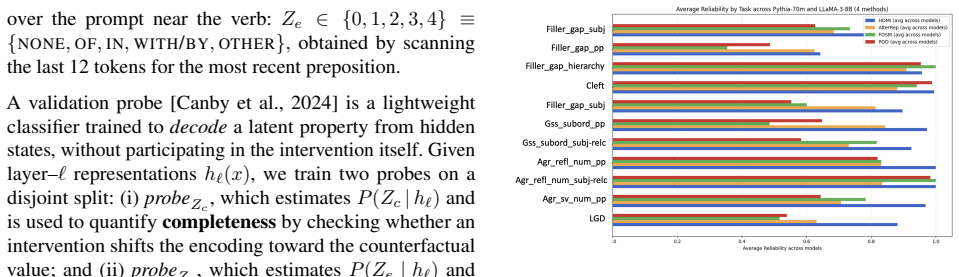
The paper establishes that HDMI, by directly optimizing a margin objective on hidden states to favor target outputs over source outputs via the LLM's own predictive distribution, produces interventions with higher reliability—defined as the harmonic mean of completeness and selectivity—than methods that rely on trained probe classifiers, as demonstrated on the LGD agreement corpus and CausalGym benchmark for Meta-Llama-3-8B-Instruct and Pythia-70M; a lookahead extension further enables controlled text editing while preserving fluency.
What carries the argument
Hidden-state Driven Margin Intervention (HDMI): a probe-free gradient method that applies a margin loss directly to hidden states using the model's native output probabilities to steer a targeted property.
Load-bearing premise
That directly optimizing a margin objective on hidden states using the model's native output will change the targeted property as intended while preserving selectivity and fluency without introducing new misalignments.
What would settle it
Running HDMI on the LGD agreement corpus or CausalGym benchmark for Meta-Llama-3-8B-Instruct or Pythia-70M and observing that its harmonic mean of completeness and selectivity is not higher than the scores of prior probe-based methods.
Figures


read the original abstract
Causal probing methods aim to test and control how internal representations influence the behavior of generative models. In causal probing, an intervention modifies hidden states so that a property takes on a different value. Most existing approaches define such interventions by training an auxiliary probe classifier, which ties the method to a specific task or model and risks misalignment with the model's predictive geometry. We propose Hidden-state Driven Margin Intervention (HDMI), a probe-free, gradient-based technique that directly steers hidden states using the model's native output. HDMI applies a margin objective that increases the probability of a target continuation while decreasing that of the source, without relying on probe classifiers. We further introduce a lookahead variant (LA-HDMI) for text editing that backpropagates through the softmax embeddings, modifying the current hidden state so that the likelihood of user-specified tokens increases in next token generations while preserving fluency. To evaluate interventions, we measure completeness (whether the targeted property changes as intended) and selectivity (whether unrelated properties are preserved), and report their harmonic mean as an overall measure of reliability. HDMI consistently achieves higher reliability than prior methods on the LGD agreement corpus and the CausalGym benchmark, across Meta-Llama-3-8B-Instruct, and Pythia-70M.
Editorial analysis
A structured set of objections, weighed in public.
Referee Report
Summary. The paper introduces Hidden-state Driven Margin Intervention (HDMI), a probe-free causal probing technique for LLMs that directly optimizes a margin objective on the model's native next-token probabilities to modify hidden states, increasing the likelihood of target continuations while decreasing source ones. A lookahead variant (LA-HDMI) is proposed for text editing by backpropagating through softmax embeddings. Interventions are evaluated via completeness (intended property change) and selectivity (preservation of unrelated properties), with reliability as their harmonic mean. The central empirical claim is that HDMI and LA-HDMI achieve higher reliability than prior probe-based methods on the LGD agreement corpus and CausalGym benchmark, demonstrated across Meta-Llama-3-8B-Instruct and Pythia-70M.
Significance. If the evaluation metrics are shown to be independent of the optimization objective, the probe-free design using native model outputs would represent a meaningful advance in causal intervention methods, reducing reliance on auxiliary classifiers that may misalign with the model's geometry. The approach could enable more generalizable control over internal representations while preserving fluency, with potential implications for interpretability and editing in generative models. The use of standard benchmarks and multiple model scales is a positive aspect for comparability.
major comments (2)
- [Evaluation section] Evaluation section (likely §4 or §5): The abstract and method description define completeness as whether the targeted property changes as intended, but provide no explicit formula or protocol for measuring it independently of the margin objective's probability shifts. If completeness is scored using the same next-token probability changes optimized by HDMI (or generations resulting directly from the intervention), the reliability metric becomes circular by construction, as successful optimization will register high completeness tautologically. This undermines the claim of superior reliability over probe-based baselines, which use separate classifiers for evaluation. Please provide the precise definition of completeness (e.g., via equation or pseudocode) and confirm it relies on an auxiliary, non-optimized measure such as held-out behavioral tests or independent probes.
- [§3 (Method)] §3 (Method) and experiments: The weakest assumption—that direct margin optimization on hidden states alters the intended causal property without introducing new misalignments—is not sufficiently tested. The paper should include ablations or controls showing that selectivity on unrelated properties is preserved beyond superficial checks, and that downstream behavior changes are attributable to the targeted property rather than side effects in representation space. Without this, the higher reliability on LGD and CausalGym may not generalize.
minor comments (2)
- [Abstract] Abstract: The phrasing 'across Meta-Llama-3-8B-Instruct, and Pythia-70M' contains a grammatical error (extra comma); correct to 'across Meta-Llama-3-8B-Instruct and Pythia-70M'.
- [Experiments] The manuscript should include quantitative results, error bars, statistical significance tests, and full experimental protocol details (e.g., number of runs, hyperparameter choices) in the main text or appendix to support the reliability claims, as these are absent from the abstract.
Simulated Author's Rebuttal
Thank you for the constructive feedback on our manuscript. We address each major comment below, clarifying the evaluation protocol and committing to additional empirical controls where appropriate.
read point-by-point responses
-
Referee: [Evaluation section] Evaluation section (likely §4 or §5): The abstract and method description define completeness as whether the targeted property changes as intended, but provide no explicit formula or protocol for measuring it independently of the margin objective's probability shifts. If completeness is scored using the same next-token probability changes optimized by HDMI (or generations resulting directly from the intervention), the reliability metric becomes circular by construction, as successful optimization will register high completeness tautologically. This undermines the claim of superior reliability over probe-based baselines, which use separate classifiers for evaluation. Please provide the precise definition of completeness (e.g., via equation or pseudocode) and confirm it relies on an auxiliary, non-optimized measure such as held-out behavioral tests or independent probe
Authors: We appreciate the referee's concern regarding potential circularity. Completeness is measured via the benchmark-specific protocols on held-out test sets: for LGD, this is the change in agreement label on unseen examples (independent of the exact source/target token probabilities optimized by the margin loss); for CausalGym, it follows the benchmark's predefined behavioral tests for the target property. The margin objective only shapes the immediate next-token distribution during intervention, while completeness evaluates the resulting property shift through these separate metrics. We will add an explicit equation and pseudocode in the revised §4 to formalize this distinction and confirm reliance on auxiliary, non-optimized measures. revision: yes
-
Referee: [§3 (Method)] §3 (Method) and experiments: The weakest assumption—that direct margin optimization on hidden states alters the intended causal property without introducing new misalignments—is not sufficiently tested. The paper should include ablations or controls showing that selectivity on unrelated properties is preserved beyond superficial checks, and that downstream behavior changes are attributable to the targeted property rather than side effects in representation space. Without this, the higher reliability on LGD and CausalGym may not generalize.
Authors: We agree that stronger controls would better substantiate the core assumption. The current selectivity results are computed on the benchmarks' unrelated properties, but we will add ablations in the revision: (1) measuring preservation of additional unrelated attributes via auxiliary classifiers, (2) intervening on non-causal dimensions as a control, and (3) verifying that downstream changes track the targeted property rather than diffuse representation shifts. These will be reported alongside the existing reliability numbers to address generalizability. revision: yes
Circularity Check
No significant circularity; method and evaluation defined independently
full rationale
The HDMI intervention is defined directly via a margin objective on the model's native next-token probabilities, without reference to auxiliary probes or fitted parameters from the evaluation metrics. Completeness and selectivity are presented as separate evaluation criteria whose harmonic mean yields reliability; nothing in the abstract or described method reduces completeness to the optimized probability shifts by construction or renames the optimization success as an independent prediction. The superiority claim on LGD and CausalGym is therefore not forced by self-definition or self-citation chains. This is the normal case of a self-contained empirical method.
Axiom & Free-Parameter Ledger
Reference graph
Works this paper leans on
-
[1]
Elucidating mechanisms of de- mographic bias in llms for healthcare.arXiv preprint arXiv:2502.13319,
Hiba Ahsan, Arnab Sen Sharma, Silvio Amir, David Bau, and Byron C Wallace. Elucidating mechanisms of de- mographic bias in llms for healthcare.arXiv preprint arXiv:2502.13319,
-
[2]
Understanding intermediate layers using linear classifier probes
Guillaume Alain and Yoshua Bengio. Understanding in- termediate layers using linear classifier probes.arXiv preprint arXiv:1610.01644,
-
[3]
A Arora, D Jurafsky, and C Potts. Causalgym: Benchmark- ing causal interpretability methods on linguistic tasks, 2024.URL https://arxiv. org/abs/2402.12560, page 12,
-
[4]
How reliable are causal probing interventions? arXiv preprint arXiv:2408.15510,
Marc Canby, Adam Davies, Chirag Rastogi, and Julia Hock- enmaier. How reliable are causal probing interventions? arXiv preprint arXiv:2408.15510,
-
[5]
Sumanth Dathathri, Andrea Madotto, Janice Lan, Jane Hung, Eric Frank, Piero Molino, Jason Yosinski, and Rosanne Liu. Plug and play language models: A simple approach to controlled text generation.arXiv preprint arXiv:1912.02164,
-
[6]
Competence-based analysis of language models.arXiv preprint arXiv:2303.00333,
Adam Davies, Jize Jiang, and ChengXiang Zhai. Competence-based analysis of language models.arXiv preprint arXiv:2303.00333,
-
[7]
arXiv preprint arXiv:1808.06640 , year=
Yanai Elazar and Yoav Goldberg. Adversarial removal of demographic attributes from text data.arXiv preprint arXiv:1808.06640,
-
[8]
The dual-route model of induction.arXiv preprint arXiv:2504.03022,
Sheridan Feucht, Eric Todd, Byron Wallace, and David Bau. The dual-route model of induction.arXiv preprint arXiv:2504.03022,
-
[9]
Explaining and Harnessing Adversarial Examples
URLhttp://arxiv.org/abs/1412.6572. John Hewitt and Percy Liang. Designing and inter- preting probes with control tasks.arXiv preprint arXiv:1909.03368,
work page internal anchor Pith review arXiv 1909
-
[10]
Gedi: Generative discriminator guided sequence generation.arXiv preprint arXiv:2009.06367, 2020
Ben Krause, Akhilesh Deepak Gotmare, Bryan McCann, Nitish Shirish Keskar, Shafiq Joty, Richard Socher, and Nazneen Fatema Rajani. Gedi: Generative discrim- inator guided sequence generation.arXiv preprint arXiv:2009.06367,
-
[11]
Alisa Liu, Maarten Sap, Ximing Lu, Swabha Swayamdipta, Chandra Bhagavatula, Noah A Smith, and Yejin Choi. Dexperts: Decoding-time controlled text gen- eration with experts and anti-experts.arXiv preprint arXiv:2105.03023,
-
[12]
Towards Deep Learning Models Resistant to Adversarial Attacks
URLhttps://arxiv.org/abs/1706.06083. Kevin Meng, David Bau, Alex Andonian, and Yonatan Be- linkov. Locating and editing factual associations in gpt. Advances in neural information processing systems, 35: 17359–17372,
work page internal anchor Pith review arXiv
-
[13]
arXiv preprint arXiv:2311.04897 , year=
Koyena Pal, Jiuding Sun, Andrew Yuan, Byron C Wal- lace, and David Bau. Future lens: Anticipating subse- quent tokens from a single hidden state.arXiv preprint arXiv:2311.04897,
-
[14]
Information-theoretic probing for linguistic structure
Tiago Pimentel, Josef Valvoda, Rowan Hall Maudslay, Ran Zmigrod, Adina Williams, and Ryan Cotterell. Information-theoretic probing for linguistic structure. arXiv preprint arXiv:2004.03061,
-
[15]
Null it out: Guarding protected attributes by iterative nullspace projection
Shauli Ravfogel, Yanai Elazar, Hila Gonen, Michael Twiton, and Yoav Goldberg. Null it out: Guarding protected attributes by iterative nullspace projection.arXiv preprint arXiv:2004.07667,
-
[16]
Shauli Ravfogel, Grusha Prasad, Tal Linzen, and Yoav Gold- berg. Counterfactual interventions reveal the causal effect of relative clause representations on agreement prediction. arXiv preprint arXiv:2105.06965,
-
[17]
Disjoint processing mechanisms of hier- archical and linear grammars in large language models
Aruna Sankaranarayanan, Dylan Hadfield-Menell, and Aaron Mueller. Disjoint processing mechanisms of hier- archical and linear grammars in large language models. arXiv preprint arXiv:2501.08618,
-
[18]
The Fourteenth International Conference on Learning Representations (ICLR 2026) , year =
Arnab Sen Sharma, Giordano Rogers, Natalie Shapira, and David Bau. Llms process lists with general filter heads. arXiv preprint arXiv:2510.26784,
-
[19]
Steering Language Models With Activation Engineering
Alexander Matt Turner, Lisa Thiergart, Gavin Leech, David Udell, Juan J. Vazquez, Ulisse Mini, and Monte MacDi- armid. Activation addition: Steering language models without optimization.arXiv preprint arXiv:2308.10248,
work page internal anchor Pith review Pith/arXiv arXiv
-
[20]
Steering Language Models With Activation Engineering
doi: 10.48550/arXiv.2308.10248. URL https: //arxiv.org/abs/2308.10248. Also circulated as "Steering Language Models With Activation Engineer- ing". Jesse Vig, Sebastian Gehrmann, Yonatan Belinkov, Sharon Qian, Daniel Nevo, Yaron Singer, and Stuart Shieber. In- vestigating gender bias in language models using causal mediation analysis.Advances in neural in...
work page internal anchor Pith review Pith/arXiv arXiv doi:10.48550/arxiv.2308.10248
-
[21]
and Potts, Christopher , booktitle=
Zhengxuan Wu, Aryaman Arora, Zheng Wang, Atti- cus Geiger, Dan Jurafsky, Christopher D Manning, and Christopher Potts. Reft: Representation finetun- ing for language models. 2024.URL https://arxiv. org/abs/2404.03592. Supplementary Material Sadegh Khorasani1 Saber Salehkaleybar2 Negar Kiyavash3 Matthias Grossglauser1 1School of Computer and Communication ...
-
[22]
Objective Completeness Selectivity Reliability Target-only (ϕτ ) 0.7407 0.8145 0.7758 Margin ((1)) 0.9412 0.8117 0.8716 ∆(target-only−margin)−0.2005 +0.0028−0.0958 Table 4: Hyperparameters with the range of values used in the tasks. Hyperparameter Range hdmi_alpha1 hdmi_inner_steps30 alterrep_alpha{0.1, 0.5} alterrep_inlp_rank_apply32 probe_epochs{75, 100...
work page 2005
-
[23]
also uses interventions (editing the input or patching the internal representation) to measure causal effects cleanly and to pinpoint which internal components actually cause a behavior. Thus, it is more about using interventions to perform mediation analysis than using mediation analysis to intervene. Our work is the converse: we optimize a logit-margin,...
work page 2020
discussion (0)
Sign in with ORCID, Apple, or X to comment. Anyone can read and Pith papers without signing in.